IASbaba's Daily Current Affairs Analysis

Archives
(PRELIMS Focus)
Category: Science and Technology
Context:
- Recently, the IIT-Kanpur team developed a new way to predict solar cycles.
About Solar Cycles:
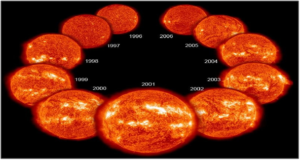
- Nature: The solar cycle describes an approximately 11-year cycle of solar activity.
-
- Mechanism: It is driven by the Solar Dynamo mechanism, where the movement of electrically charged plasma generates powerful magnetic fields.
- Frequency: It is indicated by the frequency and intensity of sunspots visible on the surface. Every 11 years or so, the Sun’s magnetic field completely flips.
- Polarity flip: This means that the Sun’s north and south poles switch places. Then it takes about another 11 years for the Sun’s north and south poles to flip back again.
- Hale Cycle: A full magnetic cycle (returning to original polarity) takes two solar cycles, roughly 22 years.
-
- Measurement: It is tracked by counting sunspots—dark, cooler regions with intense magnetic fields
- Impact: The solar cycle has the potential to impact Earth’s climatic conditions through changes in solar radiation, cosmic rays, and ozone distribution.
- Cycle Stages:
-
- Solar minimum: It is the beginning of a solar cycle or when the Sun has the least sunspots. Over time, solar activity—and the number of sunspots—increases.
- Solar maximum: It is the middle of the solar cycle or when the Sun has the most sunspots. As the cycle ends, it fades back to the solar minimum, and then a new cycle begins.
Source:
Category: Defence and Security
Context:
- Bengaluru-based Alpha Design Technologies Ltd (ADTL) has completed a major upgrade of the Indian Air Force’s Pechora, a surface-to air missile (SAM) system.
About Pechora Missile System:
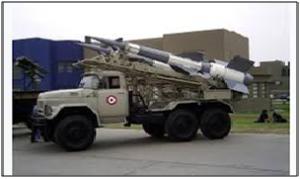
- Official name: The Pechora missile system is officially known as the S-125 Neva/Pechora.
- Nature: It is a Soviet-origin, medium-range surface-to-air missile (SAM) system designed to intercept low- to medium-altitude targets.
- Induction: It has been a mainstay of India’s air defence network since the 1970s.
- Composition: The system consists of a radar-guided missile launcher and a fire control unit, typically employing the V-600 missile.
- Radar: It uses the 4R90 Yatagan radar, equipped with five parabolic antennas, to detect, track, and lock onto targets. Once a threat is identified, the system can launch missiles to intercept and destroy it mid-air.
- Effectiveness: It is particularly effective against slow-moving or low-flying targets, making it well-suited for countering drones and cruise missiles.
- Operational efficiency: It can operate independently or as part of a larger, integrated air defence network, and is capable of functioning even in environments with heavy electronic jamming.
- Range: The Pechora system has an operational firing range of up to 30–35.4 km, with some upgraded versions reaching 35.4 km.
- Altitude: It can engage targets flying at altitudes from as low as 20 meters up to 20–25 km, making it versatile for both low and medium-altitude threats.
- Detection: The system’s radar can detect targets up to 100 km away, providing early warning and engagement capability.
- Accuracy: The Pechora boasts a high kill probability of around 92% and can engage up to two targets simultaneously at speeds up to 900 m/s.
Source:
Category: Government Schemes
Context:
- MoSPI has operationalised a new web-based portal, PAIMANA portal for the mandated monitoring of Central Sector Infrastructure Projects worth ₹150 crore and above.

About PAIMANA Portal:
- Full Form: PAIMANA stands for Project Assessment, Infrastructure Monitoring & Analytics for Nation-building.
-
- Nodal ministry: It is a flagship initiative of the Ministry of Statistics and Programme Implementation (MoSPI).
- Objective: It functions as a centralised national repository of infrastructure projects, enabling web-generated analytical reports and enhancing data accuracy, and operational efficiency.
- Integration: It is integrated with DPIIT’s Integrated Project Monitoring Portal (IPMP/IIG-PMG) through APIs.
- Centralized project monitoring: It serves as a centralized project monitoring system, providing a single-window interface for ministries, departments, and implementing agencies to upload, track, and review project information.
- Real-time dashboards: It features real-time dashboards with drill-down capabilities, enabling users to monitor progress across sectors, states, and timelines.
- Advanced data analytics: It includes role-based user access, interactive dashboards, reporting and query modules, and review cases for identification of data gaps.
Source:
Category: Polity and Governance
Context:
- Recently, Minister of State of the Ministry of Law and Justice informed the Rajya Sabha about district legal services clinics established by the National Legal Services Authority.

About National Legal Services Authority (NALSA):
- Establishment: It was established under the Legal Services Authorities (LSA) Act, 1987.
-
- Objective: It aims to provide free and competent legal services to the poor and marginalised sections of the society including Scheduled Caste (SC) and Scheduled Tribe (ST).
- Constitutional mandate: It fulfils the objectives of Article 39A (Directive Principle), which mandates the State to provide free legal aid. It is also supported by Articles 14 (Equality before law) and Article 22(1) (Rights of arrested persons).
- Lok Adalats: NALSA organizes Lok Adalats for amicable settlement of disputes. Awards made by Lok Adalats are deemed to be a decree of a civil court and are final and binding.
- Organizational Structure:
-
-
- Patron-in-chief: The Chief Justice of India.
- Executive chairman: The second senior-most judge of the Supreme Court.
- State level: State Legal Services Authority (SLSA) headed by the Chief Justice of the High Court.
- District level: District Legal Services Authority (DLSA) chaired by the District Judge.
-
- The free legal services include:
-
-
- Payment of court fees, process fees, and all other charges payable or incurred in connection with any legal proceedings
- Providing the service of lawyers in legal proceedings;
- Obtaining and supply of certified copies of orders and other documents in legal proceedings.
- Preparation of appeal, paper book, including printing and translation of documents in legal proceedings.
-
- Persons eligible for free legal services includes:
- Women and children
- Members of SC/ST
-
-
- Industrial workmen
- Victims of mass disasters, violence, flood, drought, earthquake, and industrial disaster
- Disabled persons
-
- Persons in custody
-
- Persons whose annual income does not exceed Rs. 1 lakh (in the Supreme Court Legal Services Committee the limit is Rs. 5,00,000).
- Victims of trafficking in human beings.
Source:
Category: Environment and Ecology
Context:
- Sunabeda Wildlife Sanctuary in Odisha is emerging as a promising habitat for leopards, with an estimated population of over 70 individuals, according to forest officials.
About Sunabeda Wildlife Sanctuary:
-
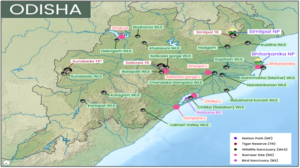
- Location: It is located in the Nuapada district of Odisha.
- Establishment: It was declared a sanctuary in 1983.
- Tiger reserve: The sanctuary has received “in-principle approval” from the NTCA to become a Tiger Reserve.
- Connectivity: Sunabeda is part of the Deccan Peninsula biogeographic zone. It serves as a corridor connecting Satkosia Gorge Wildlife Sanctuary with Sitanadi and Udanti sanctuaries in Chhattisgarh.
- Terrain: The sanctuary harbours a great diversity of wildlife habitats, with a vast plateau, canyons, and 11 waterfalls.
-
- Rivers: It also forms the catchment area of the Jonk River (tributary of the Mahanadi River), over which a dam has been constructed to facilitate irrigation.
- Vegetation: The important vegetation of this sanctuary comprises dry deciduous tropical forests.
-
- Flora: Bija, Teak, Sisoo, Asan, Dharua, Mahul, Char, Sandalwood, Sidha, etc.
- Fauna: It is an ideal habitat for the Barasingha (swamp deer). Other important animals found are tigers, Leopards, hyenas, Barking Deer, Chital, Gaur, Sambar, Sloth Bear, Hill Myna, etc.
- Tribes: The area is inhabited by tribal communities like the Gond and Paharia tribes.
Source:
(MAINS Focus)
GS-III: “Conservation, environmental pollution and degradation.”.
Context (Introduction)
At COP30 in Belém (2025), India committed to submitting a revised, more ambitious Nationally Determined Contribution (NDC). Achieving this commitment requires economy-wide decarbonisation, especially in hard-to-abate sectors—with steel being the most critical.
India’s steel sector:
- Produces ~125 million tonnes/year
- Needs to scale to >400 million tonnes by mid-century
- Contributes ~12% of India’s total carbon emissions, primarily due to coal-based blast furnace technology
This places steel at the centre of India’s climate–growth dilemma.
Core Idea
Green steel is not optional—it is a strategic necessity. Without rapid transition to low-carbon steelmaking, India risks:
- Lock-in of carbon-inefficient infrastructure
- Loss of export competitiveness
- Failure to meet climate commitments
Key Challenges
- Carbon Lock-in Risk
- Steel investments today determine emissions for 30–40 years
- Continued expansion of coal-based blast furnaces risks locking in billions of dollars of high-carbon assets
- High Cost & Technology Barriers
- Low-carbon steel has 30–50% higher capital intensity
- Technologies (hydrogen DRI, CCUS) are still:
- Capital-heavy
- Low-maturity
- Scale-constrained
- Input Constraints
- Green hydrogen: limited supply, high cost
- Renewable energy: insufficient dedicated capacity for steel
- Scrap steel market: informal, fragmented, limited availability
- Natural gas: limited availability as a transition fuel
- Policy Gaps
- Despite:
- Green Steel Roadmap (Sept 2025)
- Green Steel Taxonomy (Dec 2024) – first globally
- National Green Hydrogen Mission
- Carbon Credit Trading Scheme (CCTS) covering 253 steel units
Investment signals remain weak; incentives have not yet shifted capital away from coal-based routes.
Global Context & External Pressure
- EU Carbon Border Adjustment Mechanism (CBAM) penalises high-carbon steel imports
- Carbon prices in Europe reached $90–100 per tonne of CO₂, making green steel viable
- Countries unable to demonstrate low-carbon production risk:
- Border taxes
- Loss of premium export markets
Why It Matters
- Steel underpins:
- Infrastructure
- Manufacturing
- Defence and urbanisation
- Decarbonising steel:
- Enables India’s net-zero pathway
- Preserves export competitiveness
- Prevents future stranded assets
- Early movers in green steel gain first-mover advantage globally
Way Forward
- Carbon Pricing & Market Signals
- Roll out carbon price regime early
- Use price signals to disperse green steel costs across value chains
- Scale from Pilots to Commercialisation
- Fast-track:
- Demonstration plants
- Near-zero emission full-scale facilities
- Mandate all new steel capacity to be low or near-zero carbon
- Public Procurement & Demand Creation
- Create domestic demand via:
- Public procurement of green steel
- Infrastructure mandates
- Socialise Green Steel Taxonomy
- Infrastructure & Shared Ecosystems
- Government-led hubs for:
- Green hydrogen
- Renewable energy
- CO₂ transport and storage
- Shared infrastructure to reduce costs for MSME steel producers
- Equitable Transition
- Fiscal support for:
- Small and medium producers
- Workforce reskilling
- Ensure transition is just and inclusive
Conclusion
Steel is India’s next climate frontier. What renewable energy was to India a decade ago, green steel is today—a test of policy credibility, industrial vision and climate leadership. By combining: Decisive corporate action, Robust, market-aligned policy frameworks, Early investment signals, India can decarbonise steel, safeguard growth, and shape the future of global sustainable industrialisation.
Mains Question
India’s climate goals cannot be achieved without decarbonizing its steel sector. Examine the challenges and policy imperatives of green steel in shaping India’s climate transition. (15 marks) (250 words)
GS-III: “Indian Economy and issues relating to planning, mobilisation of resources, growth, development and employment.”
Context (Introduction)
India’s manufacturing sector has regained momentum amid:
- Geopolitical reconfiguration of global supply chains
- Firm-level diversification away from single-country dependence
- Renewed industrial policy focus worldwide
As highlighted in the Economic Survey, the next phase of India’s industrial growth will depend not on how much India manufactures, but what it manufactures and how strategically indispensable it becomes in global production networks.
Core Idea
India’s manufacturing transition must shift from: Broad-based volume expansion → to Strategically important, technology-intensive and export-competitive production
This requires:
- Moving up the value chain
- Deepening industrial ecosystems
- Aligning manufacturing with infrastructure quality, logistics efficiency, and standards compliance
Key Arguments
- Manufacturing Is Moving Up the Value Chain
India is witnessing early gains in sectors combining:
- High technology content
- Value addition
- Export potential
Examples:
- Electronics: Production expanded ~6x, exports grew ~8x in 11 years
- Pharmaceuticals: World’s largest vaccine supplier; major generic medicines hub
These sectors demonstrate:
- Strong R&D–industry linkages
- Faster technology absorption
- Greater global tradability
- Limits of Cluster-First Industrialisation
While industrial clusters have been central to policy:
- Many clusters remain small, fragmented and low-productivity
- Limited capacity to generate scale efficiencies
There should be a shift towards:
- Larger, deeper and integrated industrial ecosystems
- Greater backward–forward linkages
- Enhanced skill and innovation density
- Tier-2 and Tier-3 Cities as the Next Industrial Frontier
The next generation of industrial clusters is likely to be anchored in Tier-2 and Tier-3 cities
Advantages highlighted:
- Lower land and real-estate costs
- Lower operating and wage costs
- Larger labour pools
- Less congestion than metros
However, competitiveness here depends critically on:
- Quality infrastructure
- Logistics connectivity
- Reliable utilities
- Infrastructure & Logistics as Competitiveness Multipliers
India has made notable progress:
- Logistics costs declined to ~14% of GDP (FY23)
- Several Indian ports ranked among World Bank’s top-100 (CPPI 2024)
- Initiatives:
- PM Gati Shakti
- National Logistics Policy
- Rapid highway expansion
Yet:
- Road freight dominates despite rail and coastal shipping being cheaper for bulk movement
- Limited multimodal integration constrains efficiency gains
- Standards, Quality and Global Market Access
- Quality Control Orders (QCOs)
- Alignment with international standards
- Credible certification and labelling systems
Purpose:
- Prevent low-quality imports
- Push domestic firms up the quality ladder
- Enhance export credibility
However, success depends on:
- Phased implementation
- Adequate testing infrastructure
- Industry consultation
- MSMEs: Backbone with Binding Constraints
MSMEs contribute significantly to:
- Employment
- Output
- Exports
Recent gains:
- Formalisation
- Better access to finance
- Deeper supply-chain integration
Yet challenges persist:
- Credit gaps
- Skill shortages
- Technology adoption constraints
Their integration into strategic value chains is critical for sustained manufacturing growth.
Why It Matters
- Strategic manufacturing:
- Enhances export resilience
- Improves terms of trade
- Reduces vulnerability to global shocks
- Deep manufacturing ecosystems:
- Generate high-quality jobs
- Strengthen innovation capacity
- Infrastructure-manufacturing synergy determines:
- Speed of industrial scaling
- Global competitiveness
Manufacturing is no longer about scale alone—it is about strategic indispensability.
Way Forward
- Prioritise Strategic & Technology-Intensive Sectors
- Electronics
- Pharmaceuticals
- Advanced materials
- Clean-tech manufacturing
- Build Integrated Industrial Ecosystems
- Shift from fragmented clusters to:
- Large-scale industrial zones
- Strong backward–forward linkages
- Infrastructure with Manufacturing Focus
- Time-bound approvals
- Reliable utilities
- Multimodal logistics hubs near industrial centres
. MSME Integration
- Bridge credit gaps
- Strengthen skilling
- Accelerate technology diffusion
- Predictable Regulatory Regimes
- Stable policies
- Single-window systems
- Fast dispute resolution
Conclusion
India’s next manufacturing leap will not be measured by output alone, but by strategic relevance, technological depth and ecosystem strength. As global production networks fragment and reconfigure, India has a historic opportunity to position itself not just as a manufacturing location, but as a manufacturing anchor in global value chains.
The challenge is clear: scale with strategy, infrastructure with intent, and growth with resilience.
Mains Question
- India’s next phase of industrialisation depends not merely on scaling manufacturing, but on what it produces and how deeply it integrates into global value chains. Examine. (15 marks) (250 words)