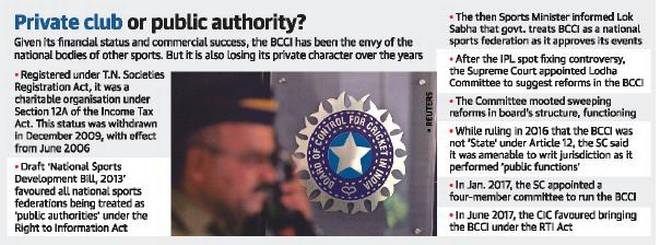
The board and all its member cricket associations should be brought under the Right to Information law regime.
The 90-year-old Board of Control for Cricket in India (BCCI) should be declared a public body.
The board’s monopolistic activities, directly and indirectly, affect the fundamental rights of citizens, players, and other functionaries. A private citizen should be able to move the highest court against the BCCI for any violation of his fundamental rights.
The BCCI exercises ‘state-like’ powers in the regulation of cricket, and thus, comes under the definition of ‘state.’
The BCCI virtually acts as a National Sports Federation (NSF). The commission recommended that the Ministry website should explicitly mention BCCI in the list of NSFs. This would automatically bring it within the purview of the RTI Act.
Concerns:
The commission said the board has been “flying under the radar of public scrutiny and encouraged an environment of opacity and non-accountability.”
It has created “an impression in the minds of the general public that corruption and other forms of malpractices are adversely affecting one of the most popular sports played in India.”
BCCI is a “limb of the state”:
The commission pointed out that-
The cricket board, as an entity, is permitted de facto by the state to represent the country at the international stage.
It selects the Indian cricket team. The selected players wear the national colours and are the recipients of Arjuna awards.
The ICC recognises BCCI as the ‘official’ body representing India.
The Law Commission was led by former Supreme Court judge, Justice B.S. Chauhan.
Part of: Mains GS Paper II- International relations
Key pointers:
India and the UK will build on the recommendations of a joint trade review to reduce barriers.
Prime Minister Narendra Modi pledged that there would be no dilution in the importance of the UK to India post-Brexit
The two sides signed a statement of shared values, emphasising support for a “global outlook and commitment to rules based international system”.
As part of the bilateral agreement, Indian firms will make investments of about £1 billion in UK.
Britain and India agreed to forge a new India-UK Trade Partnership, building on the trade review carried out over the past year, focussing on life sciences, IT, food and drink. A UK-India Tech Partnership, and research partnership was also agreed upon.
The joint statement:
“We share a global outlook and commitment to a rules-based international system that strongly opposes unilateral actions that seek to undermine that system through force or coercion,” said the joint statement from the Prime Ministers.
It also pledged to work with other countries in the Commonwealth on issues ranging from cybersecurity to plastic pollution and climate change.
The visit is the third bilateral between the two Prime Ministers since 2015, as Britain has sought to emphasise the potential for growth in trade with non-EU partners once Britain leaves the EU.
Security challenges and their management in border areas; linkages of organized crime with terrorism.
Role of external state and non-state actors in creating challenges to internal security.
General Studies 2:
Government policies and interventions for development in various sectors and issues arising out of their design and implementation.
Setting up of Defence Planning Committee: A significant policy reform
Introduction:
In a significant defence policy reform, the government, has revamped the existing defence planning system by establishing a Defence Planning Committee (DPC) under the chairmanship of the National Security Adviser (NSA). This new institutional mechanism, set up as a permanent body, is intended to “facilitate a comprehensive and integrated planning for defence matters” – a vital ingredient in defence preparedness. Comprehensive and integrated planning was missing in the mechanism set up in the early 2000s in the wake of the Kargil conflict. The new measure is likely to have a far reaching consequence on the way defence planning is undertaken and on defence preparedness.
Salient Features of the New Mechanism:
The heart of the new institutional mechanism is the all-powerful DPC with the NSA at the helm.
The Committee has a cross-section of members drawn from the higher echelons of the civil and military services including the three service chiefs, the Defence Secretary, Foreign Secretary, and Secretary (Expenditure) of the Ministry of Finance (MoF). Besides, the NSA is empowered to co-opt other members as and when required.
The charter of duties of the DPC is two-fold.
To analyse and evaluate all relevant inputs relating to defence planning, which includes- the national defence and security priorities, foreign policy imperatives, relevant strategic and security-related doctrines, defence acquisition and infrastructure development plans, including the 15-year Long-Term Integrated Perspective Plan (LTIPP), defence technology and development of the Indian defence industry and global technological advancement.
To prepare at least five different sets of drafts including: -> National security strategy, strategic defence review and doctrines; -> International defence engagement strategy; -> Roadmap to build defence manufacturing eco-system; -> Strategy to boost defence exports; and -> Prioritised capability development plans for the armed forces over different time-frames in consonance with the overall priorities, strategies and likely resource flows.
In order to assist the functioning of the DPC, the new mechanism provides for four sub-committees, one each on Policy and Strategy, Plans and Capability Development, Defence Diplomacy, and Defence Manufacturing Eco-System. The reports of the DPC are to be submitted to the Defence Minister and further approval are to be taken as required.
Present system:
It was thought that the creation of the post of Chief of Defence Staff (CDS) as the ultimate arbitrator of all requirements of the armed forces including the planning aspects would bridge a key gap in the existing defence planning mechanism.
With the CDS not finding favour with successive political dispensations, the existing system of planning is perceived to have given way to the parochial interests of various stakeholders. This has had an adverse impact not only on how security threats were perceived by various security organs, but also on how scarce resources are distributed among the services and within the various branches of each service.
The existing planning process has had very little control on aspects like indigenisation and self-reliance in defence procurement matters.
Conclusion:
With the powerful DPC in place and the NSA assuming the role of de facto CDS for all practical purposes other than in operational matters, the defence planning process is expected to become more rational as well as provide a much needed boost to defence preparedness. The DPC is expected to clearly articulate the key national security/ defence/ military goals as well as prioritise defence and security requirements as per the likely available resources while at the same time providing adequate focus on emerging security challenges, technological advancements, and establishing a strong indigenous defence manufacturing base.
Connecting the dots:
The establishment of Defence Planning Committee recently, will have a far-reaching consequence on the way defence planning is undertaken and on defence preparedness. Discuss.
NATIONAL
TOPIC:
General studies 2:
Welfare schemes for vulnerable sections
Government policies and interventions for development in various sectors and issues arising out of their design and implementation.
Issues relating to development and management of Social Sector or Services relating to Health, Education, Human Resources
General studies 3:
Indian Economy and issues relating to planning, mobilization of resources, growth, development and employment.
Inclusive growth and issues arising from it.
Skill Development Indicators: Evidence based policy implementation
Background:
Skill development has emerged as a key strategy to realize the potential of a young workforce with an average age of 29, by enhancing their employability.
The National Skill Development Mission launched by the Union government envisions skilling at scale with speed and standards, with a focus on strengthening institutional training, infrastructure, convergence, training of trainers, overseas employment, sustainable livelihoods and leveraging public infrastructure.
The national policy for skill development and entrepreneurship 2015 provides an enabling framework to realize this vision. The policy framework outlines the paradigms and enablers to realize the potential of India’s demographic advantage by addressing challenges such as aspirations and mobilization of youth, quality and relevance of training; access to training, inclusivity and leveraging available technology.
Recognition of prior learning (RPL) has been introduced in India to facilitate an assessment and certification of the skills acquired by the individual through experience, observation and self-learning in order to give him/her an edge in career advancement.
Several challenges remain for skill development in India:
The proportion of the formally trained in India is low at 4.69% of the total workforce compared to countries like Germany (75%) and South Korea (96%).
The mismatch between skill, academic training and employment has widened, leading to a situation where, on one hand, employers are unable to find appropriately trained people, and on the other, the youth are unable to find employment that they aspire for.
The latest India Skill Report indicates that only about 45.6% of the youth coming out of educational institutions are employable.
In order to address the mismatch between supply and demand, it is necessary to harmonize youth aspirations with industry demand and the training offered by training institutes.
Need to develop skill development indicators (SDIs):
The significant variation in demographic profile necessitates local interventions. Southern states like Goa, Tamil Nadu, and Kerala have a higher median age, between the range of 29-31 years, due to early fertility transitions, and will soon be ageing. Hinterland states such as Uttar Pradesh, Bihar, and Rajasthan have a low median age between 20 and 22 years. Thus, this northern belt will have a rising working age population. This requires addressing skill challenges of access, equity, relevance and financing differently.
Availability of real-time data on challenges faced by a region/area/district/state, identification of sectors requiring skilled manpower, and demand-supply match,will help assess the outcomes of various interventions undertaken thus far so that the future course of policy action can be planned or modified.
Example:
International efforts to develop indicators for skill development:
The Organisation for Economic Co-operation and Development (OECD) established the world indicators of skills for employment (WISE). The WISE framework includes a focus on contextual factors in a country, such as the-
Gross domestic product (GDP), population, employment in informal sector.
Factors affecting skill acquisition, such as educational attainment, literacy rate, enrolment ratios, vocational programme, participation in training/apprenticeship.
Factors affecting skill requirement, such as employment share by level of education, occupation, incidence of self-employment, skill use and outcomes in terms of growth in GDP, labour productivity, employment rate, earnings, etc.
Adapting from this framework, indicators must be developed to address challenges such matching skills across sectors/regions to realize the potential of our youth and the working population.
Benefits of SDIs:
SDIs would improve the effectiveness of various platforms set-up by the ministry of skill development and entrepreneurship.
They would also enable the states to evaluate and compete with their own past performance and facilitate sharing of best practices across different sectors and states/union territories.
They would help assess the match between employers’ needs and future labour market opportunities and based on the assessment of existing policy initiatives and their outcomes, the future course of policy action could be planned or modified.
The indicators can be classified under four broad parameters:
The parameter of access would measure the capacity and outreach of the programmes.
Relevance would measure the ease of entry to the labour market with an enhanced employability.
Equity will measure the equal accessibility of the opportunity to all and quality will evaluate whether the training imparted meets the required standard of employability.
The parameter of finance would measure the cost-effectiveness of the funding provided.
The dearth of reliable data is a pressing challenge in developing these indicators. There is a need to generate data leading up to the labour market. This can be done by systematically including key questions on skills in employment-unemployment surveys. Once the indicators are finalized, an index can be built, ranking the states based on their performance outcomes.
Conclusion:
With the advent of the fourth industrial revolution, it needs to be ensured that our youth manage the shifts in skill requirements. The need of the hour is to build evidence that can redirect policy solutions to address the constraints, make policy inclusive and sustainable according to the demographic context of each state in order to fully realize the potential of youth and ensure optimum income and employment for the workforce.
Connecting the dots:
Despite several initiatives, skill development in India is not taking at a pace as expected. Discuss how local interventions based on evidence, skill development indicators, will help.