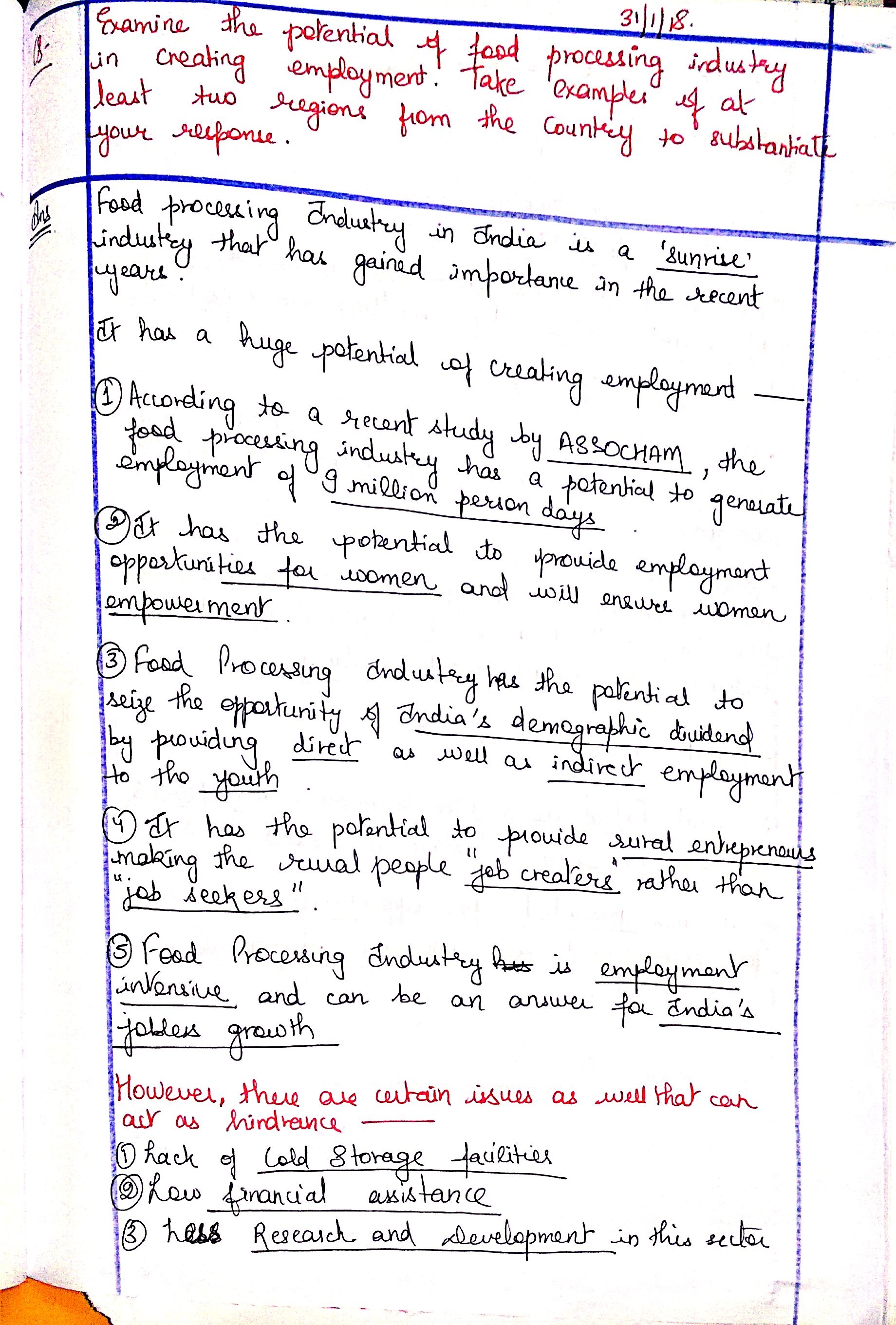
Q.1) EXAMINE THE POTENTIAL OF FOOD PROCESSING INDUSTRY IN CREATING EMPLOYMENT. TAKE EXAMPLES OF AT LEAST TWO REGIONS FROM THE COUNTRY TO SUBSTANTIATE YOUR RESPONSE.
Body:
The food processing industry is a key contributor to employment generation in India. By 2024, food processing sector is expected to employ 9 million people in India and expected to generate about 8,000 direct and 80,000 indirect jobs in the state, the ASSOCHAM-Grant Thornton joint study on ‘Food Retail: Investment: Infrastructure’ noted.
As the consumers in the country are becoming more health- conscious, the demand for nutritious food is growing proportionately. In addition, rising number of working women and nuclear families is resulting in high demand for ready-to- eat and frozen food. Thus, overall India’s food value chain is poised to create multiple opportunities for investment and employment in storage infrastructure, farming, retail and quality control.
It is estimated that Indian food processing industry is pegged close to US$ 121 billion to US$ 130 billion.
With the second largest arable land in the world, it is the largest producer of milk, pulses, sugarcane and tea in the world and the second largest producer of wheat, rice, fruits and vegetables.
Despite the massive production, the degree of processing is low and ranges between 2-35% for different produce.
India is one of the top rankers in the production of bananas, guavas, ginger, papaya etc., although processing levels in the country remain limited, which indicates an extensive opportunity in the food processing sector.
Indian food and retail market is projected to touch US$ 482 billion by FY 2020 from the current level of US$ 258 billion in 2015
Though India ranks first in production of milk, pulses and tea and second in production of fruits and vegetables, its share in the world food trade is less than two per cent. Thus the policymakers have identified food processing as a key sector in encouraging labor movement from agriculture to manufacturing.
To reduce post-harvest losses of fruits and vegetables, Government plans to set up 500 cold chain projects in the country. Moreover, 42 sanctioned mega food parks in the country are likely to become operational by 2018.
Food processing industry in India regional wise:
India’s coastal zone:
India is the third largest producer of fish and the second largest producer of “fresh water” fish. The 8,000 km coastline from both inland and marine resources, 3 million hectares of reservoirs, 1.4 million hectares of brackish water, 50,600 sq. km of continental shelf area and 2.2 million sq. km of exclusive economic zone supplement India’s vast potential for fishes.
Marine exports account for around 3% of the total exports of the country and nearly 20% of the agricultural exports.
The major fish producing centers as well as processing, freezing and storage facilities in the country are concentrated in the states of Karnataka, Andhra Pradesh, Maharashtra, Tamil Nadu, Gujarat, Kerala and Odisha.
There is a huge scope for investments in packaged marine processing plants, operations in preservation, processing and export of coastal fish. There is also scope for developing technology for value addition and infrastructure for exports in the form of marine products based food parks through public private partnership. Besides, there is an increased demand for processed and ready-to-eat marine products in the domestic market.
Andhra Pradesh food processing industry:
AP is developing parks which will have cold storage, warehouse, power, water etc. The entrepreneurs will get 25-50 per cent incentives if they start a unit in food processing sector. The park developers will get Rs 20-50 crore grant to start the park with certain conditions.
The region produces 8 lakh tonnes of papaya, 15 lakh tonnes of ground nut and 9 lakh tonnes of mango per year. Pomegranate production is also increasing. Millets production has also increased many folds, along with that meat and many other products which will help state to become sunrise state of food processing industry.
Conclusion:
The Food Processing industry is critical to India’s growth and the government is focused on providing adequate impetus to the sector. A well-developed Food Processing sector will help facilitate crop diversification and generate employment opportunities. The introduction of modern processing techniques for food will result in improved shelf-life of the agricultural produce and ensure steady revenue to farmers
2. What is backward and forward integration? What are its advantages and drawbacks? Examine its potential for the food processing sector in India.
Approach:
Introduction- What is backward and forward integration
Advantages and drawback
Potential for food processing sector.
Conclusion
Introduction:
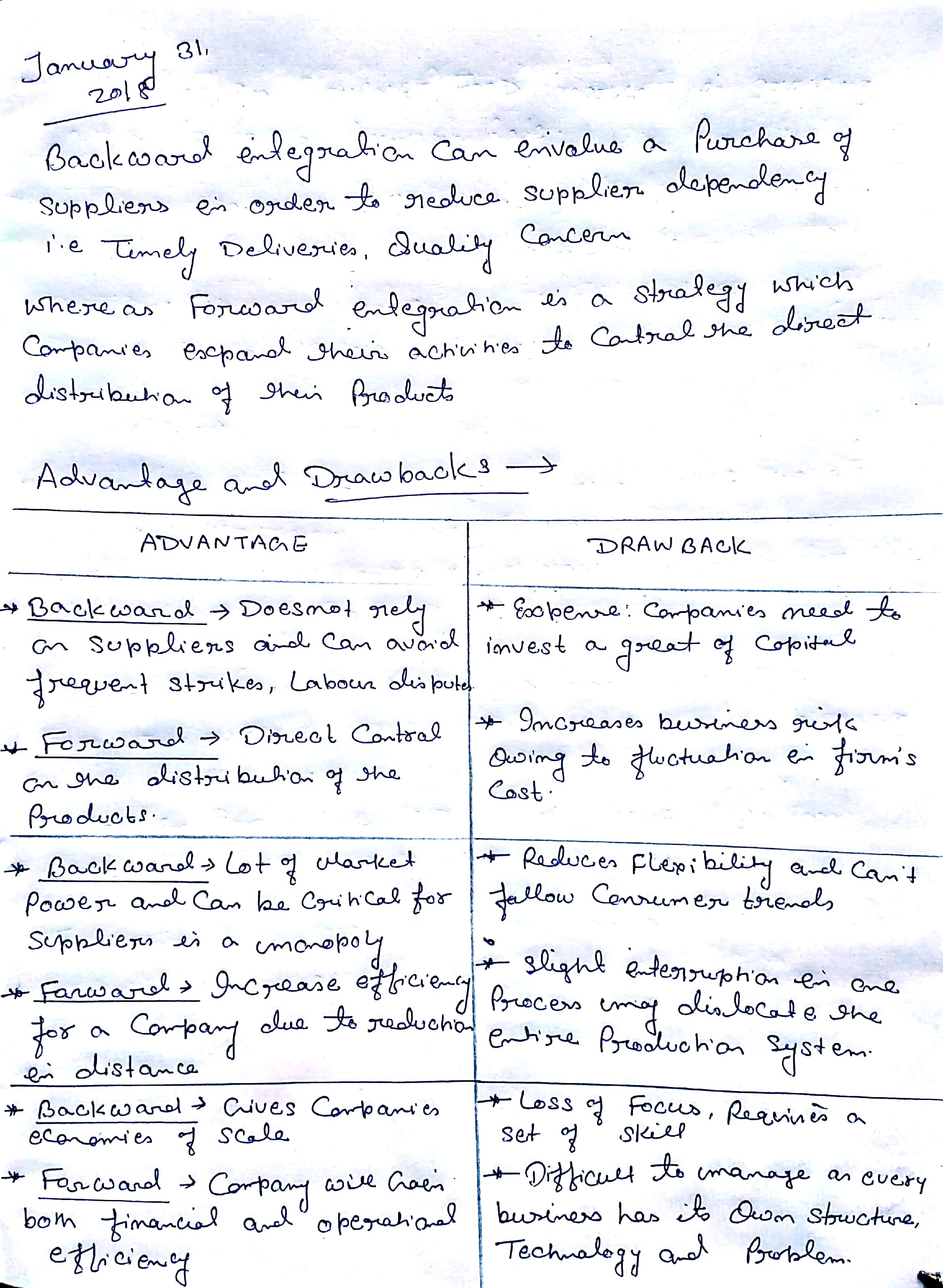
Backward integration is owning the source of raw materials such as land for cultivation, leather tannery, oil mills, husbandry etc.
Examples:
Amul sets up dairy farmers’ cooperative in villages to collect milk.
Starbucks (chain of coffee bars) buys coffee plantations in Central America.
For continuity of raw material supply PepsiCo entered into contract farming with farmers of West Bengal.
Forward integration includes the processing and selling point (retail outlets).
Examples:
Amul has its own pizza outlets and ice cream parlors.
Nike, Adidas, Apple have their own retail outlets in big cities.
Forward and backward integration also called vertical integration
Advantages:
Forward and backward integration provide an edge to the company. Because it reduces production cost and help manage inventory/demand better. Gives a competitive edge to company.
Elimination of middleman ensuring steady supply.
Drawbacks:
Risk of monopoly.
Vertical integration requires huge investment.
Potential for food processing sector:
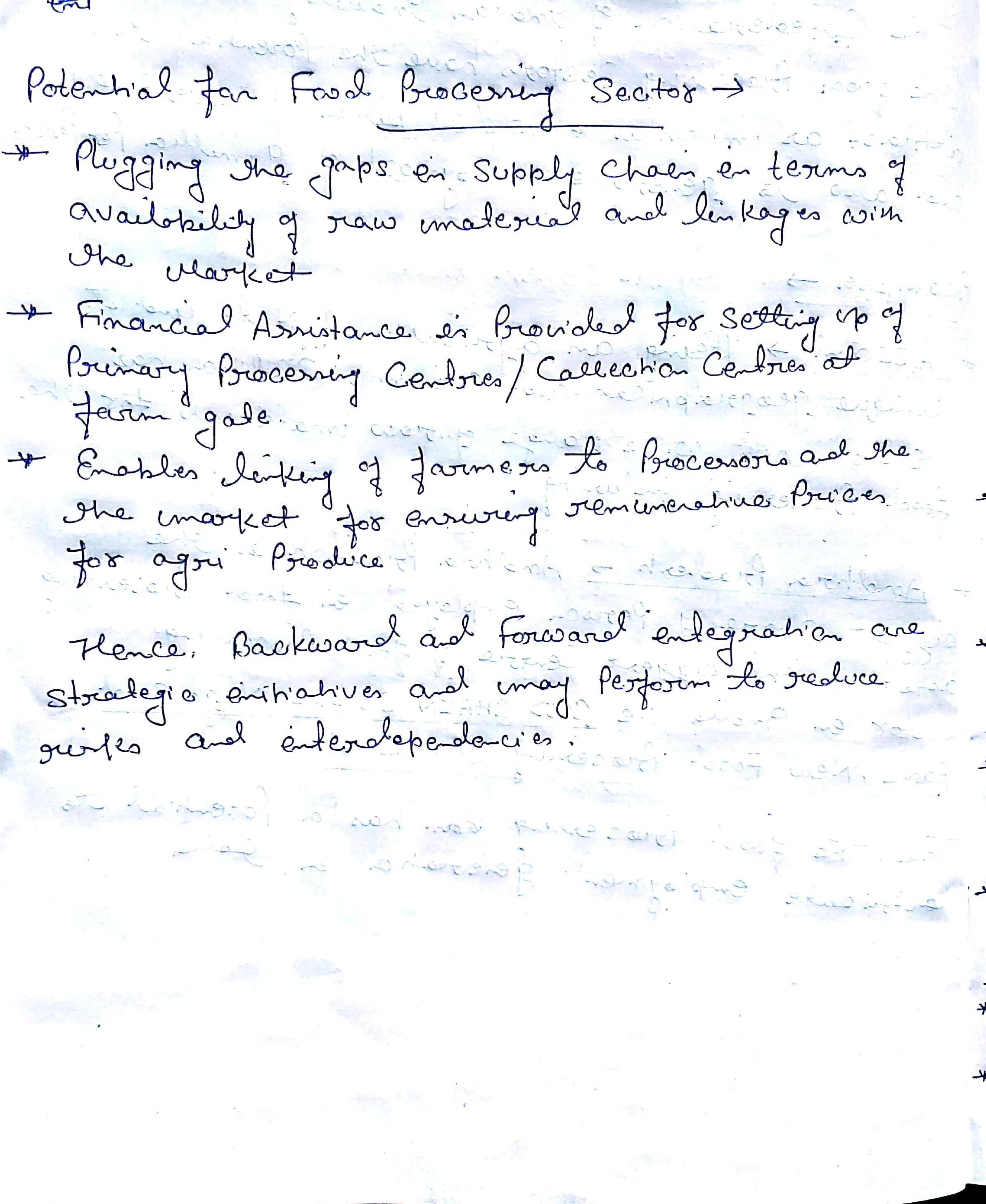
It will in plugging the gaps in supply chain in terms of availability of raw material and linkages with the market, thereby, reducing the wastage of agricultural produce.
More profit to farmers as middlemen is eliminated.
Productivity will improve as investment will be made into best techniques of growing.
Overall boost to food processing sector- assured input, better market reach, potential for export.
Conclusion:
Food processing sector is rightly considered as sunrise sector of the economy. For this vertical integration can be a game changer. However, to overcome the drawbacks its necessary that the process is well regulated by the government so that there is no monopolization to the disadvantage of the farmers.
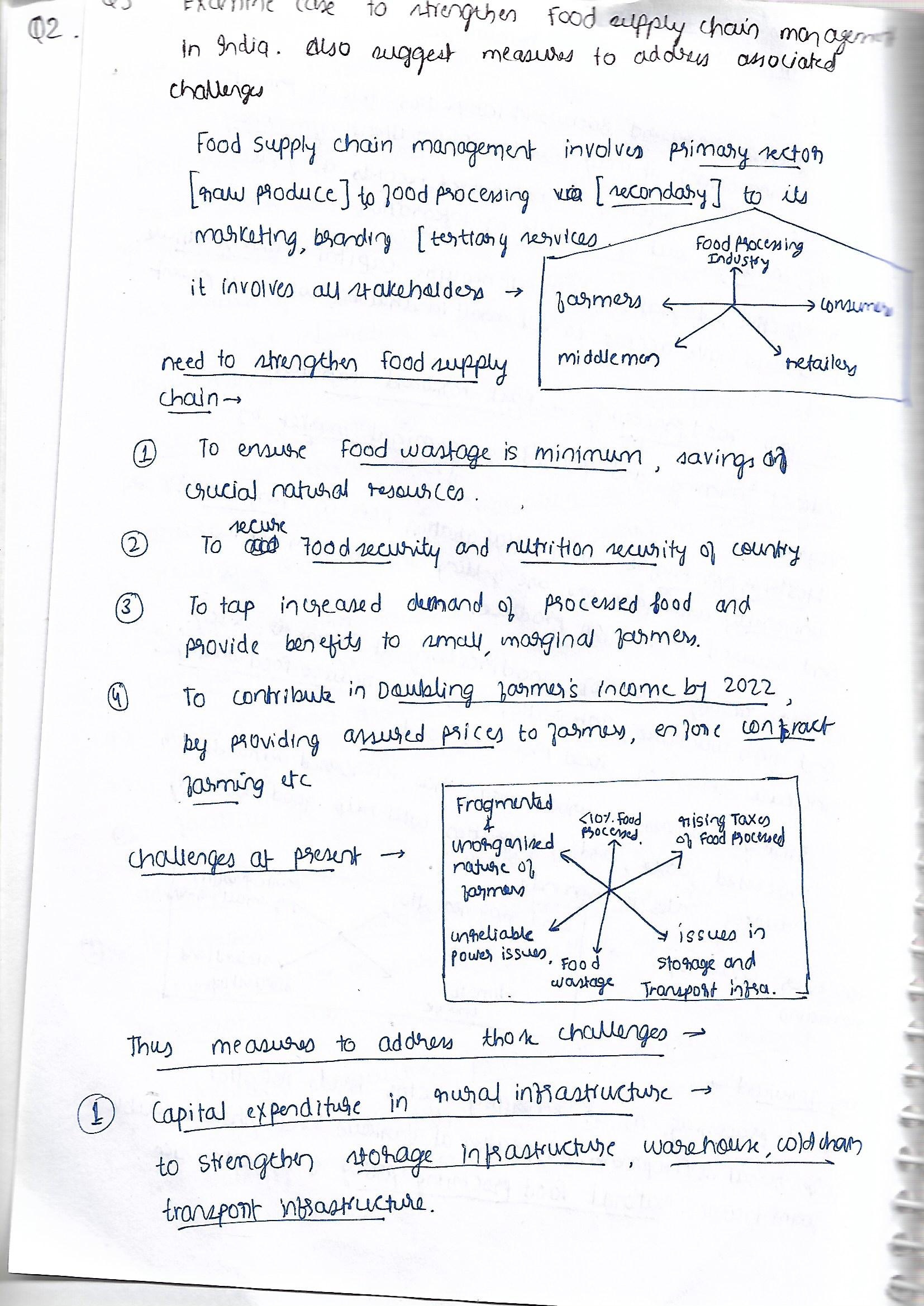
3. Examine the case to strengthen food supply chain management in India. Also suggest measures to address the associated challenges.
Introduction: Give small intro Food supply chain management.
Body: In body, the answer should contain two parts, one about how you will strengthen food supply chain management and second what are the challenges for the same.
Conclusion: 2-3 line conclusion.
Introduction
Food supply chain management refers to managing a series of links for delivery of food items starting from farms to consumers’ plate. There is an urgent need to strengthen this supply chain to address various issues plaguing the agriculture sector.
Body
Need to strengthen Food supply chain Management:
Post-harvest Losses.
Food security.
High produce but less supply: Spoilage during storing.
Nutrition deficiencies and mal nutrition: Inspite of bumper production majority suffer from access.
Increasing demand.
Inflation.
Doubling farmers’ income.
Sustainable growth and development: Conservation of water, soil etc.
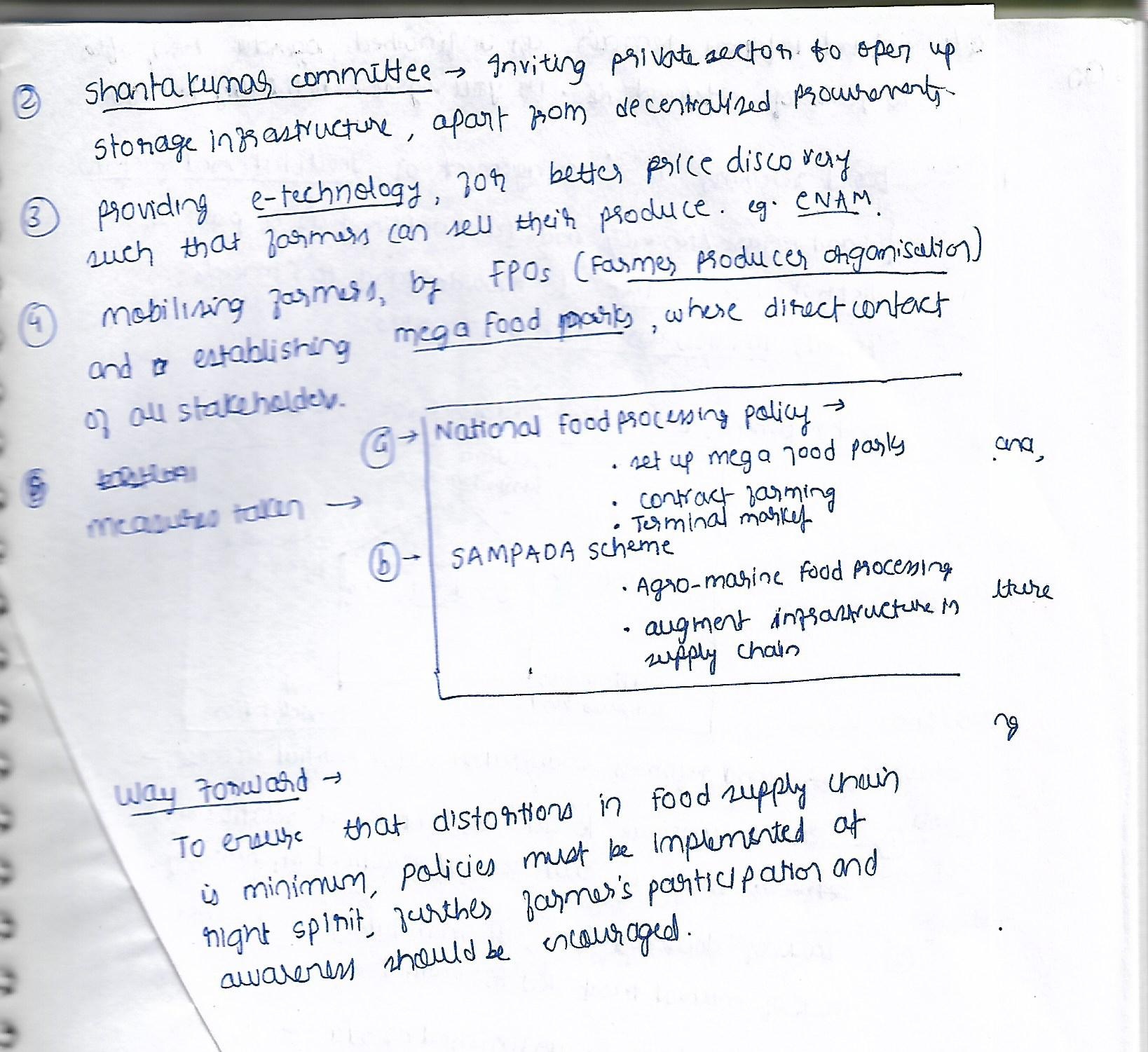
Measure for Challenges:
Restrictive Laws: APMC acts of respective states, Land acquisition etc.
Infrastructure: storage facility, Transportation etc.
Investment: In the sector.
Government control: Reduce public sector and government control.
Politicization: Remove restriction on FDI in agriculture, Private sector participation.
Technology: Increase awareness to technology.
Note: A line or two explanations are required for all points. Here just what is required in explanation is highlighted. 8-10 points are enough.
Conclusion
Government is also coming up with many policies and initiatives like E-Nam, Food processing parks, Model tenancy act, SAMPADA scheme, Bio-fortified foods etc. But still various reforms and initiatives are needed to address the challenges to minimize the bottlenecks for food supply chain management.
4. Land reforms remain an unfinished agenda even after 70 years of independence. Do you agree? Critically analyse.
Introduction: Give small intro about land reforms.
Body: In body, the answer should contain two parts, one about why it still remains unfinished business and second part how to bring about a change and improve land availability.
Conclusion: 2-3 line conclusion.
Introduction
Land Reforms refer to a government initiative started by Indira Gandhi to restrict excessive land ownership and ensure redistribution of land to landless people of the country especially agricultural fields.
Body
It remains unfinished:
Majority of farmers are small and marginal.
Landownership among SC, Women and other backward is very low.
Land fragmentation.
It remains as an unfinished agenda even after 70 years because of:
Land records: Lack of proper land records and documents.
Political: Political leaders who are supposed to ensure are themselves landlords.
Benami Transfers.
Different criteria based on fertile, non-fertile and plantation fields.
Inefficient laws to punish defaulters and lack of legal awareness.
Non-fertile/Fallow land submission.
Rotation of tenants.
Commercial conversations: Agriculture land into commercial conversation.
Land acquisition by government.
However it achieved partial success:
Land consolidation in regions of Haryana and Punjab: Green revolution.
Digitalization of land records.
9th schedule: Stopped court from interfering.
Abolition of Zamindari system, landlords etc.
Note: Explanations are required for all points. 8-10 points are enough. Give more weightage to first part.
Conclusion
However government is trying to implement new reforms in this area in form of contract farming, Model Tenancy act etc. In globalized and capitalist world, trying to achieve socialistic principles will lead to Law and Order issues along with uprisings so government should bring in innovative laws to protect both Land owners and tenants to complete this process started during independence time.
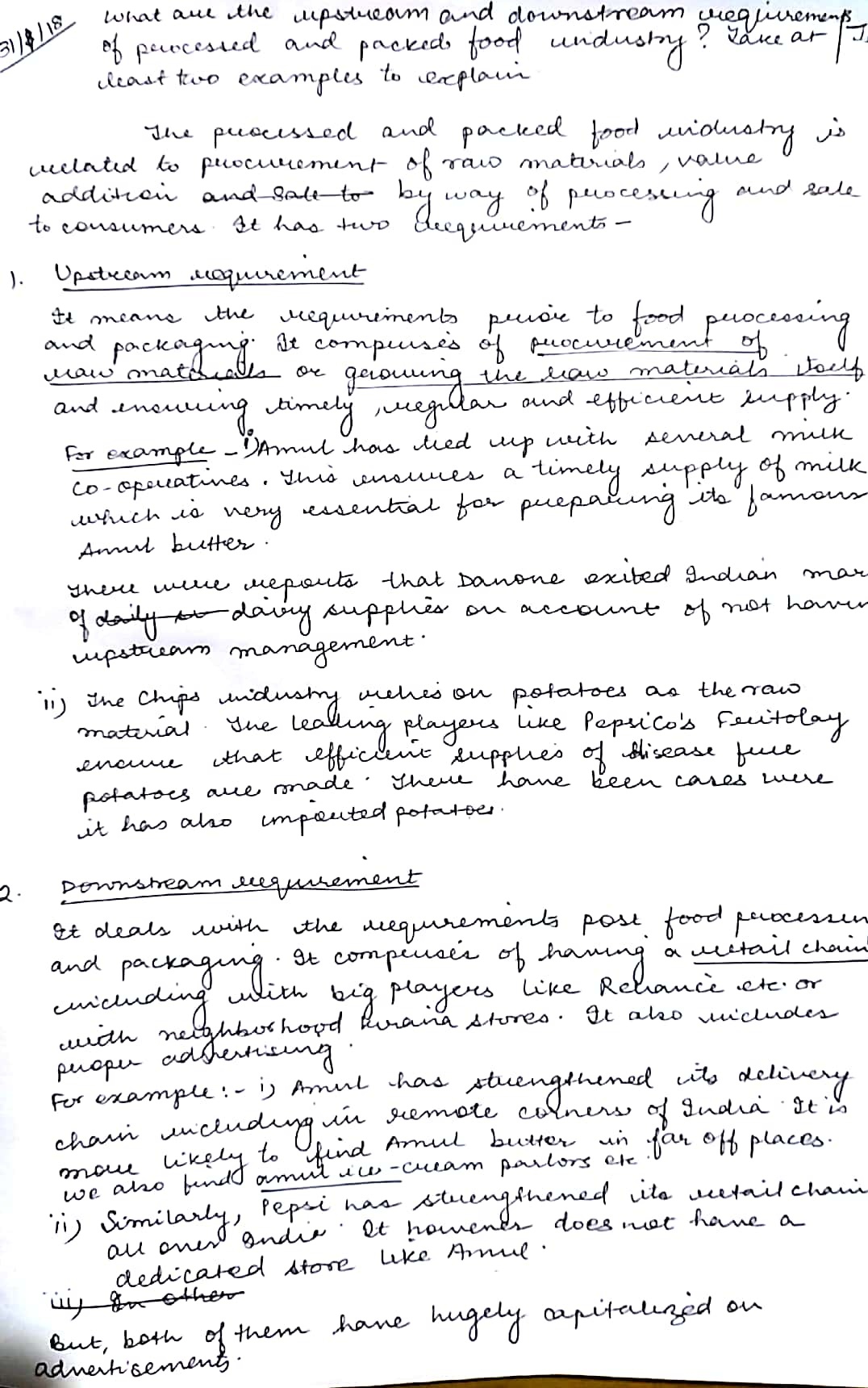
Q5. What are the upstream and downstream requirements of processed and packed food industry? Take at least two examples to explain.
Approach:
Define what is upstream and downstream in general
Explain these terms wrt food processing using examples
Body:
Food processing industry is one of the sunshine sectors with a huge potential in India, given the high production of horticulture, fisheries etc.
The supply side of a producer is considered the upstream side whereas the customers are part of the downstream side. Thus, the upstream and downstream ends are defined according to the point of reference.
For food processing industry, upstream requirements:
Accessibility to raw materials is the first upstream requirement for any industry.
The food processing industry also requires modern extraction techniques.
To make the food processing industry sustainable, it is important to ensure good linkages with farmers.
The storage facilities for raw materials like grains, meat, and fish etc. are important part of food processing upstream requirements.
Food processing industry also requires good quality testing facilities.
Transport facilities are essential part of upstream requirements of food processing industry in India.
The food industry also requires a sizable amount of work force.
For Example: AMUL has tied up with several rural milk cooperatives to ensure a steady supply of milk for making its milk based products such as butter, cream, cheese etc.
Downstream Requirements:
The downstream stage in the production process involves processing of the materials collected during the upstream stage into a finished product.
The downstream stage also includes the actual sale of product to customers like businesses, governments or individuals.
Since, downstream processing has direct contact with customers through the finished product, it requires a large work force.
Similar to upstream stage, it also requires good transportation facilities, large labour force, forward linkages with retail and export centres etc.
Example: PepsiCo making the famous Lays Chips has a wide network in retail which readily supplies the sale points for its processed food stock.