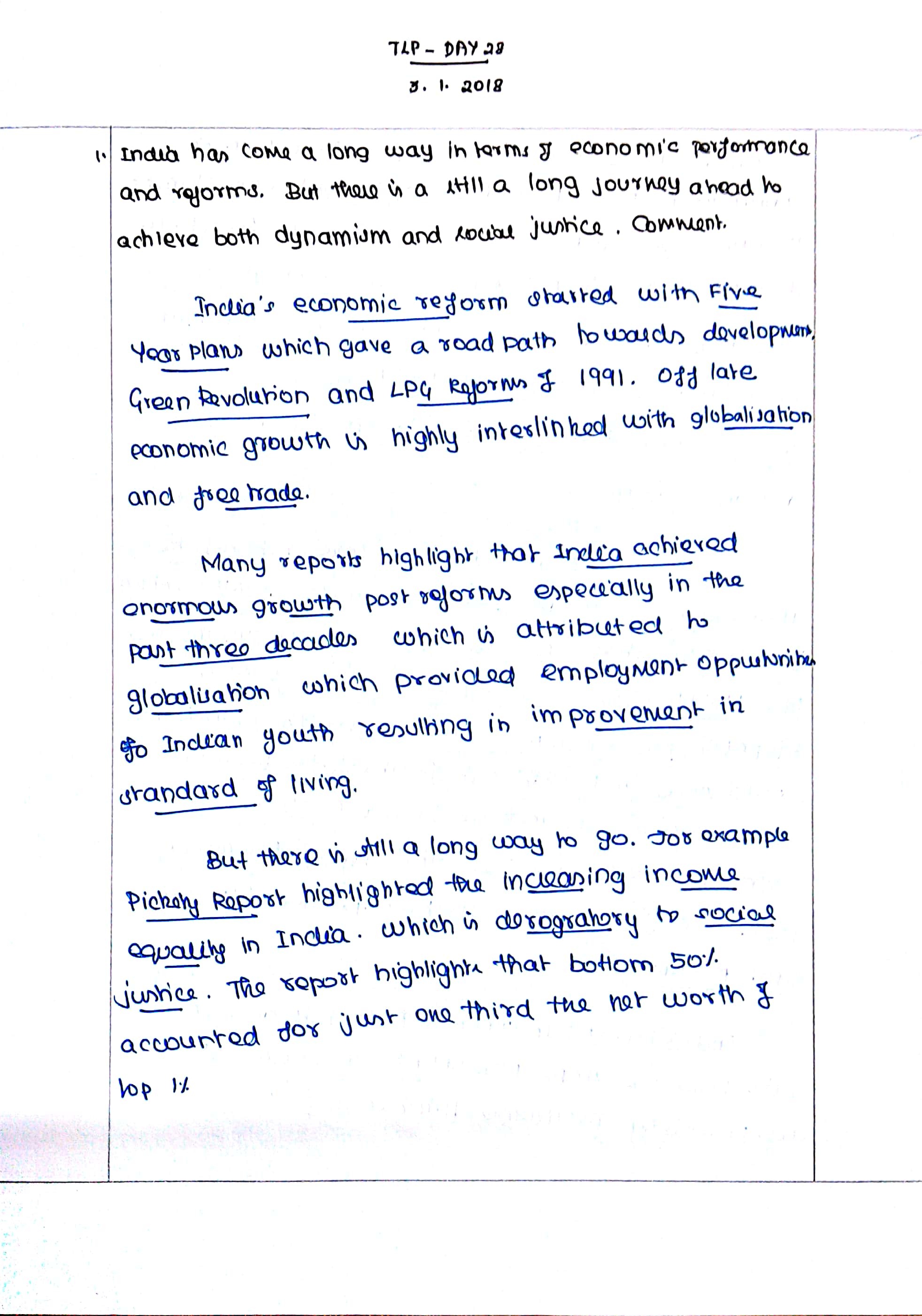
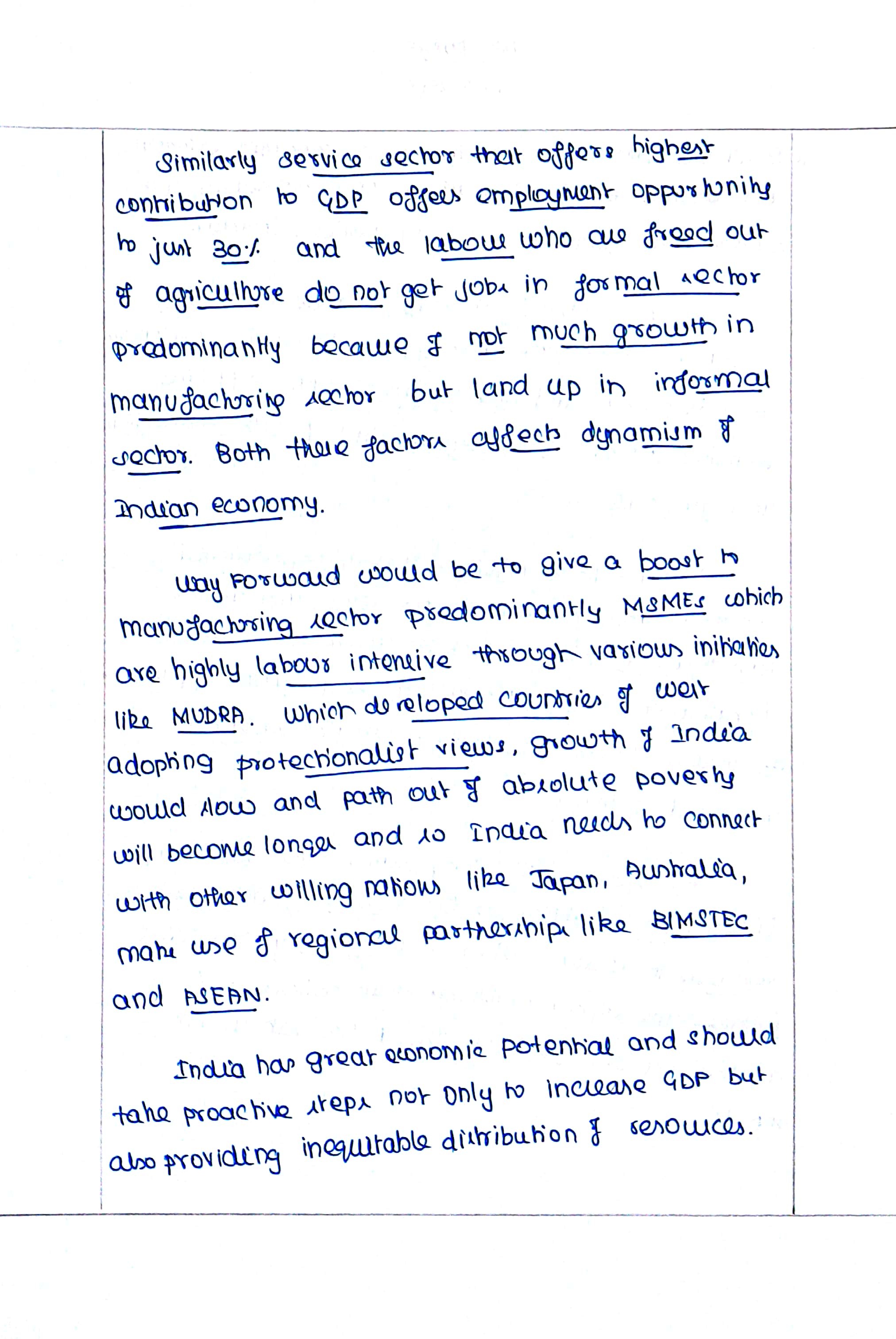
Q 1. India has come a long way in terms of economic performance and reforms. But there is still a journey ahead to achieve both dynamism and social justice. Comment.
Approach
The question can be divided into 3 parts
In the introduction, elaborate how India has come a long way in terms of economic reforms
How social justice has lagged behind?
As conclusion, what can be done going forward?
Introduction
25 years since the sweeping economic reforms of 1991, India has come a long way. From a fixed ‘Hindu growth rate’ of 3%, Indian economy grew at a rapid rate of 6-7% during this period. The GDP increased from $300 billion to $2 trillion (2016). The poverty rate declined from 37% (1991) to 21.9% in 2011.
This tremendous growth has been an outcome of sustained reforms over the period. These can categorized as follows:
First generation reforms: 1991 liberalization, end of license raj, privatization
Second generation reforms: FEMA 1999, FRBM Act 2003, relaxation in FDI norms etc.
Third generation reforms: GST, recent labour reforms, ease of doing business etc. (all ongoing)
However, the rapid economic growth failed to trickle down to the bottom rungs of the Indian society. As a result, the constitutional mandate of achieving social justice has fallen behind as evidenced by the following:
Lacking in Social Justice
Rising inequality – 1% own 22% wealth
3rd largest economy by rank in Human Development Index – 131
Prevalence of caste and religion based violence
Underdevelopment of tribal areas – low literacy compared to overall numbers
Increasing crimes again women + poor sex ratio in states like Haryana and Rajasthan
Little rights and opportunities for differently-abled, marginalized sections such as transgenders
Widening rural – urban divide leading distress migration and problem of slums
How to Attain Social Justice
Protective + supportive laws for weaker sections with strict implementation – SC/STs, tribals, transgenders etc. Schemes like USTAD, Nayi Roshni.
Increased focus on old age population – appropriate provision of social security
Increased public expenditure on social indicators – education and health
Skill Development + entrepreneurship
Generation of formal jobs – 10 million every year
Women empowerment – increase female labour force participation like China
Progressive taxation – such as done in GST
Good governance – transparency, accountability, grievance redressal mechanism
Energizing judiciary to protect the interest of weaker sections
Rural development – farm to fork, double farmer income, e-NAM, infrastructure etc.
Use of Digital India to bridge the rural-urban inequality
Conclusion
Development is an inclusive concept. Economic growth without commensurate social development will lead to increase in inequality and regional imbalance. In a country like India it can even have an impact on national integrity and unity. Thus it is high time that India’s development journey combines economic growth with social justice.
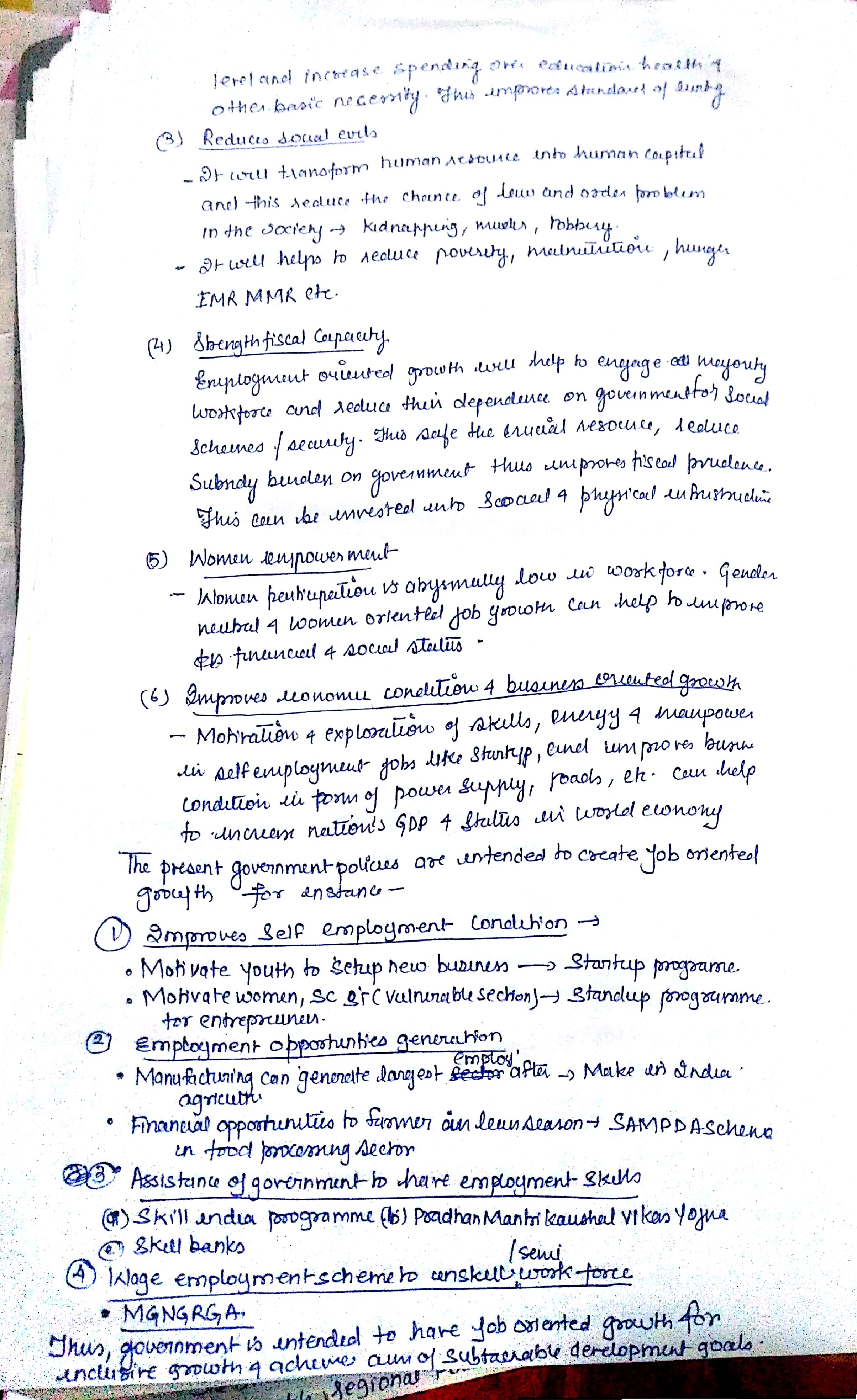
Q.2) In Indian economy, where huge labour force is available, importance of an employment oriented growth is observable. Comment. Are current policies oriented in that direction? Examine.
Introduction:
India is the fastest growing large economy, posting a growth rate of over 7 per cent, yet jobs are not growing as fast as GDP. What needs to be done to address the problem of jobless growth which, if not addressed, has the potential to turn India’s demographic dividend where around 65% of the population is in the bracket of youth into demographic disaster?
Importance of employment oriented growth:
The number one priority of the Indian government must be much faster generation of more, and better jobs, as they have following problems:
The Indian economy’s growth, in terms of GDP, is the highest in the world at present.
However, it is one of the slowest in the world in creating jobs. The employment elasticity of the Indian economy i.e., the rate of jobs growth in relation to GDP growth has been less than the global average from 2000 to 2010.
The average employment elasticity of the global economy was 0.3 in this period, while India’s was only 0.2.
Making capital artificially cheaper promotes its sub-optimal use in a labour abundant economy like India.
It may induce adoption of labour-saving production technologies especially if labour laws are not business friendly; so does raising minimum wages without commensurate rise in productivity. That kills jobs.
Current govt policies towards job creation:
While the Indian government is pressing on the accelerator to induce more job growth, with its Make in India, Skill India and Startup India campaigns, technological advances may be throwing a spanner in the works, as they might face the following problems, like:
Rapid advances in digital technologies and automation are displacing people from work in all sectors of the economy—in manufacturing, in services, and even in knowledge industries.
Studies in the US and Australia estimate that by 2035, 35% of all work in their economies will be automated and this can impact over 50% of present employment.
The International Labour Organization says, in its Future of Work Report, “The unfurling technological revolution is so far-reaching in its labour-replacing potential that it is inherently different from what has been experienced in the past.”
Some of the following programs govt has come up with to create jobs:
Promotion of Entrepreneurship: Job-makers are been promoted from school level through schemes like Atal Innovation Labs, Stand up India and Start up India
Manufacturing Industries: They hold the key to large employment levels. Make in India is right step in the direction.
Impetus to MSME: Credit issue for MSMEs has been eased by setting up of MUDRA Banks.
Skill Development Programmes: NSDC and STRIVE, SANKALP schemes are providing the necessary skills to compete in the industry.
Infrastructural Projects: Recent initiatives like Bharatmala, Sagarmala provides a huge opportunity in employment level for many years due to the nature of projects.
Ensuring proper implementation of GST for ease of small industries and MSMEs will help increase their growth. Relaxation of labor laws will encourage in increased hiring by firms.
Conclusion:
The solution to India’s need to create more jobs faster is to urgently apply a more effective process to develop a good, synergistic policy-matrix.
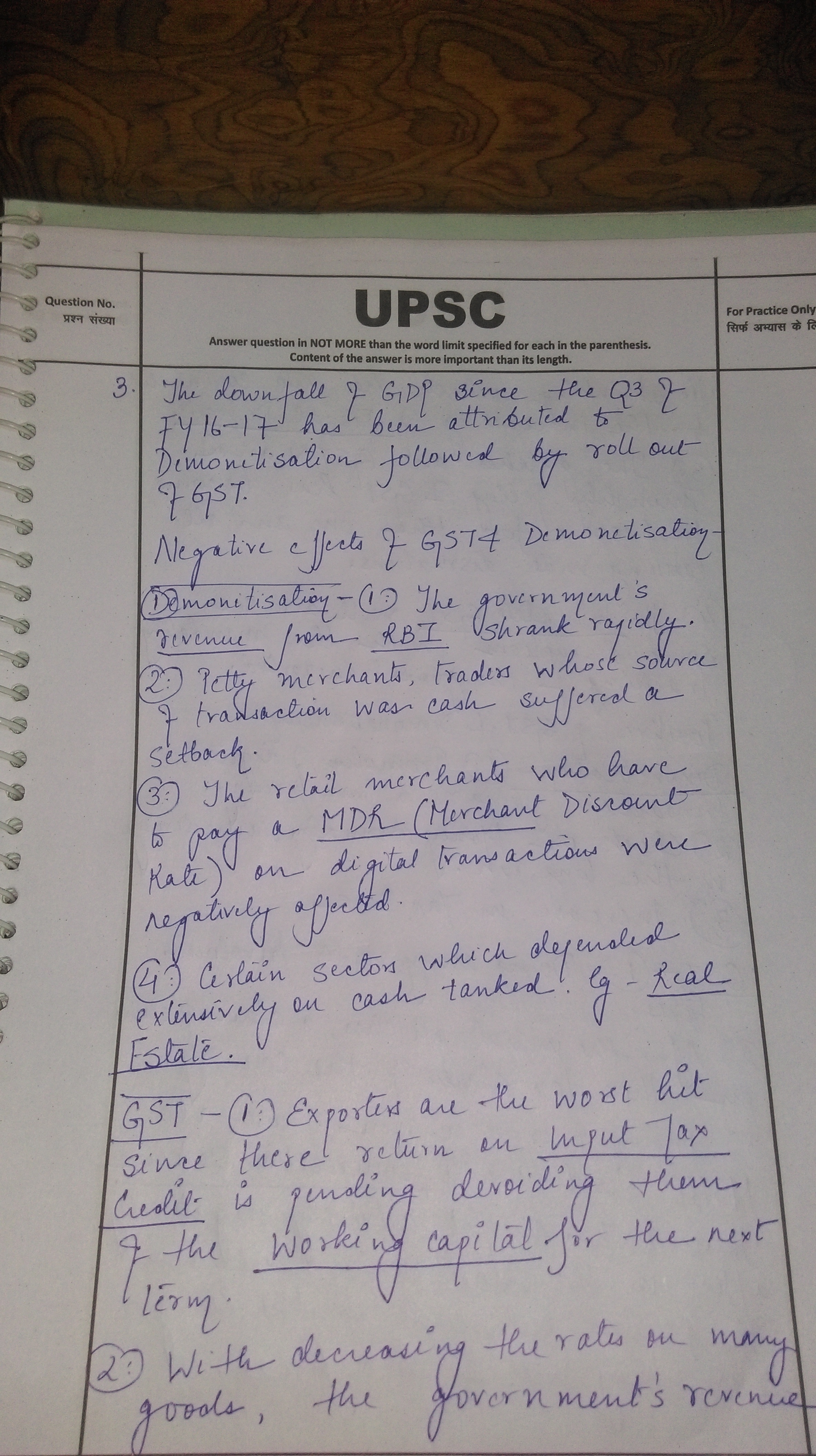
3. Have demonetisation and GST adversely affected the growth rate? Critically examine.
Approach:
Introduction- A brief on what demonetisation and GST is.
Adverse effects- of both the reforms.
Critical comment part- Benefits too.
Way forward.
Conclusion – Adverse effects on short term but in long run has scope to benefit the economy.
Introduction:
Post the LPG reforms of 1991, the GST and demonetisation are rightly heralded as one of the biggest reforms having scope of structurally transforming the Indian economy, the way it functions.
Demonetization refers to an economic policy where a certain currency unit ceases to be recognized or used as a form of legal tender. Rs 500 and Rs 1000 notes were demonetised in India in November, 2016.
Goods and Services Tax (GST) is an indirect tax reform which aims to remove tax barriers between states and create a single market.
Adverse effects:
Demonetisation:
Given heavy dependence on cash demonetisation hit trade and consumption hard.
The unorganised sector was hit hard, as day to day transactions in cash matters a lot.
Many lost their jobs due to the sudden cash crunch for the businesses.
Loss of effective working days. As people had to spent many hours tanding in queues outside ATMs
GST:
GST in current form is very complex for most of the small and medium scale businesses to understand.
Most of the firms in unorganised sector find it difficult to comply with.
Benefits:
Demonetisation:
It is expected that increased digitalisation, more formalisation of the economy etc. will compensate for the temporary slip in the long run.
Less of corruption as seen in dropping of real estate prices.
Will help tackle black money as transactions now digitally can be tracked easily.
GST:
A unified market and increasing the ease of doing business.
Less number of taxes means easy to comply with.
Overall taxes on many commodities especially for middle and poor class reduced, therby benefit the lower rungs of the society.
Tax to GDP ratio wil improve in long run.
Way forward:
The government needs to ensure that the rollout of GST is smooth. The concerns like high tax rates, anti-profiteering etc should be adequately addressed to keep the confidence of market intact.
Action against suspicious deposits under demonetisation be taken.
Digital literacy should be provided to increase digitalisation.
Facilities like POS machines, ATM machines must be deployed in every corner of the country.
Conclusion:
Overall, GST and demonetisation, as shown by various reports, did lead to slowdown of economy. But this should be seen only as short-term effect. In long term both the reforms are surely going to benefit us.
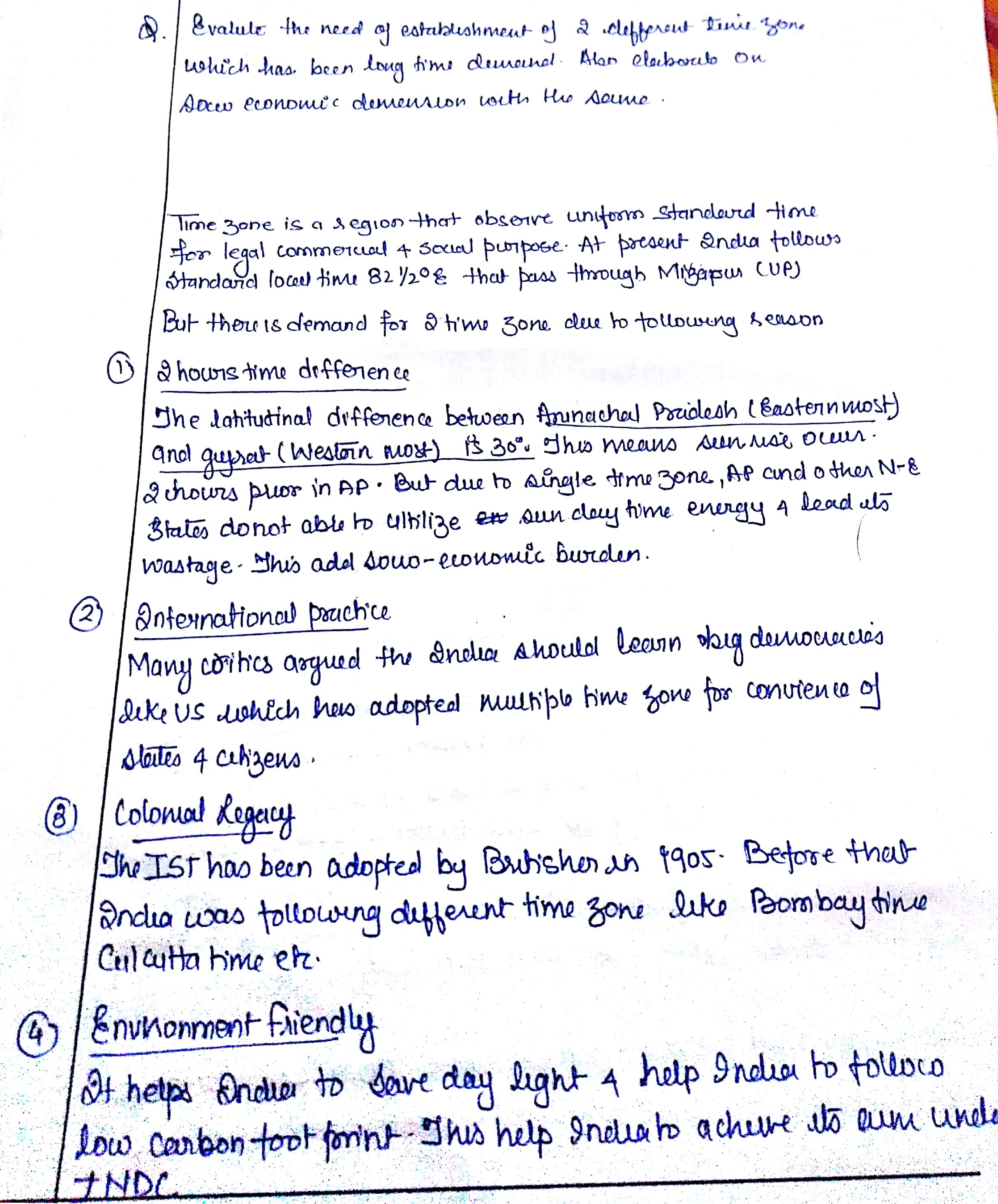
4. Evaluate the need of establishing two different time zones for India which has been a long time demand. Also elaborate on the socio-economic dimensions associated with the same.
Background: Arunachal Pradesh Chief Minister Pema Khandu reiterated northeastern states’ decades old demand for a separate time zone. Leaders from the region argue that a separate time zone would increase daylight savings and efficiency.
Need of establishing two different time zones for India?
India is the 7th largest country in the world in terms of its landmass. As a result, it has a large latitudinal and longitudinal spread equaling approximately 30 degrees for both. But, despite its size, India has a single time zone. This creates problems, especially for the people in North East.
There has been long time demand for two different time zones especially from north eastern states. Being limited to single time affects socio-economic dimension of the economy. It can be seen that:-
India longitudinal extension is near to 30 degree (68.7 E – 97.25 E) and thus an average of 2 hours difference between eastern and western states.
Internationally countries with such large longitudinal gap have more than one time zone eg. USA has 6 and Russia has 11 time zones.
Sticking to single time zones affect economy of states e.g offices closing at 5 PM IST in Assam means 9 PM technically. It increases state expenses like in power consumption, transportation costs etc.
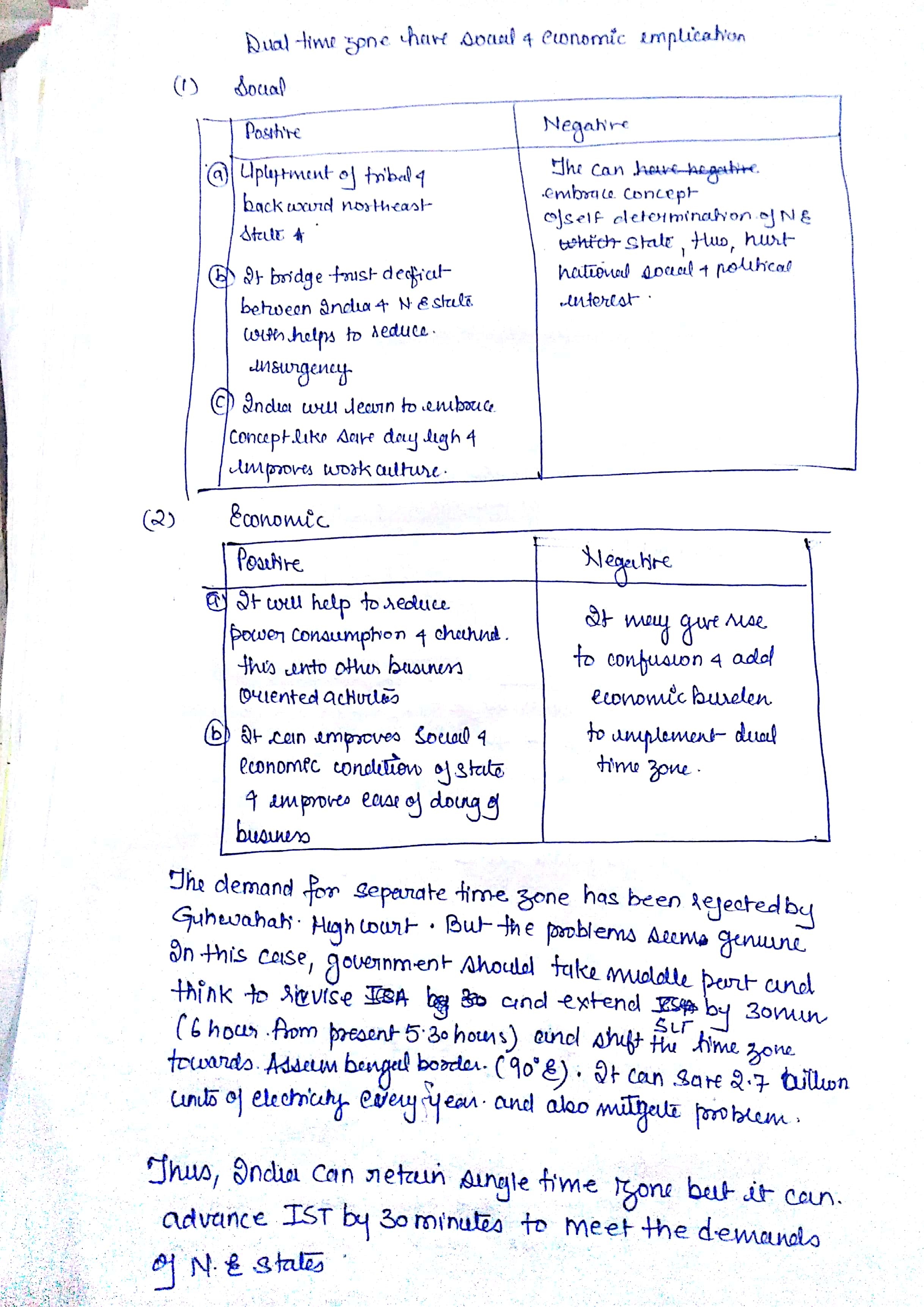
Socio-economic dimensions
Single time zone socio-economic dimension can be seen like:-
More pocket expenditure in form of fare expenses, power utilization etc. specially affects low income earner.
Extra strains on government exchequer to maintain supporting infrastructure.
Affecting productivity of work force, if office starts at 10 AM IST it means 2 PM technically.
Local population popularly supported for other time zones, refusal for such in past bring desperation among people.
Challenges:
1- The two time zone will affect the airline,rail services in whole country.
2- Difficulty in dealing with governance.
3- Separate time zone will create the tendency of separate mind set.
4- The biological clock of other people working in NE region will be affected.
5- The unstated assumption is that the grant of a different time zone is only the first temporal step towards conceding spatial autonomy.
Way forward
1- Committee set up by department of science and technology in 2002 has suggested of shifting the timing of offices and schools.
2-Challenges and benefits can be studied by analyzing the time zone of various countries example- USA,Russia etc.
Conclusion:
Though the task is different, various countries like US, Russia have implemented it and shown a significant progress in adapting it. Looking at the importance of north east states for their integrated role in Indian growth, India should try it for a pilot basis and evaluate the same for better future policy.
Q.5) The need for transparency in electoral funding for a level playing field in elections is a fundamental requirement. How are the measures initiated in the recent budget influencing the same?
Approach:
Introduction: Mention what is electoral funding and how it happens in India
Body: The question has two parts. First part is why transparency is fundamental requirement and second part is Measures initiated in the budget. You should also include one more part to mention loopholes in those measures only then the answer is complete.
Conclusion: 2-3 lines are must.
Introduction
Electoral Funding is a process of raising money by political parties and individuals for campaigning and carrying out political activities. They are of two types, one is State funding and another is public funding. India follows the public funding method.
Body
There is a need for transparency in electoral funding; it is also a fundamental requirement because:
Prevalence of Black Money and Corruption.
Political and Corporate nexus leading to lobbying.
Pseudo policy and Nepotism.
Discrimination against smaller and new parties.
Measures Initiated by recent budget:
Electoral Bond: Introduction of electoral bonds by amending RBI Act, which will be issues by specified bank branches with validity of 15 days.
Cash limit: Cash donation only upto 2000 per person.
Digital: Donation via Digital or cheque mode to parties.
Income Tax exemption: Only if they fulfill above conditions.
Shortcomings:
Cash limit: Will not stop huge, out of account cash donations from corporates and lobbying groups.
Limit: No limit on cash donation acceptance for political parties.
Electoral bond: Donor will be anonymous which is against transparency.
Answer should consist of 8-10 points. All parts of answer should be given equal weightage. Each point should be explained for a line or two.
Conclusion
Transparency in political funding can be brought in only when every rupee donated is from known sources and judiciary must step in to bring political parties under ambit of RTI act. Also we can introduce “National Election Fund” for electoral funding and ban corporate funding to political party all together.