1. Why the nationalist movement during 1885 to 1905 is branded as the moderate phase? Discuss. Did the moderate phase achieve any success? Critically examine.
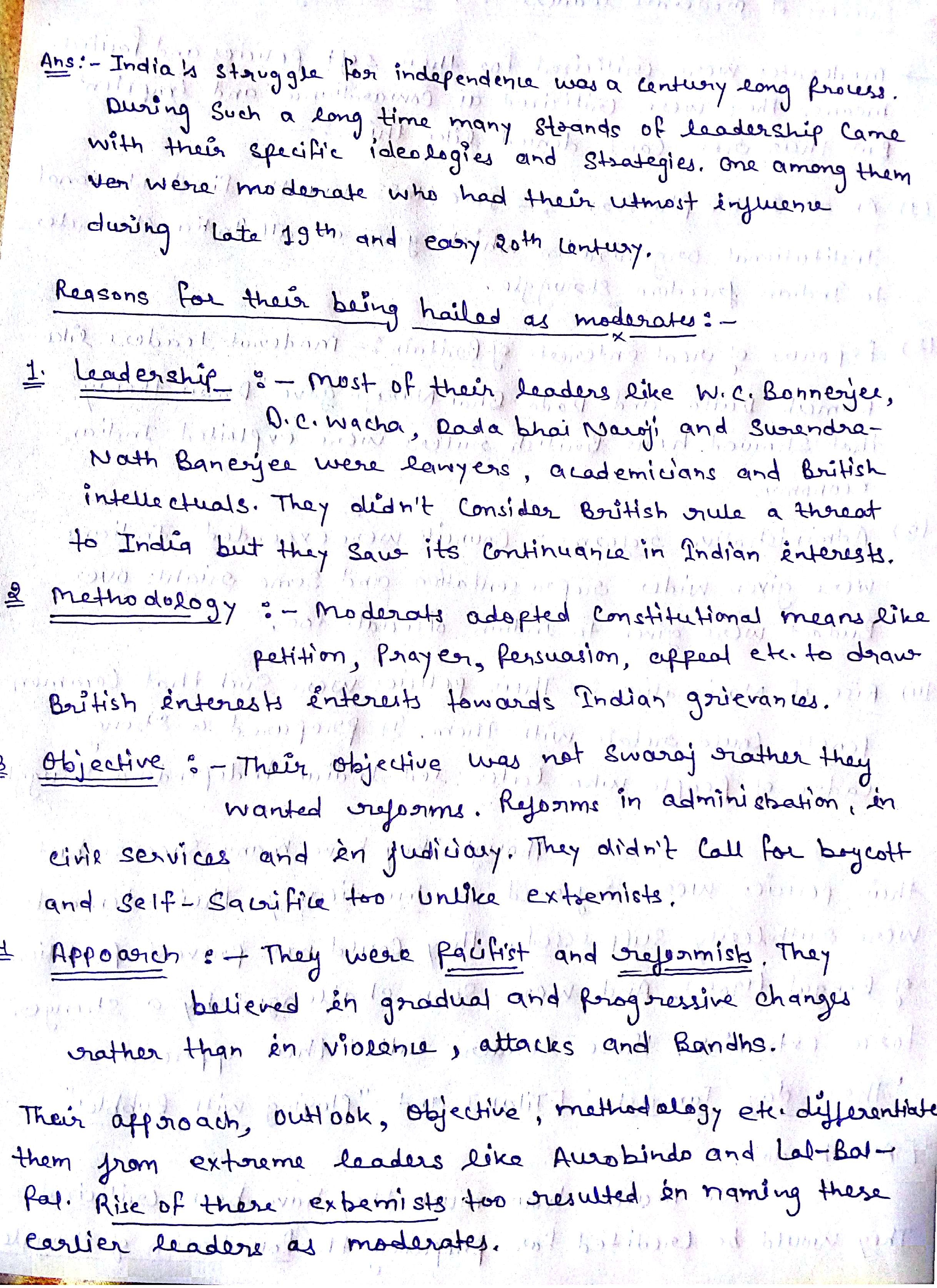
Why 1885-1905 is termed as Moderate Phase?
The period between foundation of Congress (1885) and partition of Bengal (1905) is known as moderate period of Indian national movement because of the approach adopted by the leaders of Congress was fairly moderate in nature and objective.
1.They neither desired complete independence nor adopted any aggressive attitude.
2.They relied on petition, prayer, and moderate criticism of government policies as their methods.
3.They believed that just by drawing attention of the government towards a particular problem e.g. lack of indian representation in executive council and civil services, less budgetary provision for social goods, the government would address their problem.
4.They would not oppose the government through violent confrontation instead believed in working side-by-side and within the government.
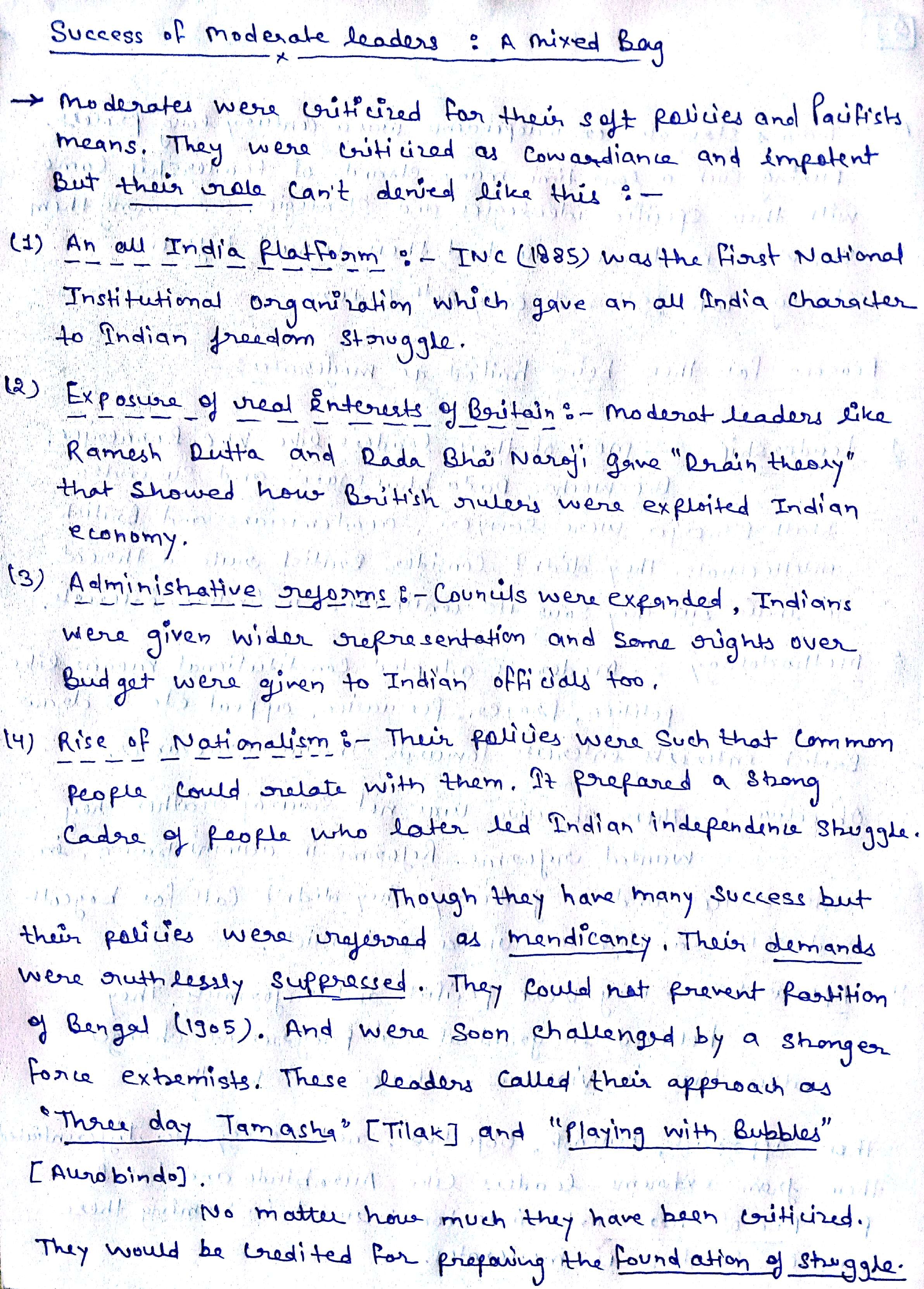
Success of Moderates
Their efforts succeed in following ways:
1) They worked intensively to expose the true nature of British rule. Work on Economic drain by Dadabahi Naoroji etc. created a big impact in understanding the British rule.
2) They used press to generate positive opinions.
3) They succeeded in gaining sympathy for Indian cause in Britain. Naoroji even became Member of British Parliament.
4) As a result British allowed various concessions and reforms such as allowing more representation of Indians in law making bodies, discussion of some part of Budgets etc. There were possible by Indian Council Act passed 1892 by the British Parliament.
5)Their Demand for Indianisation of administration led to constitution of Aitchson Commission.
6)They pressured government to lessen land revenue demands and were instrumental in famine code declaration.
7)The helped to arose nationalist feeling and to bring political consciousness throughout country by organizing INC sessions indifferent regions and cities.
However it failed to,
Arouse nationalism and unity at grass roots, masses were not aligned to this phase.
2.Identify the true nature of colonial rule initially.
3.Accommodate social reforms as part of struggle and gave importance to political reforms
4.Congress Party was a forum for elites like lawyers and journalists.
5.The British were successful in containing them by allowing minimal reforms without bringing any strong changes.
Conclusion
It is the work of the moderates that created a strong base for later national leaders like Lal-Bal-Pal, Mahatma Gandhi etc. to build a national movement. Their work on Drain of Wealth etc., expansion of press and creating public opinion had significant impact in due course of National Movement.
2. Getting rid of the ills of caste system, improving the status of women and drive towards modern education were the central pillars of 19th century reforms. Discuss.
Introduction:
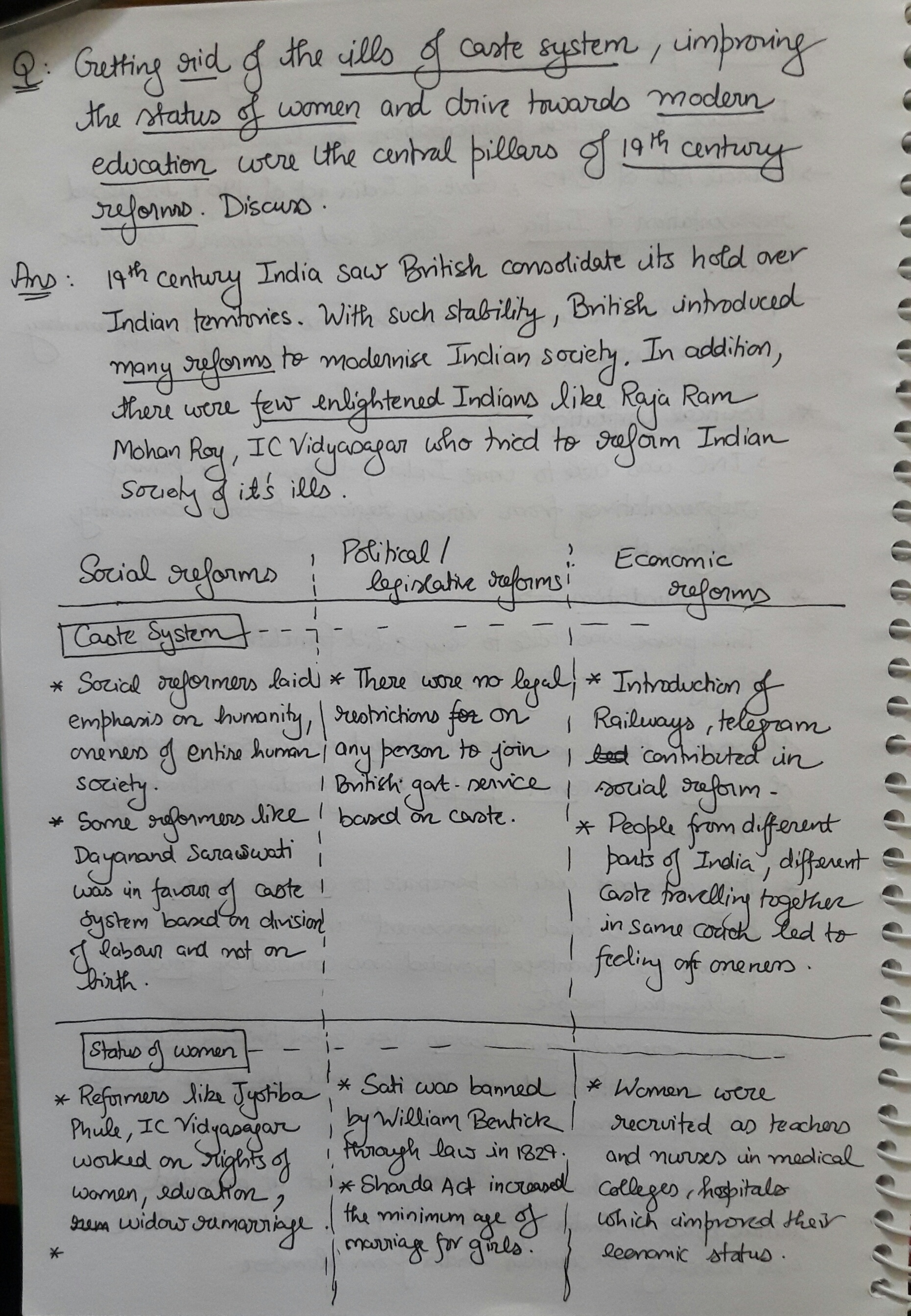
The inflow of western ideologies of liberty, equality and fraternity led to the phase of Renaissance of the Indian society. 19th century reform movement was directed against ill, socially conservative and orthodox religious practices of the society. Social reformers and political leaders worked together to remove these social ills – as it not only reformed society but brought sense of commonness and thereby nationalism.
Getting rid of the ills of the caste system:
Caste was seen as a divisive force which had no moral basis. Progressive liberals like Raja Ram Roy, Justice Ranade, and even conservatives like Dayanand Saraswati set up institutions like Brahmo Samaj, Prarthna Samaj and Arya Samaj where caste disabilities were opposed and inter caste marriage was supported.
The Arya Samaj rejected the hereditary caste system. They called for “Back to Vedas” to bring back the golden age of Varnashram were Varnas were based on occupations, not birth.
Jyoti ba phule was an important reformer who fought against the caste discriminations. He founded Satya Shodak Samaj for organising the struggle.
Caste Disabilities Act 1850 was passed by Lord Dalhousie.
It must be highlighted that these reforms were result of progressive thinking of few individuals and a big section of conservatives were yet to lend their support.
Reason for reform was either rooted in Human development (like Raja Ram Roy) or to protect Hinduism from outside influence (for conservatives).
The inclusion of members from all castes and religions by INC was the resultant of these reform movements. These efforts were fruitful in enlightening the people and their demands for better treatment leading to inclusion of Schedules 5 and 6 for tribal and lower castes and Article 17 for abolishing untouchability.
Improving the status of women:
Consistent efforts by Ram Mohan Roy led to the ‘Abolition of sati’.
Of Vidya Sagar led to invalidating of female infanticide in 1856.
Widow remarriages were encouraged by Dayanand Saraswati, Veeresa lingam Panthulu etc to improve the status of widowed woman.
Widow remarriage Act, 1856 by Dalhousie, Female Infanticide Act passed by Lord Mayo – shows that British too took efforts.
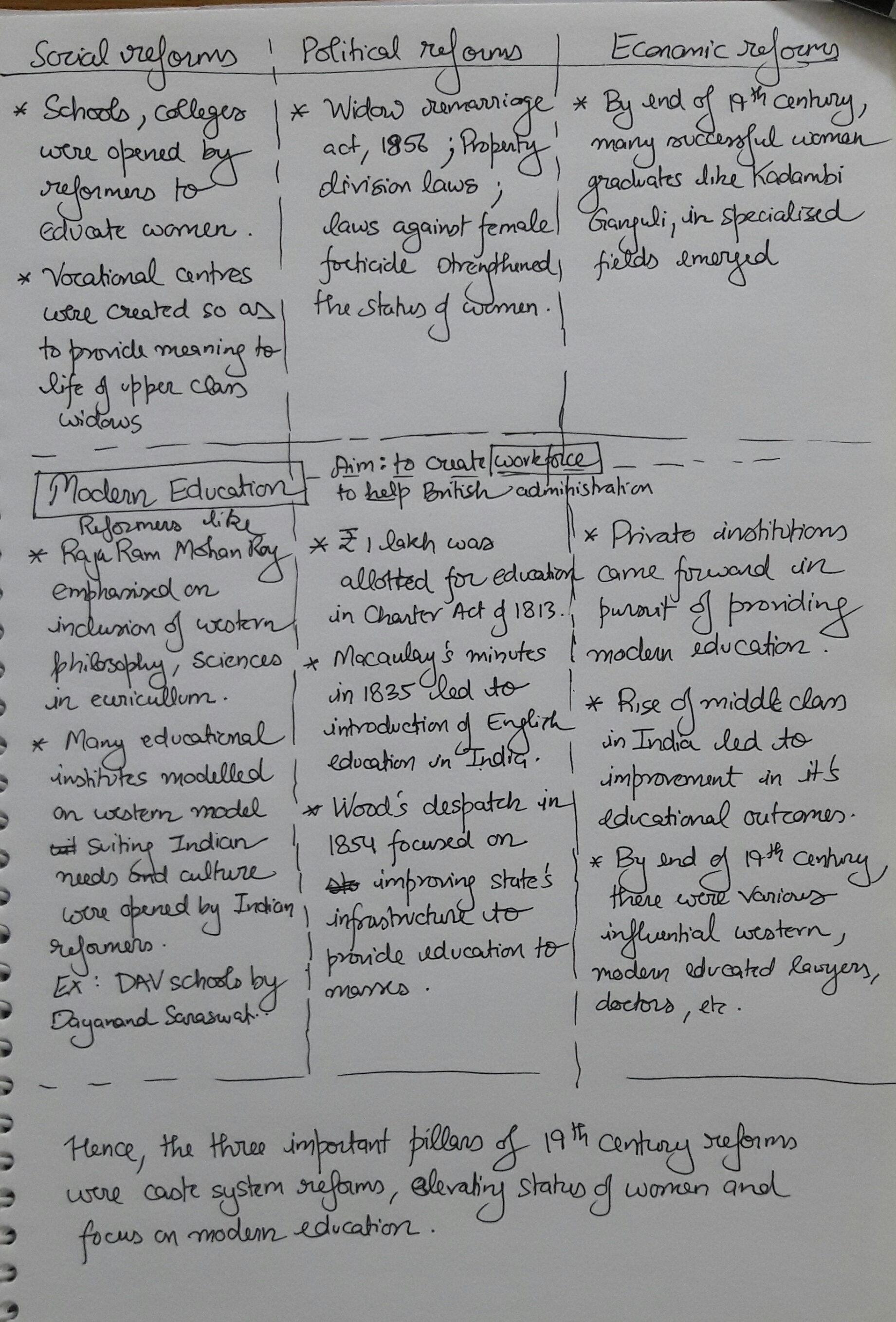
Woman education was promoted by establishing schools and colleges. Vidyasagar established schoos for girls education.
Social illiberal practices such as illiteracy of girl, injunctions on widows were targeted by Rammohan Roy, Iswar Chandra Vidyasagar, Kesub Chandra Sen etc.
Women organisations also sprung up – Mahila Samaj by P. Ramabai and Sharda Sadan – to rehabilitate widows. This shows some women started taking up their concerns on their own which was earlier initiated by progressive male reformers.
Driving towards modern education:
Reformists like Raja Ram Mohan Roy, Keshab Sen, Jyothiba Phule etc. drew positive influences from modern English education and were instrumental in educating the Indians and at the same time pleading government for legislative reforms to empower the vulnerable.
The modern education was seen as prime force in bringing about this social change. Few reformers themselves were western educated and believed that only education would rescue India from it’s social evils.
Schools and colleges were set up on modern lines to imbibe rationalism in people. Reformers even used journals and newspapers to educate masses.
Education in 19th century had no scientific basis and was based age old religious scriptures. Company needed english learned men to work under Britishers. Macaulay minute was the first step to introduce education on rational and scientific lines. Later on woods dispatch argued for focus on primary education, setting up colleges like Calcutta college. It also asked for providing women education. University of Calcutta, Bombay and Madras were founded in 1857.
Nationalists like those from Arya samaj set up DAV and Gurukul, then Vivekananda set up Ramkrishna Mission, and Sir Syed Ali set up Aligarh University. Their focus was to build character and infuse nationalistic feelings.
Conclusion:
Thus women emancipation, getting rid of caste discriminations and encouraging modern education were the central pillars of 19th century reforms that laid a good foundation for unification of the country for the purpose of later independence struggle.
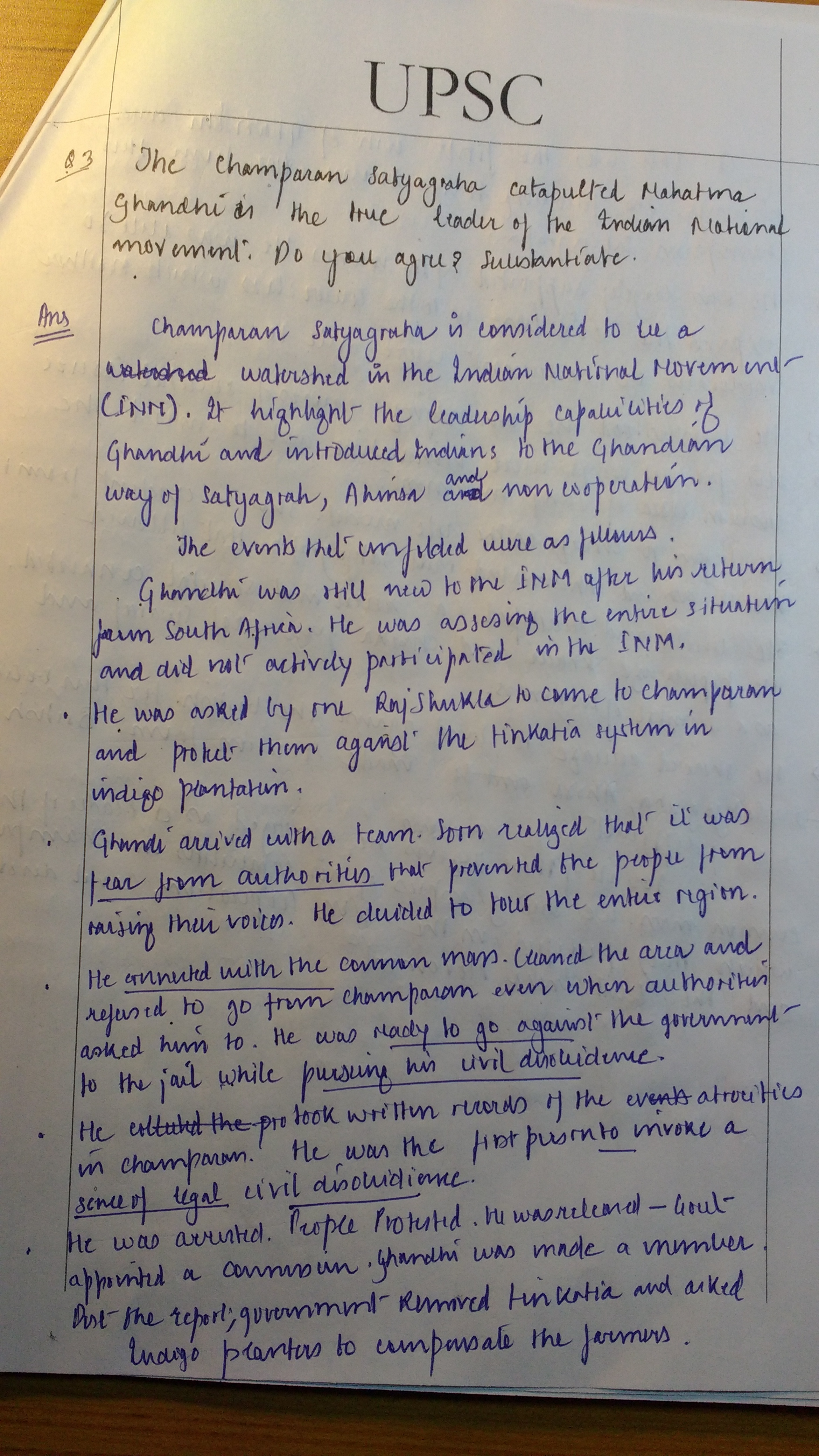
3. The Champaran Satyagraha catapulted Mahatma Gandhi as the true leader of the Indian national movement. Do you agree? Substantiate.
Gandhiji returned to India in 1915, he was already made famous by the Indian press which had spread his stories about the successful idea of Satyagraha in South Africa. On His return, he established an ashram near Ahmedabad.
Champaran Satyagraha: The Event:
Gandhi heard about an obnoxious system of agricultural labour prevailing in Bihar.In the Champaran district of Bihar, the cultivators were forced by Europeans to grow indigo, a blue dye, and this imposed on them untold sufferings. They could not grow the food they needed, nor did they receive adequate payment for the indigo.
Gandhi was unaware of this until an agriculturist from Bihar, Rajkumar Shukla, met him and told him of the woes of the people of Champaran. He requested Gandhi to go to the place and see for himself the state of affairs there.
Gandhi went to Champaran with Rajkumar early in 1917. On his arrival the District Magistrate served him with a notice saying g that he was not to remain in the district of Champaran, gndhiji refused to leave Champaran and was arrested.
Later, The Government withdrew the case against Gandhi and allowed him to remain in the district. Gandhi stayed there to study the grievances of the peasants.
He visited many villages. He cross-examined about 8,000 cultivators and recorded their statements. In this way he arrived at an exact understanding of their grievance and the causes underlying them.
He set up voluntary organizations to improve the economic and educational conditions of the people. They opened schools and also taught the people how to improve sanitation.
The government realized Gandhi’s strength and his devotion to causes. They themselves then set upon a committee to enquire into the grievances of the cultivators. They invited Gandhi to serve on that committee, and he agreed. The result was that within a few months the Champaran Agrarian Bill was passed. It gave great relief to the cultivators and land tenants.
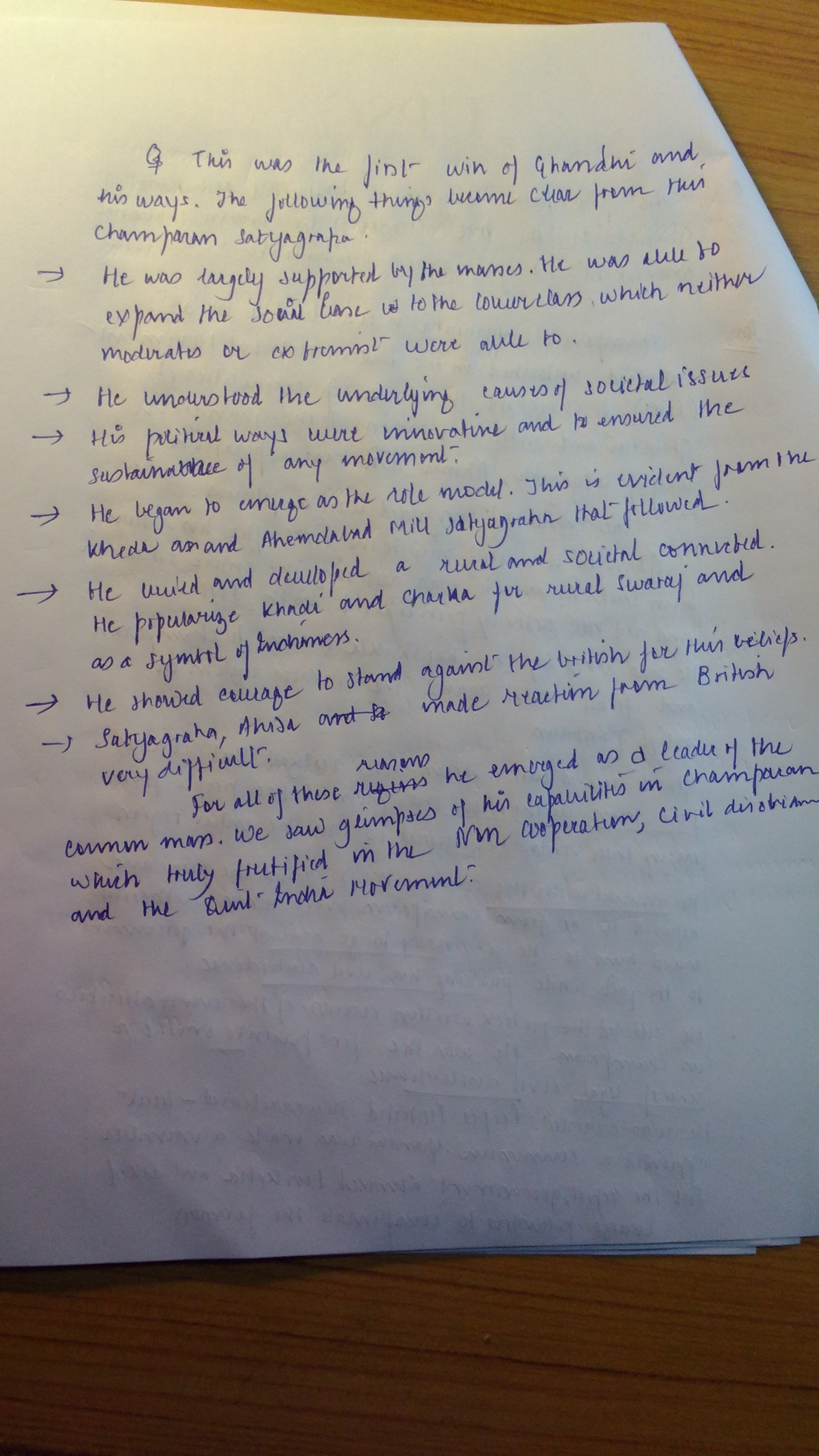
Analysis: Why it propelled Gandhi as a Leader.
Justice: Gandhiji Initiated the Satyagraha, to get Justice for the farmers, who were on account of their ingnorance, being exploited by the englisg plantation owners.
Selflessness: Gandhiji was ready to go to prison and face a trail before the magistrate for the people he had never met before. This created lot of public support in his favor.
Non-Violence: Gandhi refused to leave Champaran and even protected the policemen from the angry villagers, and requested them to desist violence. This created awe even within the policemen
Leadership: Gandhi himself took up the responsibility of training the satyagrahis. He trained and disciplined them for the struggle.
Leading by example: Gandhi always sled by examples, he believed that when the laws are unjust, one must break the law, refusing to obey the magistrate, for what he believed was a just cause, set the precedent for the future struggles.
4. What is the ‘Most Favoured Nation’ status? Should India revoke the MFN status given to Pakistan? Critically examine.
Introduction
“Most Favoured Nation (MFN)” is a free trade principle employed in context of WTO’s (World Trade Org) free trade agreements and negotiations. If a nation grants MFN status to another nation that means it would not discriminate imports from that nation in favour of imports from other nations.
This is put in place to to eliminate restrictions on trade and increase overall world trade. Violation of MFN allows a member to take the dispute to WTO dispute settlement body. National Scrutiny clause can be used by nations in extreme situation to deny MFN status to another county.
Should India revoke the MFN status given to Pakistan?
India has granted MFN status to Pakistan in 1996 but Pakistan haven’t reciprocated as it would have required to reduce trade tariffs and open trade in more commodities. On the other hand, it came up with a Non-Discriminatory Market Access (NDMA) agreement. The reason Pakistan has chosen to adopt the NDMA with India is due to political mistrust and a history of border conflicts
There are growing voices to revoke MFN to Pakistan, They support such a move claiming:
Increasing sponsoring of cross border terror by Pakistan especially in Jammu and Kashmir and constant ceasefire violations.
2.As a diplomatic tool Globally Indian is seeking to isolate Pakistan and declare it as a safe haven for terror, so isolation has to begin by Indian taking strong measures.
India has no significant need to depend on Pakistan for any specific import and India’s annual trade is worth $650 bn and total trade with Pakistan is $2.6 bn. It’s not even 0.5 % of the total trade.It will have miniscule impact on Indian trade interest.
4.Pakistans role in CPEC and gross ignorance of sovereign issues flagged by India.
5.Hindrance created by Pakistan in Indian Trade relations with Central Asia and especially Afghanistan.
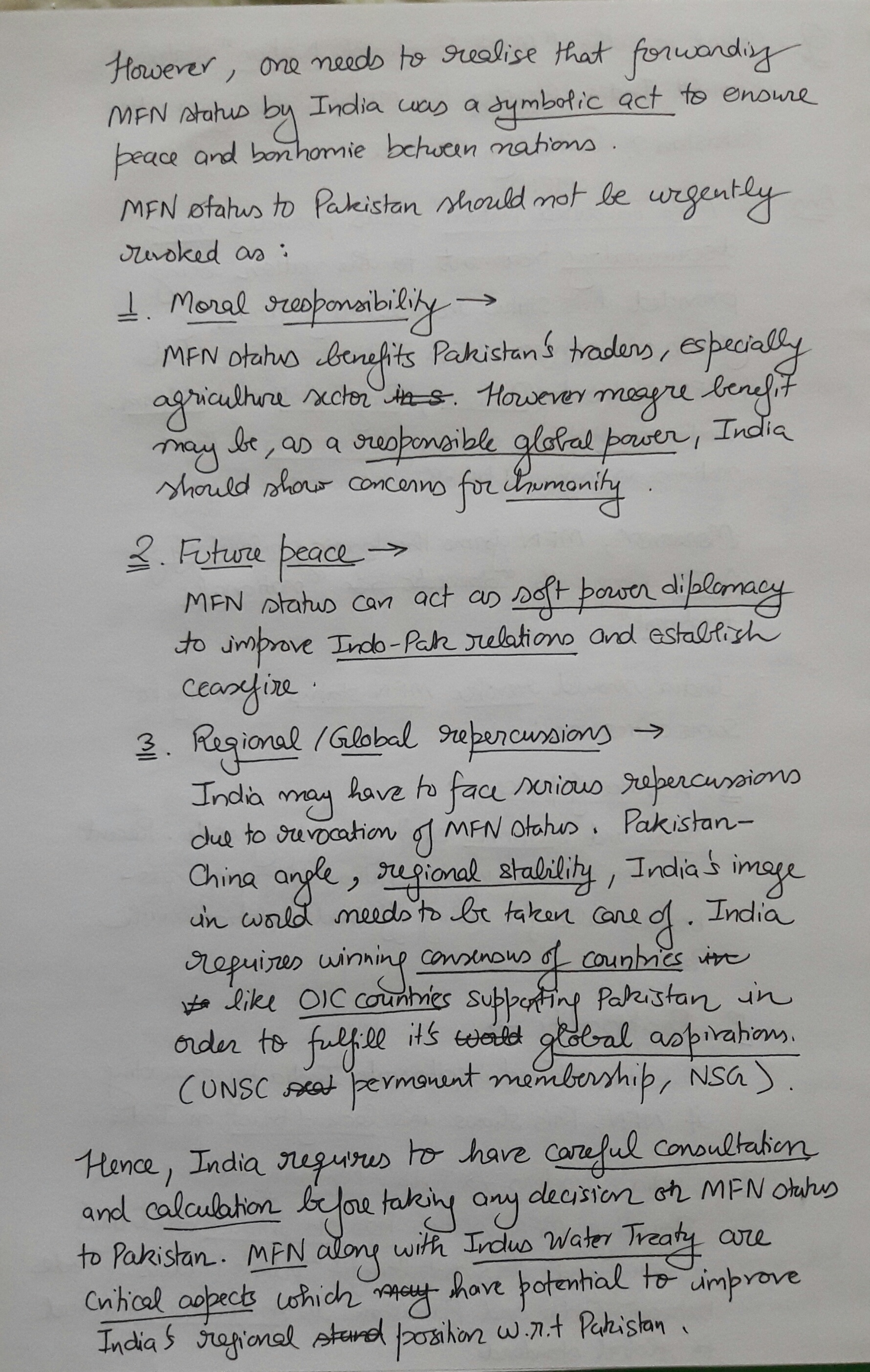
India should not revoke MFN status given to Pakistan:
A ban on trade may give rise to cross-border smuggling, which, is already a multi-billion dollar covert network
Harm India’s standing: Maybe difficult to explain such a move at global commerce-based forums since Pakistan’s trade practices have not raised any questions.
Trade balance is in India’s favour so India benefits from trade with Pakistan.
Greater trade will bring country and people closer to each other creating at atmosphere for peace talks and resolution of disputes.
It can help India access Afghanistan, Central Asia via Pakistan and for Pakistan to access South Asian markets like Nepal and Bangladesh.
IN long term it can help Indian wean away Pakistan from influence of China.
Conclusion
Currently India benefits from MFN status to Pakistan. Efforts should be made to get Pakistan reciprocate the same and setting stage fro greater trade between nations. But such a policy will not be in agreement with India attempting to isolate Pakistan and getting it declared terror sponsor state. A clear policy needs to drafted with respect to Pakistan and trade and MFN status will have to part of the larger policy.
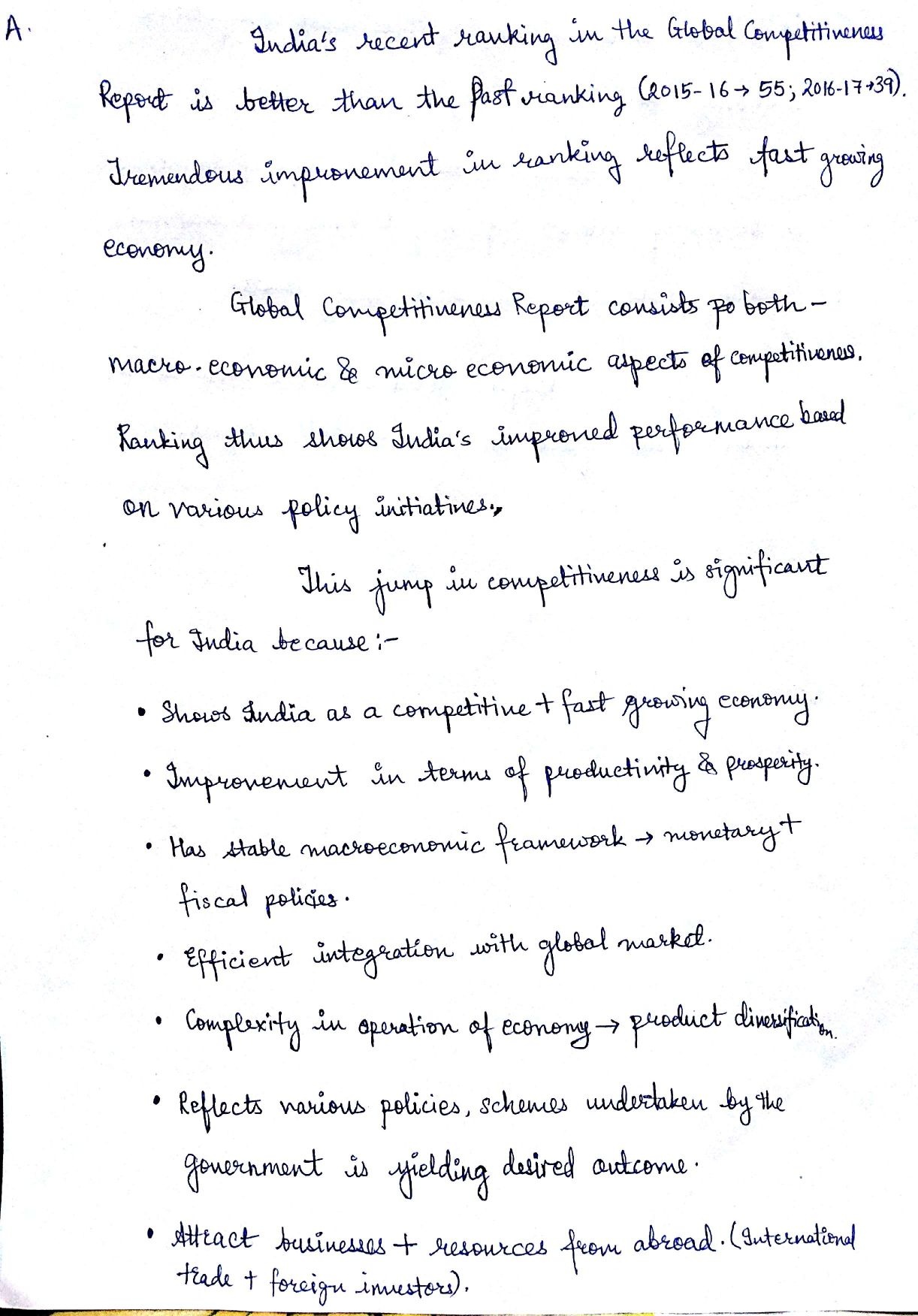
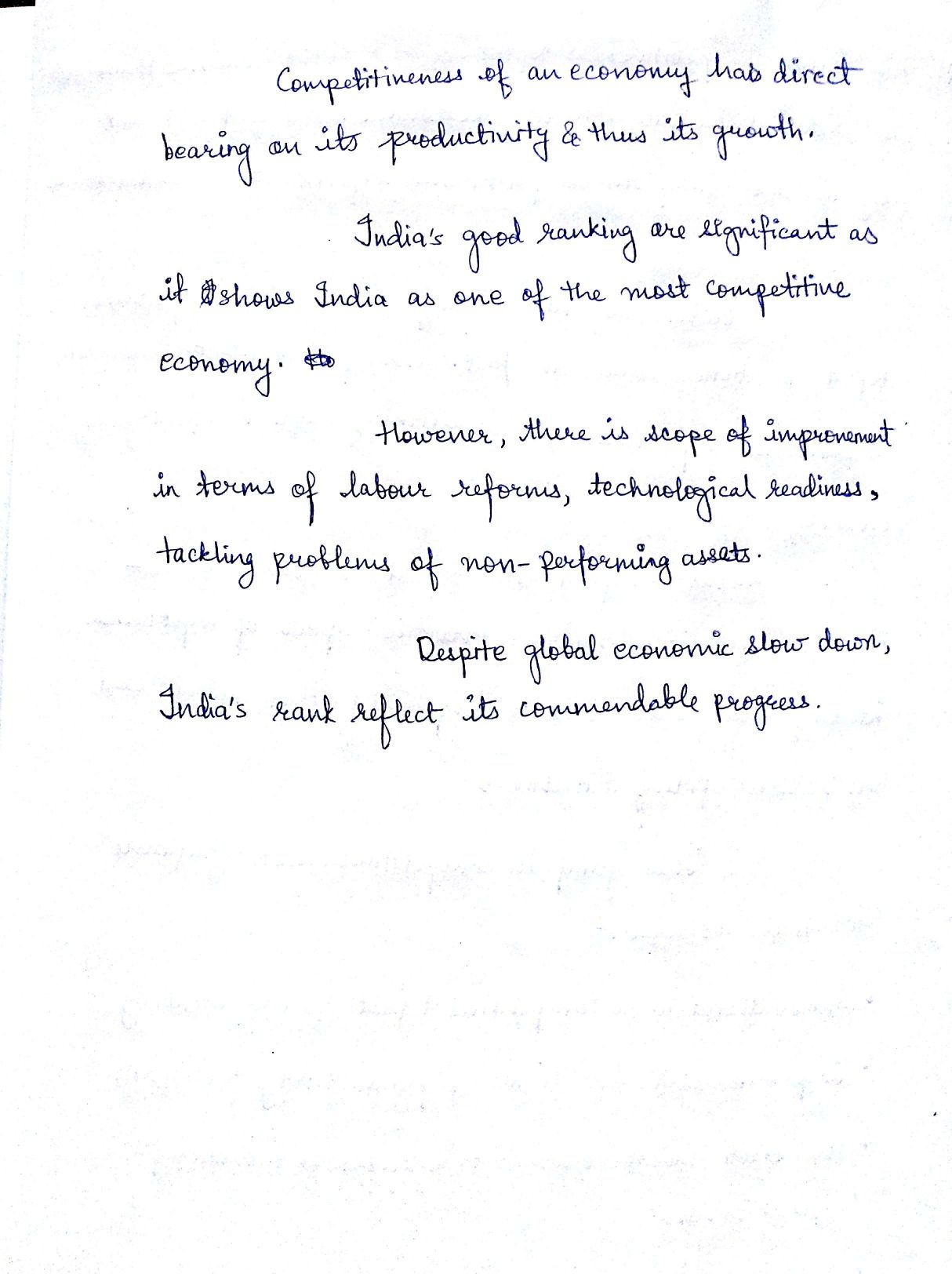
5) The Global competitiveness report of the world economic forum (WEF) was released recently which places at India at a good 39th. Why is this jump significant for India Discuss?
SYNOPSIS:
The promise of the ruling coalition at the centre of making India investor friendly destination seems to have borne when India climbed 16 places up to 39th in the Global competitiveness Index of the WEF.
SIGNIFICANCE FOR INDIA:
GCI is a global benchmark for India in terms of improvement in both Macro economic climate and Micro economic factors which is a sign of positivity for global investors looking to invest in India
The Index specifically mentions India’s stellar role in transparency whose image was sullied globally by corruption scandals in previous years has improved.
Eg: e- auction of mines, Spectrum allocation, emphasis on e-procurement has yielded results
According to analysts at Forbes reforms like opening the economy to global trade like increasing FDIs limits via automatic route especially in aviation and Defence, abolition of FIPB has made India as an attractive destination amongst BRICS nations.
It also shows effectiveness of India’s fiscal and monetary policies which have yielded results especially controlling macro-economic indicators like inflation , formulation of MPC etc.
Any global index which is highly reputed like GCI also shows areas of readiness like the report mentioned lack of technological readiness which shows programs like Digital India need to pick up speed and rising NPAs among public sector banks will call for reforms like Asset reconstruction companies, Bankruptcy code etc.
GCI also mentions Innovation and R&D as the chief drivers of competitiveness which signals that India in order to rise in rankings has to invest significantly in Human capital and better ecosystem for research.
More significantly the GCI emphasises Macroeconomic stability which is a great sign for MNCs looking to exit India after not so encouraging reports of last year which will also have a definitive advantage in improving India’s credentials in reports of credit rating agencies like Moody’s etc.
The report is also a time for inner reflection on shortcomings in India’s economy such as need to improve labour market efficiency, health indicators like IMR, MMR etc. and need for more investment in primary and technological education.
Thus furthering Nations transformation into a global superpower.