Bilateral, regional and global groupings and agreements involving India and/or affecting India’s interests
Effect of policies and politics of developed and developing countries on India’s interests.
Containing China
Background:
The fresh skirmish at the tri-junction of India, Bhutan and China is part of on-going border tensions. The stand-off continues with both sides raising the temperature gradually.
The border dispute has again raised the spectre of Chinese encirclement. It comes close on the heels of India’s boycott of the ambitious Belt and Road Initiative (BRI) summit in China. The recent dispute highlights the fraught and schizophrenic nature of the India-China relationship. China recently increased its fleet presence in the Indian Ocean Region.
Geo-Political encirclement:
China Pakistan Economic Corridor (CPEC) passes through Pakistan-occupied disputed territory. India’s contention is that CPEC is a unilateral validation of Pakistan’s claim on disputed territory.
China’s BRI is viewed as a strategic encirclement of India: Hambantota port in Sri Lanka, CPEC traversing west China via Gilgit-Baltistan all the way to Gwadar port in Balochistan, a road from Yunan province cutting through Myanmar to end at a deep-sea port in Kyaukpyu.
Geo-economic encirclement:
China has creeped within the Indian trade, business and financial landscape.
Chinese handset manufacturer Vivo won rights to cricket tournament Indian Premier League (IPL). Chinese handset brands now command over 50% of the Indian smartphone market share.
Chinese capital goods manufacturers have made deep inroads into India, with some critical sectors now highly dependent on Chinese spares and after-sales servicing. For instance, in the boiler-turbine-generator (BTG) segment, many Indian power producers have installed Chinese BTGs.
The Chinese footprint in the digital economy is also expanding rapidly. Numerous Chinese companies—Alibaba, Tencent, CTrip—have made large investments in the Indian digital ecosystem, a mission-critical segment for the Indian government.
India suffers a trade deficit with China which has increased over the years: from $38.7 billion in 2012-13 to $51 billion during 2016-17. One of the reasons for the large deficit are Chinese tariff and non-tariff barriers which constrain Indian exports; for example, Indian pharmaceutical exports have found it difficult to penetrate the Chinese market.
Doklam standoff: What is different this time?
It is much more complicated for following reasons:
One, it is happening near the western tri-junction of India, Bhutan and China. So it involves three countries. And that’s a tri-junction area where, in principle, all three countries have to agree on the posts.
The Doklam incident is taking place in an area previously considered settled, or at least not an active part of the boundary. The Sikkim tri-junction is basically the watershed between the Amo (also called the Torsa river) and the Teesta rivers in the Chumbi valley, so it is clear, and parts of it have been settled. Since 1960 both sides have constantly said that this boundary is not such a problem. The tri-junction remained to be settled, and that is a part of the issue.
Two, it represents a change in the status quo, and a considerable change, because to build a road represents a permanent presence.
Such kind of rhetoric hasn’t been there for a very long time. The last most serious one was Depsang in 2013 and then Chumar after that (2014). Basically since the 1980s we have had a modus vivendi with the Chinese. It was formalised during Rajiv Gandhi’s visit in 1988 and then during the border peace and tranquility treaty of 1993, which contained both sides to maintaining the status quo and where they had doubts about a part of the boundary, they would actually sit down and talk their way through the problem.
A Chinese scholar has suggested that if India could come to Bhutan’s aid, then a “third country” would be justified coming to “Kashmir’s aid”, referring to Pakistan-occupied Kashmir. China can be assumed to be playing for a broader equivalence here.
Way forward:
We need to de-stress the relationship between the two countries. India-China ties are under stress for some time, whether it is the Chinese attitude toward the membership of the NSG (Nuclear Suppliers Group), or Masood Azhar’s listing (as a global terrorist by the UN), or the CPEC (China-Pakistan Economic Corridor), all of which have come up in the last few years.
Both the countries must sit down and worked out a new modus vivendi to govern the relationship.
We need a new strategic dialogue to discuss how we should sort out problems. It is in both our interests to do so.
We must respect each other’s core interests and manage our differences.
To bring an end to the stand-off the simplest way forward is to restore the status quo ante, which means clearing the area of both armies and then talking about it.
The high decibel in security and strategic issues seems to be disengaged from trade and investment realities. The increased Chinese foreign direct investment can help counter the rising trade deficit.
Conclusion:
There is enough space for both India and China to grow. Any sort of stress emerging from issues like BRI, NSG membership, Masood Azhar issue shouldn’t be used as an excuse to create a border skirmish. Its time a strategic dialogue is initiated between the two nations so as to recalibrate the relationship between India and China. It is time for a new “modus vivendi” between the two countries.
Connecting the dots:
The standoff in Doklam plateau has caused a valid concern and calls for recalibration of India-China relationship. Further while India has focused too much on the geo-political issues, the geo-economic issues mainly the huge trade deficit which India has with China remains neglected. Discuss.
Government policies and interventions for development in various sectors and issues arising out of their design and implementation.
General Studies 3
Indian Economy and issues relating to planning, mobilization of resources, growth, development and employment.
India’s Textile Sector and Need for a New National Textile Policy
Overview: India’s textile sector
Almost three centuries ago India was the richest country dominating the world economy with textile exports. However, lapses in our policies and certain decisions in those years allowed the British to rule upon us. As a result of the colonisation, India was exploited for the benefit of countries progressing as a result of the Industrial Revolution.
As a result of the above, India has never been able to secure a similar global standing as it did three centuries ago.
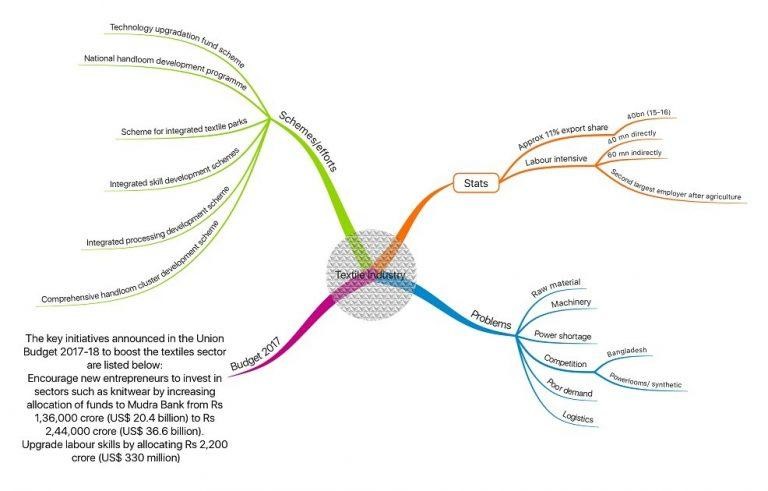
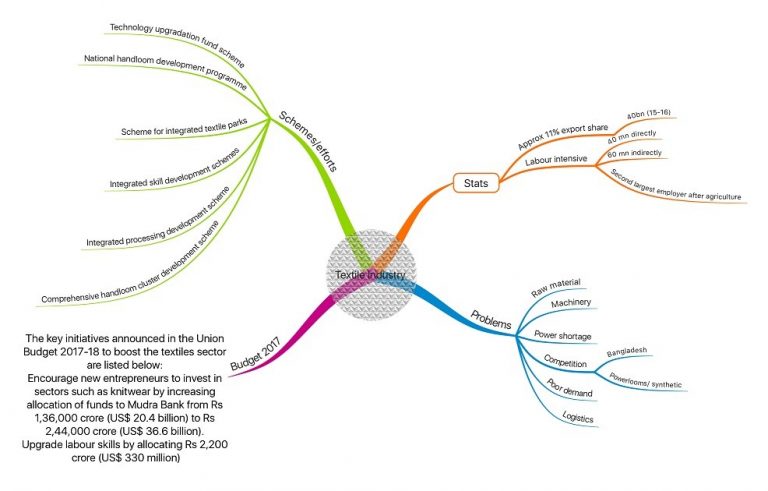
India’s textile sector, covering everything from fibre to garments, has the second-largest employment after agriculture. Textile sector has the potential to double this employment in the next seven years as per the vision document of the union textiles ministry.
Economic survey 2017 had also highlighted the importance of textile sector with regard to generating jobs that are formal and productive, having potential for broader social transformation and generating exports and growth.
It is a sector which not only provides livelihoods to millions of households, but is a storehouse of traditional skills, heritage, and a carrier of heritage and culture too. Artisans, weavers, handloom workers are custodians of designs and skills which they have been inheriting and bequeathing for ages.
This is also a sector which is undergoing a huge churn due to automation, digital printing and the relentless rise of e-commerce. All these three developments threaten to completely change the face of this industry.
Hence the below article assesses what should be India’s strategy to ride this disruptive wave and advocates for the need of national textile policy document, on the same lines of the national telecom policy of 1999, which was a game changer, and led to the upsurge of India’s telecom revolution.
Need for a new National Textile Policy
The last time a clearly discernible, printed and published policy was brought out by the ministry of textiles was 1985.
The 1985 policy was critiqued as a disastrous one as it did not serve the artisan’s agenda. One of the many consequences of the policy was the influx of synthetic garments and saris that may have been convenient to “wash and wear” and the easy transition to power looms that were supplied with synthetic yarn. However, it spelled dark days ahead for weavers used to weaving pure yarns, and worse still for the health of one’s skin in our extremely hot climate.
Since then there has been no well-articulated policy for the entire textile sector that shows the proportion of attention and support given to mill fabrics (both private and national corporations), power looms and handlooms, or the government’s vision towards their balanced development of each.
The world operated under a patently unfair quota system called the Multi Fibre Agreement (MFA), which shackled the growth of India’s textile and garment exports. The MFA was dismantled completely in 2005 and India was supposed to surge ahead. Instead we have lost steam. India’s share of textile exports in total exports, at 12%, is half of what it was in 1996.
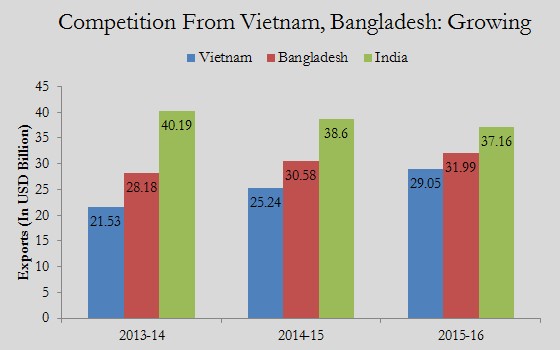
Bangladesh’s garment exports exceeded India’s in absolute terms back in 2003. Today it exports more than $35 billion worth of garments, twice that of India. Even late starter Vietnam overtook India in 2011, and now exports garments worth $32 billion.
Their growth in exports has been at 20% per year, against India’s 8%. In overall textile trade globally, India has a share of merely 5%, against China’s 39%. In the sub-segment of synthetic fibres, India’s share is just 2%, against China’s 66%.
While India has a rich mix of synthetic and natural fibres and yarns, including cotton, jute, silk, polyester and viscose, it remains a cotton-focused country. The presence of cotton in yarn, fibre, fabric and garments is close to 70% of usage within India, which is also reflected in exports. Only 30% is from synthetics and man-made fibres. The global trend is exactly the obverse, i.e. 70% consists of man-made fibres. So India’s domestic and export mix is the opposite of global fashion and demand trends.
The handloom, handicrafts and sericulture sector is largely unorganised and is operated on a small-scale through traditional tools and methods. Some of this is because of the reluctance of the informal sector to step into the limelight of the formal sector with GST.
Therefore, a coherent and holistic national textile policy on the lines of national telecom policy can give a much fillip to Telecom Sector and avoid the risk of losing to countries like Vietnam and Bangladesh.
Textiles, along with agriculture, construction and tourism, has large-scale job creation potential. It is a sector dotted with small and medium enterprises, which make up 80% of the units. It is ideally positioned to be a poster child for Make in India. But it needs a national policy and implementation plan, which can address these challenges: changing consumer and fashion trends, a significant demand for investment and modernization of machinery, massive skill upgradation, meaningful export incentives, a fibre-neutral tax policy, a big digital push in design and automation, and lastly, meeting the needs of the e-commerce phenomenon.
Connecting the dots:
Why textile sector remains an ailing sector in India? Analyse. What measures are required to solve the challenges faced by the sector?