Effect of policies and politics of developed and developing countries on India’s interests
Bilateral, regional and global groupings and agreements involving India and/or affecting India’s interests.
Banning Bottom Trawling: Will it help?
In news:
Sri Lanka’s legislative assembly recently passed an amendment to prohibit bottom trawling. Bottom trawling in the island nation’s territorial waters will now attract a possible two-year prison term and a fine of 50,000 Sri Lankan rupees. The rule is expected to affect a section of fishermen from Tamil Nadu which engages in bottom trawling, a destructive method of fishing.
Towards A Global Ban?
Sri Lanka is not the first country to impose a ban on bottom trawling. The US, EU, Norway, Canada, and Australia have all invoked partial bans, while smaller states like Chile, Palau, and Hong Kong have implemented full bans.
What is bottom trawling?
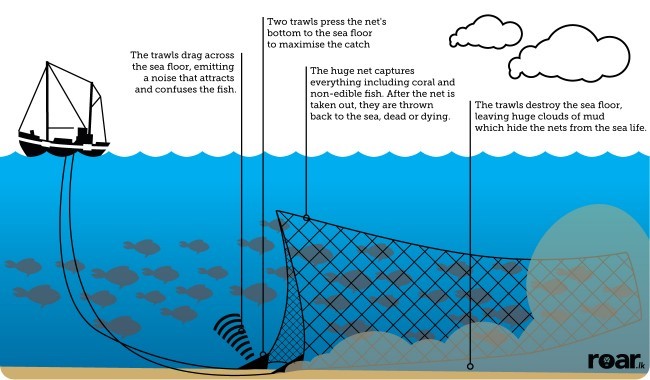
Bottom trawling is trawling (towing a trawl, which is a fishing net) along the sea floor. It is also referred to as “dragging”. It is an industrial fishing method where a large net with heavy weights is dragged across the seafloor, scooping up everything in its path – from the targeted fish to the incidentally caught centuries-old corals.
Bottom trawling is unselective and severely damaging to seafloor ecosystems. The net indiscriminately catches every life and object it encounters. Thus, many creatures end up mistakenly caught and thrown overboard dead or dying, including endangered fish and even vulnerable deep-sea corals which can live for several hundred years.
In addition, the weight and width of a bottom trawl can destroy large areas of seafloor habitats that give marine species food and shelter. Such habitat destructions can leave the marine ecosystem permanently damaged. It is known to cause great depletion of fishery resources, and curbing it is in the interest of sustainable fishing.
In recent years, some fishermen in northern Sri Lanka have also adopted bottom trawling. If this practice continues to gain ground even among local fishermen, the long-term consequences on fishing resources in the contested Palk Bay region will be irremediable.
Issue:
Tamil Nadu fishermen are arrested from time to time by the Sri Lankan Navy, and their vessels seized. If more are arrested and slapped with two-year jail terms after a summary trial, as the law now envisages, it may create new flashpoints.
Fishermen from both countries have been in talks for a long time to resolve the conflict. Sri Lankan fishermen want an immediate end to incursions by Indian trawlers, and those from Tamil Nadu insist on a three-year phase-out period. The proposal to ban bottom trawling is two years old, but the amendment has come at a time when a Joint Working Group set up by both countries last year is in place.
It said the livelihood of families of almost 1800 trawler boat fishermen and their crew who are engaged in trawler fishing in Valvettiturai, Gurunagar and Mannar North have to be safeguarded before implementing the provisions of the Act.
Way forward:
An appropriate response from Tamil Nadu would be to expedite the conversion of its trawlers to deep sea fishing vessels, and not merely condemn Sri Lanka.
Ultimately, the solution lies in the transition from trawling to deep sea fishing, for which a beginning has been made. The Central and State governments plan to provide 500 deep sea fishing boats with long lines and gill nets this year, as part of a plan to replace 2,000 trawlers in three years.
Sri Lanka should be asked to wait for this plan to be fully implemented before enforcing its bottom trawling ban.
There is a glaring need for institutionalisation of fishing in Indian waters by the government of India so that alternative means of livelihood are provided. Government will have to mark up a comprehensive plan to reduce the dependence of Indian fishermen on catch from Palk Bay. Only then will it be possible for Indian fishermen to overcome their natural, and at times desperate, impulse to wander into Sri Lankan waters and carry bottom trawling.
Blue economy is a rather ignored issue in India and that seems to have led to the current crisis. The Ministry of Agriculture and the Department of Ocean Development are the nodal bodies responsible for giving technical assistance to states for the development of fisheries and blue economy.
Both the governments should consult scientific organisations and device fishing methods which will not hurt the fishermen, before imposing a blanket ban on bottom trawling.
A livelihood issue of this nature is better resolved through promotional and developmental measures to introduce alternative modes and technologies, and not through such abrupt bans and punitive measures.
It would be fitting for the government of India to register its strongest disapproval of such move and must organize an effective defense of the rights of our fishermen in the Palk Bay.
Alternate livelihood employment opportunities should be ensured before implementation of the Act and a sufficient period of time should be given to enable these families to acquaint themselves with the alternative opportunities provided.
Conclusion:
Both countries should ensure that the situation does not disrupt regular meetings of the JWG. Besides the fisheries conflict, they need to discuss marine conservation, thus giving equal importance to protecting livelihoods and sustainable fishing.
Connecting the dots:
The Sri Lankan legislative amendment to prohibit bottom trawling will have severe implications on Indian fishermen. Discuss. Also elaborate on how such a prohitbition would be beneficial for both countries in long term.
NATIONAL/SOCIAL ISSUE
TOPIC:
General Studies 1
Population and associated issues, poverty and developmental issues, urbanization, their problems and their remedies.
General Studies 2
Government policies and interventions for development in various sectors and issues arising out of their design and implementation.
Important International institutions, agencies and fora- their structure, mandate.
July 11 has been designated by the United Nations as World Population Day.
The World Population Day was started in 1989 by the then governing council of the United Nations Development Programme after the global population had outgrown the five billion mark on July 11, 1987.
The countries resolved to observe the day in order to spread awareness about the rise in population, family planning, woes of overpopulation and empowerment of people in developing nations through population control.
This year’s theme is “access to family planning“.
Where does India’s population stand?
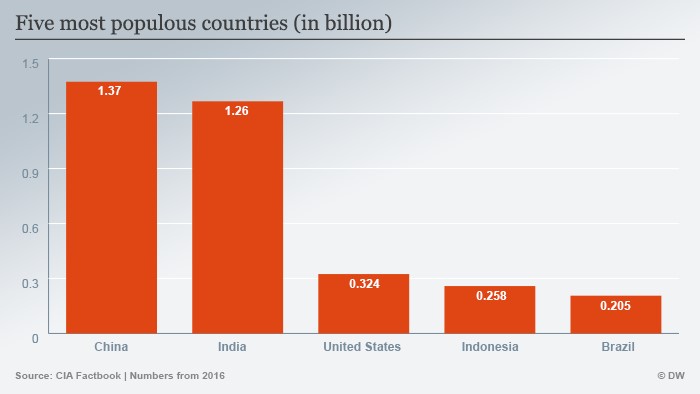
According to the latest data of April 2016 from World Bank, India’s population stands at 1.26 billion. It is only behind China which has a population of 1.37 billion according to the same data.
UN estimates that the second most populous country in the world is set to surpass China as the most populous country by 2024 and the drop in India’s population will only come around 2050.
According to the National Family Health Survey 2017 (NFHS-4), India is expected to reach replacement level fertility (RLL) of 2.1 by 2020.
Note: Replacement Level Fertility (RLL) is the size of the population that replaces a generation to a next generation in order to sustain the population level.
The survey data shows that there has been a drop in the average number of children in each family from 2.7 to 2.2 in the last decade. This seems to be one bright spot.
Around 365 million people in India are in the age bracket of 10-24 years. The NFHS expects this group to be the main driver of the population in coming decades.
Challenges:
The biggest concerns due to fast population growth comes in the matters of employment, education, healthcare and nutrition.
There is already a dearth of employment in the country and though the government is implementing several programs to address the issue, it is undeniable that the employment will need to grow faster.
We have a large number of young people but we do not have the skills or jobs for this to translate linearly into larger economic output.
India is short of specialist medical practitioners by 81 per cent in rural community health centres and the private sector has 63 per cent of the hospital beds in the country, according to a health and family welfare department data.
Any development planning with a time horizon of more than a few years has to factor in the changing size of the base population and, therefore, the changing size of the resources needed to meet the requirements even if the per capita requirements remain unchanged. However, this obvious calculation has not been made.
For example, there is an insane competition for college admissions in our towns and cities. However, the rise in the number of seats has not kept even modest pace with the rise in the number of those finishing secondary school and wanting to go on to college.
Virtually every development sector that requires investments will need a larger amount of such investment in different areas — like clinics, hospital beds, homes, schools, colleges and training institutes, jobs, social security, rural banks, piped water and policemen — as the absolute size of our population increases.
The way ahead:
Family planning: A tangible tool to empower people and enable development
The World Population Day 2017 theme this year is, ‘Family Planning: Empowering People, Developing Nations’.
The theme aims at providing safe, voluntary family planning to the people around the world and in a way, help in curbing the population growth and help maintain the world population.
Access to safe voluntary family planning is a human right. It is also central to gender equality and women’s empowerment, and is a key factor in reducing poverty. Investments in making family planning available also yield economic and other gains that can propel development forward.
Experts and national level social impact organizations, strongly advocates on issues of rights-based family planning, enabling women and men to decide freely the number and spacing of their children without any form of coercion or discrimination.
Empowering women: need of the hour
With 70% of Indian population residing in villages and growing urbanisation, it is imperative that the practice or custom of family planning is embraced by the rural community as well as the urban.
UNFPA studies conducted in more than 40 developing countries show that birth rates fall as women gain equality. In rural areas, education allows women to be in control of their lives not just financially but also reproductively. These women are in a better position to take decisions on when and how many children they desire to have. With female education and family planning, greater prosperity has followed.
Conclusion:
While family planning initiatives have been proactively driven since pre-independence era in India, the brunt of contraception has been traditionally borne by women. Eighty two years after the National Planning Committee was set up, the trends haven’t changed much. According to the latest National Family Health Survey (2015-2016), female sterilisation is still the most preferred mode of contraception (37.3%) and vasectomy ranks the lowest (1.0%), lagging far behind traditional methods, pills and intra-uterine devices. To add to this, India is also plagued with problems such as lack of awareness, familial pressures, and socio-economic and cultural restrictions limiting its family planning initiatives.
Educated women conscious of family planning are, therefore, the fulcrum of an empowered society. Women’s empowerment is indispensable when viewed within the gender equality paradigm. Although Indian family planning programmes provide contraceptive choices to both men and women, societal norms have ensured that the onus remains on the latter. Efforts need to be made to facilitate male engagement in promoting family planning and reproductive health, while encouraging them to be supportive partners of women’s reproductive health decisions.
Connecting the dots:
Family planning is critical for our nation’s economic development, and is a big first step towards growth, equality and sustainable development that opens the door to opportunity and prosperity for women and families everywhere. Elucidate.