For Previous Daily Quiz (ARCHIVES) – CLICK HERE
The Current Affairs questions are based on sources like ‘The Hindu’, ‘Indian Express’ and ‘PIB’, which are very important sources for UPSC Prelims Exam. The questions are focused on both the concepts and facts. The topics covered here are generally different from what is being covered under ‘Daily Current Affairs/Daily News Analysis (DNA) and Daily Static Quiz’ to avoid duplication. The questions would be published from Monday to Saturday before 2 PM. One should not spend more than 10 minutes on this initiative.
Gear up and Make the Best Use of this initiative.
Do remember that, “the difference between Ordinary and EXTRA-Ordinary is PRACTICE!!”
0 of 5 questions completed
Questions:
To view Solutions, follow these instructions:
You have already completed the test before. Hence you can not start it again.
Test is loading...
You must sign in or sign up to start the test.
You have to finish following test, to start this test:
0 of 5 questions answered correctly
Your time:
Time has elapsed
You have scored 0 points out of 0 points, (0)
| Average score |
|
| Your score |
|
| Pos. | Name | Entered on | Points | Result |
|---|---|---|---|---|
| Table is loading | ||||
| No data available | ||||
Consider the following statements about Small Industries Development Bank of India (SIDBI)
Choose the correct statements:
Solution (c)
Statement Analysis
| Statement 1 | Statement 2 |
| Correct | Correct |
| Small Industries Development Bank of India (SIDBI):
· It was set up on 2nd April, 1990, under an Act of the Indian Parliament. · It is under the jurisdiction of the Ministry of Finance, GoI. · It was incorporated in initially as a wholly owned subsidiary of the Industrial Development Bank of India (IDBI). · Currently the shares of SIDBI are held by the Government of India (GoI) and 22 other institutions/PSBs/insurance companies owned or controlled by the Central Government. · Headquarters: Lucknow, Uttar Pradesh |
· Purpose: To act as the principal financial institution for promotion, financing, and development of the Micro, Small and Medium Enterprise (MSME) sector, as well as for the co-ordination of functions of institutions engaged in similar activities.
· SIDBI helps MSMEs in acquiring the funds they require to grow, market, develop, and commercialize their technologies and innovative products. · The bank provides several schemes and also offers financial services and products to meet individual requirements of various businesses. · Financial support to MSMEs is provided by way of · Indirect/refinance to banks/Financial Institutions for onward lending to MSMEs · Direct finance in niche are as like risk capital, sustainable finance, receivable financing, service sector financing, etc. |
Context: Airbus Helicopters and the Small Industries Development Bank of India (SIDBI) recently signed a Memorandum of Understanding (MoU) for financing the purchase of Airbus’ helicopters in India.
Solution (c)
Statement Analysis
| Statement 1 | Statement 2 |
| Correct | Correct |
| Small Industries Development Bank of India (SIDBI):
· It was set up on 2nd April, 1990, under an Act of the Indian Parliament. · It is under the jurisdiction of the Ministry of Finance, GoI. · It was incorporated in initially as a wholly owned subsidiary of the Industrial Development Bank of India (IDBI). · Currently the shares of SIDBI are held by the Government of India (GoI) and 22 other institutions/PSBs/insurance companies owned or controlled by the Central Government. · Headquarters: Lucknow, Uttar Pradesh |
· Purpose: To act as the principal financial institution for promotion, financing, and development of the Micro, Small and Medium Enterprise (MSME) sector, as well as for the co-ordination of functions of institutions engaged in similar activities.
· SIDBI helps MSMEs in acquiring the funds they require to grow, market, develop, and commercialize their technologies and innovative products. · The bank provides several schemes and also offers financial services and products to meet individual requirements of various businesses. · Financial support to MSMEs is provided by way of · Indirect/refinance to banks/Financial Institutions for onward lending to MSMEs · Direct finance in niche are as like risk capital, sustainable finance, receivable financing, service sector financing, etc. |
Context: Airbus Helicopters and the Small Industries Development Bank of India (SIDBI) recently signed a Memorandum of Understanding (MoU) for financing the purchase of Airbus’ helicopters in India.
Arrange the following Islands of South China Sea from South to North
Choose the correct code:
Solution (d)
| Option d |
| Correct |
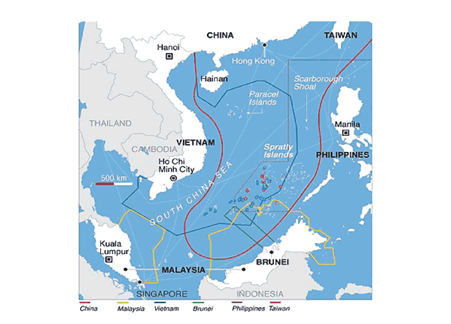
Scarborough Shoal: · The Scarborough Shoal (also known in English as the Scarborough Reef) is a series of small rocks and islands which are formed into a triangle shape in the South China Sea, located some 220 kilometers from the Philippines. · The largest island features a lagoon and is around sixty square miles in area, while many of the rocks are so small they protrude only a metre or so from the sea at low tide and are completely submerged when the tide is high. · The deep waters around the shoal make it a productive fishing area, rich in marine life, and the lagoon also contains many commercially valuable shellfish and sea cucumbers. · The shoal is the source of an ongoing and, so far, unresolved dispute between the People’s Republic of Chinaand the Philippines, with both countries claiming that the shoal lies within their territory and saying they have exclusive rights to access its waters. · There are no structures built on Scarborough Shoal, but the feature is effectively controlled by China, which has maintained a constant coast guard presence at the feature since 2012. · China, which now refers to the shoal as Huangyan Island, makes a historical claim to the area, stating that they can trace their ownership of the area back to the Yuan Dynasty of the 1200s. · The Philippines claim the area on the basis of geography, as it is much closer to the Philippines’ main island of Luzon, which contains the capital, Manila, but lies over 500 miles from China. |
Context: The Philippines recently challenged China to open Scarborough Shoal to international scrutiny after it accused Beijing of destroying the shoal’s marine environment.
Solution (d)
| Option d |
| Correct |
|
Scarborough Shoal: · The Scarborough Shoal (also known in English as the Scarborough Reef) is a series of small rocks and islands which are formed into a triangle shape in the South China Sea, located some 220 kilometers from the Philippines. · The largest island features a lagoon and is around sixty square miles in area, while many of the rocks are so small they protrude only a metre or so from the sea at low tide and are completely submerged when the tide is high. · The deep waters around the shoal make it a productive fishing area, rich in marine life, and the lagoon also contains many commercially valuable shellfish and sea cucumbers. · The shoal is the source of an ongoing and, so far, unresolved dispute between the People’s Republic of Chinaand the Philippines, with both countries claiming that the shoal lies within their territory and saying they have exclusive rights to access its waters. · There are no structures built on Scarborough Shoal, but the feature is effectively controlled by China, which has maintained a constant coast guard presence at the feature since 2012. · China, which now refers to the shoal as Huangyan Island, makes a historical claim to the area, stating that they can trace their ownership of the area back to the Yuan Dynasty of the 1200s. · The Philippines claim the area on the basis of geography, as it is much closer to the Philippines’ main island of Luzon, which contains the capital, Manila, but lies over 500 miles from China. |
Context: The Philippines recently challenged China to open Scarborough Shoal to international scrutiny after it accused Beijing of destroying the shoal’s marine environment.
Consider the following statements Global Alliance of National Human Rights Institutions (GANHRI)
How many of the statements given above are correct?
Solution (b)
Statement Analysis
| Statement 1 | Statement 2 | Statement 3 |
| Correct | Correct | Incorrect |
| · GANHRI represents about 120 national human rights institutions across the world.
· It is responsible for reviewing and accrediting these institutions in compliance with the Paris Principles every five years. · It is recognised and a trusted partner of the United Nations. · Paris Principles – It was formally known as Principles Relating to the Status of National Human Rights Institutions and was adopted by the UN General Assembly on December 20, 1993. · It sets out minimum standards that NHRIs must meet in order to be considered credible and to operate effectively. |
· GANHRI acts through its Subcommittee on Accreditation (SCA), which categorises member NHRIs into two groups, ‘A’ and ‘B.
· General Assembly – It is GANHRI’s supreme deliberative body. · It adopts and reviews the program of activities and is responsible for electing the governance bodies and monitoring the activities of the GANHRI Bureau. · Sub-Committee on Accreditation – The Sub-Committee on Accreditation (SCA) is the body responsible for making recommendations on accreditation under the auspices of Office of the United Nations High Commissioner for Human Rights (OHCHR). |
· ‘A’ rank indicate full compliance with the Paris Principles and rank ‘B’ indicate partial compliance with the Paris Principles.
· Rank ‘A’ – NHRIs with rank ‘A’ status can participate in the UN Human Rights Council, its subsidiary bodies, and some UNGA bodies and mechanisms. · They are also eligible for full membership of GANHRI, which includes the right to vote and hold governance positions. · Rank ‘B’ – NHRIs accredited with rank ‘B’ status can participate in GANHRI meetings, but cannot vote nor hold governance positions. · Currently India holds rank ‘A’ status. |
Context: It was in news.
Solution (b)
Statement Analysis
| Statement 1 | Statement 2 | Statement 3 |
| Correct | Correct | Incorrect |
| · GANHRI represents about 120 national human rights institutions across the world.
· It is responsible for reviewing and accrediting these institutions in compliance with the Paris Principles every five years. · It is recognised and a trusted partner of the United Nations. · Paris Principles – It was formally known as Principles Relating to the Status of National Human Rights Institutions and was adopted by the UN General Assembly on December 20, 1993. · It sets out minimum standards that NHRIs must meet in order to be considered credible and to operate effectively. |
· GANHRI acts through its Subcommittee on Accreditation (SCA), which categorises member NHRIs into two groups, ‘A’ and ‘B.
· General Assembly – It is GANHRI’s supreme deliberative body. · It adopts and reviews the program of activities and is responsible for electing the governance bodies and monitoring the activities of the GANHRI Bureau. · Sub-Committee on Accreditation – The Sub-Committee on Accreditation (SCA) is the body responsible for making recommendations on accreditation under the auspices of Office of the United Nations High Commissioner for Human Rights (OHCHR). |
· ‘A’ rank indicate full compliance with the Paris Principles and rank ‘B’ indicate partial compliance with the Paris Principles.
· Rank ‘A’ – NHRIs with rank ‘A’ status can participate in the UN Human Rights Council, its subsidiary bodies, and some UNGA bodies and mechanisms. · They are also eligible for full membership of GANHRI, which includes the right to vote and hold governance positions. · Rank ‘B’ – NHRIs accredited with rank ‘B’ status can participate in GANHRI meetings, but cannot vote nor hold governance positions. · Currently India holds rank ‘A’ status. |
Context: It was in news.
Consider the following statements:
Statement I – Sub-orbital trips refer to space flights that cross the geocorona.
Statement II – Geocorona is the farthest reaches of Earth’s atmosphere.
Select the correct answer using the codes given below:
Solution (d)
| Option d |
| Correct |
| · Sub-orbital trips refer to space flights that cross the Karman line (100 km altitude from Earth’s surface).
· These trips provide a brief experience of weightlessness and a view of the Earth from space but last only about 10-15 minutes from take-off to landing. · Private space companies like Blue Origin, Virgin Galactic, SpaceX, and others are offering sub-orbital space tourism flights to interested individuals. · The sub-orbital flights are currently the most accessible form of space tourism, as orbital trips and journeys to the International Space Station (ISS) or beyond are significantly more expensive. · Space tourism is currently accessible only to the ultra-wealthy, but the market is expected to grow rapidly as more private players enter the industry. · Karman line is an imaginary line that scientists use to define the border between outer space and the Earth’s atmosphere. · Anything past the Karman line is not subject to control by countries like their airspace. · Anything flying below Karman line is called an aircraft while those crossing this line get classified as a spacecraft. · The farthest reaches of Earth’s atmosphere is a cloud of hydrogen atoms called the geocorona. |
Context: An Indian entrepreneur, Satish Thotakura, recently became the first Indian to take a sub-orbital trip aboard Blue Origin’s spacecraft.
Solution (d)
| Option d |
| Correct |
| · Sub-orbital trips refer to space flights that cross the Karman line (100 km altitude from Earth’s surface).
· These trips provide a brief experience of weightlessness and a view of the Earth from space but last only about 10-15 minutes from take-off to landing. · Private space companies like Blue Origin, Virgin Galactic, SpaceX, and others are offering sub-orbital space tourism flights to interested individuals. · The sub-orbital flights are currently the most accessible form of space tourism, as orbital trips and journeys to the International Space Station (ISS) or beyond are significantly more expensive. · Space tourism is currently accessible only to the ultra-wealthy, but the market is expected to grow rapidly as more private players enter the industry. · Karman line is an imaginary line that scientists use to define the border between outer space and the Earth’s atmosphere. · Anything past the Karman line is not subject to control by countries like their airspace. · Anything flying below Karman line is called an aircraft while those crossing this line get classified as a spacecraft. · The farthest reaches of Earth’s atmosphere is a cloud of hydrogen atoms called the geocorona. |
Context: An Indian entrepreneur, Satish Thotakura, recently became the first Indian to take a sub-orbital trip aboard Blue Origin’s spacecraft.
A new plant species named Phtheirospermum lushaiorum has been discovered in the dense forests near Phawngpui National Park by researchers from the Botanical Survey of India. It is named ‘lushaiorum’ after the Lushai tribe, honoring their biodiversity conservation efforts. Lushai tribe belong to which of the following Indian state/UT?
Solution (a)
| Option a |
| Correct |
| · A new plant species named Phtheirospermum lushaiorum has been discovered in the dense forests near Phawngpui National Park in Mizoram by researchers from the Botanical Survey of India.
· It is a rare terrestrial hemi-parasitic plant. · Hemi-parasitic plants lack fully developed roots and obtain water/minerals from host plants via historical connections, while also performing photosynthesis. · This hemi-parasitic species faces threats due to anthropogenic activities like trekking and leaf litter collection by local villagers in the Phawngpui area. · It is named ‘lushaiorum’ after the Lushai tribe of Mizoram, honoring their biodiversity conservation efforts. · Lushai tribe – Lushai is another tribe under Kuki-chin group of tribes. · Their main concentration is under Kanchanpur Sub-Division of North Tripura District and also found in Mizoram. · Lushai’s are commonly known as Mizos. · Racially they are known to be under Mongoliod origin. · Lushai live on Jhum Cultivation and hunting of wild animal. · They eat meat of any kind of animals and birds. · They are also famous as orange producing community. · Their Cheraw Dance (Bamboo Dance) is very much popular in and outside the country. |
Context: Recently a New hemiparasite plant species named after Lushai tribe of Mizoram.
Solution (a)
| Option a |
| Correct |
| · A new plant species named Phtheirospermum lushaiorum has been discovered in the dense forests near Phawngpui National Park in Mizoram by researchers from the Botanical Survey of India.
· It is a rare terrestrial hemi-parasitic plant. · Hemi-parasitic plants lack fully developed roots and obtain water/minerals from host plants via historical connections, while also performing photosynthesis. · This hemi-parasitic species faces threats due to anthropogenic activities like trekking and leaf litter collection by local villagers in the Phawngpui area. · It is named ‘lushaiorum’ after the Lushai tribe of Mizoram, honoring their biodiversity conservation efforts. · Lushai tribe – Lushai is another tribe under Kuki-chin group of tribes. · Their main concentration is under Kanchanpur Sub-Division of North Tripura District and also found in Mizoram. · Lushai’s are commonly known as Mizos. · Racially they are known to be under Mongoliod origin. · Lushai live on Jhum Cultivation and hunting of wild animal. · They eat meat of any kind of animals and birds. · They are also famous as orange producing community. · Their Cheraw Dance (Bamboo Dance) is very much popular in and outside the country. |
Context: Recently a New hemiparasite plant species named after Lushai tribe of Mizoram.