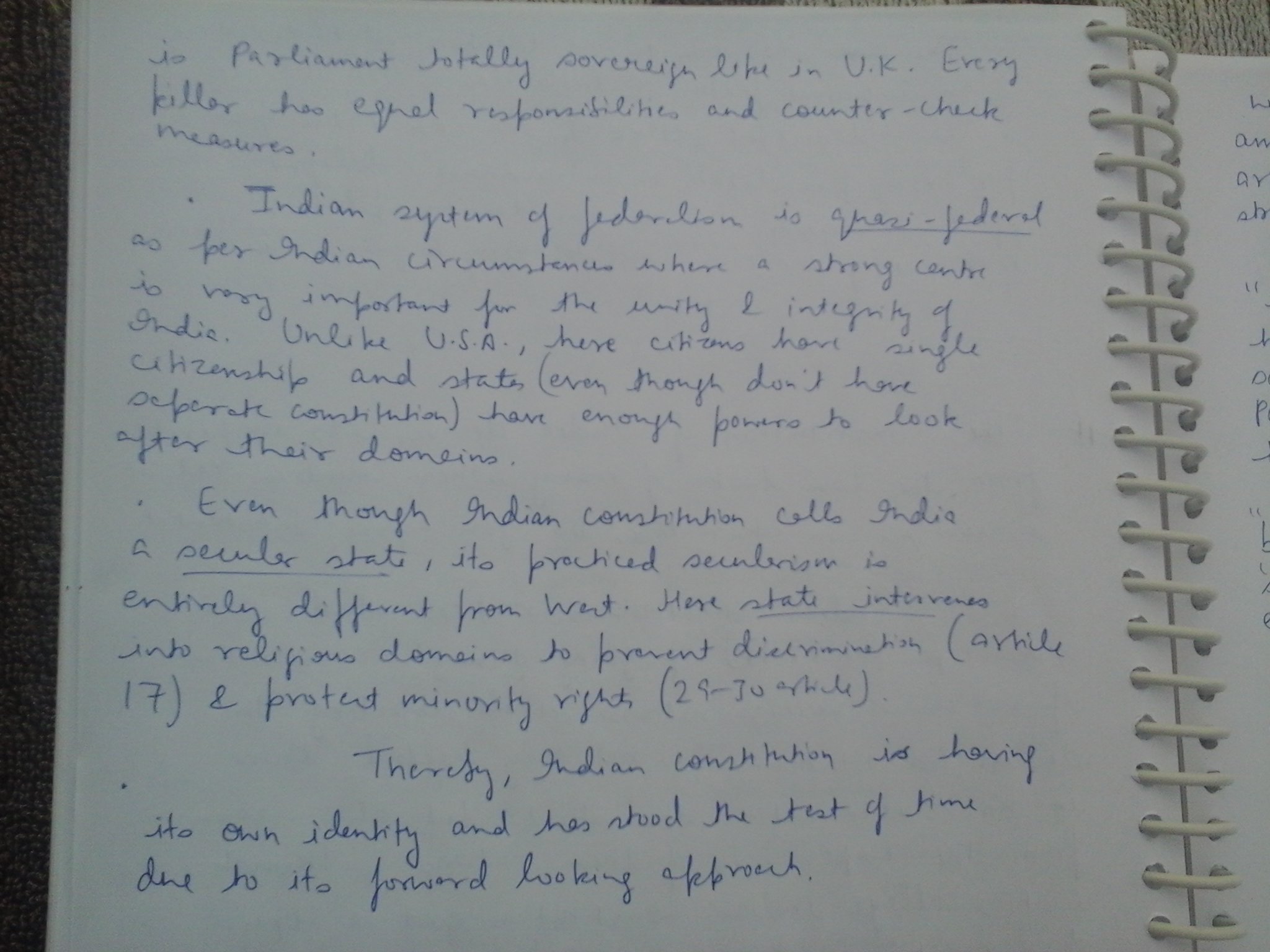
1. The Constitution of India derives its inspiration from the law books of many other countries. Yet it is unique in character. Do you agree? Substantiate.
Since the question mentions about inspiration from other Law books, in the introduction a stray mention can be there about what we have adopted from other constitutions. Like Federal Structure with Unitary tilt (Canada), Fundamental Rights (America), Emergency Provisions (Weimar German Constitution), DPSPs etc.
The mains focus has to be on the Uniqueness of the Indian Constitution. Many of you have covered good points.
More points can be mentioned according to the world limit.
Best Answer 1: Mukesh-Max
http://a.disquscdn.com/uploads/mediaembed/images/4274/4293/original.jpg
http://a.disquscdn.com/uploads/mediaembed/images/4274/4292/original.jpg
Best Answer 2: Dharavi Writer
http://a.disquscdn.com/uploads/mediaembed/images/4274/5360/original.jpg
http://a.disquscdn.com/uploads/mediaembed/images/4274/5361/original.jpg
Best Answer 3: Shernizaad
http://a.disquscdn.com/uploads/mediaembed/images/4274/3241/original.jpg
2. Critically examine the evolution of the ‘basic structure’ doctrine and the role of judiciary in it.
Note: The following content should be definitely present in your answer for scoring better marks.
The court propounded what has come to be known as “the basic structure” doctrine. Any part of the Constitution may be amended by following the procedure prescribed in Article 368. But no part may be so amended as to “alter the basic structure” of the Constitution. It is unamendable.
Role of judiciary:
Ever since the Supreme Court has been the interpreter of the Constitution and the arbiter of all amendments made by parliament.
The court by majority overruled the Golak Nath case which denied parliament the power to amend fundamental rights of the citizens.
The Supreme Court declared that Article 368 did not enable Parliament to alter the basic structure or framework of the Constitution and parliament could not use its amending powers under Article368 to ‘damage’, ’emasculate’, ‘destroy’, ‘abrogate’, ‘change’ or ‘alter’ the ‘basic structure’ or framework of the constitution. This decision is not just a landmark in the evolution of constitutional law, but a turning point in constitutional history.
Through the concept of basic structure the Supreme Court has upheld:
So for the protection of welfare state, fundamental rights, Unity and integrity of the nation, Sovereign democratic republic and for Liberty of thought, expression, belief, faith and worship, interpretation of judiciary is mandatory. We can say none is above constitution even parliament and judiciary.
Best answer: Credible Hulk
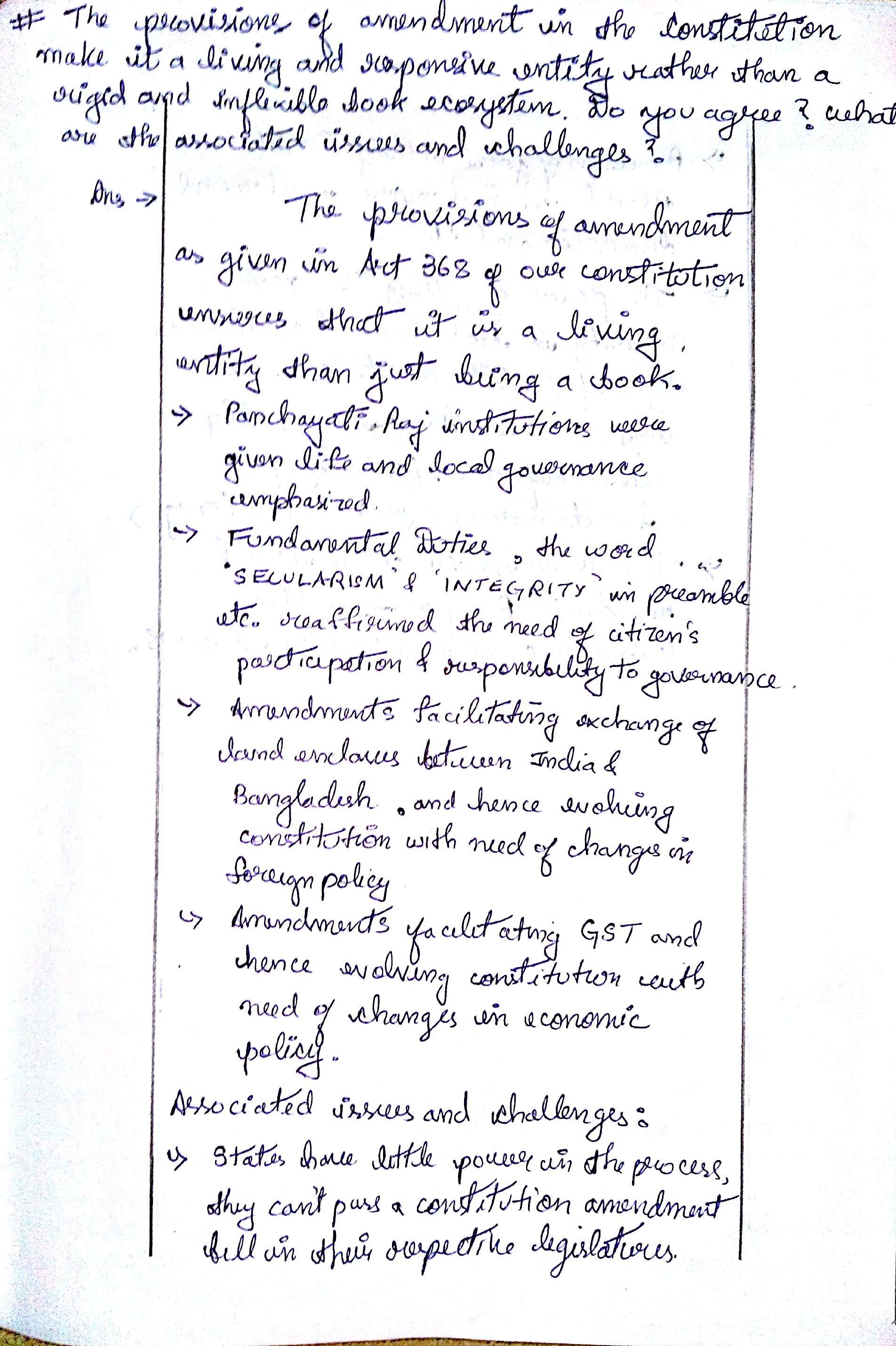
3. The provisions of amendment in the Constitution make it a living and responsive entity rather than a rigid and inflexible book of law. Do you agree? Critically examine.
Introduction
Your introduction should highlight that how and why our constitution makers opted for a living constitution and also mention the drawbacks of rigid constitution in brief.
Body: –
(You can add more points here)
Conclusion
You should conclude it by saying that any modern democratic nation need to have a flexible constitution which can sustain the democratic ethos/values while also accommodating the aspirations of its people
Best answer1: -iasnoob
http://a.disquscdn.com/uploads/mediaembed/images/4274/1646/original.jpg
http://a.disquscdn.com/uploads/mediaembed/images/4274/1647/original.jpg
Best Answer2: -SherniZaad
http://a.disquscdn.com/uploads/mediaembed/images/4274/3302/original.jpg
http://a.disquscdn.com/uploads/mediaembed/images/4274/3303/original.jpg
Best Answer3: -Madster
The makers of the Constitution tried to add all those provisions which they thought would satisfy the pressing needs of the population. However, there were certain provisions which required a mature democracy to be implemented eg. a 3 tier government would devolve powers to the masses however considering the conditions prevailing in rural villages like discrimination, poverty, illiteracy, it was preferable not to give them powers without making them capable of handling it efficiently. Therefore the makers added a provision of Constitutional Amendment under article 368 which enabled the parliament to make suitable changes to the constitution in accordance to the needs of the changing times and as the situation demands ,with the approval of the states. Thus when the rural and urban local bodies was considered suitable for handling the powers ,73rd and 74th amendment were made to devolve the powers to local bodies
However there are some issues and challenges being faced
However these challenges are providing the necessary safeguards to the constitution which is a living and responsive entity
4. Frequent terrorist attacks on civilians and army establishments have exposed the weakness of India’s intelligence gathering apparatus. Examine. Also suggest the measures to develop a robust intelligence framework in India.
Introduction:
The recent attack on an Army Base camp in Uri, which led to the death of 18 soldiers of the Indian Army, exposes the weakness and lapses of India’s intelligence gathering agencies.
Earlier incidents like the Pathankot, Boudh gaya, even kargil war could have been averted if we had strong intelligence inputs.
Body:
Major causes the lapses:
Lack of co-ordination between different intelligence agencies which leads to not only delay in intelligence gathering but also in taking action on that intelligence
Much needed institutions like the NATGRID and NCTC have not been taking shape at the required speed which causes scattering and isolation of valuable data.
The state police forces have been slow on taking action on the intelligence input, this is because of shortage of manpower and sometimes due to pure apathy.
Write a brief conclusion
Best answer: Vengeance
Gurdaspur, Pathankot, and recently Uri became targets of terrorist attacks killing Indian soldiers & disrupting Indian intelligence strategies.
Fault lines have come up to surface as:
Measures to develop robust intelligence framework:
Indian Intelligence has been vulnerable, from various dimensions including cyberspace to territorial integrity. July, 2016 finally saw appointment of NATGRID chief after years of delay which is an active step in strengthening intelligence infrastructure
5. Having the infrastructure and systems in place is no guarantee of public policy success. Do you agree? Substantiate by taking at least two examples, one from financial inclusion schemes and other from the health sector.
Introduction:
Your introduction should outline the ingredients of a good public policy. Also mention how and why focusing on only one or two aspects out of them cannot lead to successful policy.
Mention the factors apart from infrastructure and systems, which are needed for public policy success.
Body
Conclusion
Your conclusion should say that a successful policy need participation from all the stakeholders and it should be designed to include all. Mere focus on Infrastructure or/ and system will not lead to successful implementation always.
Best answer1: – Mukesh_MAX
http://a.disquscdn.com/uploads/mediaembed/images/4274/4383/original.jpg
http://a.disquscdn.com/uploads/mediaembed/images/4274/4385/original.jpg
Best answer2: -SherniZaad
http://a.disquscdn.com/uploads/mediaembed/images/4274/3689/original.jpg
http://a.disquscdn.com/uploads/mediaembed/images/4274/3690/original.jpg
Best answer3: -iasnoob
http://a.disquscdn.com/uploads/mediaembed/images/4274/1819/original.jpg
http://a.disquscdn.com/uploads/mediaembed/images/4274/1820/original.jpg
Best answer4: – TheCredibleHulk
https://uploads.disquscdn.com/images/c107ab3a24ef3bc1807ca390cc56cf1cc1181fa38cf0ebf3e0e971be6e1679bc.jpg