Dear friends,
We are thankful to you for your overwhelming response for our offline initiative.
After we announced about offline program on 18th June (our 1st anniversary), we received more than 540 mails asking about the details and registration procedure.
Finally the wait is over as we have launched the registration link on our site for our complete Fully Integrated Module for Prelims-Mains- Interview offline program for 2017.
You can find the link here: Click here
Interested candidates can fill the registration form. Program will start from the first week of September.
It will be a 10 month long program with 6 months of classroom till February. It will followed by a 15 day knowledge enhancing Module for Prelims 2017 in the Month of May.
The pricing has been done based on various factors and are priced to the minimum possible level for it to remain inclusive, in this era of commercialization.
The details will be communicated in the mail we send with the invites.
The classes will be conducted on the similar lines as that of the ones being conducted in our premier institutes like IITs and IIMs. The pedagogy will include an amalgamation of pre-reads, case studies, in house quizzes, interactive teaching discussions and debates.
We would like to remind you that there are only limited seats as we emphasize more on quality and not on quantity. So register soon.
And at this point of time we have more than 1200 registrations.Many have mailed us emotionally saying that we are baba’s followers from day one and should be given preference.
Very tough job, considering the fact that we believe in personalized interaction which is difficult to implement, if the numbers exceed the minimum criteria of 200. Having said that, we will surely reconsider it on the basis of genuine demand for the program from your end.
What would be the criteria for admission ? Conducting a test is not the criteria that we are in favor of. Hence, we have decided to include a state-wise representation for our program so that a balance is created and word-of-mouth for our efforts are ensured (Just like the workshops 🙂 )
We will send out select invites for our Integrated Prelim-Main-Interview classes from 20th of July.
Details and registration form for Mains offline program for 2016 will be launched soon.
Aspirants for 2017:
Fill this link– Click
Wait till 20th July for first round of invites. The invites will go on till August 20th.
This will not be first cum first serve basis. We know that a major chunk of crowd would want to wait till Aug 7. Hence the invites till 20th July will be very minimal.
Full Details of the Program (Module) for 2017 Offline will be posted at around 10th of August.
Aspirants for 2016:
Wait for our write-up/Post on 10th August 🙂
We are incorporating a new Model based on the feedback that we’ve received – Special Integrated Test Series and Classroom Model for 2016 Mains Offline.
We would like to consider some candidates who have already written mains for this program.Why?
This Program is not a typical Test Series but will be based on quality enhancement.
Nearly 23 candidates with ranks plus same number of people with interview experience will be attending this program.
This will be unique and outcome based classroom cum activities program (classes will be taken by UPSC Rank holders including senior IAS officers ).
We would want the cohort group to be similar. Hence this decision.
For people who are writing prelims for the first time. Check whether you are clearing prelims and get back to us on Aug 8-10.
With these caveats you can register on the link for 2016 which will be activated on July 18.
Online ILP – 2017
Our ILP 2016 was the largest comprehensive online program for 2016. After having learned from our experiences and feedback by our fellow aspirants, we are devising a much targetted program for the benefits of our 2017 aspirants
Please read the feedback for 2016 here: Click
We have loads of inquiries regarding our Online 2017 Program. We promise to put our best efforts at the right time. Hence, it’s a request from our end to please not get impatient while contemplating on your journey with us 🙂
We are keen to introduce our 2017 Plan and we are sure that it will turn out to be a game-changer in the landscape of CSE preparation.
Full Details of the Program (Module) for 2017 Online will be posted in the second week of August.
P.S– Many of you have visited our Office (Center). All of you are welcome to come and meet us personally and make an informed decision best suited for your needs 🙂
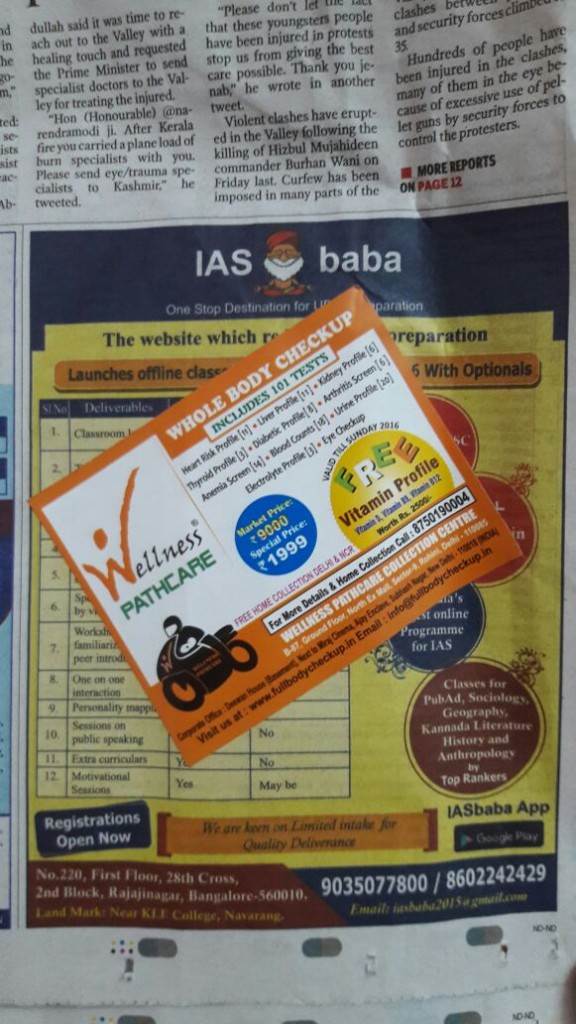
P.P.S– See how ‘Photobombing is done’. It is in Today’s The Hindu Delhi Edition- Done in Mukherjeenagar 😛