If IASbaba has tried to offer you 100% in past SEVEN months through its initiatives, but the question is, how much have you actually taken? A Sufi mystic used to say that most people are misers more in taking than in giving.
Friends, this exam appears to be an insurmountable mountain not by chance but by its design. You are aspiring to be the one running the largest democracy of the world. Mammoth! Where things go wrong every day! If you don’t believe us? Just scan the headlines of any day’s THE HINDU cover to cover and you will believe. This exam is to test the shear grit if you are capable enough for the job or not. How? By simply simulating the real thing .Thrown at you is a vast syllabus and then you are expected to understand, internalize and provide viable solutions to varied problems crisscrossing the country.
Running this country requires nerves of steel and so does this exam! You all believe that you will wake up one fine day and finish the syllabus first by a deadline. Then you will do all the answer writing by a second deadline then revision by another. Then more answer writing and … well wake up!
Many of you must have lined in front of the coaching factories, charging exorbitant amount, just to get that perfect guidance. But most of the time the returns are negligible as compared to the inputs.
Don’t you all think, that’s where IASbaba has changed the game for you and offered you a way out?
TLP is absolutely free for everyone: this is a platform where you can hone your writing skill with individual attention, reviews and guidance.
The feedbacks are to the point and target the exact problem of the aspirants.
What drives us to do this? We still see people posting in comments, how we are falling short on many fronts, etc. We assure you that we take this criticism very seriously and constantly try to evolve and improve.
We want our users to connect deeply with us and share a bond with IASbaba and with each other.
The simple aim is to improve your answer writing using TLP. As each one of you knows it is the single most important skill to be developed for mains. We have reviewed many answers on IASbaba where some people have used very limited knowledge to come up with 7/10 answers, just by the sheer skill of their presentation. No matter how much knowledge you attain before your exam, it will be of no use if you are unable to express it properly and according to the demand of the question. After all you are awarded marks for what and how you write and not by a brain mapping of how much you know. So this is what we suggest :
Accountability
All those are doing well with TLP, please continue with your plans of course. All those who are struggling, please sit and introspect where you are going wrong. We suggest that you become accountable to yourself. Decide how many questions you are going to attempt every day, no matter what and ideally try to answer all. Mention the date and the number of questions you are going to attempt in the comments below. And try to stick to your promise.
Maintainability
Once you have defined your goals here, each one of you can pick one other participant, to keep a check if he/she is meeting his/her goals . Just one for everybody and that should be a zero sum game. You will all be tracked by one person and in return for the service will track another (not the same person you are being tracked by). Please reply to the person you are tracking in the comments box, so that the same person is not picked more than once. The idea is not to pester each other but to just have that feeling inside of being watched and feeling accountable; just a tool to push yourself a bit harder and to get out of your comfort zones.
If by any chance or reason you feel you can’t meet your minimum goal on a certain day, just write in that day’s TLP comments that you are going to miss your goal for today and your reasons in brief (let’s not tell stories) . Again this will act as a check on you. Also track the disqus profile of the member you have chosen everyday to see if he/she has met the goals for the day; if not, has he/she mentioned why he/she has missed the target. If not, just send a soft reminder (or a hard one if you like ;))
Every day, let’s try to write all the questions (or at least your stated minimum target). If cannot then make a note of the missed questions and write it some other day when you can.
Feedback
We saw on previous TLP that many people had no feedbacks from other members. Some members even had to ask others to review their posts. Friends, don’t be so selfish that you take all the feedbacks you can get, and give none in return?
We think giving feedbacks is one of the best ways to learn. Even if you think that you don’t posses the complete information about a question, then also you can comment on the style of writing, sentence formation or some point which you know. Please don’t feel that you are not capable enough to give feedbacks. Nobody is that “bechara” out here.
Yes, it is a time consuming process. But it’s rewarding in terms of picking up some good traits from others and pointing out some general errors which others are making so that you don’t repeat the same on your answers. So please let’s get out of this “banta apna kaam, bolo ram ram” attitude. 🙂
Just in case if by any chance your answer is missed by us, then you can request some of your peers to review it for you. Later, you can read the synopsis of the answer given to you by IASbaba Team and that would be the proverbial icing on the cake!
Summary
It may sound complicated to some. But it’s not. See, all those who are doing well need not participate. All those who are “tourists” here, can come and go. But all others who feel that this site is an integral part of their lives and feel the need for a little external push to make them perform just have to do the following:
State your goals in the comment box. Pick up a person you want to track from the comments and reply to him/her. You are set!
Every day, try to answer all the questions and if not, meet your minimum goals. Then give at least one feedback for every answer you have written. At the end of the day, just check once on the person you are tracking that’s it!
“Write, Review, Track”. You can even give it an acronym: The WRiTe Plan
Suggestions for you!
Many of you complain about inability to attempt TLP HOT questions. You know, reason is not your inability but the way of preparation! How?
You are a wandering soul (Not that Vietnam Operation :P). You seem so busy in doing this all the time.
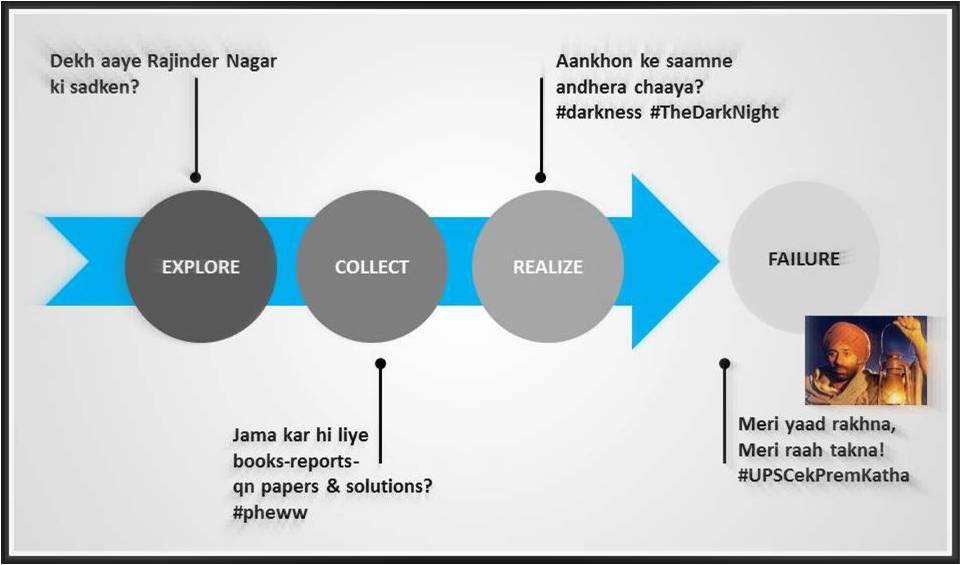
The process of Exploration, Collection and in the end Realization is the life story of many of you.
Do not try to invest more time on TLP questions. If you look at the questions, it is nothing but a past current issue in the form of question. All of you have prepared past current affairs and would surely have made enough of notes. But why are you failing to answer the questions based on issues that you have already prepared? We are sure many of you already have bunch of notes!
What’s lacking then?
This also proves that the way you prepare current affairs needs an amendment. Reality is, when you sit for Mains, all the questions will be new and you need to write 20/25 answers in 3 hours. Will you have enough time to go through links and references then?
How will you cope up?
That is the reason we force everyone to work on the “THOUGHT PROCESS”. It may be that many of you are unable to write very good answers right now but you surely will improve.
Try to develop uniqueness in your thought process. Let your mind work in generating the points. Jot them down and you will surely produce decent content yourself. Rather than trying to write a beautiful introduction and conclusion, work on content, deciphering the question and understand the issue. This is an evolutionary process. Nobody can become a good writer overnight. A good writer is one, who can express the story in a convincing manner. And this requires constant practice.
If filling the space of answer sheets with mere words was required then it would have been a cake walk for all!
Every day we post THREE questions on TLP. Take a chart paper and cut it to 8 parts. In a month, you will have around 75 such questions/issues.
Make a Mind Map around every issue in the form of Flash Card (using chart paper) like this
The ongoing discourse on food and faith has more to do with personal sensitivity than religion. Unfortunately the debate over food has been given a communal colour which is against India’s secular credentials. Examine
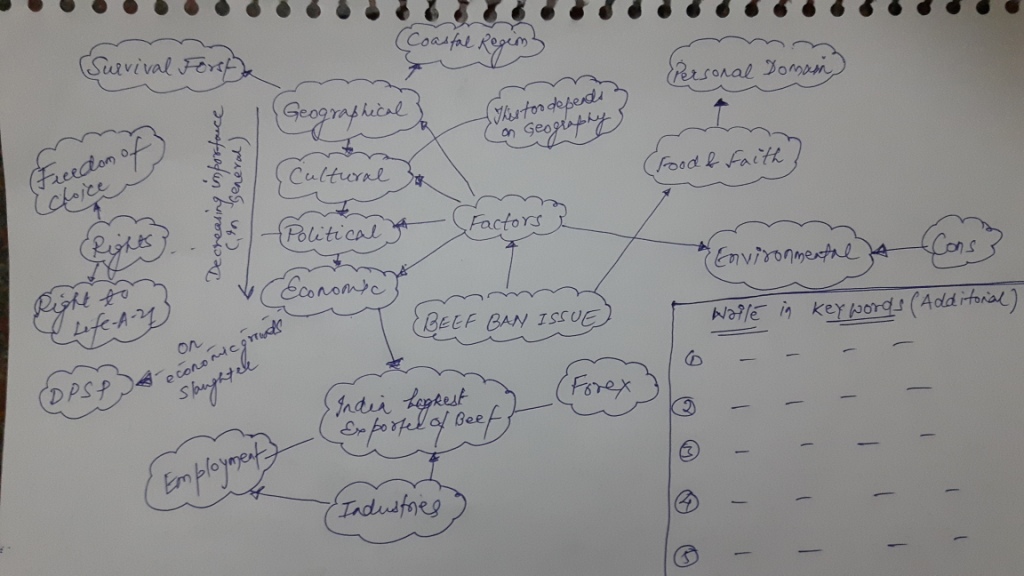
The concept is to revise again and again using these flash cards. It will be mobile. You can even paste it around your study place to have a constant look.
Keep doing it and gradually all the issues and the story line will stick in your mind. You cannot produce the content/bulky notes you have prepared. But you can easily produce content based on your thought process in the form of flash cards.
This will also make sure that you have prepared past current affairs with required details and dimensions.
Remember!
“Knowledge is not what is acquired but what is there with you in terms of your productivity. If you cannot produce what you claim, it’s worthless”
Reward from IASbaba 🙂
We will track the best writer and reviewer of the month and will announce TOP 5 such aspirants. IASbaba will get in touch with them and they will get a surprise gift from IASbaba.
This is just to encourage you people and in the process larger benefits are waiting for you.
P.S- On Saturday and Sunday- No TLP. We want to give enough time to you in revisiting the HOT issues of TLP (Monday to Friday) in these two days.
Let’s see how many of you have actually understood this article and are ready to take the pledge? IASbaba is already there for you, we just need strong hands to make this journey a successful one.
Always remember, your productivity matters not MNREGA type working 🙂