Q.1) What are the reasons of winter rainfall in north western states of India and southern India?
The Top Answer for this Question is written by – Saurabh Sharma
Ans) The north-western India, particularly Punjab, Haryana, HP, J&K, western UP and western Rajasthan receive winter rainfall due to the western disturbances. These disturbances are the extra-tropical cyclones that originates over the mediterranean sea.
They move eastwards under the effect of westerlies winds and recharge the moisture from caspian sea before striking India. Unlike tropical cyclones, they can sustain over the land and can cover large distances. These winter rains although scanty but are extremely useful for rabi crops.
The southern part of the peninsular India also receives winter rainfall but due to another reason. The ITCZ shifts further south and exits Indian mainland with the commencement of winters. Besides, the high pressure develops over the northern plains. Hence winds start blowing in reverse direction to that of summer monsoon.
These winds when pass over the Bay of Bengal extracts moisture and cause rainfall over the eastern coast of Tamil Nadu, southern Andhra pradesh. Hence the areas which lies in rain shadow region of summer monsoons find compensated with these winter rains.
Q.2) Discuss the development of paper and pulp industry in India. What are the factors which determine the location of this industry in certain pockets of India? Comment on the scope of paper and pulp industry in north eastern states.
The Top Answer for this Question is written by – Tom_Dwan
Ans) India’s Pulp and Paper industry has undergone a significant change during the last three decades, especially after liberalisation.
Development of paper and pulp industry in India
1. Pre independence
– paper manufacturing introduced in India by muslim rulers in 10th century.
– in 1870 Royal paper mills at Ballyganj near Kolkata was setup.
– growth was sluggish.
2. Post independence
-fiscal incentives were provided during the planning periods to reduce the import.
-helped in increasing 17 mills in 1950 to 600 mills today.
-P&P sector was de-licensed in July, 1997 to allow 100 % Foreign Direct Investment (FDI).
-except import for newsprint and pulp,India ready for export of other types of paper.
Major Area having P&P industry: West Bengal,Madhya Pradesh,Andhra Pradesh,Karnataka,Orissa
The locational factors of the pulp and paper industry
1. Raw Material – Bamboo,Sabai grass,Bagasse,straw from wheat and rice,salai wood
2. Water – requires high quantity of fresh water.
3. Power – A ton of newsprint may require about 2,000 kilowatt hours of electricity
4. Transport – The transport cost of newsprint and paper is slightly higher than the transport cost of its raw material.
-coastal area good for industry for this reason.
Scope of P&P industry in north east
The potential of a P&P is immense in the Northeast, primarily because
1. availability of a variety of fibres that is rich in cellulose
2. major bamboo producing area
3. water requirement can be fulfilled by Brahmputra river and good rainfall.
Q.3) Discuss different practices of aquaculture in India. What steps have been taken by the government to promote it.
The Top Answer for this Question is written by – Rahul Agrawal
Ans) Aquaculture is the practice of rearing aquatic animals such as fishes, shrimps etc. for commercial purpose. Aquaculture in India is broadly divided into freshwater aquaculture and brackish water aquaculture.
Fresh Water Aquaculture: It is generally dominated by cultivation of Indian carps in which Rohu, Catla and Mrigal are most prominent species. Some varieties of shrimps are also reared. The practice is most common in states of West Bengal, Andhra pradesh, orissa etc. It has been observed than only about 40% of the potential of inland water bodies, lakes, paddy fields have been harnessed.
Brackish water Aquaculture: Given the 8000+km coastline of India, brackish water aquaculture also have immense potential. Though, devoid of quality fish catch, Giant tiger prawns are the most popular variety.
Apart from it, aquaculture is also done for breeding decorative varieties of fishes and sea weeds.
Government has come up with several schemes time to time for promoting development of aquaculture:
A. Farmer fishing development agency and brackish water farmer fishing development agency provide institutional support.
B. Blue revolution campaign of Indian government, resulting in investment in infrastructure like cold supply chain, freezing equipments for higher commercial gains
C. Promotion of products of aquaculture in the food habits among the Indian population.
D. Providing quality fish seeds to farmers at the subsidized costs.
Q.4) World Bank and planning commission of India developed an elaborate plan of interlinking of rivers of northern and southern India. Critically comment on its feasibility.
The Top Answer for this Question is written by – Lakshmisrinivaspasam
Ans) Interlinking of rivers to connect 14 Himalayan rivers and 16 peninsular rivers to transfer water from surplus areas to deficit areas
Advantages –
1. Solve water crisis in peninsular region and there by eliminates poverty.
2. Solves problem of floods and droughts.
3. Can generate hydroelectricity.
4. Improves inland navigation and thereby reduces transport costs to goods.
Disadvantages
1. Long gestation period and huge amount of finances are required.
2. Causes submergence and displacement of millions of people.
3. About 13 GW power is required to lift water.
4. Environmental damage…requires clearance of forests and threat to biodiversity and alters hydrological system
Problems
1. Needs cooperation from upper riparian states to lower riparian states.
2. Needs international cooperation and support of China and bangladesh.
3. Though Himalayan rivers are perennial water flow is not ensured all round the year.
So rather than embarking on such large project alternatives like
1. Connecting regional interlinking of rivers like ken – betwa, Krishna godavari (polavaram )
2. Efficient management of existing water resoiurces by rain water harvesting and reducing evapotranspiration,seepage losses,
3. Phasing out of power subsidies and implementing water auditing systems and using technologies like desalination, reusing domestic and industrial waste water are more feasible given the developmental and infrastructural challenges ahead.
Q.5) Recently, there have been substantial developments in the field of monsoon prediction in India. Discuss these developments and also enumerate the variables that are taken into account for predicting the monsoons.
The Top Answer for this Question is written by – Rahul Agrawal
Ans) India is associated with monsoon rainfall regime, marked by seasonal reversal of winds , and rainfall concentrated in 3-4 months of south west monsoon. There have been many theories regarding the origin of monsoon, with the earlier theories based on differential heating of land and water(Haileys) and shifting of pressure belts (Flohn).
Since, these theories proved to be unsatisfactory for explaining monsoon , off late various new prediction techniques have been included:
A. El-Nino: It has found to be having great impact on Indian monsoon hence, it is included as variable in monsoon prediction.
B. Jet Stream: As monsoons, are marked by sudden burst, upper atmospheric jet stream circulations are also considered as causative factors. Shifting of westerly jet stream to tropical easterly jet stream is associated with monsoon burst
C. Indian Ocean Dipole: Also, it has been observed that though all drought years have been El-Nino years, every El-Nino incident didn’t result in drought. Meteorologist have identified Indian ocean dipole ( Also called madden-jullien oscillation) as a controlling factor of Indian monsoon. Positive IOD corresponds to higher rainfall and vice versa.
D. A recent study of WMO, has found some link between temperature of water surface in Bay of Bengal and monsoon.
Despite, various analysis and studies, monsoon prediction has still been guesswork at best due to complex involvement of various factors. This was evident when Indian Meteorological organization predicted a 12% shortfall in Indian monsoon in 2015 while skymet, a private weather organization, tipped it to be 2-3% surplus.
High Order Thinking
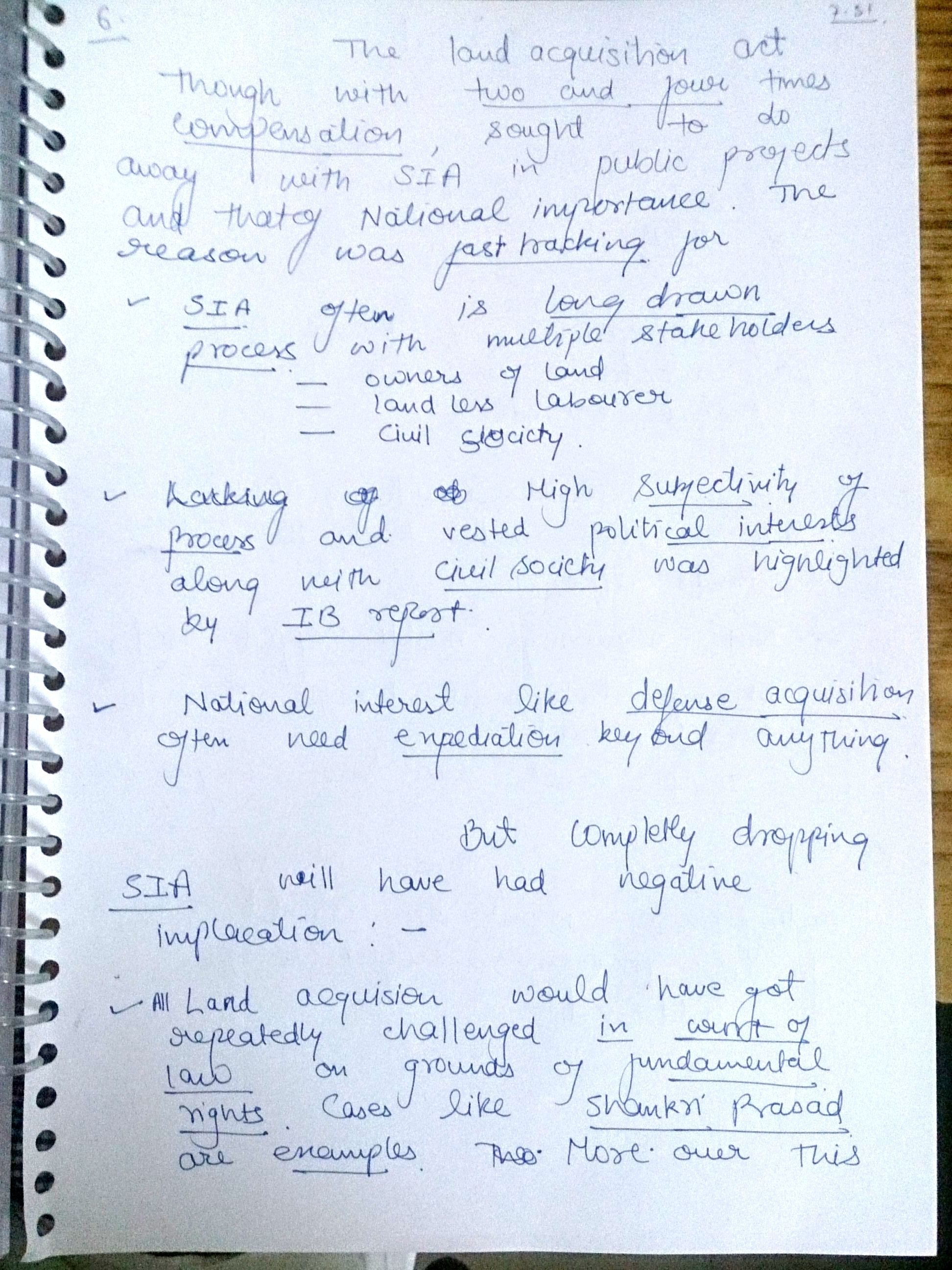
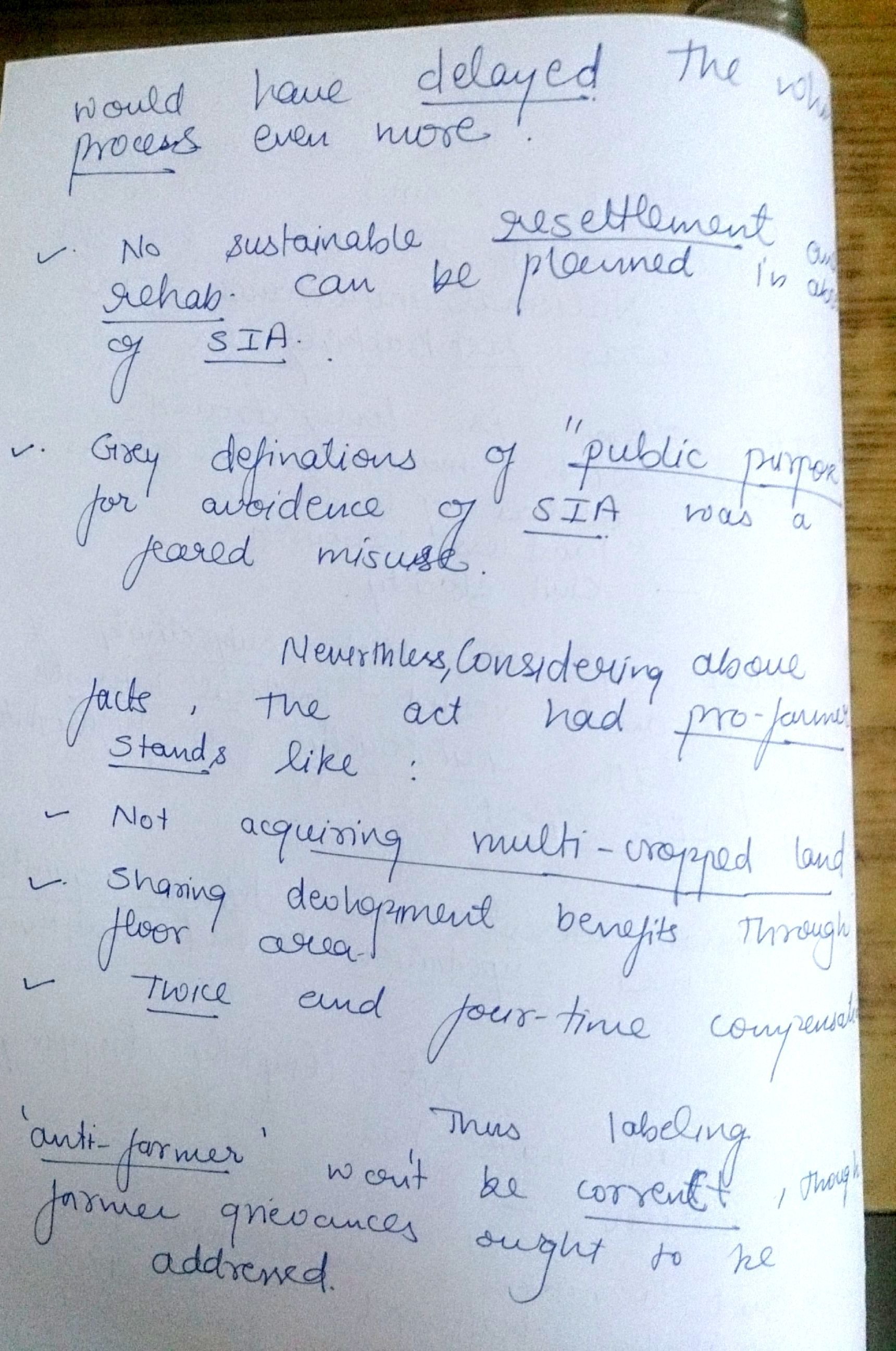
Q.1) The provisions related to social impact assessment (SIA) and the consent clause in the Land Acquisition Act, 2013 need to be diluted in order to fast track the infrastructure projects. Do agree? Examine the issue in light of the opposition to the ordinance that was meant to expedite the process of land acquisition in India. Do you think the amended provisions were anti farmer?
The Top Answer for this Question is written by – Khwabeeda
Ans)
Image 1 – https://a.disquscdn.com/uploads/mediaembed/images/2752/1554/original.jpg
Image 2 – https://a.disquscdn.com/uploads/mediaembed/images/2752/1557/original.jpg
Q.2) Indo-Russian ties have evolved with the changing configuration of the global order. However, few irritants remain which include the Syrian question and India’s endorsement of the Russian troop mobilization, below par bilateral trade volume and Russian engagement with China and Pakistan. Critically examine these aspects.
The Top Answer for this Question is written by – Vardan Maheshwari
Ans) India and Russia share relations which has stood the test of time and still going very strong.During Cold War, India and Soviet Union enjoyed a strategic, military and economic relationship.Post cold war, Russia inherited close ties with India, even as India improved its relations with the West.
However in the recent years, the gap in the friendship has widened due to strategic and economic reasons of both the countries.
Irritants in India-Russia Relations analyzed:
a)India has clarified its position that Russian involvement in Syria is to stop the proliferation of IS.
b)The India’s relations with Russia has been mainly G2G and lack P2P contacts and mainly concerned in defense co-operations due to which the bilateral trade between the countries is low.However, both the governments have set a target of 30 billion dollars by 2025 and also looking to sign Free Trade Agreement.
c)Since India has diversified its economic and military co-operation with the West reducing dependence on Russia. Thus in-order to handle the turmoil in the economy,
Russia has signed gas deal with China and has engaged in military co-operation with Pakistan which is bit concerning for India’s interest.
Inspite of the irritants in the relationship, both countries share all weather friendship co-operation in wide areas like FGFA construction,Bramhos construction, both are the members of SCO and BRICS and the upcoming visit of our Prime Minster will further deepen the relationship.
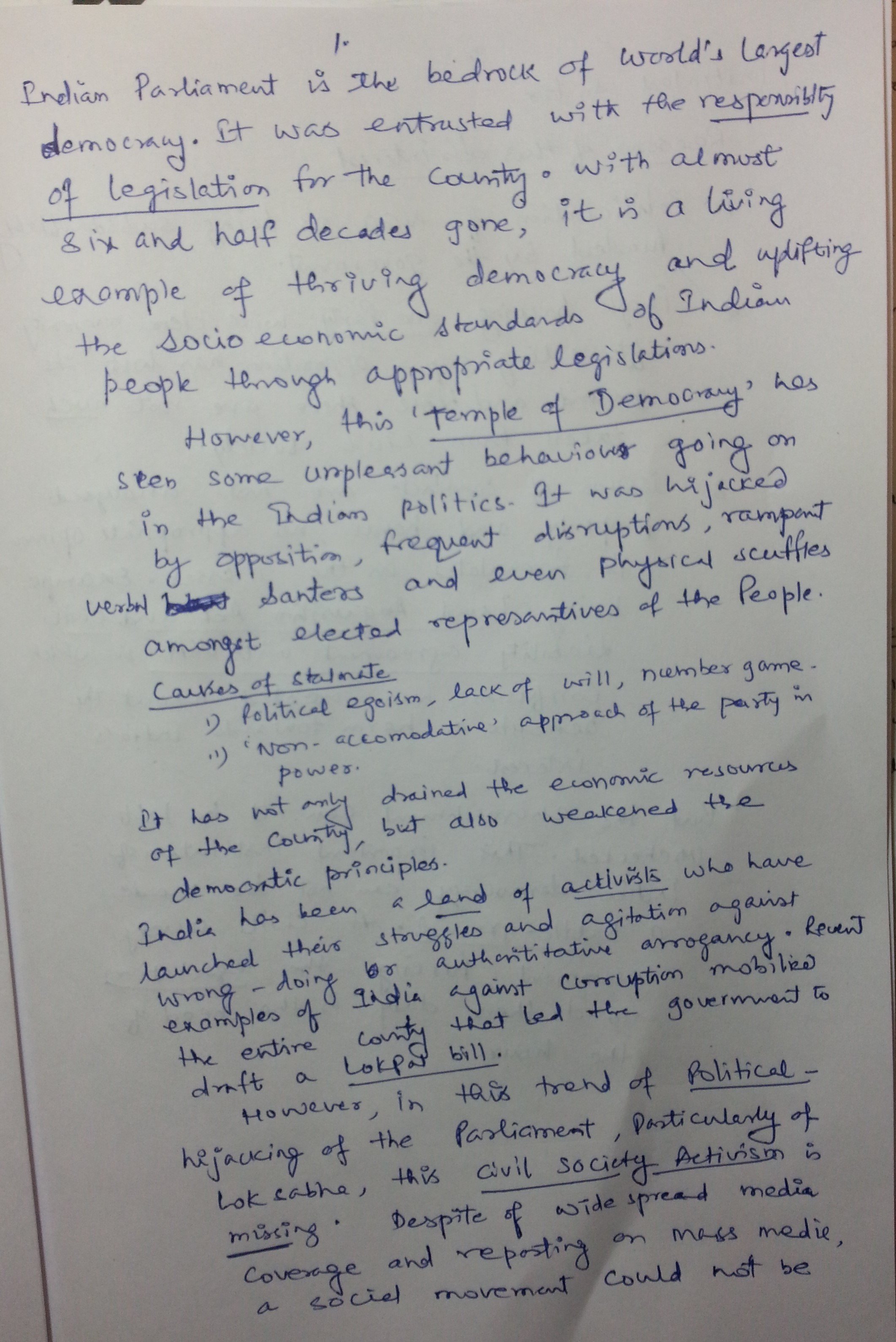
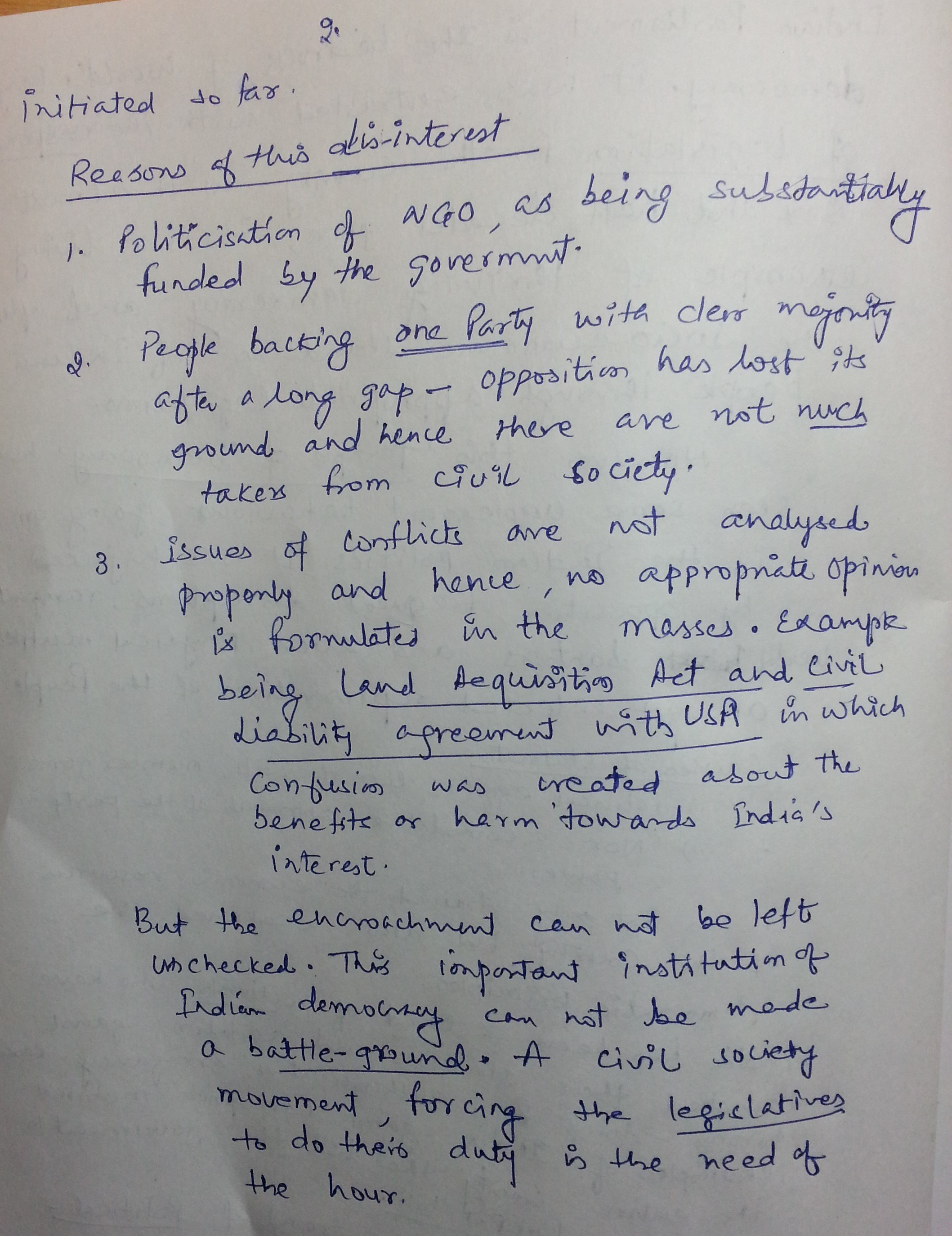
Q.3) It is unfortunate that the Parliament is not functioning the way it is supposed to, with frequent disruptions, rampant verbal banters and unparliamentary behaviour being norm of the day. However, what is more disturbing is the lack of a social movement directed against such unexpected impasse. Do you agree? Elucidate.
The Top Answer for this Question is written by – Lucky Kuchu Verma
Ans)
Image 1 – https://a.disquscdn.com/uploads/mediaembed/images/2752/1567/original.jpg
Image 2 – https://a.disquscdn.com/uploads/mediaembed/images/2752/1568/original.jpg