For Previous Daily Quiz (ARCHIVES) – CLICK HERE
The Current Affairs questions are based on sources like ‘The Hindu’, ‘Indian Express’ and ‘PIB’, which are very important sources for UPSC Prelims Exam. The questions are focused on both the concepts and facts. The topics covered here are generally different from what is being covered under ‘Daily Current Affairs/Daily News Analysis (DNA) and Daily Static Quiz’ to avoid duplication. The questions would be published from Monday to Saturday before 2 PM. One should not spend more than 10 minutes on this initiative.
We will make sure, in the next 4 months not a single day is wasted. All your energies are channelized in the right direction. Trust us! This will make a huge difference in your results this time, provided that you follow this plan sincerely every day without fail.
Gear up and Make the Best Use of this initiative.
Do remember that, “the difference between Ordinary and EXTRA-Ordinary is PRACTICE!!”
0 of 5 questions completed
Questions:
To view Solutions, follow these instructions:
You have already completed the test before. Hence you can not start it again.
Test is loading...
You must sign in or sign up to start the test.
You have to finish following test, to start this test:
0 of 5 questions answered correctly
Your time:
Time has elapsed
You have scored 0 points out of 0 points, (0)
| Average score |
|
| Your score |
|
| Pos. | Name | Entered on | Points | Result |
|---|---|---|---|---|
| Table is loading | ||||
| No data available | ||||
Which of the following statement is incorrect regarding Stand Up India Scheme?
Solution (b)
Explanation:
Stand-Up India Scheme –
As on 26.02.2021, more than 81% i.e., 91,109 accounts with an amount of Rs. 20,749 crore have been sanctioned to women entrepreneurs under Stand Up India Scheme.
Article reference: More than 81% account holders are Women under Stand Up India Scheme
Solution (b)
Explanation:
Stand-Up India Scheme –
As on 26.02.2021, more than 81% i.e., 91,109 accounts with an amount of Rs. 20,749 crore have been sanctioned to women entrepreneurs under Stand Up India Scheme.
Article reference: More than 81% account holders are Women under Stand Up India Scheme
Consider the following statement about “Horticulture production in India”:
Form the following options, choose the correct answer.
Solution (c)
Explanation:
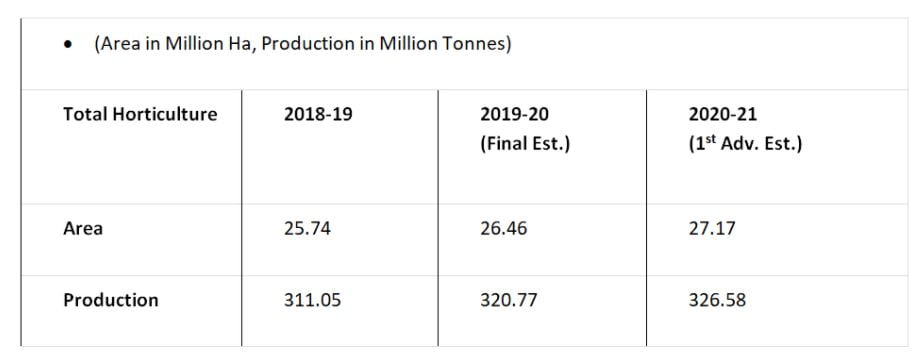
Horticulture Production in India
Article reference: Release of Final Estimates of 2019-20 of Area and Production of Horticultural Crops
Solution (c)
Explanation:
Horticulture Production in India
Article reference: Release of Final Estimates of 2019-20 of Area and Production of Horticultural Crops
Consider the following statements regarding “Sacred Ensembles of the Hoysala”:
Which of the above statements is/are correct?
Solution (a)
Temple Architecture of Hoysala
In addition to supporting both Shaivite and Vaishnavite sects of Hinduism, the Hoysala rulers gave court recognition and status to Jainism, a religion that prescribes a path of non-violence and self-control as paths to spiritual liberation and emphasizes the equality of all beings. (So, Statement 3 is incorrect)
Article link: Declaration Of World Heritage Sites By UNESCO
Solution (a)
Temple Architecture of Hoysala
In addition to supporting both Shaivite and Vaishnavite sects of Hinduism, the Hoysala rulers gave court recognition and status to Jainism, a religion that prescribes a path of non-violence and self-control as paths to spiritual liberation and emphasizes the equality of all beings. (So, Statement 3 is incorrect)
Article link: Declaration Of World Heritage Sites By UNESCO
Consider the following statements regarding “The National Council for Teacher Education”
Which of the above statements is/are incorrect?
Solution (b)
Statement 1: The National Council for Teacher Education, in its previous status since 1973, was an advisory body for the Central and State Governments on all matters pertaining to teacher education, with its Secretariat in the Department of Teacher Education of the National Council of Educational Research and Training (NCERT). Despite its commendable work in the academic fields, it could not perform essential regulatory functions, to ensure maintenance of standards in teacher education and preventing proliferation of substandard teacher education institutions. (So, statement 1 is correct)
Statement 2: The National Policy on Education (NPE), 1986 and the Programme of Action thereunder, envisaged a National Council for Teacher Education with statutory status and necessary resources as a first step for overhauling the system of teacher education.
The National Council for Teacher Education as a statutory body came into existence in pursuance of the National Council for Teacher Education Act, 1993 in August, 1995. ( Hence, statement 2 is incorrect)
Objectives
Article link: Steps taken by National Council of Teacher Education to strengthen the teacher education system
Solution (b)
Statement 1: The National Council for Teacher Education, in its previous status since 1973, was an advisory body for the Central and State Governments on all matters pertaining to teacher education, with its Secretariat in the Department of Teacher Education of the National Council of Educational Research and Training (NCERT). Despite its commendable work in the academic fields, it could not perform essential regulatory functions, to ensure maintenance of standards in teacher education and preventing proliferation of substandard teacher education institutions. (So, statement 1 is correct)
Statement 2: The National Policy on Education (NPE), 1986 and the Programme of Action thereunder, envisaged a National Council for Teacher Education with statutory status and necessary resources as a first step for overhauling the system of teacher education.
The National Council for Teacher Education as a statutory body came into existence in pursuance of the National Council for Teacher Education Act, 1993 in August, 1995. ( Hence, statement 2 is incorrect)
Objectives
Article link: Steps taken by National Council of Teacher Education to strengthen the teacher education system
Which of the following is incorrect regarding Command Area Development and Water Management (CADWM) Scheme?
Solution (d)
Command Area Development and Water Management (CADWM) Programme
Government of India is implementing Command Area Development and Water Management (CADWM) Programme which was brought under Pradhan Mantri Krishi Sinchai Yojana (PMKSY) – Har Khet Ko Pani 2015-16 onwards.
The main objectives of CADWM program are:
Under CADWM Scheme operated by the Department of Water Resources, River Development and Ganga Rejuvenation, financial assistance is given to the States for creation of Micro irrigation infrastructure in the canal irrigated commands with an aim to improve water use efficiency and promote micro-irrigation.
It is provisioned in the CADWM scheme that micro-irrigation shall cover at least 10% of the targeted CCA of the Project.
Central Assistance @ 50% are being provided with a cost norm of Rs.50,000 per hectare for development of micro irrigation infrastructure covering construction of sump, installation of water pump, and laying of piped conveyance system up to the field head. (So, Statement (d) is incorrect)
Article link: Water Crisis Due to Water Exploitation
Solution (d)
Command Area Development and Water Management (CADWM) Programme
Government of India is implementing Command Area Development and Water Management (CADWM) Programme which was brought under Pradhan Mantri Krishi Sinchai Yojana (PMKSY) – Har Khet Ko Pani 2015-16 onwards.
The main objectives of CADWM program are:
Under CADWM Scheme operated by the Department of Water Resources, River Development and Ganga Rejuvenation, financial assistance is given to the States for creation of Micro irrigation infrastructure in the canal irrigated commands with an aim to improve water use efficiency and promote micro-irrigation.
It is provisioned in the CADWM scheme that micro-irrigation shall cover at least 10% of the targeted CCA of the Project.
Central Assistance @ 50% are being provided with a cost norm of Rs.50,000 per hectare for development of micro irrigation infrastructure covering construction of sump, installation of water pump, and laying of piped conveyance system up to the field head. (So, Statement (d) is incorrect)
Article link: Water Crisis Due to Water Exploitation