In News: The Ministry of Power has for the first time laid down Rights to the Electricity Consumers through “Electricity (Rights of Consumers) Rules, 2020”.
These Rules emanate from the conviction that the power systems exist to serve the consumers and the consumers have rights to get the reliable services and quality electricity.
As the Distribution Companies across the country are monopolies – whether government or private – and the consumer has no alternative – therefore it was necessary that the consumers’ rights be laid down in Rules and a system for enforcement of these rights be put in place.
These rules are also an important step towards furthering the ease of doing business across the country. Implementation of these Rules shall ensure that new electricity connections, refunds and other services are given in a time bound manner. Wilful disregard to consumer rights will result in levying penalties on service providers.
Key areas are covered in the Electricity (Rights of consumers) Rules:
Rights of consumers and Obligations of Distribution licensees
Release of new connection and modification in existing connection
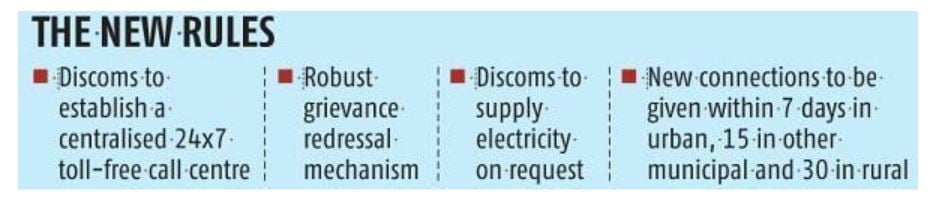
It is the duty of every distribution licensee to supply electricity on request made by an owner or occupier of any premises in line with the provisions of Act.
It is the right of consumer to have minimum standards of service for supply of electricity from the distribution licensee.
Release of new connection and modification in existing connection.-
Transparent, simple and time bound processes,
Applicant has option for online application,
Maximum time period of 7 days in metro cities and 15 days in other municipal areas and 30 days in rural areas identified to provide new connection and modify an existing connection:
Metering –
No connection shall be given without a meter
Meter shall be the smart pre-payment meter or pre-payment meter.
Provision of Testing of meters
Provisions for replacement of defective or burnt or stolen meters specified
Billing and payment –
Transparency in applicable consumer tariff and bills
Consumer shall have the option to pay bills online or offline.
Provision for advance payment of bills
Disconnection and reconnection provisions
Reliability of supply
The distribution licensee shall supply 24×7 power to all consumers. However, the Commission may specify lower hours of supply for some categories of consumers like agriculture.
The distribution licensee shall put in place a mechanism, preferably with automated tools to the extent possible, for monitoring and restoring outages.
Consumer as prosumer
While the prosumers will maintain consumer status and have the same rights as the general consumer, they will also have right to set up Renewable Energy (RE) generation unit including roof top solar photovoltaic (PV) systems – either by himself or through a service provider.
Net metering for loads up to ten kW and for gross metering for loads above ten kW.
Standards of performance.
The Commission shall notify the standards of performance for the distribution licensees.
Compensation amount to be paid to the consumers by the distribution licensees for violation of standards of performance
Compensation mechanism
Automatic compensation shall be paid to consumers for which parameters on standards of performance can be monitored remotely.
The standards of performance for which the compensation is required to be paid by the distribution licensee include, but are not limited to, the following, namely:-
No supply to a consumer beyond a particular duration, to be specified by the Commission;
Number of interruptions in supply beyond the limits as specified by the Commission;
Time taken for connection, disconnection, reconnection, shifting;
Time taken for change in consumer category, load;
Time taken for change in consumer details;
Time taken for replacement of defective meters;
Time period within which bills are to be served;
Time period of resolving voltage related complaints; and
Bill related complaints.
Call Centre for Consumer Services
Distribution licensee shall establish a centralised 24×7 toll-free call centre
Licensees shall endeavour to provide all services through a common Customer Relation Manager (CRM) System to get a unified view
Grievance redressal mechanism .-
Consumer Grievance Redressal Forum (CGRF) to include consumer and prosumer representatives.
The consumer grievance redressal has been made easy by making it multi-layered and the number of consumer’s representatives have been increased from one to four.
The licensee shall specify the time within which various types of grievances by the different levels of the forums are to be resolved. Maximum timeline of 45 days specified for grievance redressal.
General Provisions.-
Use of online access to various services such as application submission, monitoring status of application, payment of bills, status of complaints raised ,etc., to consumers through its website, web portal, mobile app and its various designated offices area-wise.
The distribution licensee shall provide all services such as application submission, payment of bills, etc., to senior citizens at their door-steps.
The details of scheduled power outages shall be informed to the consumers. In case of unplanned outage or fault, immediate intimation shall be given to the consumers through SMS or by any other electronic mode along with estimated time for restoration.