
Hello Friends
The 60 Days Rapid Revision (RaRe) Series is IASbaba’s Flagship Initiative recommended by Toppers and loved by the aspirants’ community every year.
It is the most comprehensive program which will help you complete the syllabus, revise and practice tests on a daily basis. The Programme on a daily basis includes
Daily Prelims MCQs from Static (Monday – Saturday)
Daily Current Affairs MCQs (Monday – Saturday)
Daily CSAT Quiz (Monday – Friday)
Note – Daily Test of 20 static questions, 10 current affairs, and 5 CSAT questions. (35 Prelims Questions) in QUIZ FORMAT will be updated on a daily basis.
To Know More about 60 Days Rapid Revision (RaRe) Series – CLICK HERE
60 Day Rapid Revision (RaRe) Series Schedule – CLICK HERE
0 of 35 questions completed
Questions:
The following Test is based on the syllabus of 60 Days Plan-2025 for UPSC IAS Prelims 2025.
To view Solutions, follow these instructions:
You have already completed the test before. Hence you can not start it again.
Test is loading...
You must sign in or sign up to start the test.
You have to finish following test, to start this test:
0 of 35 questions answered correctly
Your time:
Time has elapsed
You have scored 0 points out of 0 points, (0)
| Average score |
|
| Your score |
|
| Pos. | Name | Entered on | Points | Result |
|---|---|---|---|---|
| Table is loading | ||||
| No data available | ||||
With reference to the ‘National Gene Bank of India’, which of the following statements is/are correct?
Select the answer using the code given below:
Solution (b)
Explanation:
Solution (b)
Explanation:
Consider the following statements:
Which of the above statements is/are correct?
Solution (a)
Explanation:
Solution (a)
Explanation:
Consider the following statements:
Statement-I: World Wetlands Day is celebrated on 2nd February every year.
Statement-II: The Ramsar Convention on wetlands was adopted on 2nd February, 1971.
Which one of the following is correct in respect of the above statements?
Solution (a)
Explanation:
Solution (a)
Explanation:
With reference to Intergovernmental Panel on Climate Change (IPCC), consider the
following statements:
Which of the above statements are INCORRECT?
Solution (c)
Explanation:
Solution (c)
Explanation:
With reference to United Nations Conference on the Human Environment, 1972 consider the following statements:
Which of the above statements are correct?
Solution (b)
Explanation:
The 1972 United Nations Conference on the Human Environment in Stockholm was the first world conference to make the environment a major issue. The participants adopted a series of principles for sound management of the environment including the Stockholm Declaration and Action Plan for the Human Environment and several resolutions. Hence, statement 3 is correct.
Solution (b)
Explanation:
The 1972 United Nations Conference on the Human Environment in Stockholm was the first world conference to make the environment a major issue. The participants adopted a series of principles for sound management of the environment including the Stockholm Declaration and Action Plan for the Human Environment and several resolutions. Hence, statement 3 is correct.
Which of the following statements is/are correct about UN Convention to Combat Desertification (UNCCD)?
Select the answer using given code:
Solution (d)
Explanation:
Its permanent Secretariat is located in Bonn, Germany. The functions of the secretariat are to make arrangements for sessions of the Conference of the Parties (COP) and its subsidiary bodies established under the Convention, and to provide them with services as required. Hence, statement 3 is correct.
Solution (d)
Explanation:
Its permanent Secretariat is located in Bonn, Germany. The functions of the secretariat are to make arrangements for sessions of the Conference of the Parties (COP) and its subsidiary bodies established under the Convention, and to provide them with services as required. Hence, statement 3 is correct.
With reference to United Nations Environment Programme (UNEP), consider the following statements:
How many of the statements given above is/are correct?
Solution (c)
Explanation:
Solution (c)
Explanation:
Consider the following statements:
How many of the above statements is/are correct?
Solution (d)
Explanation:
Solution (d)
Explanation:
Which of the following protocol/convention regulates the transboundary movement of living modified organisms (LMOs)?
Solution (b)
Explanation:
The Cartagena Protocol on Biosafety to the Convention on Biological Diversity is an international agreement which aims to ensure the safe handling, transport and use of living modified organisms (LMOs) resulting from modern biotechnology that may have adverse effects on biological diversity, taking also into account risks to human health. It was adopted on 29 January 2000 and entered into force on 11 September 2003. Hence, option b is the correct option.
Solution (b)
Explanation:
The Cartagena Protocol on Biosafety to the Convention on Biological Diversity is an international agreement which aims to ensure the safe handling, transport and use of living modified organisms (LMOs) resulting from modern biotechnology that may have adverse effects on biological diversity, taking also into account risks to human health. It was adopted on 29 January 2000 and entered into force on 11 September 2003. Hence, option b is the correct option.
Consider the following statements about Kigali Amendment:
Which of the above statements is/are correct?
Solution (c)
Explanation:
At the Kigali meeting, the world agreed to reduce the use of HFCs and move to refrigerants that neither cause global warming nor create an ozone hole. Notably, unlike Paris Agreement (where there are no repercussions for non-compliance), the Kigali Amendment to the Montreal Protocol is legally binding with mandatory targets for countries. Hence, statement 2 is correct.
Solution (c)
Explanation:
At the Kigali meeting, the world agreed to reduce the use of HFCs and move to refrigerants that neither cause global warming nor create an ozone hole. Notably, unlike Paris Agreement (where there are no repercussions for non-compliance), the Kigali Amendment to the Montreal Protocol is legally binding with mandatory targets for countries. Hence, statement 2 is correct.
The 30 by 30 (30X30) target, which aims to designate 30% of Earth’s land and ocean area as protected areas by 2030 is launched by?
Solution (c)
Explanation:
30 by 30 (or 30×30) is a worldwide initiative was launched by the High Ambition Coalition for Nature and People (HAC) in 2020 for governments to designate 30% of Earth’s land and ocean area as protected areas by 2030. The High Ambition Coalition (HAC) for Nature and People was launched in 2019 by Costa Rica, France and Britain as an intergovernmental group to champion a global deal for nature and people that can halt the accelerating loss of species, and protect vital ecosystems. Hence, option c is the correct answer.
Solution (c)
Explanation:
30 by 30 (or 30×30) is a worldwide initiative was launched by the High Ambition Coalition for Nature and People (HAC) in 2020 for governments to designate 30% of Earth’s land and ocean area as protected areas by 2030. The High Ambition Coalition (HAC) for Nature and People was launched in 2019 by Costa Rica, France and Britain as an intergovernmental group to champion a global deal for nature and people that can halt the accelerating loss of species, and protect vital ecosystems. Hence, option c is the correct answer.
With reference to Paris Agreement, consider the following statements:
Which of the above statements is/are correct?
Solution (d)
Explanation:
Solution (d)
Explanation:
With respect to Mission LiFE, consider the following statements:
Which of the above statements is/are correct?
Solution (b)
Explanation:
Mission LiFE aims to nudge individuals and communities to practice a lifestyle that is synchronous with nature and does not harm it. Those who practice such a lifestyle are recognised as Pro Planet People. India is the first country to include LiFE in its Nationally Determined Contributions (NDCs). Hence, statement 2 is correct.
Solution (b)
Explanation:
Mission LiFE aims to nudge individuals and communities to practice a lifestyle that is synchronous with nature and does not harm it. Those who practice such a lifestyle are recognised as Pro Planet People. India is the first country to include LiFE in its Nationally Determined Contributions (NDCs). Hence, statement 2 is correct.
With reference to Central Pollution Control Board (CPCB), consider the following
statements:
Which of the above statements is/are correct?
Solution (a)
Explanation:
Solution (a)
Explanation:
With respect to National Action Plan for Climate Change (NAPCC), consider the following statements:
Which of the above statements is/are correct?
Solution (c)
Explanation:
Solution (c)
Explanation:
Consider the following statements:
Which of the above statements is/are correct?
Solution (d)
Explanation:
Solution (d)
Explanation:
Consider the following statements about Convention on Migratory Species (CMS):
Which of the above statements are correct?
Solution (c)
Explanation:
Solution (c)
Explanation:
Consider the following statements:
The Biological Diversity Act of 2002 provides that:
How many of the statements given above are correct?
Solution (b)
Explanation:
Solution (b)
Explanation:
With reference to an organization called the Central Zoo Authority (CZA), consider the following statements:
Which of the statements above is/are correct?
Solution (c)
Explanation:
Solution (c)
Explanation:
Which of the following activities are carried out under the ‘Namami Gange Programme’?
Select the correct answer using the code given below:
Solution (b)
Explanation:
Solution (b)
Explanation:
Consider the following pairs:
| Committee | Mandate |
|
Reforms in the BCCI |
|
Reforms in legal education in India |
|
Reforms in direct and indirect taxes in India |
|
Reforms in the insurance sector |
How many given pair/s is/are correctly matched?
Solution (d)
Explanation:
Context: The Insurance Regulatory and Development Authority of India (Irdai) has formed a high-powered committee, led by Dinesh Khara, former chairman of the State Bank of India, to scrutinize various aspects of the Insurance Act 1938 and suggest amendments.
| Committee | Mandate |
|
Reforms in the BCCI |
|
Reforms in legal education in India |
|
Reforms in direct and indirect taxes in India |
|
Reforms in the insurance sector |
Hence option d is correct.
Source: https://indianexpress.com/article/business/irdai-7-member-committee-review-insurance-sector-reforms-9845174/
Solution (d)
Explanation:
Context: The Insurance Regulatory and Development Authority of India (Irdai) has formed a high-powered committee, led by Dinesh Khara, former chairman of the State Bank of India, to scrutinize various aspects of the Insurance Act 1938 and suggest amendments.
| Committee | Mandate |
|
Reforms in the BCCI |
|
Reforms in legal education in India |
|
Reforms in direct and indirect taxes in India |
|
Reforms in the insurance sector |
Hence option d is correct.
Source: https://indianexpress.com/article/business/irdai-7-member-committee-review-insurance-sector-reforms-9845174/
India’s first wildlife bio-bank is located in which of the following zoological park?
Solution (c)
Explanation:
Context: As part of a national programme, the country’s first ‘biobank’ in a zoo is up and running at Padmaja Naidu Himalayan Zoological Park, better known as Darjeeling Zoo, officials said.
India’s first wildlife bio-bank at Padmaja Naidu Himalayan Zoological Park (Darjeeling Zoo) is fully operational. Since its establishment in July 2024, it has collected DNA and tissue samples from 60 animals of 23 species, prioritizing endangered species. Hence option c is correct.
Source: https://indianexpress.com/article/cities/kolkata/in-a-first-darjeeling-zoo-gets-biobank-to-collect-cell-tissue-samples-9838337/
Solution (c)
Explanation:
Context: As part of a national programme, the country’s first ‘biobank’ in a zoo is up and running at Padmaja Naidu Himalayan Zoological Park, better known as Darjeeling Zoo, officials said.
India’s first wildlife bio-bank at Padmaja Naidu Himalayan Zoological Park (Darjeeling Zoo) is fully operational. Since its establishment in July 2024, it has collected DNA and tissue samples from 60 animals of 23 species, prioritizing endangered species. Hence option c is correct.
Source: https://indianexpress.com/article/cities/kolkata/in-a-first-darjeeling-zoo-gets-biobank-to-collect-cell-tissue-samples-9838337/
Consider the following statements about the Digital Brand Identity Manual (DBIM):
Which of the statements given above is/are correct?
Solution (c)
Explanation:
Context: The Ministry of Electronics and Information Technology (MeitY) yesterday marked a significant step in India’s digital governance with the launch of the Digital Brand Identity Manual (DBIM) and the inaugural Chief Information Officer (CIO) Conference 2025.
Source: https://pib.gov.in/PressReleasePage.aspx?PRID=2104686#:~:text=As%20part%20of%20the%20Gov,ministries%2C%20departments%2C%20and%20agencies
Solution (c)
Explanation:
Context: The Ministry of Electronics and Information Technology (MeitY) yesterday marked a significant step in India’s digital governance with the launch of the Digital Brand Identity Manual (DBIM) and the inaugural Chief Information Officer (CIO) Conference 2025.
Source: https://pib.gov.in/PressReleasePage.aspx?PRID=2104686#:~:text=As%20part%20of%20the%20Gov,ministries%2C%20departments%2C%20and%20agencies
Which of the following countries are part of the Lithium Triangle?
Select the correct answer using the code below:
Solution (d)
Explanation:
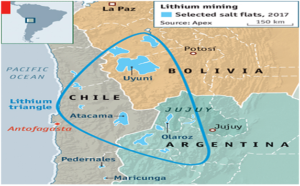
Context: A Memorandum of Understanding (MoU) between Mineral Exploration and Consultancy Limited (MECL), a PSU under the Ministry of Mines, and the Provincial Government of Catamarca, Argentina will pave the way for deeper collaboration in exploration and resource development of critical minerals. Argentina, known for its vast lithium reserves as part of the ‘Lithium Triangle,’ is a crucial partner for India in securing essential minerals required for electric vehicle batteries and renewable energy storage.
The lithium triangle made up of Argentina, Chile, and Bolivia—contains roughly half the world’s known lithium. Hence option d is correct.
Source: https://pib.gov.in/PressReleasePage.aspx?PRID=2104761
Solution (d)
Explanation:
Context: A Memorandum of Understanding (MoU) between Mineral Exploration and Consultancy Limited (MECL), a PSU under the Ministry of Mines, and the Provincial Government of Catamarca, Argentina will pave the way for deeper collaboration in exploration and resource development of critical minerals. Argentina, known for its vast lithium reserves as part of the ‘Lithium Triangle,’ is a crucial partner for India in securing essential minerals required for electric vehicle batteries and renewable energy storage.
The lithium triangle made up of Argentina, Chile, and Bolivia—contains roughly half the world’s known lithium. Hence option d is correct.
Source: https://pib.gov.in/PressReleasePage.aspx?PRID=2104761
Which of the following statements is true regarding DDoS attacks?
Solution (c)
Explanation:
Context: In January, the web-based portal Kaveri 2.0, which streamlines property registrations in Karnataka, faced sporadic, crippling server outages. As a result, property registration and document-related citizen services went almost to a standstill in the state. On investigating the outage, the Revenue Department and E-Governance Department concluded that it was not due to “technical glitches” but a “motivated Distributed Denial of Service (DDoS) attack” on Kaveri 2.0 – a portal launched in 2023 to reform land registration.
Source: https://www.thehindu.com/sci-tech/technology/whats-a-ddos-cyberattack-that-hit-karnatakas-kaveri-20-portal/article69228797.ece
Solution (c)
Explanation:
Context: In January, the web-based portal Kaveri 2.0, which streamlines property registrations in Karnataka, faced sporadic, crippling server outages. As a result, property registration and document-related citizen services went almost to a standstill in the state. On investigating the outage, the Revenue Department and E-Governance Department concluded that it was not due to “technical glitches” but a “motivated Distributed Denial of Service (DDoS) attack” on Kaveri 2.0 – a portal launched in 2023 to reform land registration.
Source: https://www.thehindu.com/sci-tech/technology/whats-a-ddos-cyberattack-that-hit-karnatakas-kaveri-20-portal/article69228797.ece
Colour Revolutions refers to peaceful, mass protest uprisings in post-Soviet states, characterized by symbolic colours, aiming to replace pro-Moscow regimes with peaceful and democratic governments.
In this context, consider the following pairs:
| Colour Revolution | Country |
|
Georgia |
|
Ukraine |
|
Kyrgyzstan |
How many above pair/s is/are correctly matched?
Solution (c)
Explanation:
Context: With the dawn of the 21st century, post-Soviet States experienced a wave of uprisings known as the “colour revolutions”. The movements were associated with specific colours and were largely peaceful protests to replace pro-Moscow governments with pro-West governments in the name of democratic reforms.
Colour Revolutions refers to peaceful, mass-protest uprisings in post-Soviet states, characterized by symbolic colours, aiming to replace pro-Moscow regimes with peaceful and democratic governments.
In this context, consider the following pairs:
| Colour Revolution | Country |
|
Georgia |
|
Ukraine |
|
Kyrgyzstan |
Hence option c is correct.
Solution (c)
Explanation:
Context: With the dawn of the 21st century, post-Soviet States experienced a wave of uprisings known as the “colour revolutions”. The movements were associated with specific colours and were largely peaceful protests to replace pro-Moscow governments with pro-West governments in the name of democratic reforms.
Colour Revolutions refers to peaceful, mass-protest uprisings in post-Soviet states, characterized by symbolic colours, aiming to replace pro-Moscow regimes with peaceful and democratic governments.
In this context, consider the following pairs:
| Colour Revolution | Country |
|
Georgia |
|
Ukraine |
|
Kyrgyzstan |
Hence option c is correct.
The Experimental Advanced Superconducting Tokamak (EAST) nuclear fusion reactor set a new milestone in nuclear fusion by sustaining plasma at 100 million°C for 1,066 seconds. It is located in which of the following country?
Solution (b)
Explanation:
Context: In 2023, EAST achieved the world’s first steady-state high-confinement plasma for 403 seconds, a world record it broke on January 20, 2025, by sustaining a plasma for 1,066 seconds.
Source: https://www.thehindu.com/sci-tech/science/china-east-tokamak-keeps-fire-magnetic-fusion-burning/article69226043.ece
Solution (b)
Explanation:
Context: In 2023, EAST achieved the world’s first steady-state high-confinement plasma for 403 seconds, a world record it broke on January 20, 2025, by sustaining a plasma for 1,066 seconds.
Source: https://www.thehindu.com/sci-tech/science/china-east-tokamak-keeps-fire-magnetic-fusion-burning/article69226043.ece
Lake Chad is a dynamic freshwater body with human presence dating back to the Paleolithic era. In this context, consider the following countries:
The Lake Chad region spans over how many of the following countries?
Solution (d)
Explanation:
Context: Chad is one of four countries around Lake Chad battling Boko Haram and its allies over the past decade.
Lake Chad is a dynamic freshwater body with human presence dating back to the Paleolithic era. The Lake Chad region spans over Nigeria, Cameroon, Niger, and Chad. Hence option d is correct.
Source: https://www.thehindu.com/news/international/nearly-300-militants-killed-in-boko-haram-offensive-says-chad/article69237162.ece#:~:text=Chad%20is%20one%20of%20four,allies%20over%20the%20past%20decade&text=Chad's%20Army%20said%20that%20it,(February%2020%2C%202025)
Solution (d)
Explanation:
Context: Chad is one of four countries around Lake Chad battling Boko Haram and its allies over the past decade.
Lake Chad is a dynamic freshwater body with human presence dating back to the Paleolithic era. The Lake Chad region spans over Nigeria, Cameroon, Niger, and Chad. Hence option d is correct.
Source: https://www.thehindu.com/news/international/nearly-300-militants-killed-in-boko-haram-offensive-says-chad/article69237162.ece#:~:text=Chad%20is%20one%20of%20four,allies%20over%20the%20past%20decade&text=Chad's%20Army%20said%20that%20it,(February%2020%2C%202025)
With reference to the Aditya-L1 Mission, consider the following statements:
How many of the above statement/s is/are correct?
Solution (b)
Explanation:
Context: India’s first dedicated space based solar mission, Aditya-L1, has made a ground-breaking observation as one of its scientific payloads has captured the first-ever image of a solar flare ‘kernel’ in the lower solar atmosphere.
Source: https://www.thehindu.com/sci-tech/science/aditya-l1-payload-captures-the-first-ever-image-of-a-solar-flare-kernel/article69274469.ece
Solution (b)
Explanation:
Context: India’s first dedicated space based solar mission, Aditya-L1, has made a ground-breaking observation as one of its scientific payloads has captured the first-ever image of a solar flare ‘kernel’ in the lower solar atmosphere.
Source: https://www.thehindu.com/sci-tech/science/aditya-l1-payload-captures-the-first-ever-image-of-a-solar-flare-kernel/article69274469.ece
Q.50) If the President of India exercises his power as provided under Article 356 of the Constitution in respect of a particular State, then
Solution (b)
Explanation:
Context: Four days after N Biren Singh resigned as Chief Minister, the Centre announced that President’s rule had been imposed in Manipur and the state assembly placed under suspended animation.
Source: https://indianexpress.com/article/india/manipur-president-rule-imposed-9830795/
Solution (b)
Explanation:
Context: Four days after N Biren Singh resigned as Chief Minister, the Centre announced that President’s rule had been imposed in Manipur and the state assembly placed under suspended animation.
Source: https://indianexpress.com/article/india/manipur-president-rule-imposed-9830795/
Passage
Different factors affect the pace of spatial transformations in different ways. In India, people live in the largest cities than in small towns when compared to China. Nearly 6 per cent of the urban population lives in the largest cities in India, which is double compared to China. Most modern cities in India are undergoing haphazard growth, and because of this, the effects of living in huge cities have not been fully anticipated. The social, economic, and psychological consequences of industrialisation and urbanisation have not been fully considered and the steps which should have been taken to bring about an adjustment between man and his new environment have not been forthcoming in ample measure. This is particularly true in the case of underdeveloped regions.
Q.31) Which of the following is/are the most rational and logical inference/s that can be drawn from the passage?
Select the correct answer from the code given below:
Solution (b)
Explanation
Inference 1 is incorrect: That the given inference is correct cannot be concluded from the passage. For example, the passage says, “In India, people live in the largest cities than in small towns when compared to China. Nearly 6 per cent of the urban population lives in the largest cities in India, which is double compared to China.” The author compares the sub-sections of urban population in India and China. From the given information, we cannot gauge anything about the relative degree of urbanisation. Therefore, this answer option is beyond the scope of the passage.
Inference 2 is correct: The given inference is correct as it can be inferred from the following lines – “Most modern cities in India are undergoing haphazard growth, and because of this, the effects of living in huge cities have not been fully anticipated. The social, economic, and psychological consequences of industrialisation and urbanisation have not been fully considered …” These lines clearly imply that it is the lack of systematic policy approach which is resulting in haphazard urbanization. Therefore, this answer option is correct.
Solution (b)
Explanation
Inference 1 is incorrect: That the given inference is correct cannot be concluded from the passage. For example, the passage says, “In India, people live in the largest cities than in small towns when compared to China. Nearly 6 per cent of the urban population lives in the largest cities in India, which is double compared to China.” The author compares the sub-sections of urban population in India and China. From the given information, we cannot gauge anything about the relative degree of urbanisation. Therefore, this answer option is beyond the scope of the passage.
Inference 2 is correct: The given inference is correct as it can be inferred from the following lines – “Most modern cities in India are undergoing haphazard growth, and because of this, the effects of living in huge cities have not been fully anticipated. The social, economic, and psychological consequences of industrialisation and urbanisation have not been fully considered …” These lines clearly imply that it is the lack of systematic policy approach which is resulting in haphazard urbanization. Therefore, this answer option is correct.
Which of the following statements best reflects the crux of the passage?
Solution (c)
Explanation
Option (a) is incorrect: The central theme of the passage is about the poor urbanization model/policy. The context of the role of urbanization in rapid economic growth is not covered in the passage. Therefore, it does not reflect the best crux of the passage.
Option (b) is incorrect: The passage mostly covers the pattern and consequences of urbanisation. The context of villages has not been discussed in the passage.
Option (c) is correct: The passage covers the lack of structured policy in Indian urbanization. The following lines “Most modern cities in India are undergoing haphazard growth, and because of this, the effects of living in huge cities have not been fully anticipated” show that there is a lack of coherent policy approach. This shows that the current trend of urbanization is not sustainable and needs to be changed. So, this is the best crux of the passage.
Option (d) is incorrect: To state that industrialization and urbanization go together is not covered in the passage. Also, it is not the central theme which is about the lack of a systematic approach to urbanization.
Solution (c)
Explanation
Option (a) is incorrect: The central theme of the passage is about the poor urbanization model/policy. The context of the role of urbanization in rapid economic growth is not covered in the passage. Therefore, it does not reflect the best crux of the passage.
Option (b) is incorrect: The passage mostly covers the pattern and consequences of urbanisation. The context of villages has not been discussed in the passage.
Option (c) is correct: The passage covers the lack of structured policy in Indian urbanization. The following lines “Most modern cities in India are undergoing haphazard growth, and because of this, the effects of living in huge cities have not been fully anticipated” show that there is a lack of coherent policy approach. This shows that the current trend of urbanization is not sustainable and needs to be changed. So, this is the best crux of the passage.
Option (d) is incorrect: To state that industrialization and urbanization go together is not covered in the passage. Also, it is not the central theme which is about the lack of a systematic approach to urbanization.
Consider the following statements:
Conclusions:
Based on the given statements, which of the conclusion(s) is/are true?
Solution (b)
Explanation
We can make the following Venn diagram based on the given statements:
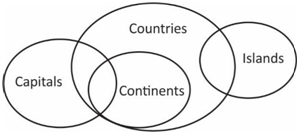
From the diagram we can infer that some Countries are Continents and some Countries are Capitals. Hence, option (b) is the correct answer.
Solution (b)
Explanation
We can make the following Venn diagram based on the given statements:
From the diagram we can infer that some Countries are Continents and some Countries are Capitals. Hence, option (b) is the correct answer.
Three statements are given below followed by four conclusions numbered I, II, III and IV. You have to take the three given statements to be true even if they seem to be at variance with commonly known facts. Read the given conclusions and then decide which of the given conclusions logically follow(s) from the given statements disregarding commonly known facts.
Statements:
Conclusions:
Which of the above conclusions is/are correct?
Solution (d)
Explanation
On the basis of the given statements, the following Venn diagram can be drawn:
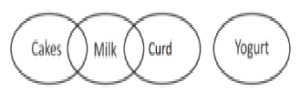
Conclusions II and III form a complementary pair. Hence, either II or III follows. Hence, option (d) is the right answer.
Solution (d)
Explanation
On the basis of the given statements, the following Venn diagram can be drawn:
Conclusions II and III form a complementary pair. Hence, either II or III follows. Hence, option (d) is the right answer.
Two statements are given below followed by a question.
Statement 1:
The number when multiplied by 4, produces an even number.
Statement 2:
Sum of its digits is even.
Question: Is the two-digit number odd?
Solution (d)
Explanation
Two-digit odd number means unit digit would be 1, 3, 5, 7 or 9.
Statement 1:
When a number is multiplied by 4, it will always produce an even number. So, S1 alone is not sufficient to answer the question.
Statement 2:
Sum of its digits can be even if both digits are odd, e.g. 51, 31, 11, 57 Or Sum of its digits can be even if both digits are even, e.g. 26, 48, 82, 68 So, S2 alone is also not sufficient to answer the question.
Even both S1 & S2 together are not sufficient to answer the question. Hence, option (d) is the correct answer.
Solution (d)
Explanation
Two-digit odd number means unit digit would be 1, 3, 5, 7 or 9.
Statement 1:
When a number is multiplied by 4, it will always produce an even number. So, S1 alone is not sufficient to answer the question.
Statement 2:
Sum of its digits can be even if both digits are odd, e.g. 51, 31, 11, 57 Or Sum of its digits can be even if both digits are even, e.g. 26, 48, 82, 68 So, S2 alone is also not sufficient to answer the question.
Even both S1 & S2 together are not sufficient to answer the question. Hence, option (d) is the correct answer.
All the Best
IASbaba