TOPIC: General Studies 3
- Conservation, environmental pollution and degradation, environmental impact assessment
In News: In today’s world of manufacturing raw materials are taken from the environment, turned in to new products which are then disposed after use. This is a linear process with a being and an end and in this process limited raw materials will eventually run out. Also, waste accumulated in this process incurs additional expenses related to its disposal and pollution.
What is a Circular Economy?
In a circular economy however, products are designed for durability, reuse and recyclability. In this process almost everything is reused, remanufactured, recycled back in to a raw material or used as a source of energy. Experts say that by embarking on a circular economy transformation, India can build a more resource efficient system even as it continues to grow and scale new heights
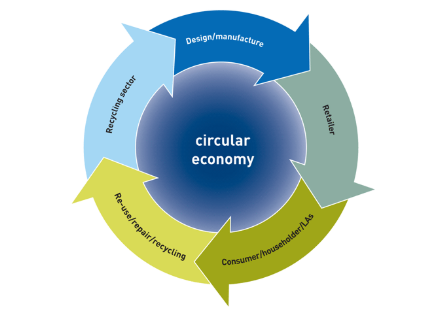
Source: http://www.wrap.org.uk/about-us/about/wrap-and-circular-economy
Circular Economy Principles
Waste becomes a resource: All the biodegradable material returns to the nature and the not biodegradable is reused.
Reintroduce in the economic circuit those products that no longer correspond to the initial consumers’ needs.
Reuse: Reuse certain products or parts of those products that still work to elaborate new artefacts.
Reparation: Find damage products a second life.
Recycle: Make use of materials founded in waste.
Valorisation: Harness energy from waste that can’t be recycled.
Functionality economy: Circular economy aims to eliminate the sale of products in many cases to establish a system of rental property. When the product completes its main function returns to the company, where it is dismantled for reusing the valid parts.
Energy from renewable sources: Elimination of fossil fuels to produce the product, reuse and recycle.
Eco-design: Considers and integrates in its conception the environmental impacts throughout the life cycle of a product.
Industrial and territorial ecology: Establishment of an industrial organizational method in a territory characterized by an optimized management of stocks and flows of materials, energy and services.
Goal of the Paris Agreement
At the heart of the Paris Agreement is a goal to keep global temperature rises well below 2˚C. The popular action area is around energy – both energy efficiency and renewable energy.
Some trends are clear. There will be more people in the world, we will be a more urbanised society over time, urban societies will consume more resources per capita, many resources will be scarce and the environmental cost of creating virgin resources will soon be too much for the planet to bear. This is why a circular economy is such an appealing concept. It is a new way of life that can help the world adapt to these trends in a climate-friendly way.
Is there really gold in solid waste and wastewater?
It is a criminal waste of energy, effort and cost to use fresh potable water for construction, watering landscaped areas or even for flushing the toilet. Using recycled greywater (from our showers and sinks, for example) or blackwater (the water flushed from our toilets) for these applications would reduce the need for freshwater, eliminate water scarcity and ensure that our bodies of water do not continue to be dumping grounds for solid waste, treated or otherwise.
The nutrient-rich fertiliser obtained in the wastewater treatment process can be used for agriculture and is a welcome by-product. Back of the envelope calculations indicate that India could save more than $1.4 billion in foreign exchange and subsidies each year only from the fertiliser obtained and also meet more than 10% of its water requirements through recycling. Who would have thought there would be?
What would it mean for India?
The impact of a circular economy could be massive. A 2016 report by Ellen MacArthur Foundation and the United Nations Conference for Trade and Development (UNCTAD) says that India could create as much as $218 billion in additional economic value by 2030, rising to $624 billion by 2050, by adopting circular principles across only three areas: cities and construction, food and agriculture, and mobility and vehicle manufacturing. The same report adds that circularity could cause a 23% reduction in greenhouse gas emissions by 2030 rising to 44% by 2050, and a 24% reduction in the use of virgin materials in the same period (38% by 2050).
Repairing is part of the DNA of developing countries. Several building blocks of circularity are deeply ingrained in Indian habits, as exemplified by the high rates of repair of vehicles and the distributed recovery and recycling of materials post-use. Often handled informally, these activities provide the only source of livelihoods to some of the world’s poorest populations. By turning these existing trends into core development strategies, India could generate significant economic savings and massively cut down on carbon emissions.
Climate change has presented us with the biggest opportunity to reboot the world economy. Along with energy efficiency and renewable energy, enhancing circularity of the economy can help us pursue a low-carbon growth path. Each of the impact areas presents business opportunities that can keep the economic engine purring as we unearth gold from unlikely places.
Connecting the Dots: