IASbaba's Daily Current Affairs Analysis

Archives
(PRELIMS Focus)
Category: Science and Technology
Context:
- Metabolic Dysfunction-Associated Steatotic Liver Disease, or MASLD, is emerging as a significant health concern, particularly in India.
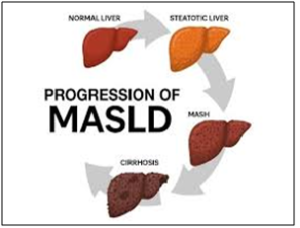
About Metabolic Dysfunction-Associated Steatotic Liver Disease (MASLD):
- Nature: Often referred to as a “silent” disease, MASLD is a liver condition that can progress over time if left unaddressed.
- Affected organ: It is a long-lasting liver condition caused by having too much fat in the liver. MASH causes the liver to swell and become damaged.
- Nomenclature: Previously known as Non-Alcoholic Fatty Liver Disease (NAFLD), its name was changed to better reflect the condition’s underlying causes. The new term highlights that the disease is a metabolic one, linked to factors such as obesity, diabetes, and high cholesterol.
- Concern: It is the most common form of liver disease in the world. It ranges in severity from hepatic steatosis (formerly fatty liver infiltration or simply fatty liver) to a more severe form of disease called metabolic dysfunction-associated steatohepatitis (MASH), formerly called nonalcoholic steatohepatitis (NASH).
- Symptoms: It often has no symptoms. However, if symptoms begin, they usually include fatigue (extreme tiredness), weakness, discomfort, or pain in the abdomen. Sometimes mental confusion can also occur.
- Pathogenesis: It is primarily driven by insulin resistance, where the body fails to manage fat and sugar properly, leading to fat deposition in the liver. Genetic factors (like the PNPLA3 gene) also play a role.
- Treatment: Treating MASLD with a healthy diet, physical activity, and weight loss can slow or even reverse liver damage, especially if it is at an earlier stage. The US FDA has conditionally approved Resmetirom and Semaglutide for treating advanced MASH. In India, Saroglitazar (a dual PPAR agonist) is approved for MASLD.
Source:
Category: Environment and Ecology
Context:
- Bhitarkanika National Park saw an increase in winged guests as compared to the previous year, according to the latest census report released by the forest department.
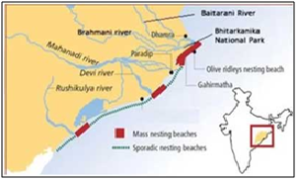
About Bhitarkanika National Park:
- Location: It is located in the Kendrapara district of Odisha.
-
- Area: It spreada across an area of 672 sq.km. of the mangrove swamp.
- Designations: It was declared as a Wildlife Sanctuary in 1975. It was constituted as a National Park in 1998. Further, it was also designated as a Ramsar Site (Wetland of International Importance) in August 2002, the second in Odisha after Chilika Lake.
- Rivers: It is situated on the delta formed by the three rivers, namely Brahmani, Baitarani, and Dhamra, and the park houses an array of creeks, backwaters, estuaries, deltas, and mudhuts.
- Boundaries: The national park is surrounded by the Bhitarkanika Wildlife Sanctuary. Gahirmatha Beach and Marine Sanctuary lie to the east, and separates a swamp region covered with a canopy of mangroves from the Bay of Bengal.
- Significance: It is India’s second largest mangrove ecosystem after the Sunderbans. Proximity to the Bay of Bengal makes the soil of the area enriched with salt.
- Uniqueness: The Gahirmatha Beach which forms the boundary of the sanctuary in the east is the largest colony of the Olive Ridley Sea Turtles. It is also home to the largest congregation of the endangered saltwater crocodile in the country. The other unique phenomenon is the Bagagahana or the heronry near Surajpore creek.
- Flora: The vegetation and species of the sanctuary are those that are mainly found in the tropical and subtropical intertidal regions. These include mangrove species, casuarinas, and grasses like the indigo bush.
- Fauna: It is also home to numerous animals like hyenas, wild boar, Chitals, Sambar, Spotted Deer, Wild Boar, Jungle cat, Wild Pigs, etc., and migratory birds, which make it their home during the winter season, lending a vibrant hue to the ecosystem. It is also home to eight varieties of Kingfisher birds, which is also a rarity.
Source:
Category: Government Schemes
Context:
- Recently, the union cabinet approved the continuation of Atal Pension Yojana (APY) up to FY 2030-31.

About Atal Pension Yojana:
- Launch: It was launched by the Government of India on 9th May 2015.
-
- Objective: It was designed to encourage voluntary savings for retirement by offering defined pension benefits, linked to the age of joining and amount of contribution.
- Administration: It is administered by the Pension Fund Regulatory and Development Authority (PFRDA).
-
- Target group: It is aimed at workers in the unorganised sector. It was initially available to all citizens of India between 18 and 40 years of age. With effect from 1st October 2022, individuals paying income tax are not eligible to join the scheme.
- Guaranteed pension: Subscribers can opt for a fixed pension ranging from ₹1,000 to ₹5,000 per month, depending on the contribution made.
- Government co-contribution: For subscribers who enrolled between June 1, 2015, and March 31, 2016, and met certain criteria, the government contributed 50% of the subscriber’s amount or ₹1,000 per annum for five years.
- Exit and withdrawal options
-
- Exit at age 60: Full pension begins.
- Exit before age 60: Permitted only in cases of death or terminal illness.
- Voluntary exit: Allowed, but the subscriber only receives the contribution made (with interest) and government co-contribution (if any) is forfeited.
Source:
Category: Miscellaneous
Context:
- Recently, the union Minister of State for Science & Technology directed that “Kaladi” traditional dairy products be upscaled for wider food applications and recipes.
About Kaladi:
- Nature: Kaladi is a famous Dogra cuisine.
-
- Location: It is a traditional dairy product of Udhampur district, Jammu & Kashmir.
- Other names: It is often called the “mozzarella of Jammu” due to its stretchable texture when cooked.
- Significance: It has received the Geographical Indication tag (GI).
- Preparation process:
-
-
- It is traditionally prepared from raw full-fat milk using whey water as a coagulant. The raw full fat milk, vigorously churned in an iron pot with a wooden plunger-like tool.
- The molten mass of milk solids was then separated by adding sour milk or curd called mathar. Once stretched, the flattened cheese was cooled on the black iron pot itself, before being placed in a bowl to solidify.
- The solidified cheese was then sun dried to help it to lose the moisture. Since the ambient temperature in the mountainous area of Udhampur remains low despite a strong sun, the Kalari dried from the outside yet remain moist inside.
-
- Key constraints:
-
-
- The product’s short shelf life, especially without refrigeration, limits its market reach.
- The government aims to improve this through scientific validation, while ensuring the preservation of Kaladi’s taste, texture, and nutritional identity, with opportunities for recipe diversification.
-
- Scientific support:
-
-
- The CSIR-Central Food Technology Research Institute (CSIR-CFTRI), Mysuru, and the CSIR-Indian Institute of Integrative Medicine (CSIR-IIIM), Jammu, will collaborate on nutrient profiling, characterisation, value addition, and shelf-life enhancement to facilitate the scaling up of Kaladi.
-
- Market and export expansion:
-
- The initiative aims to bring Kaladi to national and international markets, improving farmer incomes and showcasing Dogra cuisine globally.
Source:
Category: Geography
Context:
- The painted outline of a human hand inside a cave on the Indonesian island of Muna represents what researchers are calling the oldest example of rock art in the world, created at least 67,800 years ago.
About Muna Island:
-
- Location: It is situated in the Southeast Sulawesi province of Indonesia. The island falls within the Wallacea biogeographical zone, a transition area between Asian and Australasian flora and fauna.
- Area: With an area of 1,704 sq.km., it has a hilly surface, rising to 1,460 feet (445 metres). The north and northeast have teak forests.
- Significance: It is known for its diverse culture and natural beauty, including lush forests and pristine beaches.
- Demographics: The island is home to the Muna people, who have a rich cultural heritage and are known for their traditional crafts and dances.
- Economy: The economy of Muna Island is primarily based on agriculture, fishing, and local crafts.
- Ports: The main town and principal port is Raha, on the northeastern coast across the Strait of Buton from the neighbouring island of Buton to the east.
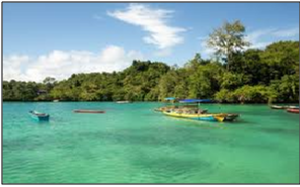
- Tourist places: One of the most famous natural attractions on Muna Island is the Liangkobori Cave, which contains prehistoric paintings. Additionally, there is Napabale Lake, which has a natural tunnel connecting it directly to the sea.
Source:
(MAINS Focus)
GS-III: “Environment: Conservation, environmental pollution and degradation, environmental impact assessment.”
Context (Introduction)
The Himalayan region witnessed near-continuous climate shocks in 2025, with over 4,000 climate-related deaths across India. Himachal Pradesh and Uttarakhand were among the worst affected, with towns such as Dharali, Harsil, Uttarkashi, Chamoli, Kullu, Mandi and Kishtwar devastated by cloudbursts, landslides, avalanches and flash floods.
Despite this, large infrastructure projects, particularly the Char Dham road-widening project, continue to be pushed in highly disaster-prone ecological zones, signalling a dangerous policy disconnect.
Core Issue:
The Himalayas are one of the world’s most climate-sensitive landscapes, warming ~50% faster than the global average (IPCC-linked studies).
Yet, development interventions are being pursued through:
- Large-scale deforestation
- Slope cutting and tunnel construction
- Road widening beyond ecological carrying capacity
This has triggered a feedback loop of land instability + climate amplification, raising the risk of an “ecocide-like scenario” in the Himalayas.
Ecological Importance of Devdar (Deodar) Forests
Devdar forests are not symbolic assets but critical ecological infrastructure:
Key ecological functions
- Slope stabilisation through deep root systems
- Landslide and avalanche buffering
- Glacial debris flow moderation
- Water quality regulation of the Ganga headwaters
- Microclimate regulation (cooler air, oxygen balance)
- Antimicrobial river ecology via phenolic compounds that suppress harmful bacteria and promote beneficial microbial systems
Policy Failure: Char Dham Road Project as a Case Study
Structural flaws
- Bypassing comprehensive Environmental Impact Assessment
- Project fragmentation to avoid scrutiny
- Adoption of 12-metre DL-PS (double-lane paved shoulder) standard despite disaster vulnerability
- Vertical hill cutting violating Himalayan geology’s “angle of repose”
- Dumping of muck into water sources
Consequences
- Nearly 700 km of widened roads
- 800+ active landslide zones
- Key border routes rendered unusable during disasters
- Locals term the project an “all-paidal (all-pedal) road”, reflecting loss of resilience
Climate Change as a Risk Multiplier
Climate change is not the root cause but a risk amplifier:
- Erratic rainfall patterns
- Accelerated glacial melt
- Entry into a dangerous “water peak phase” → catastrophic floods followed by long-term water scarcity
This makes infrastructure-led fragility far more lethal.
Institutional and Governance Gaps
- Ignoring Main Central Thrust (MCT) classification where heavy infrastructure is discouraged
- Repeated warnings by National Green Tribunal (NGT) overlooked
- NMHSE (National Mission for Sustaining the Himalayan Ecosystem) principles contradicted in practice
- Absence of carrying capacity assessments
- Weak enforcement of disaster-resilient land-use planning
Why This Matters
- Environmental security = National security in fragile border regions
- Development losses outweigh short-term gains due to repeated infrastructure damage
- Public finance strain from disaster relief and rebuilding
- Downstream impacts on Ganga basin affecting millions
- Undermines India’s climate adaptation credibility
Way Forward
- Development Sequencing
- Disaster resilience must precede connectivity, not vice versa
- Strict Ecological Zoning
- Enforce eco-sensitive zones and MCT restrictions
- No road widening beyond stability thresholds
- Scientific Engineering
- Slope stabilisation before expansion
- Terrain-specific Road widths
- Avoid vertical hill cutting
- Institutional Accountability
- Mandatory cumulative EIA
- Binding compliance with NGT rulings
- Strengthen NMHSE implementation
- Nature-based Solutions
- Protect native forests (Devdar)
- Restore natural drainage systems
- Glacier and watershed-centric planning
Conclusion
The Himalayas are not a development frontier to be conquered, but a living ecological system that sustains the subcontinent. Pursuing infrastructure-first policies in disaster zones, under accelerating climate stress, represents scientific, ecological and governance failure.
“Without the Himalayas, there is no India.” Sustainable development here is not ideological restraint but ecological necessity.
Mains Question
- “The Himalayas are not merely a site of infrastructure expansion but a critical ecological system whose destabilisation carries cascading climatic and socio-economic costs.” In this context, critically examine how infrastructure-led development in the Indian Himalayas has amplified disaster risks. Suggest a scientifically grounded and governance-oriented framework for sustainable development in ecologically fragile mountain regions. (250 words)
GS-II: “Effect of policies and politics of developed and developing countries on India’s interests; Important international institutions, agencies and fora their structure, mandate.”
Context (Introduction)
The return of Donald Trump to the U.S. presidency (Trump 2.0) has accelerated a structural shift in the international system. Trump’s success is not merely personal but systemic—enabled by other leaders mimicking his style, normalising unilateralism, strategic denial, and transactional nationalism, thereby weakening the post-war liberal international order.
Core Argument
Trump is redefining the rules of the international system by normalising unilateral territorial revisionism and strategic denial, lowering the threshold for confrontation globally. More dangerously, other leaders emulating “Trumpian” behaviour (“little Trumps”) amplify systemic instability, making global resistance fragmented and ineffective.
- Normalisation of Unilateralism
- Trump’s actions (e.g., Greenland rhetoric, transactional alliances) are not isolated provocations.
- They signal acceptability of coercive bargaining, eroding norms against territorial revisionism.
- This undermines international law, even without formal annexation.
- Strategic Denial as a New Doctrine
- Trump’s justification: preventing China/Russia from gaining influence.
- But this is not classical balance of power; it is escalatory signalling.
- Lowers incentives for cooperation in:
- Arms control
- Climate governance
- Arctic governance
- Collapse of Collective Resistance
- Countries react bilaterally, not collectively.
- Europe, Southeast Asia, and others hedge instead of confronting.
- Fear of abandonment > fear of disorder.
- Decline of the Liberal International Order
- Trump exposes a deeper truth:
- The liberal order lacked enforcers, not ideals.
- Global politics slides toward international nihilism, where:
- Power > norms
- Stability > justice
- Why ‘Modus Vivendi’ with Trump is Dangerous
- Temporary bargains do not stabilise the system.
- Trump’s episodic retreats do not rebuild trust.
- Repeated norm-breaking permanently corrodes shared understandings.
Why This Matters for India
- India cannot rely on:
- U.S. reliability alone
- Multilateral institutions alone
- The global order is becoming:
- Less rule-based
- More leader-driven
- More volatile
India faces similar constraints as Europe:
- Limited capacity to confront
- Need to balance autonomy with alignment
Way Forward: India’s Strategic Response
- Strategic Autonomy with Coalition-Building
- Avoid blind alignment or confrontation.
- Build issue-based coalitions (Indo-Pacific, climate, tech norms).
- Invest in Middle-Power Convergence
- Strengthen partnerships with:
- EU
- Japan
- ASEAN
- Reduce over-dependence on any single power.
- Defend Norms Through Practice, Not Rhetoric
- Uphold:
- UNCLOS
- Sovereignty
- Multilateral dispute resolution
- Even when enforcement is weak.
- Prepare for a Volatile Order
- Diplomacy must be adaptive, not idealistic.
- Recognise that rules may not protect, but absence of rules is worse.
Conclusion
Trump’s resurgence reveals a deeper global malaise: leaders increasingly prefer spectacle over stability and coercion over consensus. The danger lies not in one disruptor, but in the multiplication of disruptors. For India, the task is neither resistance nor submission, but strategic sobriety—defending norms where possible, hedging where necessary, and preparing for a world where power tests limits more often than rules restrain it.
Mains Question
- The success of disruptive leadership styles in global politics reflects a deeper erosion of the liberal international order. Analyse this statement in the context of recent developments in U.S. foreign policy and their wider international repercussions. (250 words, 15 marks)