
IASbaba's Daily Current Affairs Analysis

Archives
(PRELIMS Focus)
White Phosphorus
Category: Science and Technology
Context:
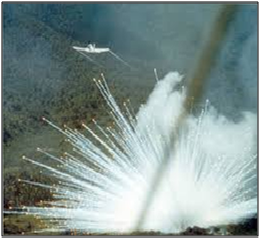
- Recently, the Human Rights Watch accused Israel of “unlawfully” using white phosphorus over residential parts of a southern Lebanese town.
About White Phosphorus:
-
- Nature: It is an allotrope of phosphorus (P₄), that turns yellow when exposed to light.
- Pyrophoric character: It ignites spontaneously in air at temperatures above 30 °C and continues to burn until it is fully oxidized or until deprived of oxygen.
- Reactivity: It is insoluble in water but soluble in organic solvents. Because of its high reactivity with oxygen, it is typically stored under water to prevent accidental combustion.
- Toxicity: It is highly toxic if ingested or inhaled and can cause severe, deep burns (often down to the bone) that are slow to heal and can reignite if exposed to air.
- Appearance: White (sometimes called yellow) phosphorus is a white to yellow waxy solid with a garlic like odour.
-
- Not a Chemical Weapon: Under the Chemical Weapons Convention (CWC), white phosphorus is not classified as a chemical weapon because it relies on thermal energy (heat/flame) rather than toxicity to achieve its primary military effect.
- Applications:
-
-
- It is often used by militaries to illuminate battlefields, to generate a smokescreen and as an incendiary.
- It is used for military purposes in grenades and artillery shells to produce illumination, to generate a smokescreen and as an incendiary.
- Its major industrial uses are in the production of phosphoric acid, phosphates and other compounds.
-
- These are also used to manufacture a range of products including fertilizers and detergents. Phosphorus has been used as a rodenticide and in fireworks.
- Impact on Humans:
- It is harmful to humans by all routes of exposure.
-
- The smoke from burning phosphorus is also harmful to the eyes and respiratory tract due to the presence of phosphoric acids and phosphine.
- It can cause deep and severe burns, penetrating even through bone.
Source:
Kharg Island
Category: Geography
Context:
- The United States is considering seizing Iran’s Kharg Island to choke off the regime’s oil revenues, a US official has suggested.
About Kharg Island:
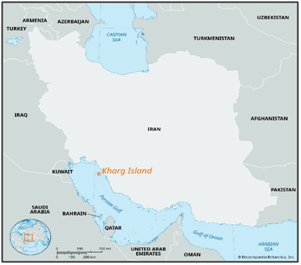
- Location: It is a small coral island in Iran in the northern Persian Gulf. It lies about 30 Km from the Iranian mainland.
- Area: Its area is 25 sq.km., its length is 8 km, and its width is 4.5 km.
- Uniqueness: This rocky limestone island is unique because it is one of the few islands in the Persian Gulf with freshwater, which has collected within the porous limestone.
- Climate: The island experiences hot and humid summers, and its highest point, Mount Didehban, stands at 87 meters above sea level.
- Oil field: The discovery of an offshore oil field in the waters around Kharg in the early 1960s stimulated the development of the island as a site for major petroleum and petrochemical installations. Connection by pipelines to the underwater oil fields transformed Kharg into Iran’s largest oil-loading terminal by the early 1970s.
- Reconstruction: During the Iran–Iraq war (1980–1988), Kharg repeatedly was bombed, and its oil facilities suffered extensive damage, but they were reconstructed in the early 1990s.
- Capacity: It boasts a massive storage capacity of 28 million barrels and loading infrastructure capable of handling VLCCs and ULCCs. It has a loading capacity of about 7 million barrels per day. It can load eight to nine supertankers simultaneously.
- Significance: It facilitates as much as 90 percent of the country’s oil exports and is vital for Iran’s economy. Its strategic significance lies in its proximity to the Strait of Hormuz, a crucial global oil passage.
Source:
Narcotics Control Bureau
Category: Polity and Governance
Context:
- Recently, the Narcotics Control Bureau (NCB) has dismantled a pan-India drug distribution network operating under the name Team Kalki.
About Narcotics Control Bureau:
- Establishment: It was constituted on 17th March 1986.
- Legal Basis: It was set up under Section 4(3) of the Narcotic Drugs and Psychotropic Substances (NDPS) Act, 1985.
-
- Governing Ministry: It operates under the administrative control of the Union Ministry of Home Affairs (MHA).
- Constitutional Mandate: Its policies are rooted in Article 47 of the Indian Constitution (Directive Principles of State Policy), which directs the State to prohibit the consumption of intoxicating drugs except for medicinal purposes.
- Motto: Its motto is “Intelligence, Enforcement, and Coordination”.
- Headquarters: Its headquarters is located in New Delhi.
-
- Leadership: It is headed by a Director General (DG), typically an IPS officer.
- Key functions:
-
-
- Coordination: It acts as the nodal point for all Central and State enforcement agencies (Customs, CBI, State Police).
-
- Intelligence: It collects and disseminates operational intelligence and maintains the National Data Bank on drugs.
-
-
- International Obligations: It implements India’s obligations under UN Conventions (1961, 1971, 1988) and liaises with international bodies like INTERPOL and the International Narcotics Control Board (INCB).
- Operational Powers: It is authorized to arrest offenders, conduct searches without a warrant, and seize contraband under the NDPS Act.
-
- Awareness: It organizes campaigns like the “International Day against Drug Abuse and Illicit Trafficking” (June 26th).
Source:
ASMITA Initiative
Category: Government Schemes
Context:
- Prime Minister recently shared an article on ASMITA initiative promoting women in sports.
About ASMITA Initiative:
- Full form: ASMITA stands for Achieving Sports Milestone by Inspiring Women Through Action.
- Nodal ministry: It comes under Ministry of Youth Affairs and Sports.
-
- Implementing authority: The Sports Authority of India (SAI) supports National Sports Federations in conducting Khelo India women’s leagues across multiple age groups at both zonal and national levels.
- Objective: It aims to promote women’s participation in sports and identify grassroots talent through dedicated leagues and competitions.
- Launch: It was started in 2021.
- Rebranding: It is a landmark vertical of the Khelo India Mission. It was formerly known as the Khelo India Women’s League.
-
- Scope: It covers over 30 sports disciplines (e.g., athletics, swimming, football) across hundreds of districts.
- Categorisation: These sports are conducted for three age groups (Under-13, 13–18, and 18+ years).
- Significance: The Khelo India ASMITA league is a core component of the ‘Khelo Bharat Niti,’ promoting sports for nation-building and women’s empowerment.
- Status: Till now, the ASMITA League has witnessed participation of almost 3 lakh women in 33 disciplines across 2600 leagues.
Source:
Dudhwa Tiger Reserve
Category: Environment and Ecology
Context:
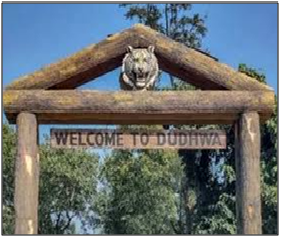
- Recently, in a rare incident a female one-horned rhinoceros was killed by two tigers in Sonaripur forest range of Rhino Rehabilitation Enclosure-I in Dudhwa Tiger Reserve.
About Dudhwa Tiger Reserve:
- Location: It is located on the Indo-Nepal border in the district of Lakhimpur-Kheri in Uttar Pradesh.
- Establishment: It was declared National Park in 1977 and Tiger Reserve in 1988.
- Constituent areas: It includes the Dudhwa National Park and two nearby sanctuaries, viz. Kishanpur and Katerniaghat.
-
- Indo-Nepal Border: It shares a transboundary link with Nepal’s Bardia National Park, facilitating genetic flow between tiger populations.
- Topography: It represents a typical Tarai-Bhabar habitat of the upper Gangetic plains, consisting of marshy grasslands, swamps, and dense forests.
- Rivers: The Sharda River flows by the Kishanpur WL Sanctuary, the Geruwa River flows through the Katerniaghat WL Sanctuary, and the Suheli and Mohana streams flow in the Dudhwa National Park, all of which are tributaries of the mighty Ghagra River.
- Vegetation: The vegetation is of the North Indian Moist Deciduous type, containing some of the finest examples of Sal forests in India.
- Flora: It mainly consists of Sal Forest (Shorea robusta) along with its associate tree species like Terminalia alata (Asna), Lagerstroemia parviflora (Asidha), Adina cordifolia (Haldu), etc.
- Fauna: Key species include Tiger, leopard, Swamp deer, Rhinoceros, chital, hog deer, barking deer, Sambhar, wild boar, and Ratel. It is the only wildlife habitat in Uttar Pradesh where Tigers and One-horned Rhinoceroses coexist.
- Birds: There are over 400 species of birds in the park, such as the Florican and black-necked storks.
Source: