IASbaba's Daily Current Affairs Analysis

Archives
(PRELIMS Focus)
Kappatagudda Wildlife Sanctuary
Category: Environment and Ecology
Context:
- The High Court of Karnataka directed the State government to include the left-out areas of the Kappatagudda reserve forest as part of Kappatagudda Wildlife Sanctuary.
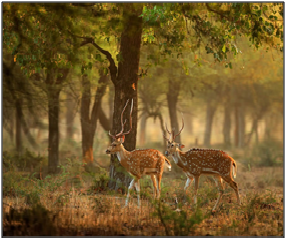
About Kappatagudda Wildlife Sanctuary:
- Location: It is located in the Gadag district of Karnataka.
- Other names: It is often called the “Western Ghats of North Karnataka”.
- Terrain: The sanctuary features diverse habitats—dry deciduous forests, grasslands, scrublands, and riverine zones.
-
- Uniqueness: It is the only sanctuary in Karnataka declared specifically for the conservation of wild flora, particularly medicinal plants.
- Mineral Resources: The area is rich in gold, iron, and manganese, causing ongoing conflicts with conservation efforts.
- Status: Originally a Conservation Reserve, it was upgraded to a Wildlife Sanctuary in May 2019.
- Historical significance: The sanctuary’s historical significance traces back centuries, evident in the remnants of ancient temples and ruins that dot the hillsides. These structures are adorned with intricate carvings and tell tales of dynasties that once ruled the land, such as the Chalukyas and Rashtrakutas.
-
- Key architectural marvels: It mainly consists of architectural marvels strewn across Kappatagudda, such as the Kappatagudda Jain Basadi, Brahma Jinalaya, Trikuteshwara Temple, and the Dambala Temple, stand testament to the craftsmanship and religious diversity of the region.
- Drainage: The Sanctuary forms the major catchment for the River Tungabhadra in the district.
- Vegetation: The sanctuary supports diverse vegetation typical of dry-scrub and deciduous ecosystems.
- Flora: The forest has about 400 medicinal plant species.
- Fauna: Key species include Leopards, Hyenas, Wolves, Foxes, Jackals, Four Horned Antelopes, Blackbucks, Monitor Lizards, Jungle Cats and various reptiles and birds.
Source:
Shahed Drones
Category: Defence and Security
Context:
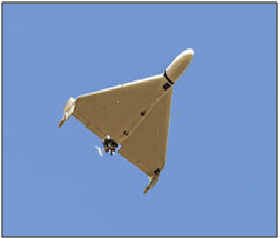
- The United States recently raised serious concerns about the capabilities of Iran’s Shahed attack drones.
About Shahed Drones:
-
- Nomenclature: Shahed (meaning witness in Farsi) drones are low-cost, one-way-attack unmanned aerial vehicles (UAVs) developed by Iran.
- Other names: These are often referred to as “kamikaze” or “suicide” drones. Russia refers to the Shahed-131 and Shahed-136 as “Geran-1” and “Geran-2,” respectively.
- Nature: They function essentially as guided missiles that fly towards a pre-designated target and explode on impact.
- Variants: Most widely used variants include Shahed-131 and Shahed-136.
-
- Cost: Each Shahed is reported to have an estimated cost between $20,000 and $50,000, making them cheaper than most other long-range, OWA UAVs. Ballistic and cruise missiles, by contrast, can cost millions of dollars each.
- Poor man’s cruise missile: This low cost, along with a low-altitude flight profile and self-sacrificial nature, has seen Shaheds labelled “the poor man’s cruise missile”.
- Range: The Shahed-131 has a range of 700–900 km, while the Shahed-136 has the longer range, i.e., between 2,000 and 2,500 kilometres.
-
- Structure: They are between 2.5 and three metres long and weigh around 200 kg at launch, most of which is the fuel and payload.
- Launch: They are launched using a disposable rocket booster fitted to their underside. Shortly after launch, the booster is jettisoned, and a piston-driven engine takes over to provide propulsion. They can be launched from both static rail mounts as well as vehicles.
- Key technologies: For navigation, it uses a combination of civilian GPS/GLONASS and an inertial navigation system (INS) often pre-programmed with coordinates before launch.
- Warheads: They can be equipped with various warheads, including high-explosive fragmentation, thermobaric, and shrapnel-filled munitions, maximising damage to both personnel and equipment.
- Significance: Produced in large numbers, swarms of Shahed drones can overwhelm air defences by saturating them from multiple directions at once.
Source:
Raisina Dialogue
Category: International Organisations
Context:
- Prime Minister recently inaugurated the 11th edition of the Raisina Dialogue in New Delhi.

About Raisina Dialogue:
- Framework: It is modelled on the lines of the Munich Security Conference and Singapore’s Shangri-La Dialogue.
- Launch: It is held annually since 2016 in New Delhi.
- Nature: It is structured as a multi-stakeholder, cross-sectoral discussion, involving heads of state, cabinet ministers, and local government officials, who are joined by thought leaders from the private sector, media, and academia.
- Significance: It is India’s flagship conference on geopolitics and geo-economics, committed to addressing the most challenging issues facing the international community.
- Host: The conference is hosted by the Observer Research Foundation (ORF) in partnership with the Ministry of External Affairs, Government of India. This effort is supported by a number of institutions, organisations, and individuals who are committed to the mission of the conference.
About Raisina Dialogue 2026:
-
- Edition: It is the 11th edition of the dialogue.
- Theme: Its theme is “Saṁskāra – Assertion, Accommodation, Advancement”.
- Participants: Around 2700 participants from 110 countries will be joining the dialogue in person.
- 6 pillars: Over the course of three days, decision makers and thought leaders of the world will engage each other across conversations in various formats over six thematic pillars:
- Contested Frontiers: Power, Polarity, and Periphery;
- Repairing the Commons: New Groups, New Guardians, New Avenues;
- White Whale: The Pursuit of Agenda 2030;
- The Eleventh Hour: Climate, Conflict, and the Cost of Delay;
- Tomorrowland: Towards a Tech-topia;
- Trade in the Time of Tariffs: Recovery, Resilience, Reinvention.
Source:
Moonshot Project
Category: Science and Technology
Context:
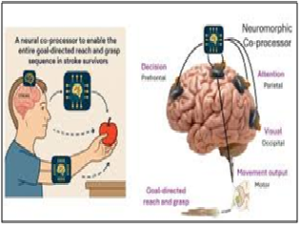
- Recently, the Indian Institute of Science (IISc) launched a moonshot project to develop brain co-processors that combine neuromorphic hardware and AI algorithms.
About Moonshot Project:
-
- Objective: It aims to develop smart, AI-driven “brain co-processors” that interface directly with the human brain to decode neural signals.
- Lead Institution: It is launched by Indian Institute of Science (IISc), Bengaluru.
-
- Funding: It is supported by the Pratiksha Trust, founded by Infosys co-founder Kris Gopalakrishnan and Sudha Gopalakrishnan.
- Key Technology: It combines neuromorphic hardware (brain-mimicking computing) with AI algorithms to create a “closed-loop” brain-machine interface.
- Significance: The project aims to build an AI-powered, closed-loop device that connects to different parts of the brain in order to help restore smooth, coordinated movement.
- Foundation for new developments: It will lay the foundation for a first-of-its-kind brain co-processor that restores complex sensorimotor function after stroke.
- Important for stroke survivors: The co-processors will be deployed towards cognitive rehabilitation of stroke survivors, to restore critical functions such as goal-directed reach and grasp abilities.
- Digital public goods: The project also aims to create India-specific neural databases (stereo EEG and ECoG) and open-source AI tools for the global research community.
Source:
Sharavathi Pumped Storage Hydroelectric Project
Category: Geography
Context:
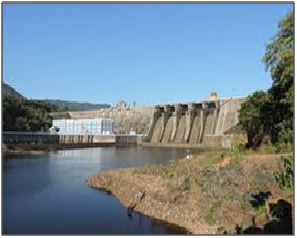
- The High Court of Karnataka issued notices to Centre and State over PIL challenging wildlife approvals for the Sharavathi Pumped Storage Hydel Project.
About Sharavathi Pumped Storage Hydroelectric Project:
- Location: It is a PSHP proposed on the Sharavathi River in the Shivamogga district, Karnataka.
- Development: It is being developed by Karnataka Power Corporation Limited (KPCL).
- Uniqueness: This project, with its aim to generate 2,000 MW of power, will be the biggest of its kind in the country.
- Structure: The project involves building a pumped storage power plant between two existing reservoirs.
-
- Dams: The Talakalale dam, which stands at 62.48 meters tall, will be the upper reservoir. This dam currently helps balance water for the existing Sharavathy hydroelectric project. The Gerusoppa dam will be the lower reservoir, and it is about 64 meters tall.
- Pumping of water: Water will be pumped uphill during off-peak hours and released downhill to generate electricity during peak demand.
- Use of renewable energy sources: The project aims to utilise renewable energy sources and reduce carbon emissions.
- Design: It is modelled on the lines of Telangana’s Kaleshwaram project.
- Other uses: It also aims to supply drinking water to Bengaluru. Five tunnels and eight pumping stations are critical parts of the plan.
- Concerns: The project falls within the Eco-Sensitive Zone (ESZ) of the Sharavathi Wildlife Sanctuary, which is home to the endangered lion-tailed macaque, hornbills, king cobras, and numerous endemic plant species of the Western Ghats.
Source: