Part of: GS Prelims and Mains III – Environment and Biodiversity; Animal Conservation
Key Pointers:
The Supreme Court has ruled that tusks are the property of the government.
The Supreme Court observed that there is a clear “declaration” in the Wildlife (Protection) Act of 1972 on elephant tusks being government property.
The ruling, however, may not affect individuals who have ownership certificates for declared ivory. Even in the case of captive elephants, either the government keeps custody of tusks or owners are permitted to retain them if they give an undertaking that they would not be traded.
Do you know?
India prohibits import and export of ivory.
The population estimation of Asian elephants in 2017 census is lower than from the last census estimate in 2012.
Karnataka has the highest number of elephants (6,049), followed by Assam (5,719) and Kerala (3,054).
Important Value Additions:
Project Elephant
Project Elephant (PE) was launched by the Government of India in the year 1992 as a Centrally Sponsored Scheme with following objectives :
To protect elephants, their habitat and corridors
To address issues of man-animal conflict
Welfare of captive elephants
Monitoring of Illegal Killing of Elephants (MIKE) Programme
Mandated by COP resolution of CITES, MIKE program started in South Asia in the year 2003 with following purpose – To provide information needed for elephant range States to make appropriate management and enforcement decisions, and to build institutional capacity within the range States for the long-term management of their elephant populations
The main objectives of the MIKE are
to measure levels and trends in the illegal hunting of elephants;
to determine changes in these trends over time; and
to determine the factors causing or associated with such changes, and
to try and assess in particular to what extent observed trends are a result of any decisions taken by the Conference of the Parties to CITES
Part of: GS Prelims and Mains II – Welfare and Women Issues; Government policies
In News:
Supreme Court held that the Domestic Violence Act — meant to punish men who abuse women in a relationship — extends to all man-woman relationships, and also protects divorced women from their former husbands.
Key pointers:
According to the recent order, ‘domestic relationship’ includes “consanguinity, marriage, a relationship in the nature of marriage, adoption or as family members living together as a joint family”.
In other words, ‘domestic relationship’ is not confined to the “relationship as husband and wife or a relationship in the nature of marriage, but it includes other relationship as well such as sisters, mother, etc.”.
The court held that domestic violence can continue even after divorce. A divorcee husband could resort to violence by entering the workplace of his former wife to commit an act of violence, or even attempt to communicate with her, or threaten or cause violence to her relatives or dependents or any other person. It amounts to domestic violence if the former husband tried to dispossess the woman from a jointly-owned property or refuse to return her ‘stridhan’ or valuable security or other property.
The Act brings all these acts of violence within its ambit.
The purpose of the enactment of this Act is to protect rights of women who are victims of violence of any kind occurring within the family.
Shangri-La dialogue and Shanghai Cooperation Organisation (SCO) summit
Part of: GS Prelims and Mains II – India and the world, International relations
In News:
Prime Minister Narendra Modi is expected to make a “major” speech on India’s defence and security outlook at the Shangri-La dialogue in Singapore (which will be held on June 1 and 2).
PM will also fly to Qingdao city in China for the Shanghai Cooperation Organisation (SCO) summit which will be held on June 9 and 10.
Important Value Additions:
About Shangri-La Dialogue (SLD):
SLD is a “Track One” inter-governmental security forum held annually by an independent think tank, the International Institute for Strategic Studies (IISS).
The event is attended by defense ministers, permanent heads of ministries and military chiefs of 28 Asia-Pacific states.
The forum gets its name from the Shangri-La Hotel in Singapore where it has been held since 2002.
Shangri-La dialogue is run by the London-based think tank International Institute of Strategic Studies and funded and hosted by the Singapore government.
Over the years ministers have used the Dialogue to propose and advance initiatives on important security issues.
About SCO:
China will host 2018 Shanghai Cooperation Organization (SCO) Summit.
The Shanghai Cooperation Organisation (SCO) is a Eurasian political, economic, and security organisation.
Creation of SCO was announced on 15 June 2001 in Shanghai, China.
SCO Members: China, Kazakhstan, Kyrgyzstan, Russia, Tajikistan, Uzbekistan, India and Pakistan
India and Pakistan joined SCO as full members on 9 June 2017 at a summit in Astana, Kazakhstan.
Afghanistan, Belarus, Iran and Mongolia have observer status at present.
The groupings main objective is military cooperation between members. It also works towards intelligence-sharing, counter-terrorism operations in Central Asia. It is primarily centred on its member nations’ Central Asian security-related concerns, often describing main threats it confronts as being terrorism, separatism and extremism.
Part of: GS Prelims and Mains III – Environment and Ecology; Science and Technology
In News:
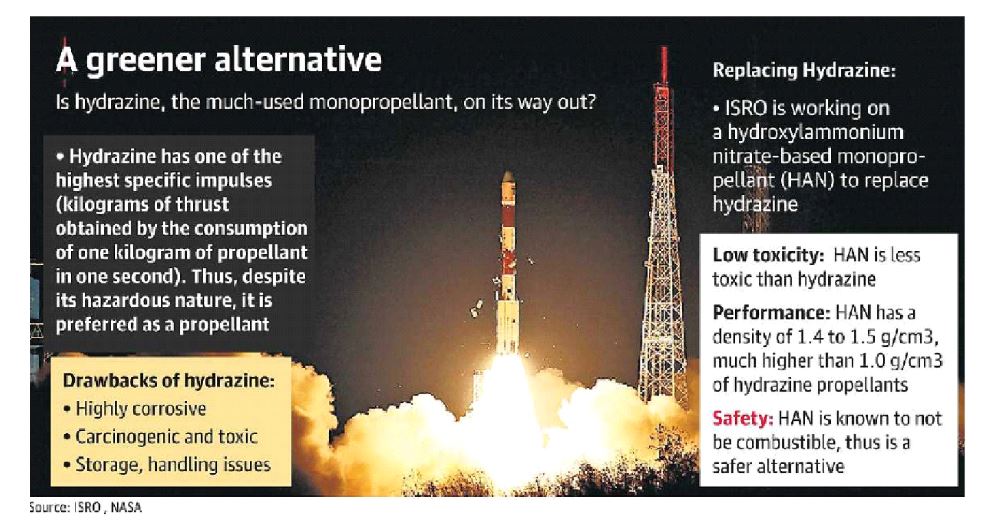
Scientists at the Indian Space Research Organisation (ISRO) are developing an environment-friendly propellant to power satellites and spacecraft.
If successful, the conventional hydrazine rocket fuel, a highly toxic and carcinogenic chemical will be replaced with a greener propellant blend based on hydroxylammonium nitrate (HAN) for future missions.
China’s first indigenous aircraft carrier “Type 001A”
In News:
China’s first domestically manufactured aircraft carrier started sea trials.
The carrier is known as “Type 001A”
The ship will give China a second aircraft carrier as it asserts its claims in the South China Sea and seeks to deter any independence movements in Taiwan.
China’s sole operational aircraft carrier, the Liaoning, is a repurposed Soviet ship bought from Ukraine, which went into service in 2012.
Do you know?
Indigenous Aircraft Carrier (IAC-1) Vikrant – is India’s first Indigenous Aircraft Carrier
Part of: GS Prelims and Mains III – Indian Economy; basic economic terminologies
In news:
Concern with definition of Shell Companies
As multiple agencies and regulators probe the suspected use of ‘only-on-paper’ firms for financial irregularities, the government is looking to put in place a proper definition for ‘shell companies’ so that investigations are not hampered and prosecution can withstand scrutiny in courts of law.
Current definition for ‘shell companies’ — a term generally used for companies that are set up for financial manoeuvrings only or are kept dormant for some future use.
Officials express that these companies generally exist only on paper and may be used for nefarious activities. Therefore, definition of shell companies should be in line with OECD definition –
OECD defines a shell company as ‘being formally registered, incorporated or otherwise legally organised in an economy but which does not conduct any operations in that economy other than in a pass-through capacity’.
(MAINS FOCUS)
NATIONAL
TOPIC: General Studies 3:
Conservation, environmental pollution and degradation, environmental impact assessment
Polluted Cities in India: WHO report
In news:
The latest survey by the World Health Organisation (WHO) — conducted every two years — of the most polluted air in cities around the world- shows that 14 of the 15 worst cities were from north India, forming a band from Jodhpur in the west to Muzaffarpur in the east.
India cities:
Kanpur figured on top of the list. Kanpur’s average PM 2.5 levels were 17 times the WHO limit in 2016, the cut-off year for the current study. It was followed by Faridabad, Varanasi, Gaya and Patna. Delhi figured sixth, which is hardly any consolation. In 2014, the WHO listed Delhi the worst in the world in terms of PM. (Particulate matter (PM) 2.5 is the smallest measurable pollutant, 30 times less than the width of human hair, and is most hazardous.)
What makes north Indian cities the most polluted in the world?
The northern Indian phenomenon is a combination of rapid increase in pollution sources due to urbanisation and its inherent geographical disadvantage that is landlocked that makes the region extremely vulnerable to winter inversion leading to massive trapping of pollution. The region does not have the advantage of a coastline.
Other experts have cited how the Indo-Gangetic plains are sandwiched between the Himalayas and the Vindhyas and are home to more than 600 million people with winds blowing from north-west to east, especially in winter, which carry pollutants from other regions.
Regional meteorological conditions alone are not responsible for causing pollution in north Indian cities. Global climate change is also responsible for these increasingly high temperatures and frequent storms and much of this is man-made.
Proliferation of air pollution sources includes motorisation, proliferation of industrial units using extremely dirty fuels without pollution control, extensive use of solid fuels for cooking, massive construction activities, enormous problem of waste mismanagement and big dust impacts. The usual suspects are – The burning of crop residue, Dust from construction debris, Vehicle exhaust.
The region thus, requires more stringent interventions to counter its disadvantages.
A national public health emergency:
Two years ago, a study on the cost of air pollution co-authored by the World Bank found that the country lost 1.4 million lives due to such contamination in 2013, shaving off a massive 8.5 per cent of GDP. The case for controlling such pollution is thus incontrovertible in economic terms, if not in saving lives. Indians can live four years longer if we comply with WHO norms.
A study on the global burden of disease by the Health Effect Institute in the US, showed that India tops the list of countries — beating China — in registering the highest number of early deaths due to ozone pollution.
To adapt: Think regionally, but act locally
Beijing, Shanghai and other Chinese cities have demonstrated that where there is the political will, there is a way to tackle air pollution. Measures that need to be taken aren’t rocket science:
More efficient means of treating crop residue.
Replacing smoky chulhas with efficient models if not LPG cylinders.
Ccracking down on construction debris and polluting thermal power stations.
Restricting the number of vehicles.
In order of priority, the chulhas are probably the most urgent because 200 million households continue to burn biomass within homes. Switching to mass public transport in cities — not necessarily expensive metros, which many can’t afford — is well within the capacity of every city.
Connecting the dots:
A survey by the World Health Organisation (WHO), of the most polluted air in cities around the world, shows that 14 of the 15 worst cities were from north India. What makes north Indian cities the most polluted in the world? Discuss.
AGRICULTURE/NATIONAL
TOPIC:
General Studies 2:
Government policies and interventions for development in various sectors and issues arising out of their design and implementation.
General Studies 3:
Agrarian/Rural distress and Rural Development
Need for policy which focus on Availability and Accessibility of Certified Seeds
In news:
Global attention has been devoted to water scarcity and its effect on Indian farmers. However, new analysis from Indian researchers suggests that far more good could come if irrigation were combined with seed improvement.
New studies and researches were conducted by noted experts from India and around the world to provide possible measures to be taken that would help Indian states respond to major challenges and improve their competitiveness, economic performance, and the well-being and prosperity of citizens.
Two new research papers provides about how to boost agricultural performance. It examines policies that would reduce the effects of water scarcity in Rajasthan and Andhra Pradesh.
Outcome of First Research Paper:
The research (by Dinesh Kumar, executive director of the Institute for Resource Analysis and Policy (Irap), Hyderabad) highlights that –
Both Andhra and Rajasthan has some hot and dry region, with frequent droughts. Only about one-third of the crops are irrigated, and the rest are dependent on rain-fed cultivation, which is susceptible to the vagaries of the weather.
The research paper stresses on reviving traditional water harvesting system such as Tanks, Nalas and Kunds.
Policy should focus on reviving traditional water harvesting system
Tanks are an important source of water for the rural economy, but—as in other areas—an explosion of well-irrigation has reduced the surface run-off into these tanks. The biggest victims are poor, small, marginal farmers, who depend on tanks for supplementary irrigation for their kharif crop.
The research talks about majorwater transfer projects (being implemented in Andhra Pradesh) – which involves moving surplus water into the tanks, so that they are full. This approach ensures farmers can continue crop production when the tanks do not receive inflows.
The annualized cost of the infrastructure and drainage required to fill the tanks is estimated to be about Rs4,500 per hectare, as well as another Rs2,000 for the annual operation and maintenance of the system.
Farmers, however, will earn more: The annual incremental net return is estimated to be about Rs9,000 per hectare. There would be further indirect benefits from energy savings because farmers wouldn’t need to pump groundwater, as well as from the incremental return from the increase in yield of wells and consequent expansion in the area served, and more intensive watering of irrigated crops. These benefits together add up to Rs15,000 per hectare per year.
This means that every rupee spent on the policy in Andhra Pradesh would generate benefits worth nearly four rupees.
Likewise, the research highlights that renovating the traditional water harvesting system in Rajasthan would return three rupees for every rupee invested, while, in Andhra Pradesh, investment in drip irrigation and mulching of high-value crops would generate about five rupees.
Outcome of Second Research Paper:
But second new research (by agricultural economist Surabhi Mittal, independent consultant and non-resident fellow, Tata-Cornell Institute for Agriculture & Nutrition (TCI), Technical Assistance and Research for Indian Nutrition & Agriculture (Tarina)), suggests another approach may help farmers a lot more.
The researcher looks at various methods of improving farm productivity and farmer income.
One of these aims to help solve the problem of the high cost and unavailability of labour through an increase in the level of mechanization by using custom hiring centres, using public-private partnerships.
Another approach focuses on relying on information and communication technology (ICT) enabled extension services, which play a crucial role in supporting agricultural activities by taking research, technology and know-how to farmers to improve adoption.
Third, the author looks at improving soil health; and,
finally, considers improving the availability of certified seeds.
The research paper highlights that the last idea would generate powerful returns.
Focus on Availability and Accessibility of Certified Seeds
In India, farm-saved seed from previous crops remains the most prominent source of seeds, year after year, accounting for nearly three-quarters of all seed usage. This means low crop productivity as optimal yield potential is a function of the quality of seeds used.
Although many improved varieties of seeds have been released for cultivation, their full impact has not been realized owing to poor adoption rates as well as poor seed replacement rates.
The way forward:
The solution to this challenge involves spending money on producing more quality seeds (for all the major crops in each state) and promoting these among farmers.
This will lead to better crop yields, increased production, and higher incomes.
Every rupee spent will have benefits to Andhra Pradesh worth around 15 times the costs, and 20 times in Rajasthan.
Improving agricultural productivity is important in order to improve farmer incomes, and it requires increases in yield, better productivity through the efficient utilization of resources, reduction in crop losses, and ensuring that farmers receive fair prices for output.
The phenomenal benefits from focusing on improving access to seeds highlight the need to prioritize policies that will achieve the most for farmers.
Connecting the dots:
Critically analyze the strategies outlined by the Indian government to achieve the target of doubling farmers’ income by 2022. Elaborate on the need to make structural changes in Indian agriculture and what more is required to achieve the target.
The state of agricultural productivity in India is still poor. Discuss. Also suggest what steps are needed to improve agricultural produce.
(TEST YOUR KNOWLEDGE)
Model questions: (You can now post your answers in comment section)
Q.1) Consider the below statements:
India prohibits import and export of ivory.
Karnataka has the highest number of elephants.
Elephant tusks are the property of the government, according to the Wildlife (Protection) Act of 1972.
Which of the above statements is/are correct?
2 only
1 and 2 only
1 and 3 only
1, 2 and 3
Q.2) Consider the following statements about elephant conservation:
Under Wildlife (Protection) Act, 1972 Elephant is a Schedule I animal.
Asian elephants are listed as “endangered” in the IUCN Red List of threatened species.
Project Elephant is a Centrally Sponsored Scheme.
Which of the above statements is/are incorrect?
2 only
2 and 3 only
All the above
None
Q.3) Who among the following can be punished under Domestic Violence Act – meant to punish men who abuse women in a relationship?
Husband
Former Husband
Brother
Son
Choose the appropriate code:
1 only
1 and 2 only
1, 3 and 4
1, 2, 3 and 4
Q.4) Consider the below statements in regard to Shangri-La dialogue:
It is a “Track One” inter-governmental security forum attended by defense ministers, permanent heads of ministries and military chiefs of 28 Asia-Pacific states.
It is held annually and run by the Singapore government.
Which of the above statements is/are correct?
1 only
2 only
Both 1 and 2
Neither 1 nor 2
Q.5) Consider the below statements about Shanghai Cooperation Organisation (SCO):
It is a Eurasian political, economic, and security organisation.
Its members include all Central Asian Countries except Uzbekistan.
India and Pakistan joined SCO as full members.
Which of the above statements is/are correct?
1 only
1 and 2 only
1 and 3 only
1, 2 and 3
Q.6) MIKE program started in South Asia deals with –
Conservation of Elephants
Conservation of Tigers
Conservation of Vultures
Conservation of Rhinos
Q.7) Scientists at the Indian Space Research Organisation (ISRO) are developing an environment-friendly propellant to power satellites and spacecraft. The green propellant blend is based on –
hydrazine rocket fuel
cryogenic technology
hydroxylammonium nitrate (HAN)
hybrid NEMA oxidizer
Q.8) Recently, China started sea trials with it’s first domestically manufactured aircraft carrier. Identify the name of the carrier from below –