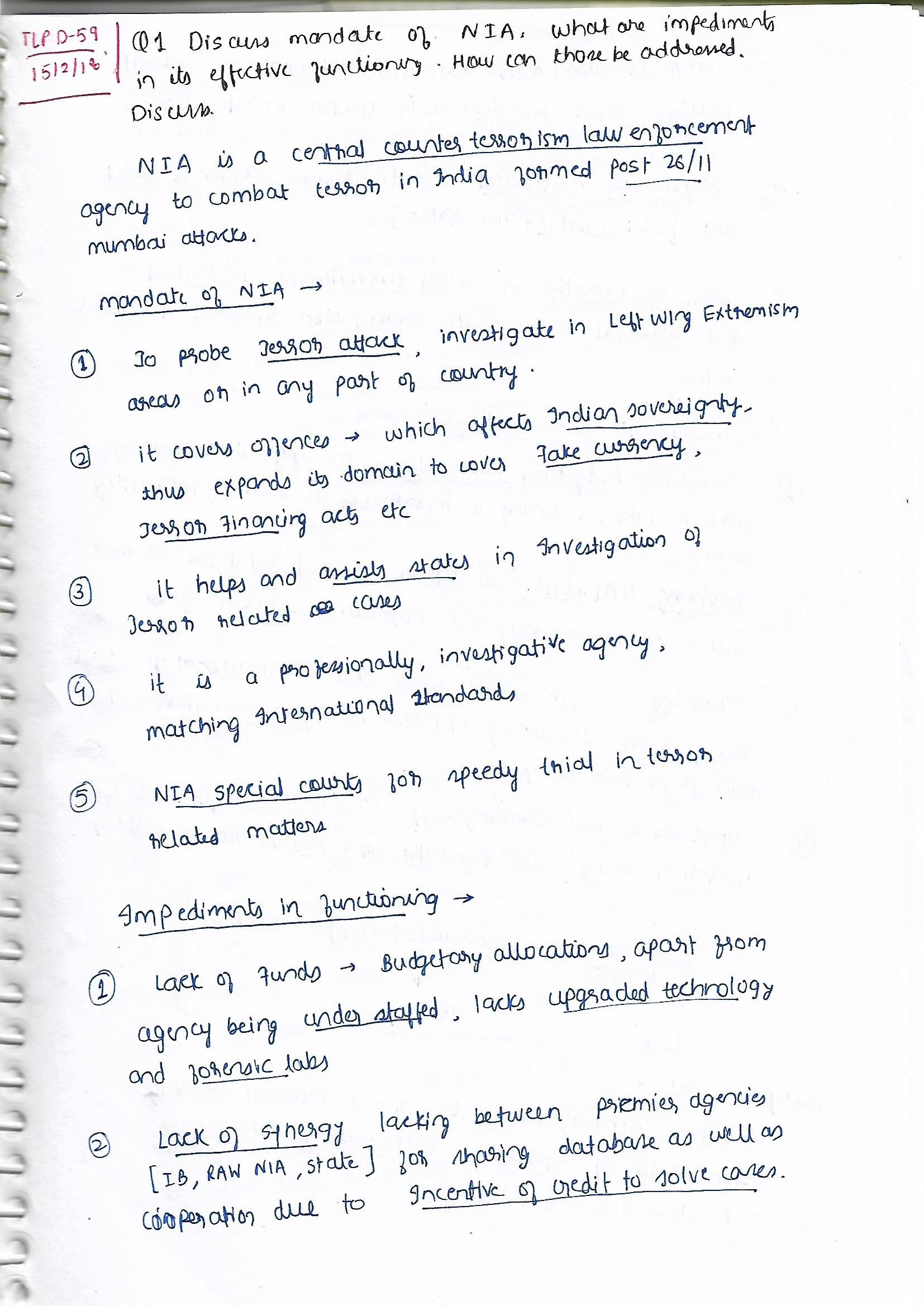
1. Discuss the mandate of the National Investigation Agency (NIA). What are the impediments in its effective functioning? How can those be addressed? Discuss.
Introduction: Define what NIA is and how it was formed.
Body: In body, mention mandates in the first part. Then mention the impediments and how to address them.
Conclusion: 2-3 line conclusion.
Introduction
After 26/11 Mumbai attack, government of India enacted NIA act on 31st December 2008 which gave birth to national Investigation agency which is presently functioning as premier central counter terrorism law enforcement agency in India.
Body
Mandates:
In-depth professional investigation of scheduled offences using the latest scientific methods of investigation and setting up such standards as to ensure that all cases entrusted to the NIA are detected.
Ensuring effective and speedy trial.
Developing into a thoroughly professional, result oriented organization, upholding the constitution of India and Laws of the Land giving prime importance to the protection of Human Rights and dignity of the individual.
Developing a professional work force through regular training and exposure to the best practices and procedures.
Displaying scientific temper and progressive spirit while discharging the duties assigned.
Inducting modern methods and latest technology in every sphere of activities of the agency.
Maintaining professional and cordial relations with the governments of States and Union Territories and other law enforcement agencies in compliance of the legal provisions of the NIA Act.
Assist all States and other investigating agencies in investigation of terrorist cases.
Build a data base on all terrorist related information and share the data base available with the States and other agencies.
Study and analyze laws relating to terrorism in other countries and regularly evaluate the adequacy of existing laws in India and propose changes as and when necessary.
To win the confidence of the citizens of India through selfless and fearless endeavors.
Impediments:
Human resource: The personnel are taken from IPS, IRS, Central armed police force etc. on deputation and do not have their own personals.
Finance: Depends on Budgetary allocation without sufficient funds.
Technology: Lack of advanced technology to tackle.
Expertise: Lack of experts and specialists.
Federal spirit: Law and Order is state subject and it is accused as encroaching on state subject.
How to address these issues:
Recruitment: Direct recruitment.
Budget: Increases allocation or maybe charged on consolidated fund.
Lists: Separate lists on issues which directly come under them than taking over from state police or central order.
Training: Special training and international exposure.
Note: The above mandates are taken from NIA website. Go through this and in exam even if 4-5 is produced it is enough. In total 10-12 points are needed for whole answer.
Conclusion
After 26/11, there has not been any incident except small attacks in Kashmir region. But government should not wait for another attack to empower the NIA. Rather steps should be taken to provide them with adequate resource in all sphere and make them competent enough on line of western countries.
Q2. What is NATGRID? How can it be developed as an effective tool to strengthen India’s intelligence apparatus? Discuss.
Approach
It is a two part question
In the introduction discuss how the idea of NATGRID came up and then discuss its main provisions
After that, mention how it strengthen India’s intelligence network
Even though not asked, do discuss some of the related concerns (see extra)
Body
The National Investigation of India had found intelligence failure as one of the prime reason behind the 26/11 attacks in Mumbai 2008. This attack exposed several weaknesses of Indian intelligence gathering and action networks. Therefore, in the aftermath, the idea of NATGRID was proposed.
The National Intelligence Grid or NATGRID is the integrated intelligence grid connecting databases of core security agencies of the Government of India. It collects comprehensive patterns of intelligence that can be readily accessed by intelligence agencies.
Role of NATGRID
It is a counter terrorism measure involved in collecting and collating a host of information from government databases including credit card transactions, tax details, bank account details, visa, immigration records and itineraries of air and rail travel.
The combined data shall be accessible by the central agencies namely the Directorate General of Central Excise Intelligence, Central Board of Excise and Customs, Narcotics Control Bureau, Enforcement Directorate, Directorate of Revenue Intelligence , Central Board of Direct Taxes, Financial intelligence unit, Central Bureau of Investigation, the Intelligence Bureau and the Research and Analysis Wing.
How it is different?
Unlike the central organizations like NCTC and the NIA, the NATGRID is necessarily a tool that enables security agencies to detect and collect relevant information on terror suspects from database pooled from various different organizations and services in the country. It will help in identification, capture and prosecution of terrorists and help preempt terrorist plots.
NATGRID also helps the police and the Intelligence Bureau keep a tab on persons with suspicious backgrounds. The police would have access to all the data related to that person and any movement by this person would also be tracked with the help of the data base. A pattern search and recognition system helps in reducing human rights violations while extracting information.
Extra: Concerns Related to NATGRID
There is fear of violation of individual privacy and misuse of information by enforcement agencies. For e.g. WikiLeaks revealed misuse by state agencies in the US
Against federalism – state agencies such as the police have been kept out of the loop
Data Protection – the capability to protect such as massive repository of data is being questioned itself.
Best Answer: None
Q.3) Examine the role played by paramilitary forces in India’s internal security. What reforms can be introduced to make their functioning more coordinated and effective? Discuss.
Body:
Paramilitary forces and internal security:India has undertaken one of the fastest expansions of paramilitary internal security forces in the world. However estimates vary, India’s paramilitary strength is widely believed to be over 1 million, representing some 50 percent of the country’s total armed forces, making India’s the second-largest paramilitary force in the world, which helps India to maintain peace from internal and external threat.
The role played by paramilitary forces in India’s internal security:
All armed forces have both domestic and international responsibilities and it plays a major role in the internal security, as we have witnessed many times. Especially paramilitary forces have played a PARAMOUNT ROLE in upholding peace and stability in India post-independence, from political problems, destabilization, terrorism, communal riots, Maoism to internal disturbances.
Problems faced by paramilitary forces:
Unregulated expansion,
Infrastructural deficiencies,
Shortages of transport and arms and ammunition,
Poor personnel management,
Ineffective coordination between the state police and the CAPF leadership,
Absence of a robust in-house grievance redressal mechanism,
Lack of promotional prospects for the constabulary and the direct recruit officers,
The structural and psychological disconnect between the cutting edge constabulary and
The ones who are at the top of the pyramid, inordinate delays in procurement of combat-ready equipment and inadequate medical facilities.
These problems need to be addressed for better functioning of paramilitary forces in India and its internal security, by addressing these problems we can make paramilitary forces functioning more effective and coordination can be improved by many folds.
Reforms needed to make their functioning more coordinated and effective:
Better coordination among intelligence agency with security agencies, by using the technology and also access to NATGRID can be handy for coordination.
Equip CRPF modern weaponry and training and cutting edge technology for intelligence.
Increase recruitment of local tribals and local citizens in state police service, as it has helped CRPF’s to combat Maoism in the internal parts of the red-corridor.
Deploy more women officers in Maoist hit areas, as they will deal with more humane manner and it leads to less human rights violation cases on government as well as it will enhance the coordination with the locals.
When forces are operating in the same situations like Jammu and Kashmir, they should be given same pay on the lines of army and also they should be provided allowances and perks on the lines of army like canteen facilities etc., which government has already done this.
More common platforms of operation between state police and forces to operate as one and together need to be created.
Exchange of intelligence and resources between the police and forces need to be made more seamless and quick.
It is too important a responsibility to be left to the IPS alone, government should give equal importance to paramilitary officers to hold higher position, for better understanding their problems and to produce solutions for the same.
Conclusion:
While these reforms should be brought to make the paramilitary forces achieve their full potential, it is to be noted that our law makers’ envisioned only a transitory role for the paramilitary forces and ultimately, the state police have to be strengthened and trained and their capabilities improved to uphold total peace in the hinterland of the country.
4. What role does DRDO play in India’s defence ecosystem? Discuss its achievements and limitations as India’s premiere defence PSU.
Approach:
Introduction
Role in defence ecosystem
Significant achievements of DRDO
Limitations
Conclusion
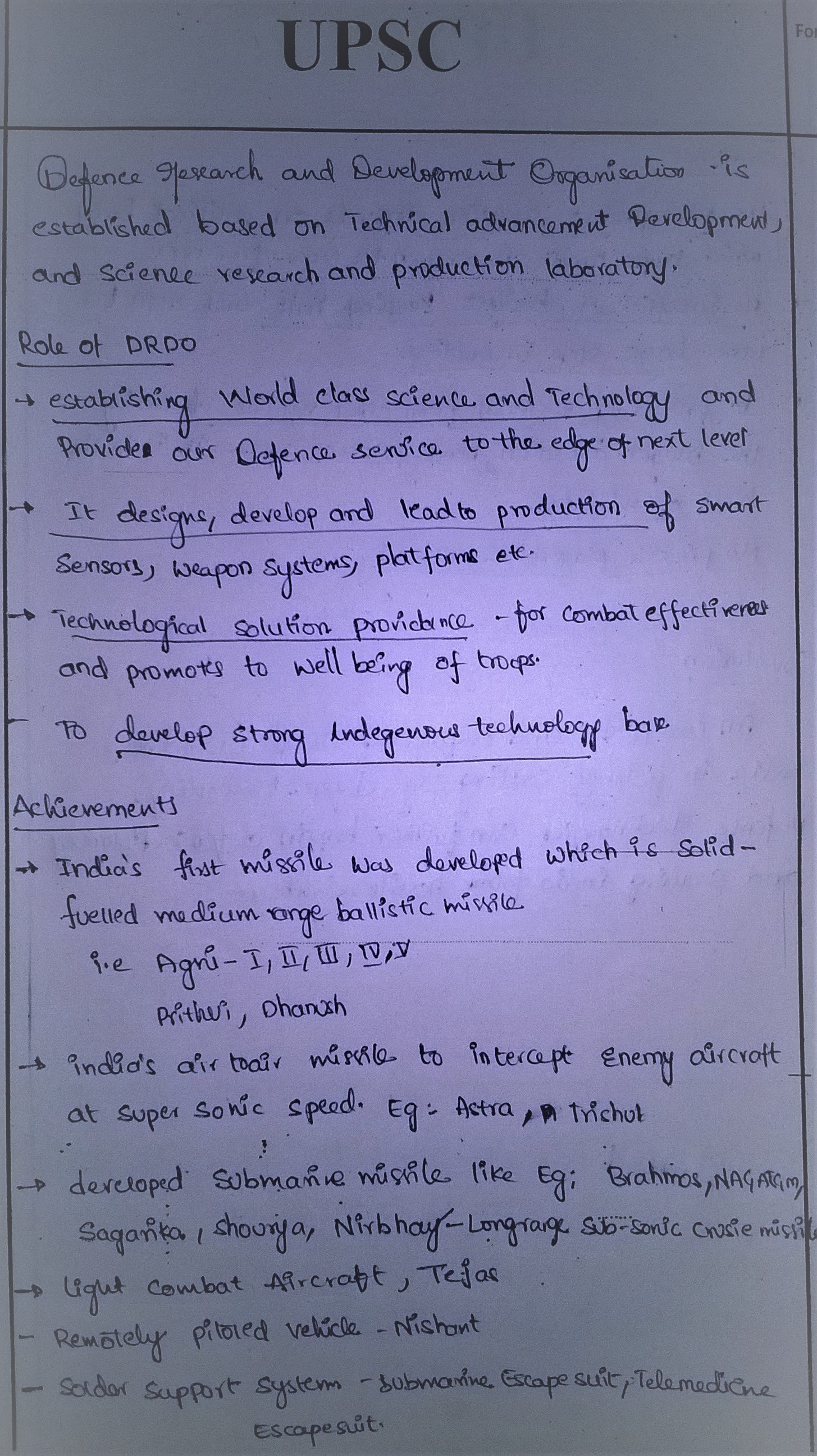
Introduction: Defence Research and Development Organisation was formed in 1958 by culmination of defence Science Organisation and some other technical development establishments. A separate department of Defence Research and Development was formed in 1980 which now administers DRDO and its 51 laboratories and establishments.
Role in defence ecosystem:
DRDO functions as the nodal agency for the execution of major development programs of relevance to defence.
Design, develop and lead to production state-of-the-art sensors, weapon systems, platforms and allied equipment for our Defence Services.
Provide technological solutions to the Services to optimise combat effectiveness and to promote well-being of the troops.
Develop infrastructure and committed quality manpower and build strong indigenous technology base.
Significant achievements of DRDO:
DRDO has made great strides since 1980 towards making our armed forces self-reliant. DRDO has progressively enhanced their combat effectiveness through development of state of the art indigenous defence systems. Few of the major products/systems developed by DRDO includes-
Platforms:
Light Combat Aircraft ‘Tejas’
Pilotless Target Aircraft ‘Lakshya-I’
Sensors:
Airborne Early Warning & Control (AEW&C)
Integrated Sonar System for EKM Submarine.
Weapon Systems:
Prithvi Missile for Army and Air Force
Supersonic Cruise Missile ‘BrahMos’
Multi Barrel Rocket Launcher System ‘Pinaka’ Mk-I
Limitations:
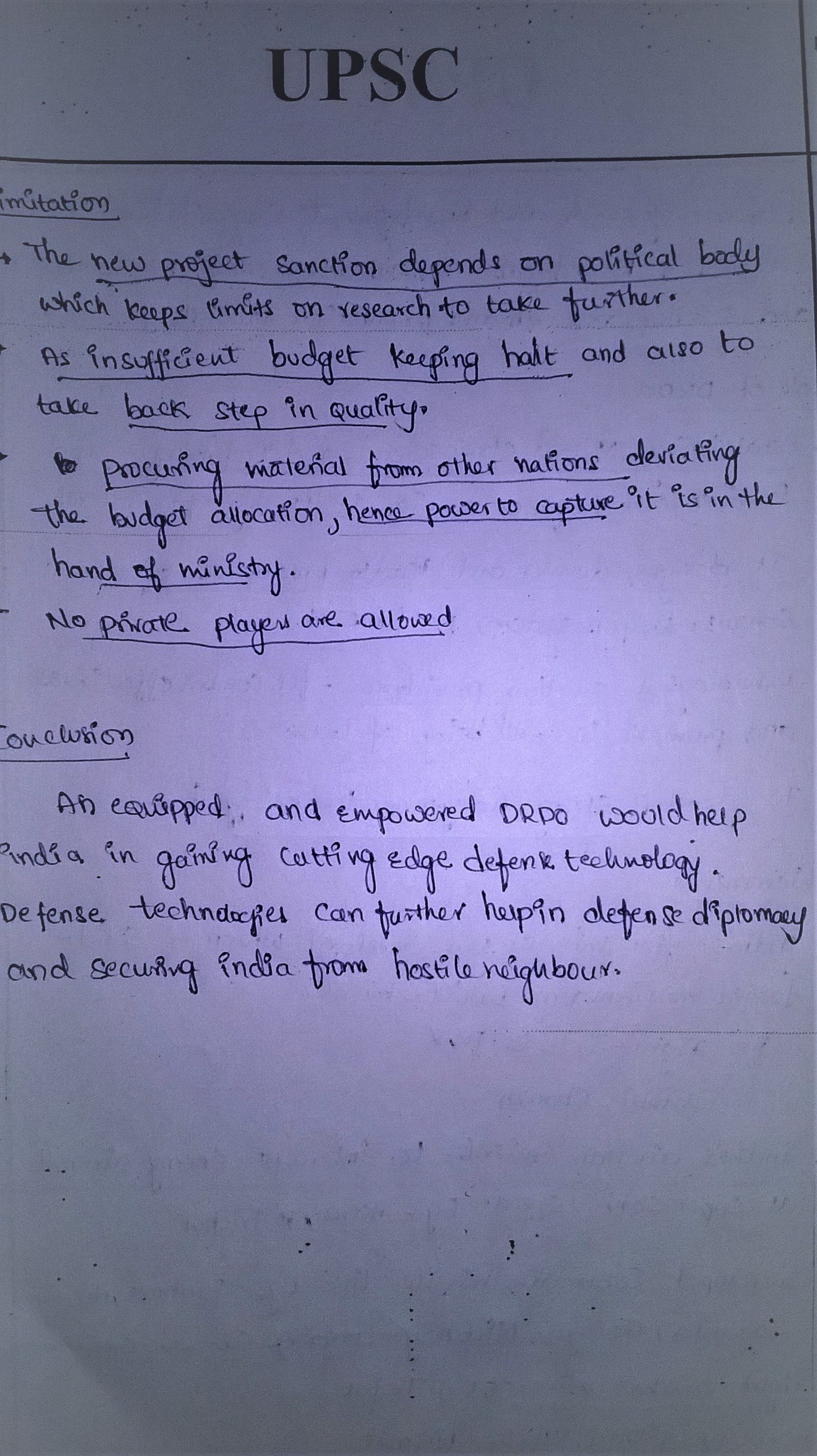
Delay in projects due to business as usual approach, lack of funds and lack of technical manpower.
Cost overruns- mainly because of delay in projetc completion.
Lack of indigenisation- Heavy reliance on other countries for intermediate products.
Insufficient budgetary expenditure.
Conclusion:
Revamping of DRDO is required in a manner that it works on the lines of ISRO. Improvising the ways of doing work, checking understaffing, investing in research and development etc is required so as to make DRDO an effective and efficient organisation.
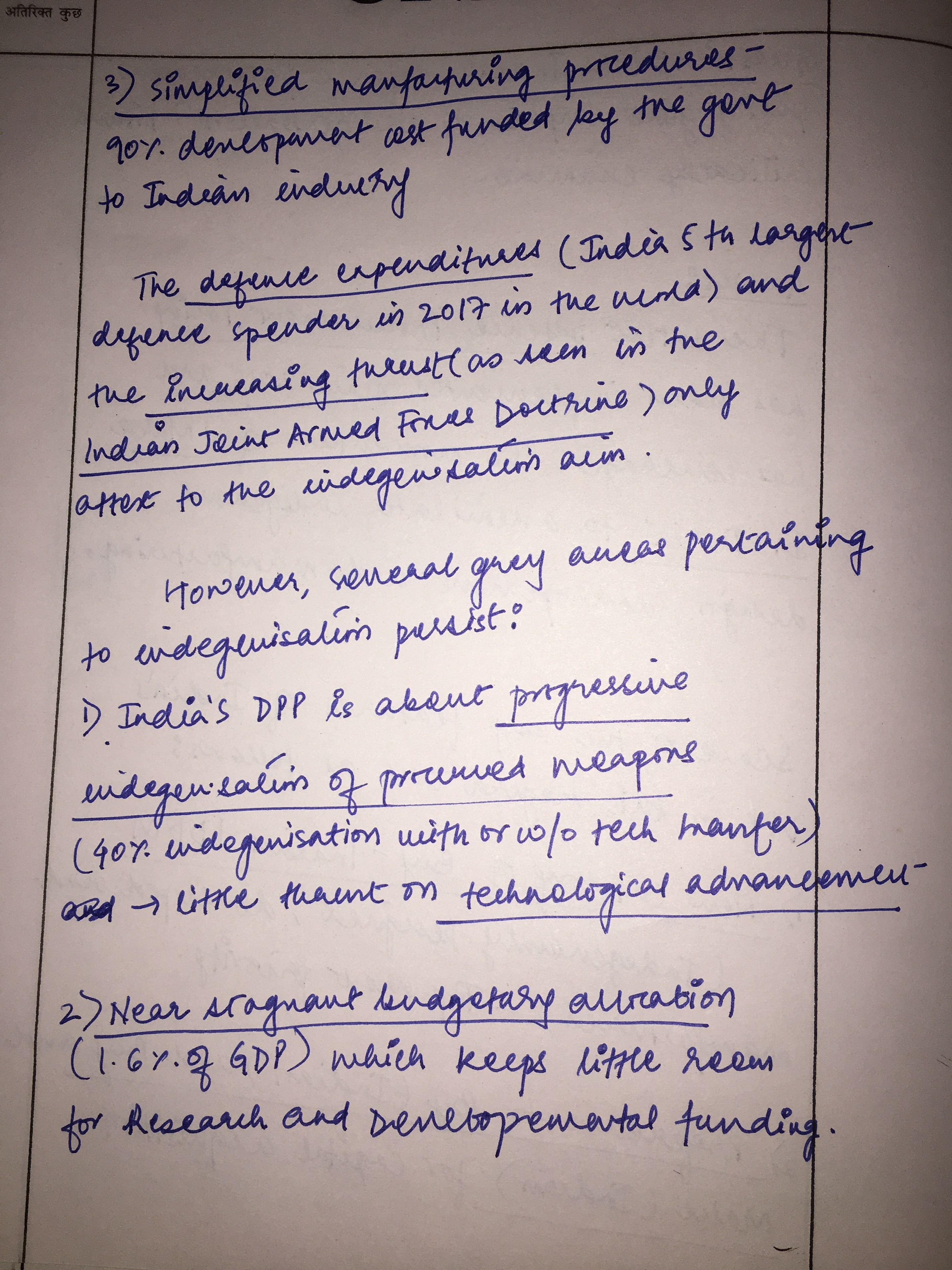
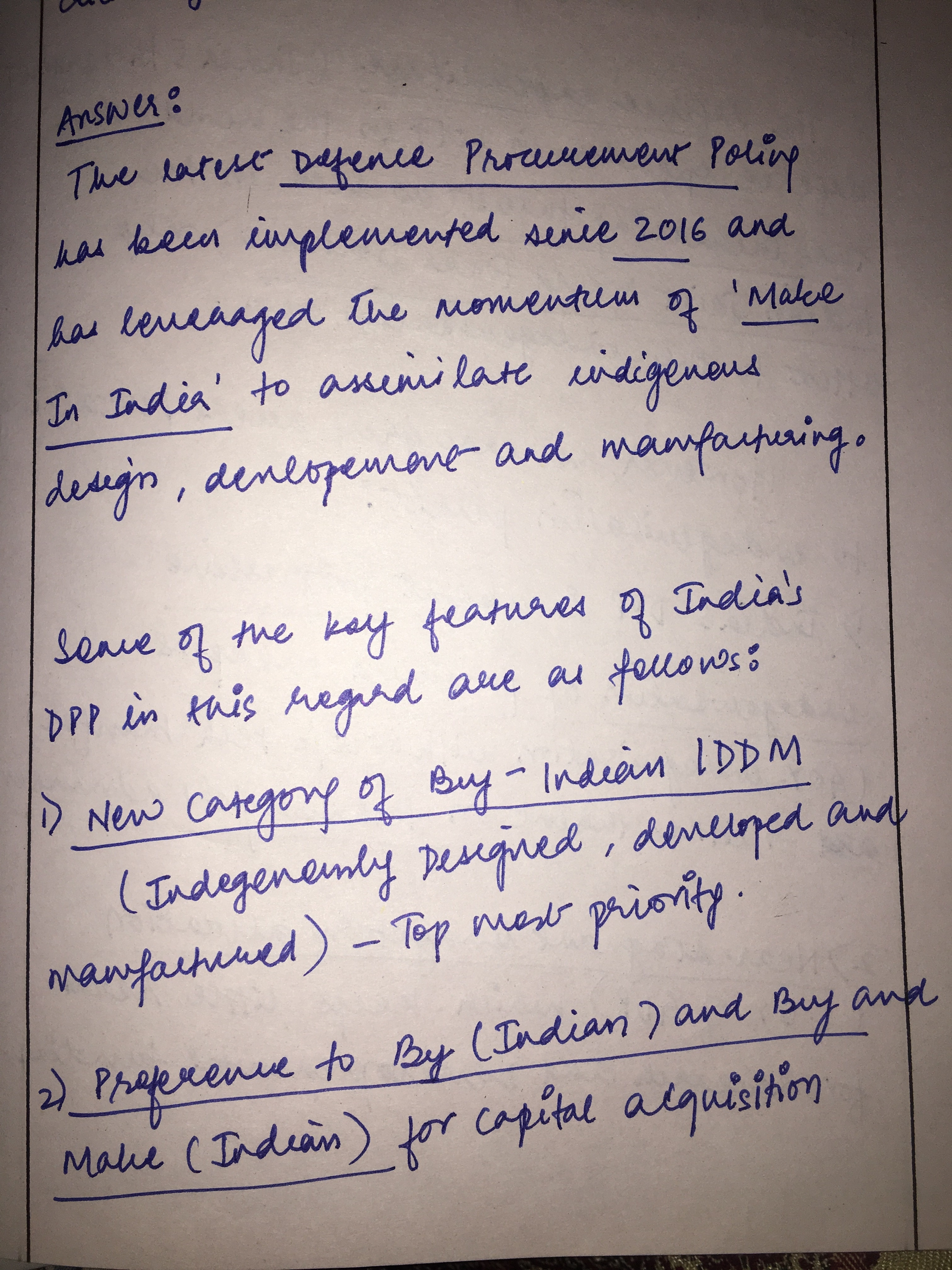
5. Does India’s Defence Procurement Policy give impetus to indigenisation? Critically examine.
Introduction: Give a small intro about Defence procurement policy.
Body: In body, mention how the present policy is helping in indigenization and in 2nd part mention the flaws in policy..
Conclusion: 2-3 line conclusion.
Introduction
Defence Procurement policy of 2016 focuses on institutionalizing, streamlining and simplifying defence procurement procedure to give a boost to “Make in India” initiative, by promoting indigenous design, development and manufacturing of defence equipment, platforms, systems and sub-systems.
Body
The policy gives importance to indigenization:
Buy Indian: IDDM Indigenously Designed, Developed and Manufactured.
Buy Indian and Buy and Make India over buy global and Buy and make Global.
Indigenous content requirement.
Funding by government of India.
MSME reservation.
Technology transfer.
Major flaws in policy to indigenization:
Presently there are only handfuls of companies manufacturing defence goods.
No plan of establishment of defence companies.
Lack of reforms in existing public sector companies like HAL, BHEL etc.
Defence labs and centers lack expertise and also retention of man power is issue.
Financial constraints.
Lack of Research and development.
Note: Explanation is needed for all points. 8-10 points in total are enough.
Conclusion
The policy is a welcome step in development of indigenous defence industries but it has to be backed by able support in terms of finance and consistency in demand from forces or else it won’t be feasible to invest huge amount with limited market.