
Hello Friends
The 60 Days Rapid Revision (RaRe) Series is IASbaba’s Flagship Initiative recommended by Toppers and loved by the aspirants’ community every year.
It is the most comprehensive program which will help you complete the syllabus, revise and practice tests on a daily basis. The Programme on a daily basis includes
Daily Prelims MCQs from Static (Monday – Saturday)
Daily Current Affairs MCQs (Monday – Saturday)
Daily CSAT Quiz (Monday – Friday)
Note – Daily Test of 20 static questions, 5 current affairs, and 5 CSAT questions. (30 Prelims Questions) in QUIZ FORMAT will be updated on a daily basis.
To Know More about 60 Days Rapid Revision (RaRe) Series – CLICK HERE
60 Day Rapid Revision (RaRe) Series Schedule – CLICK HERE
60 Day Rapid Revision (RaRe) Series Questions & Solutions DAY 25– CLICK HERE
0 of 30 questions completed
Questions:
The following Test is based on the syllabus of 60 Days Plan-2023 for UPSC IAS Prelims 2022.
To view Solutions, follow these instructions:
You have already completed the test before. Hence you can not start it again.
Test is loading...
You must sign in or sign up to start the test.
You have to finish following test, to start this test:
0 of 30 questions answered correctly
Your time:
Time has elapsed
You have scored 0 points out of 0 points, (0)
| Average score |
|
| Your score |
|
| Pos. | Name | Entered on | Points | Result |
|---|---|---|---|---|
| Table is loading | ||||
| No data available | ||||
Which of the following are features of the Indian Parliamentary System?
Select the correct answer using the code given below:
Solution (b)
Explanation:
Features of parliamentary system of government
Civil servants advise and carry out the government’s decisions.
Solution (b)
Explanation:
Features of parliamentary system of government
Civil servants advise and carry out the government’s decisions.
Consider the following statements:
Which of the above statements are correct?
Solution (a)
Explanation:
Solution (a)
Explanation:
Consider the following statements:
Which of the statements given above is/are incorrect?
Solution (c)
Explanation:
Solution (c)
Explanation:
Which of the following circumstances may lead to the resignation of the Council of Ministers?
Select the correct answer using the code given below.
Solution (d)
Explanation:
Solution (d)
Explanation:
Which of the following statements regarding the council of ministers is correct?
Solution (d)
Explanation:
Solution (d)
Explanation:
Who among the following is eligible to become a member of the Rajya Sabha?
Solution (c)
Explanation:
Solution (c)
Explanation:
Which of the following is incorrect with reference to National Emergency?
Solution (c)
Explanation:
Solution (c)
Explanation:
Consider the following statements regarding the Private Members Bill.
Which of the statements given above is/are correct?
Solution (b)
Explanation:
Committee on Private Members Bill and Resolution:
Solution (b)
Explanation:
Committee on Private Members Bill and Resolution:
Consider the following statements with reference to electoral bonds:
Which of the statements given above are incorrect?
Solution (b)
Explanation:
Solution (b)
Explanation:
Consider the following statements regarding Youth Parliament:
Which of the above statements is/are correct?
Solution (b)
Explanation:
Solution (b)
Explanation:
Consider the following statements with reference to the parliament of India:
Which of the statements given above is/are correct?
Solution (c)
Explanation:
Solution (c)
Explanation:
Consider the following pairs:
Which of the above pairs is/are correctly matched?
Solution (a)
Explanation:
Before the demands for excess grants are submitted to the Lok Sabha for voting, they must be approved by the Public Accounts Committee of Parliament.
It is like a blank cheque given to the Executive by the Lok Sabha.
Solution (a)
Explanation:
Before the demands for excess grants are submitted to the Lok Sabha for voting, they must be approved by the Public Accounts Committee of Parliament.
It is like a blank cheque given to the Executive by the Lok Sabha.
Consider the following statements:
1. Article 117 deals with all the 3 types of financial bills.
2. Financial Bill (I) can be introduced only in the Lok Sabha.
3. All financial bills are not money bills.
Which of the following statements are correct?
Solution (c)
Explanation:
Solution (c)
Explanation:
Consider the following statements:
Which of the following statements is/are correct?
Solution (a)
Explanation:
Solution (a)
Explanation:
Consider the following statements:
Which of the following statements is/are correct?
Solution (a)
Explanation:
Solution (a)
Explanation:
Which of the following is true regarding lapse of bills on dissolution of Lok Sabha?
Which of the above given statements is / are correct?
Solution (c)
Explanation:
Solution (c)
Explanation:
Consider the following statements:
Which of the above statements is/are correct regarding Election officials?
Solution (d)
Explanation:
Solution (d)
Explanation:
Consider the following statements with respect to Appropriation Bill:
Which of the statements given above is/are correct?
Solution (c)
Explanation:
Solution (c)
Explanation:
Indian Constitution employs the expression ‘Proclamation of Emergency’ to denote:
Solution (a)
Explanation:
Solution (a)
Explanation:
Which of the following amendments of the Indian Constitution made the Declaration of National Emergency immune from the judicial review?
Solution (a)
Explanation:
Solution (a)
Explanation:
Consider the following statements with respect to ‘Global Climate Observing System (GCOS)’
Select the correct statement(s)
Solution (c)
Explanation:
Source: CLICK HERE
Solution (c)
Explanation:
Source: CLICK HERE
Consider the following statements with respect to ‘Genealogical DNA test’
Choose the correct answer using the code given below
Solution (a)
Explanation:
Source: CLICK HERE
Solution (a)
Explanation:
Source: CLICK HERE
Why is a plant called ‘Senna spectabilis’ often mentioned in news?
Solution (c)
Explanation
Senna spectabilis was introduced as an ornamental species and for use as firewood from South and Central America, the species has become highly invasive in the Sigur plateau in both the core and buffer zones of the MTR. Over the last few years, its bright yellow flowers have become more visible across the Tiger Reserve. Conservationists say the invasive weed has a negative effect on local biodiversity, crowding out native species and limiting food availability for wildlife. Senna spectabilis, along with Lantana camara, is among five major invasive weeds that had taken over vast swathes of the Nilgiris, with wattle being the other major invasive species.
Source: CLICK HERE
Solution (c)
Explanation
Senna spectabilis was introduced as an ornamental species and for use as firewood from South and Central America, the species has become highly invasive in the Sigur plateau in both the core and buffer zones of the MTR. Over the last few years, its bright yellow flowers have become more visible across the Tiger Reserve. Conservationists say the invasive weed has a negative effect on local biodiversity, crowding out native species and limiting food availability for wildlife. Senna spectabilis, along with Lantana camara, is among five major invasive weeds that had taken over vast swathes of the Nilgiris, with wattle being the other major invasive species.
Source: CLICK HERE
Consider the following statements with respect to ‘Ganges River Dolphin’
Choose the correct answer using the code given below
Solution (d)
Explanation:
Source: CLICK HERE
Solution (d)
Explanation:
Source: CLICK HERE
Consider the following statements with respect to ‘World Cities Day’
Select the correct statement(s)
Solution (b)
Explanation:
Source: CLICK HERE
Solution (b)
Explanation:
Source: CLICK HERE
Study the bar chart and answer the questions based on it
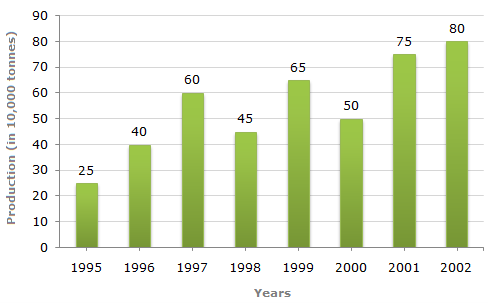
What was the percentage decline in the production of fertilizers from 1997 to 1998?
Solution (d)
Explanation
Required percentage = ((45-60)/60) = 25%
Therefore, there is a decline of 25% from 1997 to 1998.
Solution (d)
Explanation
Required percentage = ((45-60)/60) = 25%
Therefore, there is a decline of 25% from 1997 to 1998.
Study the bar chart and answer the questions based on it
In how many of the given years was the production of fertilizers more than the average production of the given years?
Solution (c)
Explanation
Average production over the given years
= 1/8( 25+ 40+ 60 + 45 + 65 + 50 + 75 + 80) = 55
Therefore, the production has exceeded the average during 1997, 1999, 2001, 2002. So, the answer is four times.
Solution (c)
Explanation
Average production over the given years
= 1/8( 25+ 40+ 60 + 45 + 65 + 50 + 75 + 80) = 55
Therefore, the production has exceeded the average during 1997, 1999, 2001, 2002. So, the answer is four times.
Study the bar chart and answer the questions based on it
The average production of 1996 and 1997 was exactly equal to the average production of which of the following pairs of years?
Solution (d)
Explanation
Average production (in 10000 tonnes) of 1996 and 1997= (40 + 60)/2= 50
We shall find the average production (in 10000 tonnes) for each of the given alternative pairs:
2000 and 2001 = (50 + 75)/2 = 62.5
1999 and 2000 = (65 + 50)/2 = 57.5
1998 and 2000 = (45 + 50)/2 = 47.5
1995 and 1999 = (25 + 65)/2 = 45
1995 and 2001 = (25 + 75)/2 = 50
Therefore , the average production of 1996 and 1997 is equal to the average production of 1995 and 2001.
Solution (d)
Explanation
Average production (in 10000 tonnes) of 1996 and 1997= (40 + 60)/2= 50
We shall find the average production (in 10000 tonnes) for each of the given alternative pairs:
2000 and 2001 = (50 + 75)/2 = 62.5
1999 and 2000 = (65 + 50)/2 = 57.5
1998 and 2000 = (45 + 50)/2 = 47.5
1995 and 1999 = (25 + 65)/2 = 45
1995 and 2001 = (25 + 75)/2 = 50
Therefore , the average production of 1996 and 1997 is equal to the average production of 1995 and 2001.
Study the bar chart and answer the questions based on it
What was the percentage increase in production of fertilizers in 2002 compared to that in 1995?
Solution (c)
Explanation
Required percentage = ((80-25)/25)% = 220%
Solution (c)
Explanation
Required percentage = ((80-25)/25)% = 220%
Read the following passage and answer the items that follow. Your answer to these items should be based on the passages only
Passage
Ever since the Centre and the States passed the landmark legislation in 2016 adopting a single countrywide Goods and Services Tax (GST), the federal council that is tasked with overseeing all the regulatory aspects of the indirect tax has had its hands full. From recommending the rates that could apply to various products and services, to deciding on what could be tax exempted, the GST Council has had the onerous task of laying out the policy framework for administering the tax in a manner that benefits all stakeholders – the governments, the consumers and the suppliers along the value chain. Given the complexity of the legacy taxes that GST subsumed and replaced and the teething troubles of operating a new tax system, ensuring optimal outcomes has proved an abiding challenge. A significant concern relates to the loopholes that unscrupulous operators have sought to exploit, whereby revenue that ought to have accrued to the Centre and the States has leaked while allowing these elements to derive illicit profits. And the scale of some has been breath-taking. Earlier this month, the Directorate General of GST Intelligence and the Directorate General of Revenue Intelligence conducted a pan-India joint operation, which saw about 1,200 officers simultaneously conducting searches at 336 different locations. In the process they unearthed a network of exporters and their suppliers who had connived to claim fraudulent refunds of Integrated GST, with more than ₹470 crore of input tax credit availed being based on non-existent entities or suppliers with fictitious addresses. A further ₹450 crore of IGST refund is also under review.
It is against the backdrop of such cases, and the fact that frauds totalling up to a staggering ₹45,682 crore have been detected since the roll-out of the tax in July 2017, that the GST Council has decided “in principle” to recommend linking Aadhaar with registration of taxpayers. In its 37th meeting in Goa on Friday, the council also agreed to appraise the possibility of making the biometrics-based unique identifier mandatory for claiming refunds. Already the GST Network — the information technology backbone on which the whole tax system runs — has made it mandatory for new dealers registering under the composition scheme for small businesses to either authenticate their Aadhaar or submit to physical verification of their business, starting January 2020. The council too needs to follow the network’s lead and move swiftly to recommend mandatory linking for refunds, especially since that has proved to be the main source of most frauds. In a becalmed economy, neither the Centre nor States can afford to forego even a rupee of revenue that is due to the public coffers.
According to the passage what remedial actions are suggested to avoid fraudulent activities?
Solution (d)
Explanation
Refer to the passage below:
‘…to appraise the possibility of making the biometrics-based unique identifier mandatory for claiming refunds. Already the GST Network …has made it mandatory for new dealers registering under the composition scheme for small businesses to either authenticate their Aadhaar or submit to physical verification of their business, …’
On reading the passage carefully, we see all the above remedial measures listed as recommendations to reduce fraudulent activities.
Hence, option d is the correct answer.
Solution (d)
Explanation
Refer to the passage below:
‘…to appraise the possibility of making the biometrics-based unique identifier mandatory for claiming refunds. Already the GST Network …has made it mandatory for new dealers registering under the composition scheme for small businesses to either authenticate their Aadhaar or submit to physical verification of their business, …’
On reading the passage carefully, we see all the above remedial measures listed as recommendations to reduce fraudulent activities.
Hence, option d is the correct answer.
All the Best
IASbaba