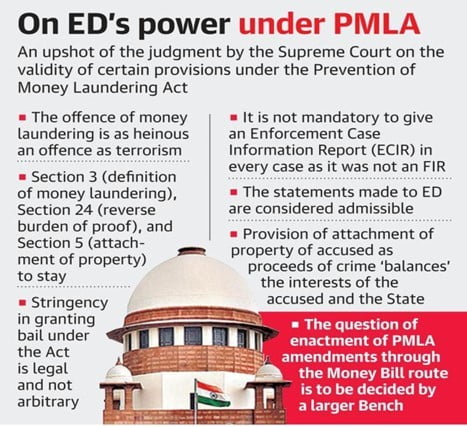
In News: The Finance Ministry notified changes to the Prevention of Money Laundering Act (PMLA), 2002
Changes to PMLA 2002:
Allowed Enforcement Directorate (ED) to share incriminating information and material about economic offenders with 15 more agencies.
These include
National Investigation Agency (NIA)
Serious Fraud Investigation Office (SFIO)
Directorate General of Foreign Trade (DGFT)
Competition Commission of India (CCI)
National Intelligence Grid
Central Vigilance Commission (CVC)
Wildlife Crime Control Bureau
MEA, State Police Department, regulators under various Acts, Defence Intelligence Agency, National Technical Research Organisation, Military Intelligence, inquiry authority under Central Civil Services Rules.
Earlier, the ED was permitted to share data with only 10 agencies, including CBI, RBI, Sebi, IRDAI, Intelligence Bureau, and Financial Intelligence Unit (FIU), among others.
Aim:
Integrate numerous State and Central government agencies
Empowering them with verified information related to an outlaw
Expedite nabbing of law-breakers
Apprehend social evils and bring them to justice in the court of law
Prevention of Money Laundering Act(PMLA):
It is a criminal law of the Parliament of India passed by the NDA government in 2002
PMLA became law and came into force on July 1, 2005.
It has blanket powers assigned to the Enforcement Directorate (ED) under PMLA for seizing, investing, searching and attaching assets.
Introduced due to India’s commitment at the Vienna Convention to combat money laundering.
Aim:
Prevention and controlling money laundering
Confiscation and seizing of property involved in or derived from money laundering.
Providing punishment to offenders
Appointment of adjudicating authority and appellate tribunal concerning money laundering matters
Dealing with every issue related to money laundering