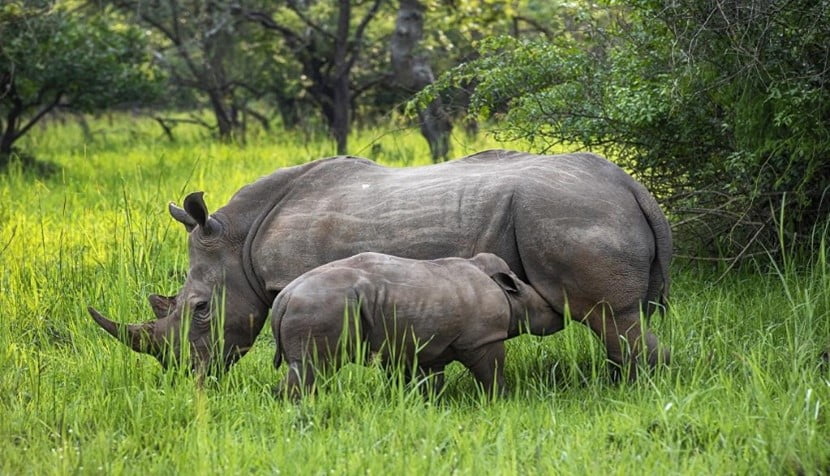
Context: In a major setback to rhino conservation in Africa, the proposal to downgrade the status of southern white rhino from Appendix I to Appendix II was accepted at the 19th Conference of Parties (COP19).
The COP19, organised by Convention on International Trade in Endangered Species (CITES) in Panama City, accepted the proposal by Botswana and Namibia to degrade the status. Wild animal species listed in Appendix I include those threatened with extinction.
About Southern white rhino:
The southern white rhino and northern white rhino are subspecies of the white rhino. Aside from living in different parts of Africa, they differ slightly in the shape of their teeth and heads, appearance of skin folds, and amount of hair.
In general, southern whites are a little larger and hairier. Contrary to the species name, both subspecies are Gray in colour.
“White” may be taken from the Afrikaans word for “wide,” in reference to their mouths, which are wide and square to help them graze on grass.
COMMON NAME: Southern white rhinoceroses
SCIENTIFIC NAME: Ceratotherium simum simum
DIET: Herbivore
AVERAGE LIFE SPAN IN THE WILD: 39 to 43 years
AVERAGE LIFE SPAN IN CAPTIVITY: 27 to 30 years
SIZE: Up to 12 feet
WEIGHT: Up to 7,900 pounds
Habitat and behavior:
Nearly 99 percent of southern white rhinos live in the savannas of Kenya, Namibia, and Zimbabwe, though the vast majority are found in South Africa.
White rhinos are semi-social and territorial. They stay together in herds on the grassy plains and mark their territory with strategically placed deposits of dung.
The males defend their territory vigorously with their horns and massive sizes.
Males tend to be more solitary than females, and live on about one square mile of land, whereas females can range over an area almost seven times as large.
White rhinos love mud. They will roll around in it, cover themselves with it, and cover their young with it. The wet mud cools them and protects their skin from sun and insects.
Threats: It is mostly threatened by habitat loss, continuous poaching in, and the high illegal demand for rhino horn for commercial purposes and use in traditional Chinese medicine.
From 2012 to 2017, white rhinos’ population dropped 15 percent, largely because of poaching. Poaching and illegal trade in rhino horn is usually part of sophisticated, organized criminal networks.