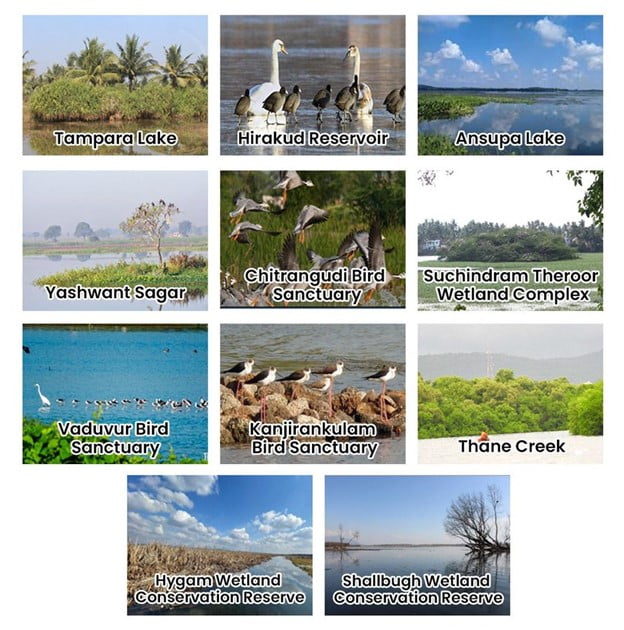
In News: India adds 11 more wetlands to the list of Ramsar sites to make total 75 Ramsar sites covering an area of 13,26,677 ha in the country in the 75th year of Independence.
The 11 new sites include: Four sites in Tamil Nadu, Three in Odisha, Two in Jammu & Kashmir and One each in Madhya Pradesh and Maharashtra.
Designation of these sites would help in conservation and management of wetlands and wise use of their resources.
India is one of the Contracting Parties to Ramsar Convention, signed in Ramsar, Iran, in 1971.
India signed it on 1st Feb 1982.
During 1982 to 2013, a total of 26 sites were added to the list of Ramsar sites, however, during 2014 to 2022, the country has added 49 new wetlands to the list of Ramsar sites.
Tamil Nadu has maximum no. of Ramsar sites (14 nos), followed by UP which has 10 nos. of Ramsar sites.
New Ramsar Sites
Odisha – Tampara Lake and Hirakud Reservoir, Ansupa Lake
Madhya Pradesh – Yashwant Sagar
Tamil Nadu – Chitrangudi Bird Sanctuary, Suchindram Theroor Wetland Complex, Vaduvur Bird Sanctuary and Kanjirankulam Bird Sanctuary
Maharashtra – Thane Creek
Jammu and Kashmir – Hygam Wetland Conservation Reserve and Shallbugh Wetland Conservation Reserve
Under Ramsar Convention, it is mandatory on the part of the Government of India to protect and conserve all the wetlands in the territory of India.
The Wetlands (Conservation and Management) Rules, 2010 were framed by the Government of India based on the recommendations of Ramsar Convention.
The Wetlands (Conservation and Management) Rules, 2010 also encompass the drainage area or catchment regions of the wetlands as determined by the authority.
Which of the statements given above is/are correct?