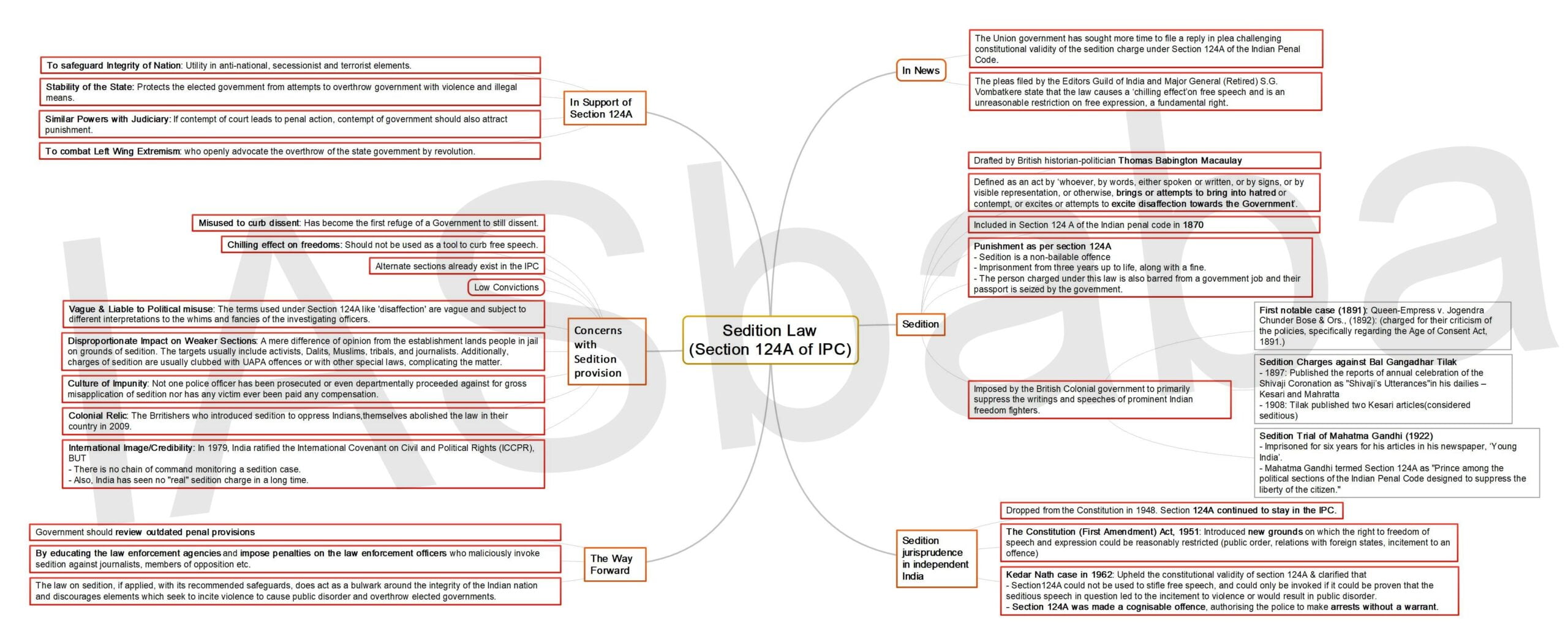
- In this matter, a five-judge Constitutional bench of the Supreme Court upheld the constitutional validity of section 124A and went on to clarify the correct position of the sedition law in India.
- In this case, Kedar Nath Singh, who was a member of the Forward Communist Party of Bihar, was charged with sedition for making insulting speeches against the ruling Indian National Congress government.
- It upheld the constitutionality of sedition, but limited its application to “acts involving intention or tendency to create disorder, or disturbance of law and order, or incitement to violence”.
- It clarified that section 124A could not be used to stifle free speech, and could only be invoked if it could be proven that the seditious speech in question led to the incitement to violence or would result in public disorder.
- Liking a social media post or cheering a rival cricket team or creating cartoons or not standing up in a cinema theatre do not constitute sedition; nor does the media merely being critical of a Government. (do you know that on all these grounds government has filed sedition cases)
Balwant Singh vs State of Punjab Case, 1995
- Balwant Singh who was the Director of Public Instructions (DPI) in Punjab, Chandigarh among other two, was alleged to have shouted pro-Khalistan slogans on the day of former PM Indira Gandhi’s assassination.
- The apex court held that unless there is public disorder merely sloganeering can’t attract punishment under Section 124A.
By two judgments in 2011, the Supreme Court unambiguously stated yet again that only speech that amounts to “incitement to imminent lawless action” can be criminalised.