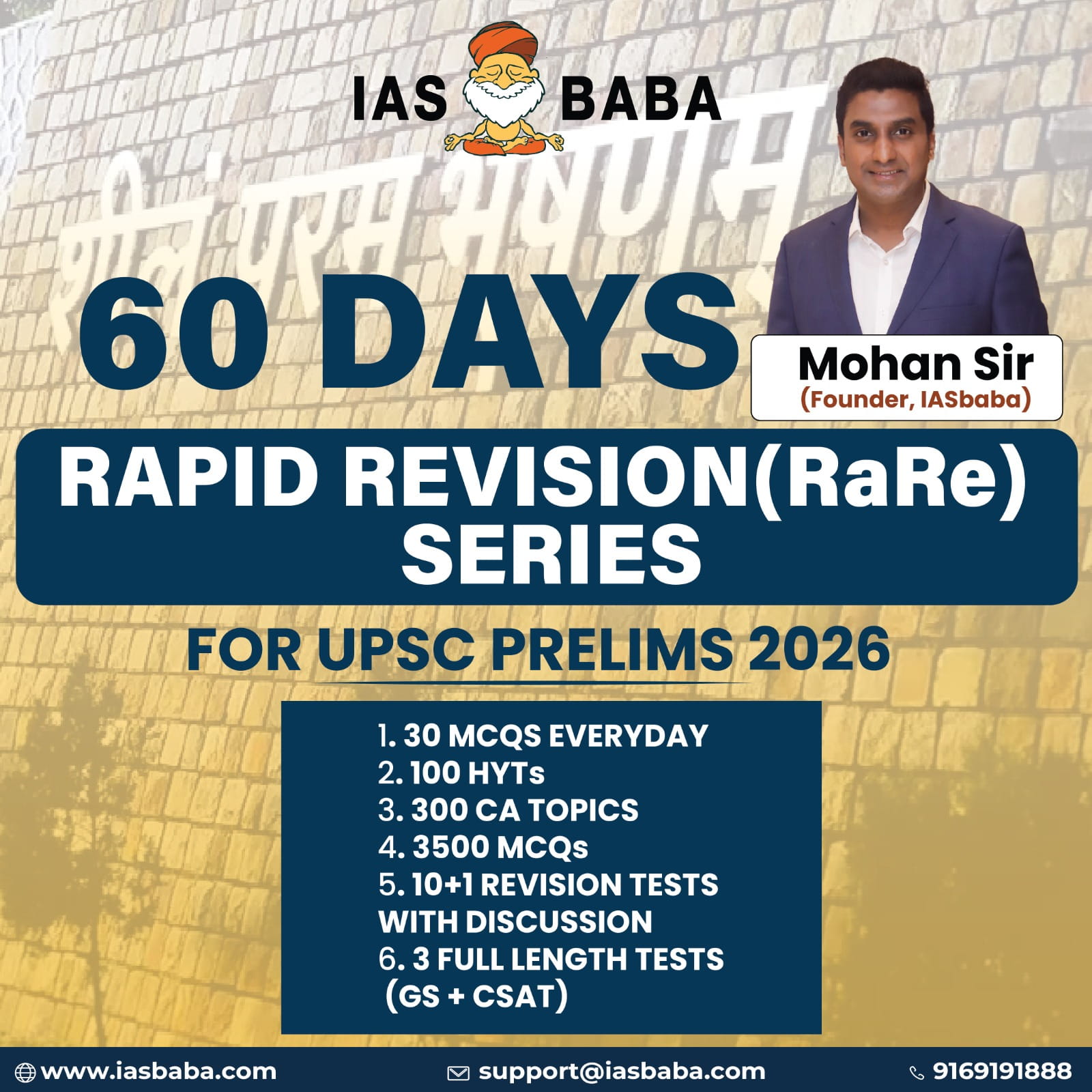
Let us pledge to make it a big game-changer (better than last year) in the next 60 days!
Note- Download the OMR Sheet and attempt the questions exactly like UPSC Prelims. After you are done, please post your OMR in the comment section. Once the solution key is released (around 5 PM), cross-check the answers and, comment the marks (you scored) in the same comment thread. This will keep you accountable, responsible and sincere in days to come.
You can also take part in the discussion with peers.
ENVIRONMENT [DAY 54]
Q.1) Which of the following are health impacts associated with Nitrogen pollution?
Blue baby syndrome
Vitamin A deficiency
Reduced functioning of thyroid
All of the above
Q.2) Which of the following diseases is/are an occupational hazard?
Pneumoconiosis
Asbestosis
Silicosis
Tuberculosis
Select the correct code
1 and 2 only
1, 2 and 3 only
3 only
1, 2, 3 and 4
Q.3) Which of the following organisation has released ‘Locust Environmental Booklet’?
International Rice Institute
FAO
World Food Programme
International Fund for Agricultural Development
Q.4) Block Count Method of census is associated with?
Tiger census
Elephant census
Lion Census
Census of One horned Rhinos
Q.5) Consider the following statements
NDMA has designated Ministry of Jal Shakti as a nodal ministry for Urban Floods.
National Disaster risk index is published by Ministry of Home Affairs in association with UNDP.
Which of the statements given above is/are correct?
1 only
2 only
Both 1 and 2
Neither 1 nor 2
Q.6) Consider the following statements with reference to Renewable Energy
Hydropower is the world’s biggest source of renewable energy by far.
The concentrating solar power (CSP) plants use mirrors to concentrate the sun’s heat, deriving thermal energy instead.
Algal fuel is a type of biomass energy that uses the unique chemicals in seaweed to create a clean and renewable biofuel.
Which of the statements given above is/are correct?
1 and 2 only
2 and 3 only
1 and 3 only
1, 2 and 3
Q.7) Consider the following statements with reference to production and usage of pesticide in India
The main use of pesticides in India is for cotton crops, followed by paddy and wheat.
In India herbicide is the most used pesticides accounting to more than two third.
Maharashtra is the largest consumer of pesticide in India.
Which of the statements given above is/are correct?
1 and 2 only
2 and 3 only
1 and 3 only
1, 2 and 3
Q.8) Recently the term ‘SILAM’ and ‘ENFUSER’ was in news with reference to
Tsunami Early warning system
Border Management
Elephant census
Air Quality forecasting
Q.9) Which of the following places has potential for Geo-thermal Energy in India?
Puga Valley
Jalgaon in Maharastra
Bakreshwar in West Bengal
Tattapani in Chhattisgarh
Select the correct code:
1 and 4 only
2 and 3 only
1, 3 and 4
All of the above
Q.10) Consider the statements about South Asia Wildlife Enforcement Network (SAWEN).
SAWEN is an intergovernmental wildlife law enforcement support body under SAARC.
Its Secretariat is in New Delhi.
It promotes regional cooperation to combat wildlife crime in South Asia.
Which of the statements given above is/are correct?
1 and 2 only
3 only
1 and 3 only
All of the above
Q.11) Consider the following statements with reference to Ecotone and Niche.
Ecotone is a zone of junction between two or more diverse ecosystems.
A niche is unique for a species and plays an important role in conservation of organisms.
Which of the statements given above is/are correct?
1 only
2 only
Both 1 and 2
Neither 1 Nor 2
Q.12) Which of the following serve as bio indicator to Pollution?
Mosses
Bryophytes
Lichens
Tubifex
Select the correct answer using the code given below:
1, 2 and 3 only
2, 3 and 4 only
1, 3 and 4 only
1, 2, 3 and 4
Q.13) ‘One Trillion Tree Initiative’ has been launched by which of the following organization in a bid to restore biodiversity and help fight climate change.
UNEP
World Bank
UNFCC
WEF
Q.14) Consider the following statements with reference to Ecological succession
The stage leading to the climax community are called successional stages or seres.
Secondary succession is relatively faster as compared to primary succession.
Succession would occur faster in area existing in the middle of the large continent.
Which of the statements given above is/are correct?
1 and 2 only
2 and 3 only
1 and 3 only
1, 2 and 3
Q.15) Consider the following statements about role of Coral reefs.
The Great Barrier Reef can be seen from outer space and is the world’s biggest single structure made by living organisms.
Soft corals are found in oceans from the equator to the north and south poles.
There are about twice as many coral species in Pacific Ocean reefs as in Atlantic Ocean reefs
Which of the statements given above is/are correct?
1 and 2 only
3 only
2 and 3 only
1, 2 and 3
Q.16) Consider the following statement with reference to Biomes
The tundra biomes are located at the northernmost parts of the globe and are defined by short, cold winters and hot summers.
Coniferous biomes are also called Taiga or Borreal forests.
Which of the statements given above is/are correct?
1 only
2 only
Both 1 and 2
Neither 1 nor 2
Q.17) Which of the following statements is incorrect in context of Radioactive Pollution?
The Ionising radiations have high penetration power and cause breakage of macro molecules.
Non-ionising radiations affect only those components which absorb them and have low penetrability.
Select the appropriate code
1 only
2 only
Both 1 and 2
Neither 1 nor 2
Q.18) Consider the following statements about Green Deal.
It is a proposed package of United States legislation that aims to address climate change and economic inequality.
It sets binding target to cut emission by at least 50% by 2030 and go net zero by 2050.
Select the correct statements:
1 only
2 only
Both 1 and 2
Neither 1 nor 2
Q.19) Which of the following statements is/are correct with reference to Integrated Development of Wildlife Habitats?
It is a central sector umbrella scheme
It provides support to protected areas, protection of wildlife outside protected areas and recovery programmes for saving critically endangered species and habitats.
So far, 21 species have been identified under the recovery programme.
Choose the appropriate code:
1 and 2 only
2 and 3 only
1 and 3 only
1, 2 and 3
Q.20) Consider the following statements with reference to Biodiversity Heritage site:
The Indian State Government can notify the Biodiversity Heritage Sites in consultation with local governing bodies.
These are notified under Wildlife Protection Act, 1972
Rules for management of Biodiversity Heritage sites are framed by Central government for uniformity throughout the country.
Which of the above statements is/are correct?
1 only
2 and 3 only
3 only
1, 2 and 3
Q.21) The below are notable lakes of India. Identify the correctly matched pairs from the code given below:
Lake in news : Associated state
Pulicat lake : Kerala
Vemband Lake : Tamil Nadu
Chandratal : Himachal Pradesh
Haflong : Assam
Which of the above given pairs are correctly matched?
1 and 2 only
2, 3 and 4 only
3 and 4 only
All of the above
Q.22) Consider the following statements with reference to Chabahar Port.
It is located in the Gulf of Aden and is closest to Gwadar port.
It serves as Iran’s only oceanic port connecting it with Indian Ocean.
The port is partly intended to provide an alternative for trade between India and Afghanistan.
Which of the statements given above is/are incorrect?
1 only
2 and 3 only
2 only
1, 2 and 3
Q.23) Arrange the following components of core sector industries in decreasing order in terms of their weights
Petroleum Refinery products
Electricity
Natural Gas
Fertilizers
Choose appropriate code:
1-2-3-4
1-2-4-3
1-3-2-4
4-3-2-1
Q.24) Consider the following statements about National Infrastructure Pipeline initiative:
It includes economic and Social Infrastructure projects.
This initiative will improve project preparations and attract both domestic and foreign direct investments for the Indian economy.
It is under Ministry of Finance.
Which of the statements given above is/are correct?
1 and 2 only
2 only
2 and 3 only
All of the above
Q.25) Consider the following statements about Aluminium- Air- battery:
Aluminium-air battery-based electric vehicles are expected to offer much greater range of 400 km or more per battery compared to lithium ion based batteries.
They can be recharged like lithium ion batteries.
Which of the statements given above is/are correct?
1 only
2 only
Both 1 and 2
Neither 1 nor 2
Q.26) With reference to “National Startup Advisory council”, consider the following statements:
It has been constituted by Department for Promotion of Industry and Internal Trade (DPIIT).
Its objective is to advise the Government on measures needed to build a strong ecosystem for nurturing innovation and startups in the country.
Which of the above statements is/are correct?
1 only
2 only
Both 1 and 2
Neither 1 and 2
Q.27) Recently e-SANTA platform has been launched to connect –
Different IITs involved in developing AI technologies
Aqua farmers and buyers
FPOs involved in certification of Organic products
NGO’s working for destitute people in this pandemic times
Q.28) With reference to “Blue Nature Alliance “consider the following statements:
It is an initiative led by World Wide Fund for Nature to protect and preserve ocean resources
It aims to protect 5% of the world’s ocean in five years.
Which of the above statements is/are correct?
1 only
2 only
Both 1 and 2
Neither 1 and 2
Q.29) ‘Poshan Gyan’ a national repository on health and nutrition has been launched by
Ministry of women and child development
Niti Aayog
Ministry of Education
FSSAI
Q.30) Consider the following statements with reference to Codex Alimnentarius Commission.
CAC is an intergovernmental body established jointly by the UN’s Food and Agriculture Organisation (FAO) and the World Health Organisation (WHO).
Its objective is to protect consumer’s health and ensure fair practices in food trade.
Which of the above statements is/are correct?
1 only
2 only
Both 1 and 2
Neither 1 and 2
Read the following passages and answer the questions that follow each passage. Your answer to these questions should be based on passage only.
Passage 1
The first battle of the American Revolution occurred at Lexington, Massachusetts, in 1775. The American colonists were angry about numerous taxes issued by the British king. In 1776, the colonists issued the Declaration of Independence, a document written by Thomas Jefferson that outlined America’s intention to become a new country separate from England. England wanted to maintain control of America, and vowed to fight the colonists. The war lasted eight long years. The Americans won many important battles such as those at Saratoga and Yorktown. Many American heroes emerged such as George Washington, Thomas Jefferson, and Benjamin Franklin. Finally, in 1781, the British surrendered at Yorktown, Virginia, and a new nation was born two years later.
Q.31) Why did the war take place?
Colonists were angry about their bad living conditions.
England attacked the colonists.
Colonists were angry about having to pay so many taxes.
Colonists wanted to have more land.
Passage 2
Plastics are now widely present in the environment, as visible waste along coastlines, in lakes and rivers, and even in the soil. The recent finding that micro plastic particles are found even in ‘safe’ bottled water indicates the magnitude of the crisis. There is little doubt that the global production of plastics, at over 300 million tonnes a year according to the UN Environment Programme, has overwhelmed the capacity of governments to handle what is thrown away as waste. Micro plastics are particles of less than 5 mm that enter the environment either as primary industrial products, such as those used in scrubbers and cosmetics or via urban waste water and broken-down elements of articles discarded by consumers. Washing of clothes releases synthetic microfibers into water bodies and the sea. The health impact of the presence of polypropylene, polyethylene terephthalate and other chemicals in drinking water food and even inhaled air may not yet be clear, but indisputably these are contaminants. Research evidence from complementary fields indicates that accumulation of these chemicals can induce or aggravate immune responses in the body. More studies, as a globally coordinated effort, are necessary to assess the impact on health.
Q.32) According to the passage what has added to the crisis of plastic?
Presence of plastic along the coastlines
Finding of micro plastic in safe bottled drinking water
Its aggravated effects on immune responses in the body
Washing of clothes which releases synthetic microfibers into water bodies and the sea
Passage 3
Read not to contradict and confute, nor to believe and take for granted, nor to find talk and discourse, but to weigh and consider. Some books are to be tasted, others to be swallowed, and some few to be chewed and digested; that is, some books are to be read-only in parts; others to be read, but not curiously; and some few to be read wholly and with diligence and attention. Some books may also be read by deputy, and extracts made of them by others; but that would be only in the less important arguments and the meaner sort of books; else distilled books are like common distilled waters, flashy things. Reading makes a full man, conference a ready man, and writing an exact man. And therefore if a man writes little, he had need have a good memory; if he confers little, he had need have a present wit; and if he read little, he had need have much cunning to seem to know that he doth not. Histories make men wise, poets witty, the mathematics subtle, natural philosophy deep, moral grave, logic and rhetoric able to contend.
Q.33) What can be done about the ‘meaner’ sort of books?
to be read but not to contradict and confute
to be read curiously
to be read, but not curiously
they can be “read by deputy and extracts made of them by others
Q.34) Two persons X and Y went to a Stationary shop. A purchased 5 pens, 2 notebooks and 6 pencils and used up all his money. B purchased 6 pens, 6 notebooks and 18 pencils and paid 50% more than what A had paid. What percentage of the A’s money was spent on pens?
12.5%
15%
16.66%
25%
Q.35) The price of commodity X increases by 40 paise every year while the price of commodity Y increases by 15 paise every year. If in 2001, the price of commodity X was Rs 4.20 and that of Y was Rs 6.30, in which year commodity X will cost 40 paise more than the commodity Y?
2010
2011
2012
2013
NOTE- Follow this for Comments
Mention- Time Taken after solving the Test
After the release of Solution, Edit your Comment to Mention- Correct/Incorrect and Score
2 Marks for Correct/0.66 minus for Incorrect.
What IMPACT can the ‘60 Day’ have on the final results? We will explain by taking a small example. Imagine you are sitting in the examination hall, appearing in Prelims Paper I. You have attempted 70 questions already but still unsure about a few. Then you stumble upon a question that was asked in 60 Day (and believe us, it has happened to hundreds of students countless times). You choose the right answer and submit your paper hoping for the best! Eventually, you go on to clear Mains as well as Personality Test and secure a good rank as well. When the cut off gets announced by UPSC, you realize that you have scored just one mark more than the cut off! Yes, that one mark can change your life (and it has done so to many of our students in the past). Now, imagine the kind of impact 60 to 80 marks can have! Isn’t that so fascinating to imagine?
One’s level of preparedness is always different for different subjects. Even within a subject, one’s comfort level may vary with topics. For example, one might be more comfortable in solving questions of Polity than Economics and within Polity also, one might be at ease with questions on fundamental rights than Parliament. The level of comfort and ease that one has with a subject/ topic gets manifested in the examination. However, there is no conscious effort by aspirants to micro analyze these aspects. Now, coming to the second aspect i.e. the mistakes that one commits in answering MCQs, it can be said that there are mainly four reasons behind incorrect responses in the OMR sheet. They are:
Lack of information
Lack of analytical ability
Silly mistakes
Excessive risk-taking
Let’s analyze them one by one:
Lack of information: You simply don’t know the information. You are clueless and that’s why you don’t attempt the question. For example, you may have never come across a regime called the ‘Wassenaar Agreement’ during your preparation and you can’t do much about it. The lack of information is pardonable and rectifiable. You can read more and gather more information. That is within your reach.
Lack of analytical ability: You know the concept but the question is a twisted one and you are not able to apply the concept. For example, in a question asking you to identify the climate type of a region based on certain given parameters like precipitation, temperature, and air density, you might find it difficult to mark the correct option even if you are aware of all the options given in the question! That is clearly a lack of application and you can overcome it by developing a habit of framing questions in your mind while you study any topic.
Silly mistakes: This habit is unpardonable. You know the concept, you become happy, you misread the question, you mark the incorrect answer and you are out of the race! Such mistakes reveal your hurriedness while answering the question. A simple mistake of reading ‘chose the incorrect option’ as ‘chose the correct option’ can destroy your chances. It means that you need to have patience and focus while attempting the paper.
Excessive risk-taking: You are confused between the options and just in order to increase your attempts, you make wild guesses and try your luck only to repent eventually. Risk-taking is an art and one must be very careful while doing the guesswork in confusing questions. If you are not lucky enough, it can spoil your chances.
You will realize that these problems will have different meanings for different people. For example, one might find a lack of information as the main culprit in answering wrong the questions on Culture while in Polity, lack of analytical ability is usually the culprit. The point here is that you must analyse your preparation on these yardsticks by applying them on different subjects/ topics. If one is having a headache, he/ she can’t have the same medicine for fever. Isn’t it.
This is where our revamped ’60 Day’ comes into the picture. It will give you an opportunity to micro analyze your preparation and perform better in the examination.
Finally, it is up to you to take advantage of this framework. We are sure of only one thing- if you follow this program, assess yourself on the basis of the given framework and keep improving your weaker areas, success will be yours.
We are providing you with the right platform, the right guidance, and the right competition. Do you have the right motivation to make full use of this initiative? We think you have. Come, be a part of this initiative and take the first step towards SUCCESS!
Importance of self – tracking:
We could have provided all of you with login id and passwords to monitor your daily performance in the 60-day program.
Instead, a simple and most beautiful way which Disqus provides is profile based commenting!
Yes, we have seen the most successful candidates who have taken the maximum benefit from this program monitoring themselves by commenting on their answers in the box given (Disqus comment). And reviewing their performance themselves once in 10 days on the progress meter.
ENTER YOUR PERFORMANCE AND GET YOUR RANK-Click Here
Important:
Ranks and Cut off will be calculated for the entries in the given form only. Cut Off will be released around 10PM and Rank List will be announced soon.
Top 10 performers will be selected by finding the average ranks of entire 60 Days Programme and they would get FREE GUIDANCE and MENTORSHIP from IASbaba’s Core Team.