GS-2: Functions and responsibilities of the Union and the States, issues and challenges pertaining to the federal structure
GS-3: Internal Security
Call for ‘Greater Tipraland’
Context: Three months before elections to the Tripura Tribal Areas Autonomous District Council (TTAADC), the state’s royal scion and former state Congress president Pradyot Kishore Manikya Debbarma has given a call for a ‘Greater Tipraland’ (through his organisation TIPRA) , covering Tripuris in and outside of the district council and even the Tripuri diaspora.
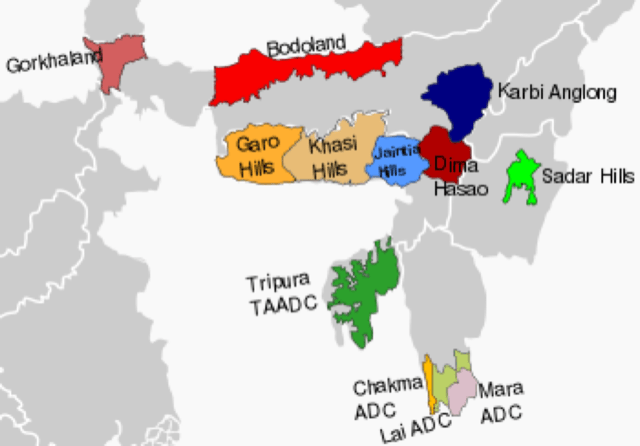
Map: showing Autonomous Administrative Councils in North East India
What is the demand for Greater Tipraland?
Greater Tipraland’ has been a political demand on the lines of ‘Greater Nagalim’
It seeks to – in a democratic manner – cater to the aspirations of Tripuris in Mamit of Mizoram, Kachar and Hailakandi in Assam, and even in Khagrachari, Bandarban, and Chittagong of Bangladesh.
Tripuris are 19 indigenous clans, most of whom live in the TTAADC areas which make up two-thirds of the state’s geographical area but comprise only one-third of the state’s population of 37 lakh people. 70 percent land under the TTAADC is covered by hills and forests and most inhabitants are prone to ‘jhum’ (slash and burn) cultivation.
What are ‘Tipraland’ and ‘Greater Tipraland’?
‘Tipraland’ was a demand of the Indigenous People’s Front of Tripura (IPFT), which is now in power in Tripura in alliance with the Bharatiya Janata Party. It was a political call for the creation of a separate state for indigenous groups.
Greater Tipraland demands that every indigenous area or village which is today outside the TTAADC be included
Pradyut Kishore who is now spearheading the demand for Greater Tipraland has claimed the demand arose due to unfulfilled demands of revising NRC in Tripura and opposition to CAA in the past.
Critical Analysis of the issue:
Vote Bank Politics: In the wake of impending elections to TTAADC, this is seen an effort by Pradyot to consolidate the tribal vote bank for his party, Tipraha Indigenous Peoples Regional Alliance (TIPRA).
Changed Political Scenario: With Pradyot’s new political maneuvering, TIPRA has emerged as the single-largest tribal political party of Tripura. The royal scion has announced a mega merger and alliance with all major tribal political parties.This may alter the power balance in State (dominated by CPIM and ruling BJP-IPFT govt.)
New-age ethnic politics: Tripura saw turbulent violent struggles by different outlawed insurgent outfits for past three decades- all demanding self-determination and sovereignty on different community lines. This new demand is to unite people from both tribal and non-tribal behind ethnic identity.
Challenge to Federal Spirit: Eventhough thedemand for Greater Tipraland is on democratic lines, such ethnicity based redrawing of boundaries will hamper the delicate balance in North East. It may also further embolden the demand of Nagas thus putting the entire region under contestations.
Impacts Relations with Bangladesh: With the passage of 100th Constitutional Amendment Act of 2015, the land boundary between India and Bangladesh has been settled. However, such demands that includes areas falling in Bangladesh will negatively impact the cooperative bilateral relationship between both countries.
Can create Insurgency: This being a political sensitive issue where ethnicity, development and federalism are involved, Union government has to watch closely the developments & engage with stakeholders to address their grievances. If left unattended the pent up grievances can turn into insurgency in long run.
Way Ahead
Even though at this stage, the demand appears to be aimed at consolidating vote bank for the Council elections, Governments (both Union and State) should not take light of these developments.
Connecting the dots:
Bru Refugees Agreement and the role of Pradyut Kishore: Click here