Q1. What are the recent trends in Indo-Bangladesh relations? Examine. What is the strategic significance of Bangladesh for India? Discuss.
Approach – It expects students to write about recent trend in India Bangladesh relations. Also highlight on strategic significance of Bangladesh for India.
Introduction
India was the first country to recognize Bangladesh as a separate and independent state and established diplomatic relations with the country immediately after its independence in December 1971. The relationship between India and Bangladesh is anchored in history, culture, language and shared values of secularism, democracy, and countless other commonalities between the two countries. It is based on sovereignty, equality, trust, understanding and win-win partnership that goes far beyond a strategic partnership.
Body
Recent trends in Indo Bangladesh relations:
Coastal surveillance: Both sides noted the progress made in finalization of a Memorandum of Understanding (MoU) on Establishment of Coastal Surveillance Radar System in Bangladesh. The coastal surveillance system will pave way for Indo-Bangladesh White Shipping Agreement in future. This will be useful amid growing terror threats via seas and growing presence of China in the Bay of Bengal region.
Line of credit: Since 2010, India approved three Lines of Credit to Bangladesh of $7.362 billion to finance development projects. But, because of bureaucratic red tapism, just $442 million have been disbursed until December 2018.
River water cooperation: Exchange of data and information to prepare a framework of interim sharing agreements for six rivers — Manu, Muhuri, Khowai and Gomati rivers of Tripura and Dharla river of Bangladesh and Dudhkumar river of West Bengal. Use of Bangladesh’s Feni river for drinking water supply in Tripura.
Teesta water agreement: Failed river water sharing agreements between India and Bangladesh despite many efforts. Chief among them is the Teesta agreement which was inked in 2011 but has not moved forward because of tensions between the Central and West Bengal governments.
Cooperation over pandemic related moves: Over the past months, Bangladesh has supported India’s call for a regional emergency fund for fighting Covid-19 and declared a contribution of $1.5 million. India has also provided medical aid to Bangladesh.
Push to agreement on trans-shipment: The first trial run for trans-shipment of Indian cargo through Bangladesh to Northeast states under a pact on the use of Chittagong and Mongla ports took place recently.
Soft power: India also grants 15 to 20 lakh visas every year to Bangladesh nationals for medical treatment, tourism, work, and just entertainment.
Economic and development partnership: Bangladesh is India’s biggest trade partner in South Asia with bilateral trade growing steadily over the last decade – India’s exports to Bangladesh in 2018-19 stood at $9.21 billion, and imports from Bangladesh at $1.04 billion. Import of bulk Liquefied Petroleum Gas (LPG) from Bangladesh. Inauguration of Vivekananda Bhaban (student’s hostel) at Ramakrishna Mission, Dhaka. Inauguration of Bangladesh-India Professional Skill Development Institute (BIPSDI) at the Institution of Diploma Engineers Bangladesh (IDEB), Khulna, Bangladesh.
Strategic significance of Bangladesh to India –
India and Bangladesh share 4096.7 km. of border, which is the longest land boundary that India shares with any of its neighbours.
Lying some 600 miles north of the Andaman Islands in the Bay of Bengal, with the major port of Chittagong and another, Cox’s Bazaar, almost bordering its neighbour Myanmar, the country is an important littoral on our eastern seaboard.
Bangladesh is India’s biggest trade partner in South Asia. India’s exports to Bangladesh for financial year 2018-19 (April-March) stood at US $ 9.21 bn and imports from Bangladesh for the same period stood at US $ 1.22 bn.
Bangladesh’s economy is now one-and-a-half times as large as that of West Bengal better integration between the two would provide a huge boost for eastern India. So would provide better connectivity between India’s landlocked Northeast and Bangladesh.
India has benefited from its security ties with Bangladesh, whose crackdown against anti-India outfits has helped the Indian government maintain peace in the eastern and northeast states.
Increasing importance of Bangladesh in geopolitics of Indo-Pacific due to economic success of Bangladesh is drawing attention from a range of countries in East Asia, including China, Japan, South Korea, and Singapore. Dhaka is bound to intensify in the new geopolitics of the Indo-Pacific.
India will inaugurate a new railway line with Bangladesh to save its ‘Chicken’s Neck’ from China.
India is also looking at fast-tracking the Bangladesh-Bhutan-India Nepal (BBIN) initiative which will boost connectivity among the South Asian neighbours through rail and road.
Way ahead –
Lower hanging fruits: The sides can address the less conflictual issues, as it will be difficult to address the Teesta project before the West Bengal elections due next year.
Implement its assurances in a time-bound manner: The greater attention is required to development projects in Bangladesh under the Indian Lines of Credit.
Collaboration in the development of a Covid-19 vaccine: Including its trial, and looks forward to early, affordable availability of the vaccine when ready.
Conclusion
Both Bangladesh and India have great opportunities to resolve all the outstanding issues. India as a regional super power needs to take initiative and Bangladesh requires cooperating with India for fixing outstanding issues. Both the counties have to think for the economic ties instead of valuing the domestic politics. Central political objectives must supersede the regional or the state objectives for continuing and establishing the future relations.
Q2. Examine India’s recent efforts to counter the threat of terrorism originating from Pakistan.
Approach – It expects students to write about – in first part write about terrorism issue arising from Pakistan – in second part write about steps taken by India to counter threat of terrorism – in third part write way forward.
Introduction
Bilateral relations of India and Pakistan have been under the shadow of misunderstanding, tensions and wars since 1947. To counter Pakistan, India has embarked upon a bi-dimensional strategy towards Pakistan. First, it has intensified its campaign to diplomatically isolate at various global forums. Secondly, it has inclined to use hard force when faced with terrorism.
Body
Pakistan and state-sponsored terrorism:
Pakistan has been accused by neighbouring countries India, Afghanistan and Iran and other nations, such as the United States the United Kingdom, and France of involvement in terrorist activities in the region and beyond.
Money is transferred to terror organization via Pakistan army.
Pakistan’s tribal region along its border with Afghanistan has been described as a safe haven for terrorists by western media and the United States Defense Secretary. According to an analysis published, Pakistan was, “with the possible exception of Iran, perhaps the world’s most active sponsor of terrorist groups… aiding these groups that pose a direct threat to the United States.
Pakistan’s active participation has caused thousands of deaths in the region; all these years Pakistan has been supportive to several terrorist groups despite several stern warnings from the international community
The government of Pakistan has been accused of aiding terrorist organisations operating on their soil who have attacked neighbouring India.
Pakistan denies all allegations, stating that these acts are committed by non-state actors
Former Pakistan President Pervez Musharraf has admitted that Pakistan supported and trained terrorist groups like Lashkar-e-Taiba (LeT) in 1990s to carry out militancy in Kashmir from 1979 Pakistan was in favour of religious militancy
Many organizations change names and set up other organization to frame that Pakistan is looking into it.
India taken following steps to counter threat of terrorism originating from Pakistan:
Government of India has created National Investigation Agency (NIA) in 2008 after Mumbai attacks which acts as a federal agency to combat terror.
Multi Agency Centre (MAC) revamped after 26/11 attacks, acts as a multi-agency intelligence coordination mechanism for counter terrorism.
Combating Financing of Terrorism Cell (CFT- Cell) is also created to deal with the policy matters on combating terrorist financing and Fake Indian Currency.
India is also a member of FATF (Financial Action Task Force) whose aim is to establish international standards for combating money laundering and terrorist financing.
Recently FATF puts Pakistan on ‘grey-list’ over global terror finance.
The government has created observation posts, Border fencing, flood lighting, deployment of modern and hi-tech surveillance equipment.
Comprehensive Integrated Border Management System (CIBMS) has replaced manual surveillance/patrolling of the international borders by electronic surveillance to enhance detection and interception capabilities.
India has been supportive of all efforts, particularly in the UN to combat terrorism and has played a leading role in shaping international opinion and urging the international community to prioritize the fight against terror.
India since 1996 is trying to push a global intergovernmental convention i.e. Comprehensive Convention on International Terrorism (CCIT) to tackle terrorism. It can provide a legal framework to enhance prosecution and extradition of terrorists.
Continuous dialogues with neighbouring countries have been initiated from time to time for motivating them for a strict action against terrorists breeding in their respective territories.
Way Forward –
There is a need to reassess our policies on number of issues pertaining to the management of India’s international borders such as intelligence apparatus, internal security and border management.
Technical solutions are necessary to augment and complement the traditional methods of border guarding.
They not only enhance the surveillance and detection capabilities of the border guarding forces but also improve the impact of the border guarding personnel against infiltration and trans-border crimes.
India should move in the direction of specialisation of military to fight cross-border terrorism.
Military should also look at alternative means to strike at the terror camps across the LoC and LAC through mechanisms like Precision Engagement Capability.
A judicious mix of properly trained manpower and affordable and tested technology is likely to yield better results.
War against terrorism is a low intensity conflict or localized war and cannot be waged without the full and unstinted support of the society and can be lost easily if the morale and resolve of the society to fight against terrorism falters.
Conclusion
Since the remaining roots of militancy are now in Pakistan and PoK, and Pakistan is not inclined to bring to justice the leaders of terrorist organisations like the Lashkar-e-Taiba and the Jaish-e-Mohammed, terrorists they call ‘strategic assets’, they must be neutralised through strong deterrent and diplomatic and Isolation operations.
Q3. What are the major irritants in Indo-Nepal relations? What are their fallouts? Examine.
Approach – It expects aspirants to write about – in first part write about issues between India and Nepal – in second part write about fallout due to deteriorating relation between India and Nepal – in third part write way forward.
Introduction
Nepal is an important neighbour of India and occupies special significance in its foreign policy because of the geographic, historical, cultural and economic linkages/ties that span centuries. India and Nepal share similar ties in terms of Hinduism and Buddhism with Buddha’s birthplace Lumbini located in present day Nepal.
Body
Issues and recent deterioration of India-Nepal ties:
Border issues: Nepal and India have some contentious issues relating to the border, including the two major areas of dispute at Susta and Kalapani (India-China-Nepal tri-junction). Countries agreed to start talks at the foreign secretary-level in order to resolve the problem however, only a single talk has taken place in 2015.
Internal Security: Open border between India and Nepal leads to illegal migration and human trafficking threatening Indian security. Indo Nepal border is used as launch pad by Maoist, terrorist and drug traffickers.
Nepal’s new constitution and its aftermath: A new constitution was promulgated in Nepal in 2015.It gave extensive political privileges to the ruling hill tribes and discriminated against the people living in plains including Madhesis. It also made obtaining citizenship by Madhesis very difficult. This issue has emerged as a contentious issue between India and Nepal that was seen in form of economic blockade including blockade of gas supply, fuel etc. by India.
Big Brother attitude: There is a widespread perception in Nepal that India does not respect the country’s sovereignty and that it often intervenes in Nepal’s domestic affairs. India has been perceived to be playing a role of big brother in the region.
Peace and friendship treaty: The India-Nepal treaty of 1950 has been criticised by the Nepali political elite as an unequal one. Treaty obliged Nepal to inform India and seek its consent for the purchases of military hardware from third countries. Nepal wants to change this provision.
Nepal’s growing proximity to China: In recent times China’s presence has increased in Nepal that has heightened India’s security concerns. China plans to extend the Tibet railway to Kathmandu across the border in the next few years. Nepal signed the Belt and Road Initiative (BRI) Framework agreement with China last year. China is trying to contest Indian interests by cultivating local interest groups that could advance China’s interests in Nepal.
Demonetisation: Demonetisation has badly affected Nepali nationals because those notes were legal tender in Nepal too. Nepal has time and again requested that the Indian government make arrangements for the exchange of those notes held by Nepali nationals and its central bank.
Fallout due to deteriorating relation between India and Nepal:
In the past, Chinese interest in Nepal was to ensure that Nepalese territory is not used by Tibetans for the breeding of discontent.
However, in recent times, China has made inroads into Nepal in infrastructure, education and health sectors. Also, Nepal wants to take advantage of the BRI project built by China.
India feels that the Chinese inroads into Nepal are necessarily to counterbalance the Indian influence in Nepal. However, Nepal has asserted that its relationship with China is purely economic and will not be hurting the Indian strategic interests in any way.
Also, India is of the view that the rising Nepal and China cooperation would undermine Nepal’s distinction of buffer state between India and China.
Kathmandu has continued its long-standing efforts to spread Nepal’s options beyond India.
Multilateral development banks are by far the biggest lenders and players in the country’s development efforts. And in fact, one of Nepal’s largest aid donors is the European Union.
India and China are not the only players for big projects either. A long-delayed project to pipe water into Kathmandu was with an Italian company.
Major investments in the telecom sector are coming from Malaysia, and the largest international carrier in Nepal is Qatar Airways.
The outward movement of students, along with the growth of institutions of higher learning at home, has meant that youngest people in Nepal, including emerging contemporary leaders in politics, business or academics, have not studied in India.
This lack of common collegiate roots removes a natural bond of previous generations that had provided for better understanding and even empathy.
Way Forward –
Given the importance of ties with Nepal, often romanticised as one of “roti-beti” (food and marriage), India must not delay dealing with the matter, and at a time when it already has a faceoff with China in Ladakh and Sikkim.
Since the free movement of people is permitted across the border, Nepal enjoys immense strategic relevance from India’s national security point of view, as terrorists often use Nepal to enter India. Therefore, stable and friendly relations with Nepal is one of prerequisites which India can’t afford to overlook.
India should also try to convey to Nepal’s leadership about the congenial and friendly environment that 6 to 8 million Nepali citizens living in India enjoy. Therefore, any thoughtless erosion of this centuries old togetherness may prove difficult for both countries.
The existing bilateral treaties between India and Nepal have not taken the shifting of Himalayan rivers into consideration. A primary reason for this is the lack of an approach where ecological concerns and needs of rivers are often discussed. Therefore, India and Nepal should try to resolve the boundary dispute by taking into account all shared environmental characteristics.
Conclusion
Centuries of social, cultural, political, strategic, and economic ties can only remain strong if they can remain relevant to changing times. The governments of India and Nepal must reset the narrative, modernize their policies, and get out of the way so that the ties between people thrives again.
Q4. Has India committed a blunder by not entering the RCEP? Critically examine.
Approach – As the directive here is critically examine it is necessary to cover various angles of the issue and provide both sides views. In the introduction you can start by introducing what is RCEP and stating why India pulled itself out of RCEP. In the first half of main body part explain points in support of India’s move. In the next half argue against India’s decision to pull itself out of RCEP. A way forward while explaining when and how India should join the RCEP is necessary.
Introduction
Described as the “largest” regional trading agreement to this day, RCEP was originally being negotiated between 16 countries-ASEAN members and countries with which they have free trade agreements (FTAs), namely Australia, China,South Korea, Japan, New Zealand and India. India had been a part of negotiations for almost nine years till it pulled out in November 2019, stating that inadequate safeguards and lowering of customs duties will adversely impact its manufacturing, agriculture and dairy sectors.
Body
The purpose of RCEP was to make it easier for products and services of each of these countries to be available across this region. However, India has some major concerns due to which India opted to stay out of RCEP.
India’s decision to stay out of RCEP is a good decision:
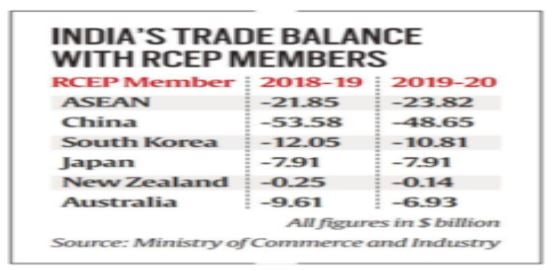
Unfavourable Balance of Trade: India has trade deficits with 11 of the 15 RCEP countries, and some experts feel that India has been unable to leverage its existing bilateral free trade agreements with several RCEP members to increase exports.
For instance, as per paper published by NITI Aayog, India has a bilateral trade deficit with most of the member countries of RCEP. Following Table 1 shows India’s trade balance with RCEP members.
Table 1: India’s trade balance with RCEP members.
Dumping of Chinese Goods: India has already signed FTAs with all the countries of RCEP except China. China is a major concern for India, as after signing RCEP, cheaper products from China might flood the Indian market.
Auto-trigger Mechanism: In order to deal with the imminent rise in imports, India had been seeking an auto-trigger mechanism that would have allowed India to raise tariffs on products in instances where imports cross a certain threshold. However, other countries in RCEP were against this proposal.
Rules of Origin issue: Rules of origin are the criteria used to determine the national source of a product. India was concerned about a “possible circumvention” of rules of origin. The deal did not have sufficient safeguards to prevent routing of the products.
Protection for domestic industries: Throughout the negotiations, the dairy industry demanded protection as the industry was expected to face stiff competition from Australia and New Zealand when the deal was signed. Similarly, steel and textiles sectors have also demanded protection.
Most favoured Nation Status: India wanted RCEP to exclude most-favoured nation (MFN) obligations from the investment chapter, as it did not want to hand out, especially to countries with which it has border disputes, the benefits it was giving to its strategic allies
No deal better than bad agreement: India’s stance was based on a “clear-eyed calculation” of the gains and costs of entering a new arrangement, and that no pact was better than a “bad agreement”.
However, the COVID-19 pandemic has changed the economic game of global powers. India is also not an exception.
Arguments for India to review its RCEP stand:
Need For Economic Realism: India should deter seeing RCEP only from the Chinese perspective. India should acknowledge that the trade bloc represents 30% of the global economy and world population, touching over 2.2 billion people, and staying out of RCEP may result in suboptimal economic growth without leveraging Asia-Pacific demand.
In this regard, India can draw inspiration from Japan & Australia, as they chose to bury their geopolitical differences with China to prioritise what they collectively see as a mutually beneficial trading compact.
Strategic Need: It is not just because gains from trade are significant, but the RCEP’s membership is a prerequisite to having a say in shaping RCEP’s rules.
This is necessary to safeguard India’s interests and the interests of several countries that are too small to stand up to the largest member, China.
Global Economic Stagnation due to Covid-19: With global trade and the economy facing a steep decline due to Covid-19 pandemic, RCEP can serve as a bulwark in containing the free fall of the global economy and re-energising economic activity.
Impact on India’s Act East Policy: There are concerns that India’s decision would impact its bilateral trade ties with RCEP member nations, as they may be more inclined to focus on bolstering economic ties within the bloc.
Way forward –
India, as an original negotiating participant of RCEP, has the option of joining the agreement without having to wait 18 months as stipulated for new members in the terms of the pact.
A possible alternative for India is to review its existing bilateral FTAs with some of these RCEP members as well as newer agreements with potential for Indian exports.
The problem is a broader one, of India’s competitiveness, which has to be improved so that opening up leads to more benefits than costs, to industrialisation and not it’s opposite.
Conclusion of 17th ASEAN-India Virtual Summit and adoption of ASEAN-India Plan of Action for 2021-2025 proves that despite conclusion of RCEP, ASEAN countries are welcoming towards India. India must try to find out possibilities of increasing trade with ASEAN countries.
Conclusion
Given India’s own ambitions to generate growth and jobs within, economic isolation could never be an option for India and becoming a key player and rule-maker on the world stage, India’s decision to withdraw from the RCEP is debatable. Instead of sitting out and building tariff walls across sectors, it must prod and incentivise the industry to be competitive, and get inside the RCEP tent at the earliest opportune moment but it should not done at the cost of sacrifice of domestic industry in India.
Q5. How do results of recent US elections affect India’s interests? Critically analyze.
Approach – A straightforward question where in you need to critically analyze the effect of results of recent US elections on India’s interests.
Introduction
With Democratic candidate Joe Biden winning the US Presidential Election over the Republican candidate and incumbent President Donald Trump as their new President by a significant margin, the world is now bracing itself for the significant changes anticipated by this turn of events. This also holds true for India as not only is the USA India’s second-largest supplier of defence equipment, it is also one of India’s most important trading partner (the Indo-US trade figures exceed $100 billion). India’s bid for a permanent seat on the UN Security Council also makes its relationship with USA vital in strategic terms.
Body
Owing to India’s strategic position in the world economy, growth prospects, and availability of cheap skilled labour, and also greater domestic demand momentum, traditionally, Indo-US ties have received a bipartisan support, and this is expected to continue even through Biden’s tenure. In this regard, the effect on India’s interests can be seen from the following points:
Under Biden administration, India’s trade with the US could recover from the dip since 2017-18 where over the past 20 years, India has always had a trade surplus (exports exceeding imports) with the US. Trade surplus had peaked at USD 21.2 billion in 2017-18 and has moderated to some extent.
Beyond trade, over the past two decades, the US is the fifth-biggest source for Foreign Direct Investment (FDI) into India. Apart from FDI (or investment in the physical assets inside India), the US also accounts for one-third of all Foreign Portfolio Investments (that is, investment in financial assets) into India. Here, Biden is likely to be less obtrusive than the current Trump administration.
H1-B Visa Issue – Under President Trump, who severely curtailed the visa regime, owing to his policy of “America First”, India had suffered the most. H-1B visa is a non-immigrant visa that allows American companies to employ foreign workers in speciality occupations that require theoretical or technical expertise. President Biden may again relax the norms for India’s benefit.
A Biden presidency may also see a renewed push towards a rules-based trading system across the world — instead of outright ad-hocism as was the case under Trump — as well as a move away from the protectionist approach that has been getting strong across the world.
Here, India’s exclusion from the US’ Generalized System of Preference (GSP) could come up for reconsideration under Biden where India was the largest beneficiary of the programme in 2017 with USD 5.7 billion in imports to the US given duty-free status but was terminated by President Trump.
Further, under the Trump administration, the US sanctions on Iran severely limited India’s sourcing of cheap crude oil. For an economy such as India, which needs a regular supply of cheap oil to grow fast, a normalisation of US-Iran relationship (and lifting of sanctions), which President elect Joe Biden has promised, would be more than useful.
On China, too, while the US apprehensions are unlikely to be fewer even under a Biden administration, it is more likely that a Biden administration will help India against China, instead of clubbing the two together.
Also, Biden has promised to re-join the Paris Climate Accord, and this may help countries such as India in dealing with the massive challenges — both technical and financial — on this front.
Other Issues – Other points of contention between India and US – such as the tricky issue of data localisation or capping prices of medicines and medical devices – have a chance of getting towards a resolution under a Biden Presidency.
Civil Liberties and Democratic Rights in India – Although some US Congressmen and women had raised red flags on the human rights situation following the revoking of J&K’s special status under Article 370 and passage of the Citizenship (Amendment) Act alongside the proposed nationwide National Register of Citizens (NRC), the Trump administration had not taken any actions beyond making some perfunctory statements. But this may change under the Biden Presidency, which can become an issue in terms of public outreach.
Further, there are many concerns related to the strategic aspects where India has some reservations in terms of Biden administration’s approach to dealing with China as well as the overall emphasis on QUAD and Indo-Pacific approach. Relations with Pakistan vis-à-vis its support to terrorism as well as tackling the Afghan issue can also become a sore point in the normally flourishing strategic relationship.
Conclusion
Combined with the control of Covid infections and the economic recovery, the US could yet again provide a growth impulse to the global economy that countries such as India need to boost their exports and grow where it has become clear that the outcome of the United States presidential election doesn’t affect India’s relationship with Washington as much as in earlier times where India’s ties with America find bipartisan support.