Government policies and interventions for development in various sectors and issues arising out of their design and implementation.
In News: In recent times, the use of e-cigarettes has become a popular alternative to cigarettes. The difference between the two is that e-cigarettes do not contain tobacco and therefore are not regulated under the Cigarettes and Other Tobacco Products Act, 2003. Rising concerns on the health risks posed by e-cigarettes have led to the promulgation of an Ordinance banning their production, export, advertisement, and storage in India.
Electronic-cigarettes
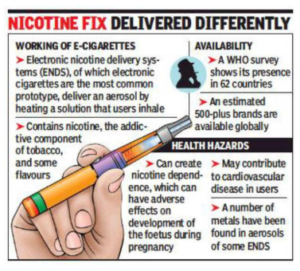
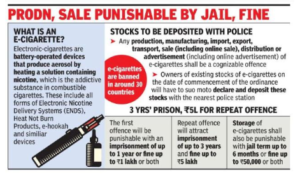
Electronic-cigarettes are battery-operated devices that produce aerosol by heating a solution containing nicotine, which is the addictive substance in combustible cigarettes.
These include all forms of Electronic Nicotine Delivery Systems, Heat Not Burn Products, e-Hookah and the like devices.
These novel products come with attractive appearances and multiple flavours and their use has increased exponentially and has acquired epidemic proportions in developed countries, especially among youth and children.
RSTV IAS UPSC – The Prohibition of Electronic Cigarettes Ordinance, 2019
Implementation
Upon promulgation of the Ordinance, any production, manufacturing, import, export, transport, sale (including online sale), distribution or advertisement (including online advertisement) of e-cigarettes shall be a cognizable offence punishable with an imprisonment of up to one year or fine up to Rs. 1 lakh or both for the first offence; and imprisonment of up to three years and fine up to Rs. 5 lakh for a subsequent offence.
Storage of electronic-cigarettes shall also be punishable with an imprisonment up to 6 months or fine up to Rs 50,000 or both.
The owners of existing stocks of e-cigarettes on the date of commencement of the Ordinance will have to suomoto declare and deposit these stocks with the nearest police station.
The Sub-Inspector of Police has been designated as the Authorized Officer to take action under the Ordinance. The Central or State Governments may also designate any other equivalent officer(s) as Authorized Officer for enforcement of the provisions of the Ordinance.
RSTV IAS UPSC – The Prohibition of Electronic Cigarettes Ordinance, 2019
Expected Impact
The decision to prohibit e-cigarettes will help protect population, especially the youth and children, from the risk of addiction through E-cigarettes.
Enforcement of the Ordinance will complement government’s efforts for tobacco control
Will help in reduction of tobacco use
Help in reduction in associated economic and disease burden
Background
The current decision has come on the back of an advisory issued by the Government in 2018 to all States to consider banning e-cigarettes. 16 States and 1 UT have already banned e cigarettes in their jurisdictions.
Notably, the Indian Council of Medical Research (ICMR), in a recent white paper on the subject, also recommended a complete ban on e-cigarettes based on currently available scientific evidence.
The WHO has also urged member countries to take appropriate steps including prohibiting these products. These products are usually marketed as being safer alternatives for conventional cigarettes but such notions of safety are false.
On the other hand, available literature suggests that these products may act as gateway products to induce non-smokers, especially youth and adolescents, to nicotine-use, leading to addiction and subsequent use of conventional tobacco products.
Considering the
Highly addictive nature of nicotine;
Safety concern of flavours in combination with nicotine;
Risk of use of other psychoactive substances through these devices;
Initiation of nicotine or psychoactive substances by non-smokers, especially adolescents and youth;
Dual use of e-cigarettes and conventional cigarettes;
Scant scientific evidence for use of e-cigarettes as effective tobacco cessation aids;
Threat to country’s tobacco control efforts;
Hindrance in achieving the targets envisaged under Sustainable Development Goals, National Monitoring Framework for Prevention and Control of Non-communicable Diseases and National Health Policy, 2017;
and in overall interest of public health as envisaged under Article 47 of the Constitution of India,
…the decision has been taken to prohibit/ban e-cigarettes including all forms of Electronic Nicotine Delivery Systems [ENDS), Heat Not Burn Products, e-Hookah and the like devices.