Part of: GS Prelims and Mains III – Indian Economy; Cyber security
In news:
RBI said dealing in cryptocurrency would encourage illegal transactions.
Cryptocurrencies are “a stateless digital currency” in which encryption techniques are used for trading and these ‘currencies’ operate independently of a Central bank like the RBI, “rendering them immune from government interference.”
Do you know?
A committee headed by Dinesh Sharma has been set up by the Centre to deal with issues relating to cryptocurrencies.
Crypto Currencies
Crypto Currencies or Virtual Currencies are type of unregulated digital money. They are mainly decentralised peer-to-peer system, and transacted between users directly, without an intermediary.
These transactions are verified by network nodes and recorded in public distributed ledger called blockchain.
They are neither issued by central bank/public authority, nor is necessarily attached to fiat currency, but is used and accepted among the members of a specific virtual community.
They are being transferred, stored or traded electronically.
Example – Bitcoin, Litecoin, Darkcoin, Peercoin, Dogecoin, Primecoin etc
WhatsApp to cap number of forwards to five chats per user
Part of: GS mains – Security issues; Welfare
In news:
To address the profusion of fake news being spread through forwards, and the government’s growing discontent with WhatsApp in tackling the issue, the messaging platform is experimenting with a limit on the number of chats a message can be forwarded to.
In India, WhatsApp is trying a limit of five chats, as against 20 for the rest of the world. The current limit is 250 chats.
Part of: GS Prelims and Mains II – International relations and India and the world
In news:
PM Modi to attend BRICS summit in South Africa and also visit Uganda and Rwanda
India and Rwanda
India to sign a defence framework agreement with Rwanda
The defence agreement is expected to enhance ties between the two countries, which became Strategic Partners in January 2017
Other areas of cooperation – dairy cooperation, leather exports, agriculture and cultural ties
PM Modi to visit the genocide memorial centre in Kigali, remembering the one million Rwandans killed in the Hutu-Tutsi conflict during the 1994 pogrom.
India was expected to enhance the Lines of Credit for Rwanda, which have already topped $400 million for development cooperation.
India has yet to set up a long-promised embassy in Kigali, despite specific promise to do so
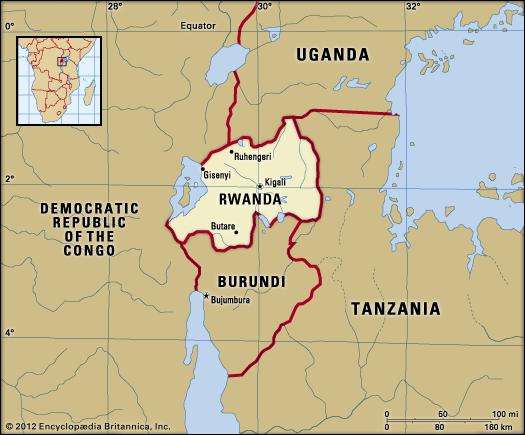
Map work:
Locate and observe the following:
Rwanda doesn’t touch Indian Ocean
It is a land-locked country
Located a few degrees south of the Equator, Rwanda is bordered by Uganda, Tanzania, Burundi and the Democratic Republic of the Congo.
Rwanda is in the African Great Lakes region and is highly elevated; its geography is dominated by mountains in the west and savanna to the east, with numerous lakes throughout the country.
African Great Lakes located around the Great Rift Valley – Lake Victoria to Lake Kivu
Part of: GS Prelims and Mains III – Science and Tech; Government policies and schemes
In news:
The government has proposed a new policy that could transform scientific instruments in government labs into lucrative assets generating a steady rental income.
It plans to lease out time on scientific instruments to researchers across the country.
The policy, called the Scientific Research Infrastructure Management and Networks (SRIMAN) would not apply to strategic sectors
(MAINS FOCUS)
NATION/WELFARE
TOPIC: General Studies 2
Government policies and interventions for development in various sectors and issues arising out of their design and implementation.
Issues relating to development and management of Social Sector/Services relating to Health, Education, Human Resources.
Welfare schemes for vulnerable sections of the population by the Centre and States and the performance of these schemes; mechanisms, laws, institutions and Bodies constituted for the protection and betterment of these vulnerable sections.
Assessment of March 2018 SC Verdict on SCs/STs Atrocities Act
Introduction:
March 2018 Supreme Court verdict on framing guidelines on how to deal with a person accused under the Scheduled Castes and the Scheduled Tribes (Prevention of Atrocities) Act, 1989, said –
“An innocent should not be punished. There should not be terror in society… We do not want any member of the Scheduled Castes (SCs)/Scheduled Tribes (STs) to be deprived of his rights.”
And the verdict called for “an inbuilt provision” to protect those falsely accused innocent people under the Act.
Fast recap:
We earlier have read that –
The SC/ST Prevention of Atrocities Act protects SCs and STs against discrimination and atrocities.
However, the SC/ST act can never be called a successful legislation. Dalits and Tribals still face discrimination.
On the other side, there is widespread concern over misuse of the provisions of the Act against innocent persons. (with regard to automatic arrests of those accused under the Act)
As per the Supreme Court of India, the SC/ST act has become an instrument of “blackmail” and is being used by some to exact “vengeance” and satisfy vested interests.
Therefore, the demand for “an inbuilt provision” to protect those falsely accused under the Act was raised – first by a parliamentary committee in December 2014 and now in March 2018, the apex court did so.
Concern:
All the three organs of the state are united with regard to this demand and this marks the collapse of the constitutional scheme to protect the weaker sections.
One, because the judgment is concerned with a limited aspect of the Act — protecting innocent officers and employees in government and private sectors from the misuse of the Act
Two, as judgment conveys a false and dangerous message that the Atrocities Act is “a charter for exploitation or oppression,” and “an instrument of blackmail or to wreak personal vengeance”.
Critics to SC verdict argue that –
One must consider why a fence was put up in the first place before pulling it down?
court appears to have mistaken a large number of acquittals in atrocities cases to be false cases
there is no precise data on the scale and extent to which the Act has been misused by SC/ST employees
a single case got transformed itself into a judicial exercise of policymaking in a surprising manner
The SC court had all the power to initiate suo motu proceedings to examine the issue, or refer the matter to a larger bench. This could have enabled the court as well as the government to delve into the relevant facts and data. But the Court failed to do so.
The court’s single-minded mission was to end “terror in society”.
Do you know?
Article 338 in the Constitution of India deals with Special Officer for Scheduled Castes, Scheduled Tribes etc
Article also says – the Union and every State Government shall consult the Commission [National Commission for Scheduled Castes] on all major policy matters affecting Scheduled Castes.
Article 338A, which created the National Commission for Scheduled Tribes, provides the same procedure in case of STs.
Constitution (123rd Amendment) seeks to create the new National Commission for Backward Classes under a new Article 338B, also has such provision.
Therefore, when the court wears the policy-making hat in matters related to SC/STs, it too is constitutionally-bound to consult these commissions.
Conclusion:
The task of balancing the rights of innocent persons facing false accusations and the need to accord legitimacy to the Atrocities Act requires compassion, equanimity, reverence for the Constitution and awareness so even impromptu (unarranged or unplanned) comments from the top court will acquire the force of law. Unfortunately, the March 20 verdict lost that balance.
Connecting the dots
The Supreme Court has recently diluted the SC and ST Act, 1989. Discuss the rationale behind. Do you think the judgment needs a review? Analyze.
WELFARE/WOMEN
TOPIC: General Studies 2
Government policies and interventions for development in various sectors and issues arising out of their design and implementation.
Issues relating to development and management of Social Sector/Services relating to Health, Education, Human Resources.
Welfare schemes for vulnerable sections of the population by the Centre and States and the performance of these schemes; mechanisms, laws, institutions and Bodies constituted for the protection and betterment of these vulnerable sections.
Crime against women-data and its flaws
In news-
Recently the Thomson Reuters Foundation put out the results of its 2018 The World’s Most Dangerous Countries for Women survey.
It found India to be the most dangerous country in the world for women.
Introduction
The data on the status of women, following an international survey suggest that India to be the most dangerous country in the world for women.
The recent social media and news debate shows that India is asking all the wrong questions about sexual crime and misunderstanding its answers too.
Amidst all the political reactions, some analysts examined the data and concluded that by international comparison, India cannot be the world’s most dangerous.
Do you know?
The survey conducted by Thomson Reuters Foundation about The World’s Most Dangerous Countries for Women took into consideration 5 key areas.
They are:
Healthcare
economic resources and discrimination
customary practices
sexual violence and harassment
non-sexual violence and human trafficking
India, which was ranked fourth most dangerous in 2011, is now the world’s most dangerous country for women.
What are the concerns about sexual crime in India?
In December 2012, a student was gang-raped in a Delhi bus and left to die, this horrific incident later turned to be the watershed moment for women’s rights. Public displays of misogyny and sexism have not abated but public disapproval of it is now far stronger.
In India support for victims remains contingent upon other allegiances — religious, for instance.
Findings of the report and its lacunae
India has not evolved much on the use and misunderstanding of data on sexual crime.
The problem is two-fold: There is the part that official data is not taking into its account, and the part that it is misunderstood.
It is fair to accept that in a deeply patriarchal and often violent country, women might fear speaking out about sexual crime, and also fear reporting it to the police. But the Delhi gang rape incident of 2012 has changed things on the ground to an extent.
There is increased awareness in addition to reporting of sexual crimes.
In this regard, the Thomson Reuters Foundation’s note that crimes against women grew between 2007 and 2016 in India might actually be capturing some progressive rather than regressive trends.
In a recent household survey it was found that less than 1% of sexual crime was reported to the police and 98% of the sexual violence women experienced was by their husbands even while marital rape is not recognised as a crime in India.
All the official data captured isn’t necessarily about crime. In an analysis of the cases decided by Delhi local courts it was found that most of it relates to cases involving consensual sex between sometimes inter-religious or inter-caste couples, matches set by the couples themselves often to their families’ disapproval.
The enduring issue of some men being charged with rape after a “breach of promise to marry”, yet another example of the price on a woman’s “chastity” — have had the opposite effect of under-reporting; it inflated the number of rape cases to an unspecifiable extent.
Way ahead
The above mentioned issues do not add up to the positive image.
If there is some “over-reporting” of rape in India, it stems from the deep discomfort the country continues to have over women’s sexual autonomy.
Now it is time for us to look into the question If Indian women are really free? And it’s no more about whether Indian women are safe.
Connecting the dots:
That India is considered as one of the most dangerous counties in the world for women, is a matter of serious introspection. In this regard, examine the factors that have led to this perception and also the possible remedial measures.
(TEST YOUR KNOWLEDGE)
Model questions: (You can now post your answers in comment section)
Q.1) Below given are the countries which forms East African Community (EAC). Select the country/countries that touches Indian Ocean:
Kenya
Tanzania
Uganda
Rwanda
Burundi
Choose the appropriate code:
1 and 2 only
1, 4 and 5 only
2, 4 and 5 only
3 only
Q.2) African Great Lakes Region consists of
Burundi
Tanzania
Uganda
Zimbabwe
Select the correct code:
1, 2 and 3
2, 3 and 4
1, 3 and 4
1, 2 and 4
Q.3) Which among the following is the first Country in the world to adopt a Cryptocurrency as Its Official Currency?
Japan
Germany
San Marino
Marshall Islands
Q.4) Consider the following statements about Bitcoin regulations in India
It is considered as a commodity derivative
Securities and Exchange Board of India (SEBI) is the regulatory body for cryptocurrencies
Select the correct statements
1 Only
2 Only
Both 1 and 2
Neither 1 nor 2
Q.5) Consider the following statements about Cryptocurrency
It is a digital or virtual currency that uses cryptography for security.
It is not a legal tender in India
Bitcoin is a type of cryptocurrency
Select the correct statements
1 and 2
2 and 3
1 and 3
All of the above
MUST READ
Onus on the CBI: on the case against P. Chidambaram