1. What do you understand by the term ‘vulnerability’? Why does vulnerability arise? Is it intrinsic of gender, religion, caste or region? Or is it structural? Examine with the help of suitable examples.
Approach:
Definition of term vulnerability:
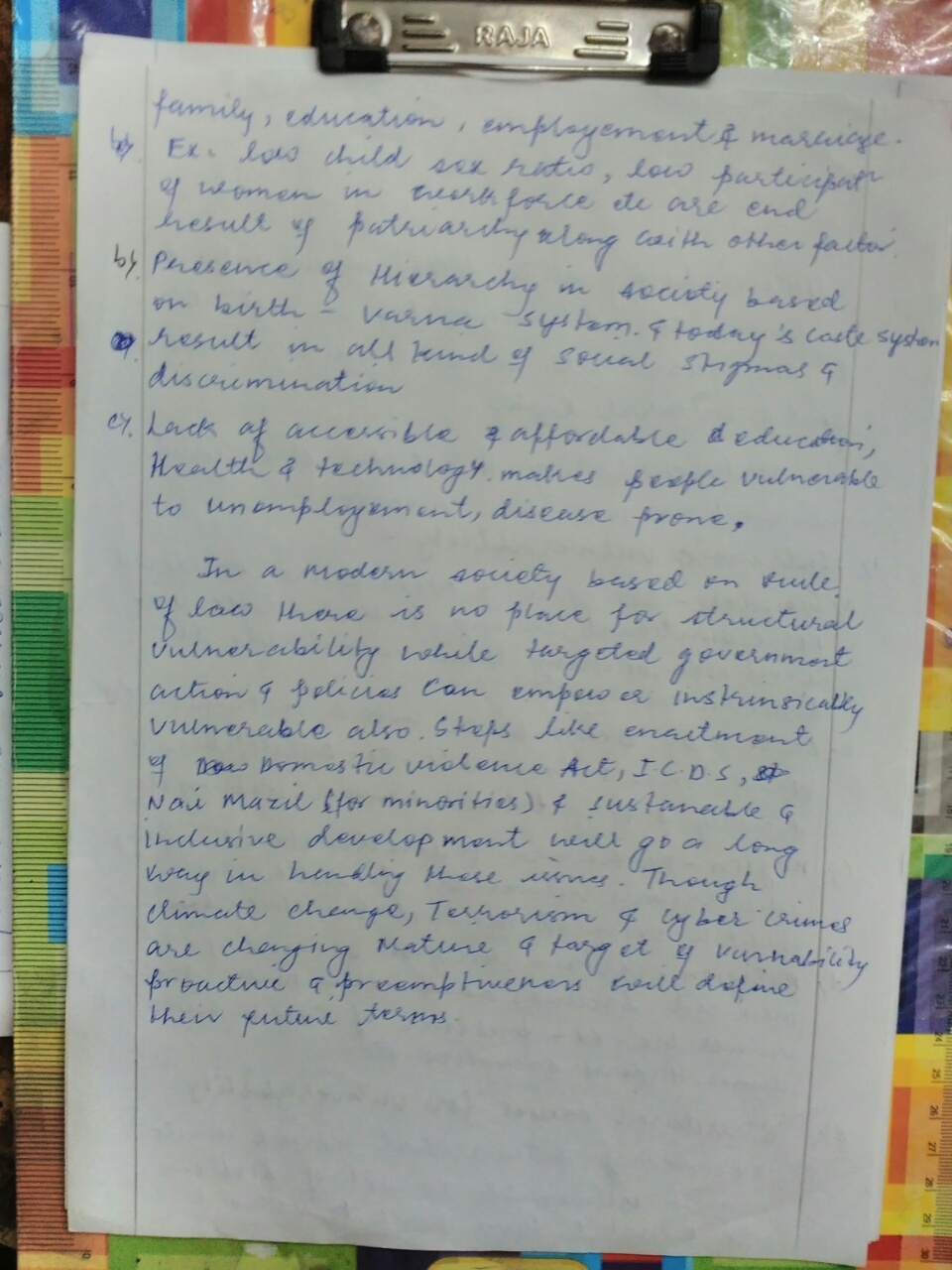
Vulnerability is the state of being exposed to the possibility of being attacked, either physically, mentally or emotionally. It is a state of being in distress. Constant state of vulnerability hampers natural growth, physical and mental of an individual and society. It arises because of natural biological, economic and also structural man-made reasons. It is both intrinsic and structural.
Vulnerability is intrinsic to:
Gender-
Patriarchy, the feature of Indian society makes women vulnerable. Women are the worst suffers of evils like rapes, child marriages, dowry and domestic violence.
Also, because of biological reasons, women are more vulnerable than men in certain aspects. This vulnerability is intrinsic in sex. For example, air pollution affects more women negatively than men.
Religion-Caste-
The notion of the superiority of one religion over other leads to minority religion open for domination by majority.
The caste system which is unique to Indian society has developed a hierarchy where the people in the lowest level are the worst suffers. Example- The literacy is lowest among SCs(Scheduled castes), maximum percentage in BPL population is that of SCs.
Caste atrocities, honor killings etc., shows the vulnerability of low castes.
Due to lower levels of socio-economic development, lower castes and few sections of minority religions are vulnerable to economic crises like unemployment etc.
Regionalism-
Regionalism post LPG has played an important role in widening the vulnerability gaps. The lopsided development of human resources has heavily contributed to exploitation and fruits of development are shared by few rather than inclusive development.
Geographical location inherently makes some regions prone to risks of disasters, economically prosperous regions are less vulnerable and peaceful.
Example- Youth of Jammu Kashmir due to lack of education and regional turbulence are more prone to terrorist instigations.
People of coasts are vulnerable to cyclones while people of arid areas are vulnerable to droughts.
Vulnerability is also structural:
The unequal access to resources has resulted into vulnerability for the have-nots of the society.
Example- In case of any natural disasters the poor people are worst hit,
Demonetization affected the people in unorganized sector more as compared to those in the organized sector.
The cyclone Ockhi has devastated the livelihood of fishermen in coastal area. But, the rich in the same area were not much affected by the cyclone.
Conclusion:
Thus, vulnerability is closely associated to the socio political, regional and economic status of the person/community. It is one of the biggest concern in modern world and can be addressed by reducing the inequality in the society at various levels. Both intrinsic and structural vulnerabilities should be addressed. While economic resources are needed to address structural vulnerabilities, it is the ethos of a society that will address the intrinsic vulnerabilities. Sustainable development with equitable distribution can only be a viable option to reduce vulnerability gap.
Best answer:
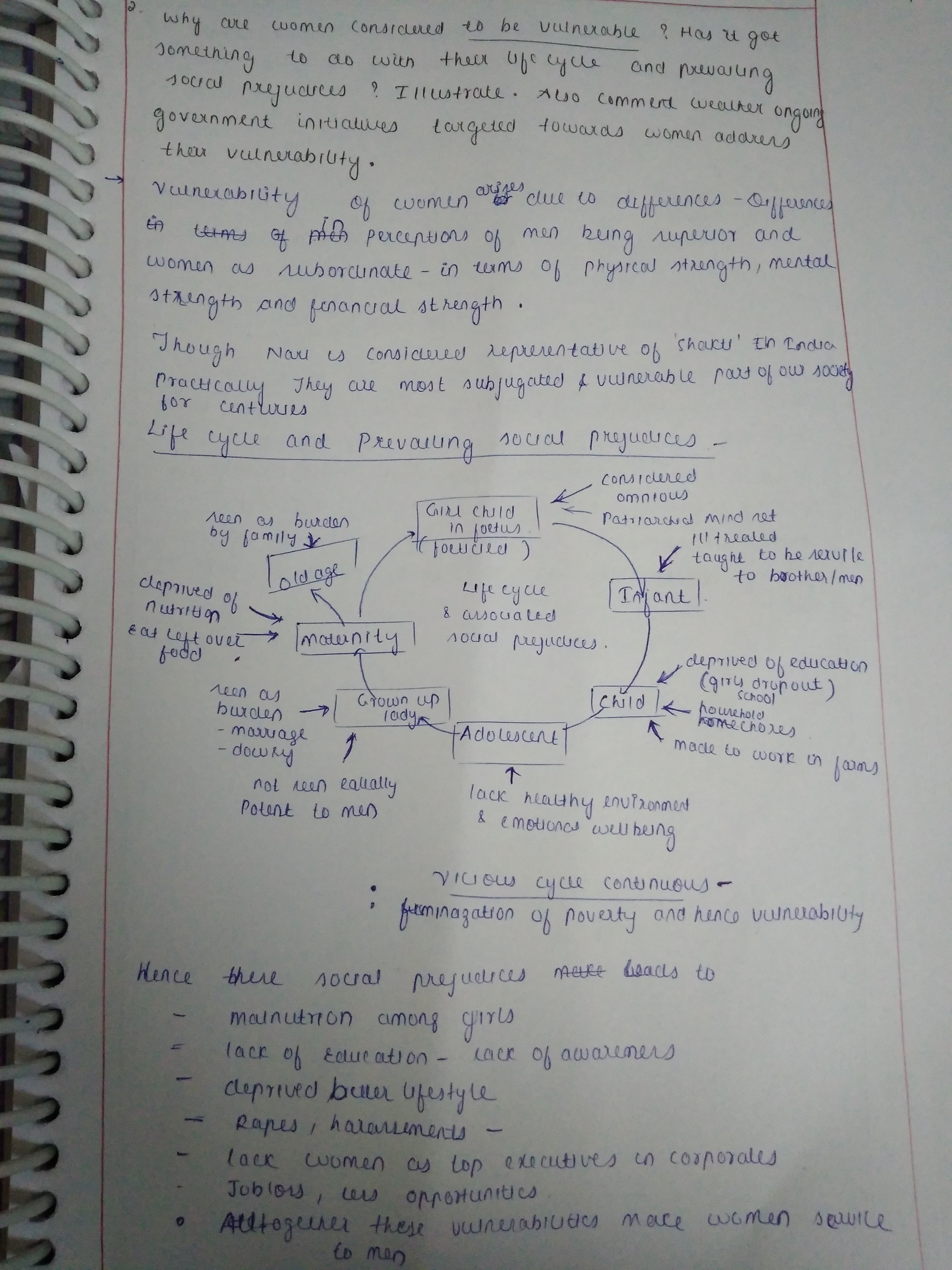
Q2. Why are women considered to be vulnerable? Has it got something to do with their life cycle and prevailing social prejudices? Illustrate. Also comment whether ongoing government initiatives targeted towards women address their vulnerability.
Approach:
Introduction
Women in India remain vulnerable throughout their journey from “the womb to their tomb”. Multiple reasons contribute to their misery:
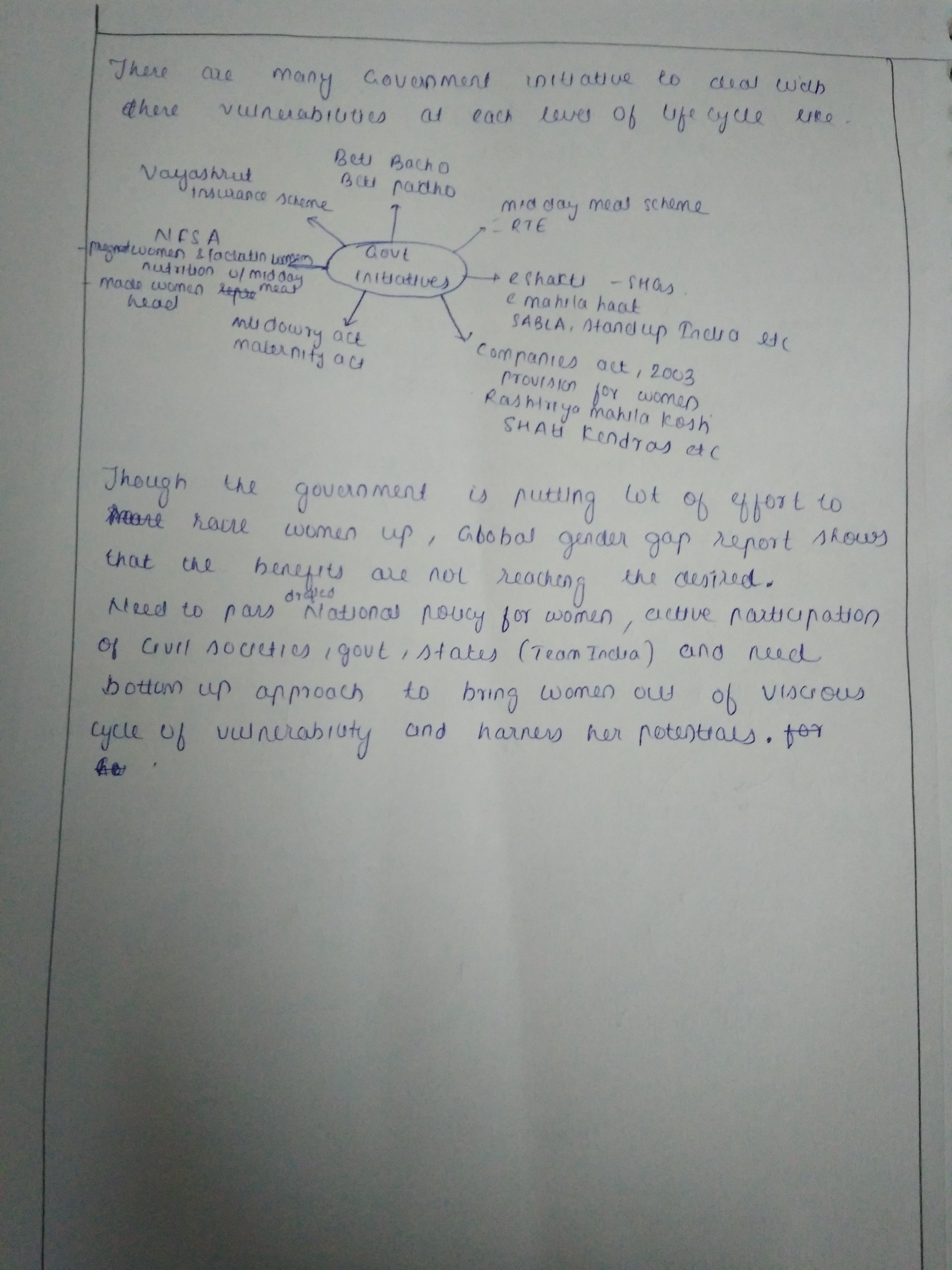
In light of above arguments, the government has taken many initiatives based on a life-cycle approach:
Conclusion
Despite the success of such government initiatives, the attitudinal change in India society is yet to take place as seen through the increasing crimes against women. Thus, what is needed is change at the individual level where our actions match our culture which holds women in highest regards.
Best Answer: Lavanya Yemulvar
3. Institutions and bodies constituted for the protection and betterment of vulnerable sections lack the teeth to enforce their mandate. Do you agree? Substantiate with the help of suitable examples.
Approach:
In Introduction, define who vulnerable sections of society are. In body, mention the bodies and institution, here categorize them than just mentioning randomly. Then mention what they lack specific to each of them and then what everyone lacks in common.
Introduction: Vulnerable sections are those due to their age, disability or any other circumstances whether temporary or permanent are dependent on others or at the greater risk of being harmed than the general population. In case of India, they are SC, ST, Women, and Disabled people among others.
Body:
Points to be covered:
Constitutional bodies:
Statutory bodies:
These are some of the commission established. You are required to pick some of them and explain. Two from each one of them are explained below.
Common points to most of them:
Conclusion:
Due to lack of any real powers, they are called toothless tigers by critics. With so much pendency in cases related to each of their domains at various levels of judiciary, government can provide these bodies’ some powers so that cases related to vulnerable sections are disposed of and relief to victims are provided soon.
Connecting the dots:
Best Answer: No best Answer.
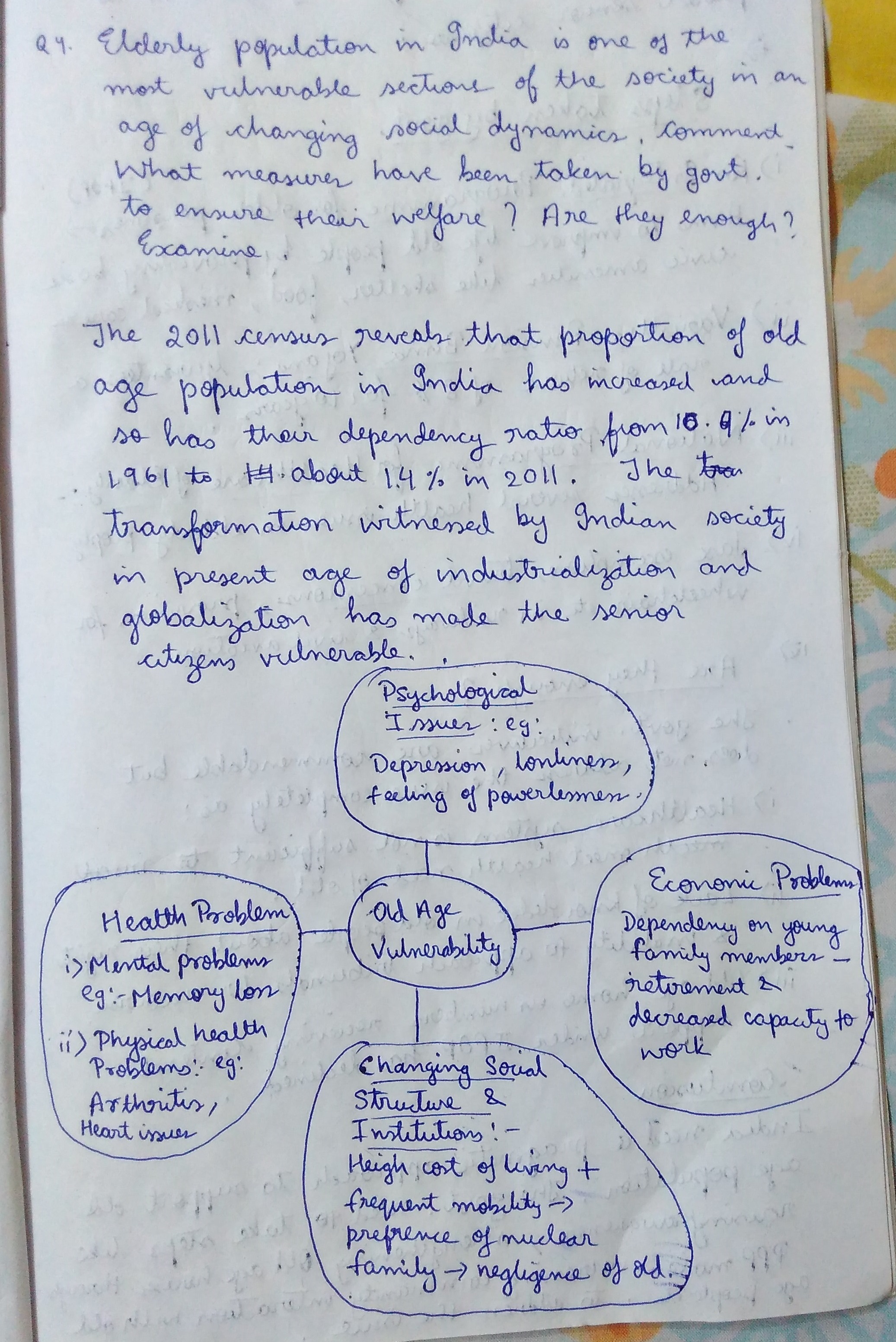
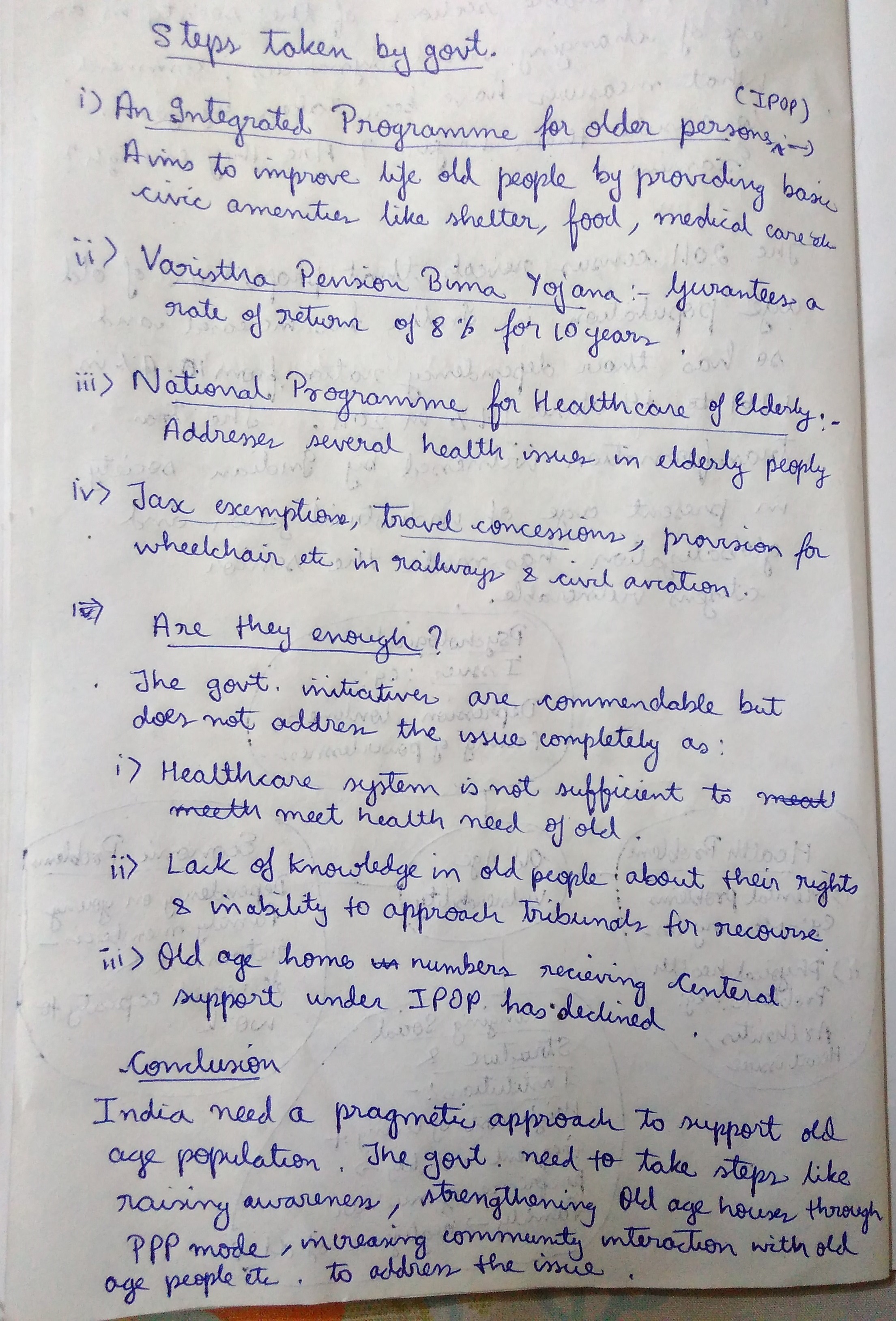
4. Elderly population in India is one of the most vulnerable sections of the society in an age of changing social dynamics. Comment. What measures have been taken by the government to ensure their welfare? Are they enough? Examine.
Approach:
Broadly there are three parts of this question. In first part you need to explain how elderly population is vulnerable keeping the ‘changing social Dynamics’ in mind.
Second part is straight forward where you need to mention some of the welfare measures of Government taken for elderly population.
In the last part you need to examine if the efforts are good enough to bring them out of that vulnerability status.
Body:
Some of the important points that should be present in your answer are:
Following are the important Government initiatives:
and justiciable through Tribunals
by relatives
iii. Penal provision for abandonment of senior citizens
Effectiveness:
All the initiatives taken by the government are with good intent. But the harsh ground reality is that, these amazing schemes have not penetrated to a large elderly population. Many of the people are either not aware or not in a position to avail the benefits of these schemes.
P.S. You can add some measures for effective implementation of these schemes.
Note: While answering this part, take a lot of care of the words that you use. These policies are made by people who have been in the system for past 20 – 25 years. You are just trying to get into the system right now. By reading some books and newspapers, you are not exactly in a right position to take a harsh stand.
Best Answer: Deadpool
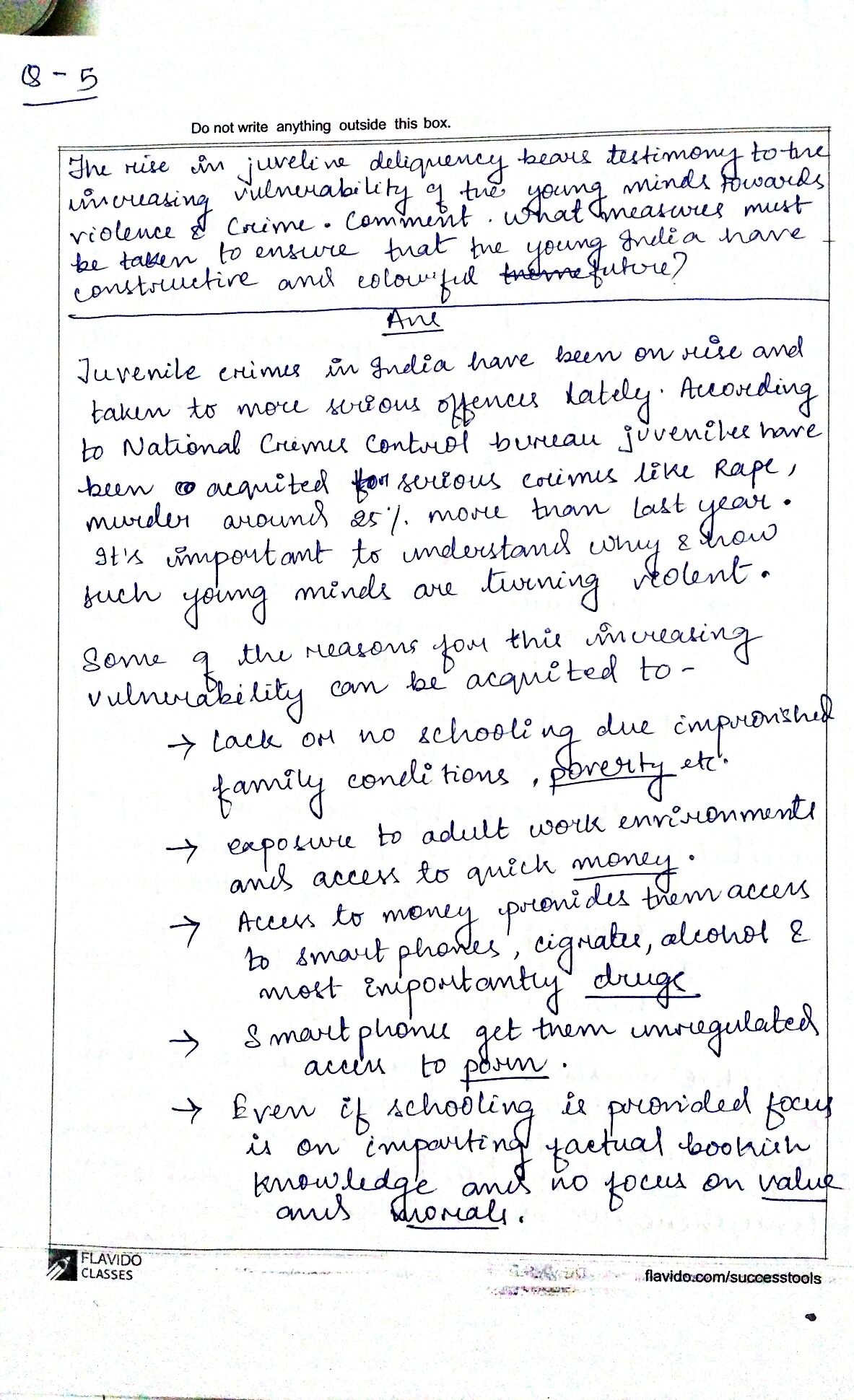
Q.5) The rise in juvenile delinquency bears testimony to the increasing vulnerability of the young minds towards violence and crime. Comment. What measures must be taken to ensure that the young in India have a constructive and colourful future? Also examine the role of society at large.
Introduction:
The number of juveniles or minors, legally those under 18 years of age, taking up crime has seen an alarming high over the past decade. This should be a particular reason to worry about for a country where 47.21 crore i.e. almost 39% of the population is under 18.
According to latest NCRB data, 33,526 cases against juveniles – majority of them in the age group of 16 to 18 years – were recorded for various offences during 2014. A cause for concern is that the highest share of cases registered against juveniles were reported for theft (20%), rape (5.9%) and grievous hurt and assault on women with intent to outrage her modesty (4.7% each).
Reasons behind the increasing vulnerability of the young minds towards violence and crime:
Poverty has always bred resentment, a root-cause of many crimes. But over the years, a fast-changing and developing society has introduced other insecurities, they are:
Children are also quick to pick up on friction between adults. “In cases of marital discord or domestic violence, kids do not reach out to their parents. They consult their friends who may not give the best advice.”
Measures to be taken to counter the juvenile crimes:
Without getting into the debate of punishment and the age of criminality, it is important to instil respect for the law. By and large in India, we do not have rule of law. And youngsters are finding out that it is easy to get away with breaking the law.
Role of society in large to prevent juvenile crimes:
The burden of delinquency prevention is widely distributed between parents, schools, non-profits, and governmental agencies at the federal, state and local levels. With so many diverse stakeholders, it is difficult to come to solid conclusions about who is responsible for protecting at-risk youth. While much of the research indicates that parents are the first line of defense in identifying and preventing delinquent behavior, parents tend to look to government agencies to create better delinquency prevention programs.
Best answer: Ashis kar