Part of: Prelims and GS III – Conservation related issues;
Context Steps will be taken to open a wildlife rescue and rehabilitation centre in the Mudumalai Tiger Reserve.
Reason for the step: Animals, captured or rescued recently in the Nilgiris, needed to be taken to the Arignar Anna Zoological Park in Chennai or the Mysore Zoo for treatment.
Mudumalai Tiger Reserve
Mudumalai Tiger Reserve is located in the Nilgiris District of Tamil Nadu state at the tri-junction of three states, viz, Karnataka, Kerala and Tamil Nadu.
It is a part of Nilgiri Biosphere Reserve (1st Biosphere Reserve in India) along with Wayanad Wildlife Sanctuary (Kerala) in the West, Bandipur National Park (Karnataka) in the North, Mukurthi National Park and Silent Valley in the South.
Flora:
The Reserve has tall grasses, commonly referred to as ‘Elephant Grass’.
Bamboo of the giant variety, valuable timber species like Teak, Rosewood, etc.
There are several species of endemic flora.
Fauna: Flagship Species: Tiger and Asian Elephant.
Context Recently it was highlighted by the Union Health minister that under recently launched PM Ayushman Bharat Health Infrastructure Mission, various tests would be done for free at the district level, which will reduce expenses and unnecessary travel for the poor.
Key takeaways
For the first time in Asia, two container-based hospitals, equipped with comprehensive medical facilities, will be stationed in Chennai and Delhi and kept at the ready to be swiftly mobilised by rail or air to respond to any calamity or disaster in the country.
Objective: To fill critical gaps in public health infrastructure, especially in critical care facilities and primary care in both the urban and rural areas.
Strengthening of points of entry will ring-fence India’s borders against the import of new infectious diseases and pathogens.
Development of critical care hospital blocks in districts shall make the districts self-sufficient in providing comprehensive treatment for infectious diseases
Every district shall have at least one medical college as well.
Context Matrilineal Meghalaya is set to break the tradition of parents hand down a major share of parental property to the khatduh, which means the youngest daughter in the Khasi language.
The Khasi Hills Autonomous District Council (KHADC) is scheduled to introduce the Khasi Hills Autonomous District Khasi Inheritance of Property Bill, 2021, for equal distribution of parental property among siblings, both male and female.
The bill will enable equitable distribution of property among the heirs irrespective of gender.
The Bill also has a provision for denying share of property to any ward who marries a non-tribal and accepts the culture and tradition of his or her spouse.
About the tradition of the Khasis
Khasis – who account for Meghalaya’s largest ethnic community – are one of the last existing matrilineal societies in the world.
Here, children receive their mother’s last name, husbands move into their wife’s home, and the youngest daughters inherit the ancestral property.
Khasi is used as an umbrella phrase to refer to many subgroups in Meghalaya who have distinguishing languages, rites, ceremonies, and habits, but share an ethnic identity as Ki Hynniew Trep (The Seven Huts).
Context The Ministry of Civil Aviation has notified a traffic management policy framework for drones, which envisages private, third-party service providers for ensuring safe operations.
Key takeaways
Major role: Under the framework, these Unmanned Traffic Management Service Providers (UTMSP) will extend automated, algorithm-driven software services instead of voice communication as in the traditional Air Traffic Management (ATM) systems.
Responsibility: They will be responsible for segregating and separating a drone from other drones and manned aircraft in the airspace below 1,000 feet in the country.
Supplementary Service Providers (SSPs): The traffic management providers will be assisted by Supplementary Service Providers (SSPs), who will maintain data about terrain, weather, location of manned aircraft and provide services such as insurance, data analytics and drone fleet management.
Law enforcement and security agencies will also have access to some information in the UTM ecosystem on a need-to-know basis.
Levy of Service fee allowed
The policy also allows UTMSPs to levy a service fee on users, a small portion of which will also be shared with the Airports Authority of India.
In order to implement this policy, the government is likely to carry out UTM-based experiments in the country and then float a request for proposal for onboarding UTMSPs.
Following which an evaluation process will be undertaken and successful participants will be awarded regions for establishment of UTM services.
Part of: Prelims and GS II – International Relations
Context G7 nations recently agreed on a joint set of principles to govern cross-border data use and digital trade.
The deal sets out a middle ground between highly regulated data protection regimes used in European countries and the more open approach of the United States.
Key provisions of the G7 Digital Trade Principles
Open Digital Markets: Digital and telecommunications markets should be competitive, transparent, fair, and accessible.
Cross Border Data Flows: To harness the opportunities of the digital economy, data should be able to flow freely across borders with trust
Safeguards for Workers, Consumers and Businesses: Labour protections must be in place for workers who are directly engaged in or support digital trade.
Digital Trading Systems: To cut red tape and enable more businesses to trade, governments and industries should drive forward the digitisation of trade-related documents.
Fair and Inclusive Global Governance: Common rules for digital trade should be agreed upon and upheld at the World Trade Organization (WTO).
Data Encryption: Businesses should not be required or coerced to transfer technology or provide access to source code or encryption keys as a condition of market access.
About G7
G7 stands for “Group of Seven” industrialized nations.
It used to be known as the G8 (Group of Eight) until 2014 when Russia was excluded because of its annexation of Crimea from Ukraine.
Countries: United States, the United Kingdom, Germany, Canada, Japan, France and Italy.
The G7 does not have a formal constitution or a fixed headquarters.
It is an informal bloc and The decisions taken by leaders during annual summits are non-binding.
Generally every member country hosts the summit once every 7 years
Miscellaneous
Dadasaheb Phalke Award
It is the country’s highest film honour conferred for “Outstanding contribution for the growth and development of Indian cinema”.
Dadasaheb Phalke Award was introduced by the government in 1969 and it was awarded for the first time to Devika Rani, “the first lady of Indian cinema”.
Dadasaheb Phalke directed India’s first feature film Raja Harischandra (1913). He is known as “Father of Indian Cinema”.
51st Dadasaheb Phalke Award was recently presented to Rajinikanth.
Context: First conducted in 2018, the Indo-Pacific Regional Dialogue (IPRD) is the apex international annual conference of the Indian Navy, and is the principal manifestation of the navy’s engagement at the strategic-level.
Aim: To review both opportunities and challenges that arises within the Indo-Pacific.
Theme: Evolution in Maritime Strategy during the 21st Century: Imperatives, Challenges, and, Way Ahead –
Evolving Maritime Strategies within the Indo-Pacific: Convergences, Divergences, Expectations and Apprehensions.
Adaptive Strategies to Address the Impact of Climate Change upon Maritime Security.
Port-led Regional Maritime Connectivity and Development Strategies.
Cooperative Maritime Domain Awareness Strategies.
Impact of the Increasing Recourse to Lawfare upon a Rules-based Indo-Pacific Maritime Order.
Strategies to Promote Regional Public-Private Maritime Partnerships.
Energy-Insecurity and Mitigating Strategies.
Strategies to Address the Manned-Unmanned Conundrum at Sea.
Part of: Prelims and Mains GS-II: Issues relating to development and management of Social Sector/Services relating to Health
In News: WHO South-East Asia Region (SEAR) High-Level Meeting held for renewed TB response co-chaired by India.
India’s contribution towards eliminating TB
Eliminating TB by 2025: India is committed to eliminating tuberculosis by 2025, five years ahead of the global target of 2030.
National Tuberculosis Elimination Programme: To align with the ambitious goal, the programme has been renamed from the Revised National Tuberculosis Control Programme (RNTCP) to National Tuberculosis Elimination Programme (NTEP
Addressing all co-morbidities and goes beyond medical interventions to tackle the social determinants of TB while minimizing access barriers to diagnosis and treatment.
Through the Nikshay Poshan Yojana, nutritional support is extended to all TB patients for the entire duration of their treatment.
Rigorously working towards Airborne Infection Control in hospital wards and outpatient waiting areas.
Has the provision of chemoprophylaxis against TB disease in pediatric contacts of TB patients and PLHIV patients.
The process is ongoing for expanding TB preventive treatment for the adult contacts too.
‘TB Mukt Bharat Abhiyaan’ has been launched as a people’s movement for TB elimination in India.
India remains committed to supporting countries in its neighbourhood with possible technical support and assistance.
Indi appreciated the South-East Asia Region (SEAR) for demonstrating the highest-level political commitment towards ending tuberculosis and increasing investments towards ending TB.
Tuberculosis (TB)
Tuberculosis (TB) is a disease caused by bacteria called Mycobacterium tuberculosis.
Transmission: TB is spread from person to person through the air. When people with TB cough, sneeze or spit, they propel the TB germs into the air.
Symptoms: Cough with sputum and blood at times, chest pains, weakness, weight loss, fever and night sweats.
TB is a treatable and curable disease.
Multidrug-resistant tuberculosis (MDR-TB) is a form of TB caused by bacteria that do not respond to isoniazid and rifampicin, the 2 most powerful, first-line anti-TB drugs. It is treatable and curable by using second-line drugs.
Extensively drug-resistant TB (XDR-TB) is a more serious form of MDR-TB caused by bacteria that do not respond to the most effective second-line anti-TB drugs, often leaving patients without any further treatment options.
Reports say
According to the India TB report, in 2020, there were 18.05 tuberculosis notifications, which was a fall of 24% from 2019 due to the disruptions caused by the pandemic.
According to the 2021 Global TB report released recently by the World Health Organization (WHO), for the first time in over a decade, Tuberculosis (TB) deaths have increased globally. WHO modelling projections suggest that the number of people developing TB and dying from the disease could be much higher in 2021 and 2022.
Context: The top three emitters of the world — China, the U.S. and the European Union — even after taking account of their net zero commitments and their enhanced emission reduction commitments for 2030, will emit more than 500 billion tonnes of carbon dioxide before net zero.
With these committed emissions, there is no hope of “keeping 1.5°C alive.” The target is dead-on-arrival.
Why India shouldn’t sign on Net Zero?
Not part of any Protocols: Neither the Paris Agreement nor climate science requires that net zero be reached individually by countries by 2050. Paris accord requires only global achievement of this goal “in the second half of the century”
Net Zero Ignores Equity: Claims that the world “must” reach specific goals by 2030 or 2050 are the product of specific economic models for climate action. These are designed to achieve the Paris goals by the “lowest cost” methods, foregoing equity and climate justice.
Against Historical Responsibility: Less than a fifth of the world has been responsible for three-fifths of all past cumulative emissions, the U.S. and the EU alone having contributed a whopping 45%. For India to declare net zero now is to accede to the further over-appropriation of the global carbon budget by a few.
India’s Commitment won’t alter much: India’s contribution to global emissions, in both stock and flow, is so disproportionately low that any sacrifice on its part can do nothing to save the world.
Bad Precedence of West: The failure of the developed world to meet its pre-2020 obligations along with its refusal to acknowledge this provides little confidence for India with regard to commitments announced by West.
What India must do
India’s emissions story cannot be bracketed with the top three. India is responsible for no more than 4.37% cumulative emissions of carbon dioxide since the pre-industrial era, even though it is home to more than a sixth of humanity.
India’s per capita emissions are less than half the world average, less than one-eighth of the U.S.’s, and have shown no dramatic increase like China’s post 2000.
The allocation of property rights (Carbon Budget), without grandfathering, is essential to ensure equitable access to any global commons. The global carbon budget has been subject to no such restriction allowing the developed countries to exploit it fully, in the past and the present.
India, in enlightened self-interest, must now stake its claim to a fair share of the global carbon budget. The absence of such a claim only eases the way for the continued over-exploitation of the global commons by a few.
Such a claim by India provides it greater, and much-needed long-term options. It enables the responsible use of coal, oil and gas, to develop, eradicate poverty, hunger and malnutrition for good.
Even if India were to enhance its short-term Nationally Determined Contributions under the Paris Agreement, it should do so while staking a claim to its share of the global commons.
Context: On October 23, China passed a new land law for the “protection and exploitation of the country’s land border areas” which will come into effect from January 1.
The law is not meant specifically for the border with India; however, the 3,488-km boundary remains disputed, and some experts feel it could create further hurdles in the resolution of the 17-month-long military standoff.
Do You Know?
China shares its 22,457-km land boundary with 14 countries including India, the third longest after the borders with Mongolia and Russia.
Unlike the Indian border, however, China’s borders with these two countries are not disputed.
The only other country with which China has disputed land borders is Bhutan (477 km).
The Chinese law
It states that “the sovereignty and territorial integrity of China are sacred and inviolable”, and asks the state to “take measures to safeguard territorial integrity and land boundaries and guard against and combat any act that undermines it”.
The state can take measures “to strengthen border defence, support economic and social development as well as opening-up in border areas, encourage and support people’s life and work there and promote coordination between border defence and social, economic development in border areas”.
In effect, this suggests a push to settle civilians in the border areas.
However, the law also asks the state to follow the principles of “equality, mutual trust, and friendly consultation, handle land border related-affairs with neighbouring countries through negotiations to properly resolve disputes and longstanding border issues”
Implications on India
The announcement of a law that makes China’s borders “sacred and inviolable” at a time of prolonged ongoing discussions to resolve the standoff in eastern Ladakh, may create further hurdles in arriving at lasting solution.
The PLA is now “bound to protect the integrity, sovereignty of the border”, and saying “that PLA is going to pull out from A, B, C, D areas, will make this much more difficult”.
Overall, it will make negotiations a little more difficult, a pullout from balance areas less likely.
China has been building “well-off” border defence villages across the LAC in all sectors. China is trying to change the facts on the ground not only through military but also civilian presence. The “dual civil and military use” of border villages is a concern for India.
Some experts think the law is just words — what has impacted the ties is not domestic Chinese legislation, but their actions on the ground.
In News: Ayushman Bharat Health Infrastructure Mission has been launched which will be one of the largest pan-India scheme for strengthening healthcare infrastructure across the country. The government will spend Rs 64,180 crore on the scheme from the financial year 2021-22 to 2025-26.
To address three critical gaps in India’s public health sector:
Augmenting health facilities for treatment
Setting up of Integrated Public Health labs for diagnosis of disease
Expansion of existing research institutions that study pandemics
Component 1: Establish comprehensive surveillance of infectious diseases
At the district level, Integrated Public Health laboratories in all 730 districts will be set up.
At the state level, five regional branches and 20 metropolitan units of the National Centre for Disease Control.
At the national level, an Integrated Health Information Platform (IHIP) will be established.
Component 2:Creation of comprehensive diagnostics and treatment facilities
At the district level, 17,788 new rural health and wellness centres will be set up; 11,024 new urban health and wellness centres will be set up; critical care hospital blocks will be established in each of 602 districts, with a population of more than 5 lakh.
At the state level, 15 health emergency operation centres will be set up.
At the national level, two container-based mobile hospitals will be set up; and critical care hospital blocks in 12 Government of India hospitals will be set up — which will also act as mentor institutions for training and capacity building.
Component 3:Comprehensive pandemic research
At the district level, strengthening of existing 80 viral diagnostics and research labs will be undertaken.
At the state level, 15 new bio-safety level III laboratories will be operationalised.
At the national level, four new regional national institutes for virology will be operationalized and a regional research platform (digital) for WHO southeast Asia Region will also be set up.
Why is the scheme significant?
India has long been in need of a ubiquitous healthcare system. A study (‘State of Democracy in South Asia (SDSA)–Round 3’) by Lokniti-CSDS in 2019 highlighted how access to public health care remained elusive to those living on the margins. The study found that
70 per cent of the locations have public healthcare services. However, availability was less in rural areas (65 per cent) compared to urban areas (87 per cent).
In 45 per cent of the surveyed locations, people could access healthcare services by walking, whereas in 43 per cent of the locations they needed to use transport.
The survey also found that proximity to healthcare services is higher in urban localities: 64 per cent of the enumerators in urban areas observed that people can access healthcare services by walking, while only 37 per cent in rural areas can do so
Note:Ayushman Bharat Digital Mission (ABDM) is a flagship digital initiative involving the creation of not just a unique health ID for every citizen, but also a digital healthcare professionals and facilities registry.
Can you answer the following questions?
Ayushman Bharat is one of the most ambitious health schemes ever launched in India. What can be the key challenges in proper implementation of this scheme?
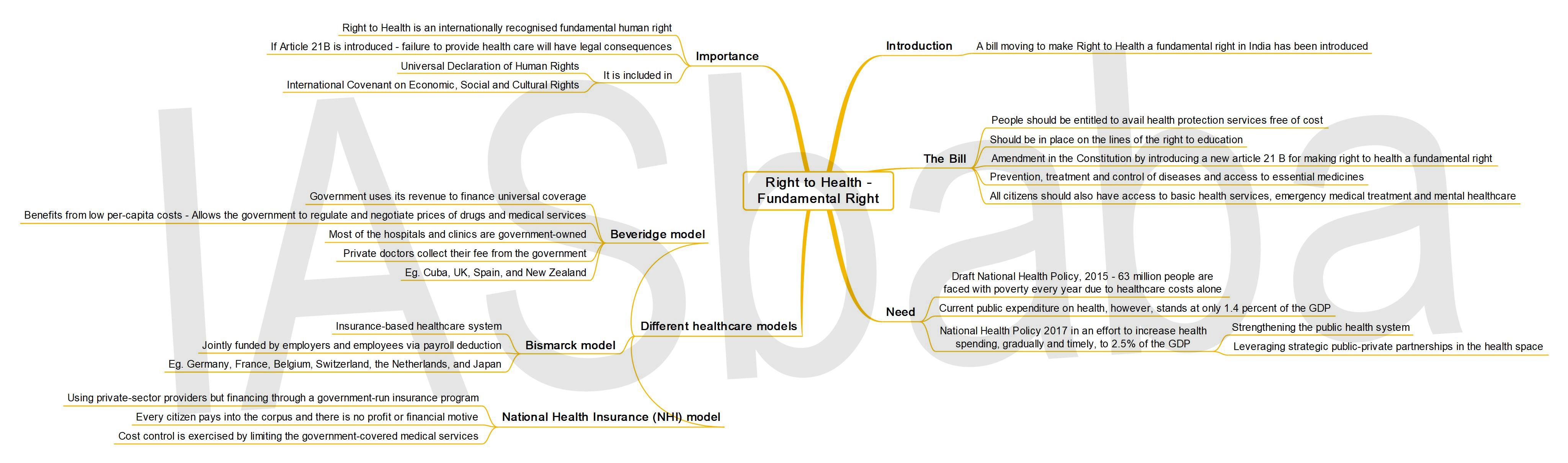
Right to health – A Fundamental Right
(TEST YOUR KNOWLEDGE)
Model questions: (You can now post your answers in comment section)
Note:
Correct answers of today’s questions will be provided in next day’s DNA section. Kindly refer to it and update your answers.
Q.1 Where is Mudumalai Tiger Reserve located?
Karnataka
Tamil Nadu
Kerala
All of the above
Q.2 Consider the following statements regarding PM Ayushman Bharat Health Infrastructure Mission:
For the first time in Asia, two container-based hospitals will be stationed in Mumbai and Delhi and kept at the ready to be swiftly mobilised by rail or air to respond to any calamity or disaster in the country.
The Objective of the scheme is to fill critical gaps in public health infrastructure
Points of entry shall be strengthened that will ring-fence India’s borders against the import of new infectious diseases and pathogens.
Which of the above is or are correct?
1 and 2 only
2 only
2 and 3 only
1, 2 and l3
Q.3 Which of the following nations is not a part of G7?
Italy
Japan
Russia
USA
ANSWERS FOR 26th Oct 2021 TEST YOUR KNOWLEDGE (TYK)