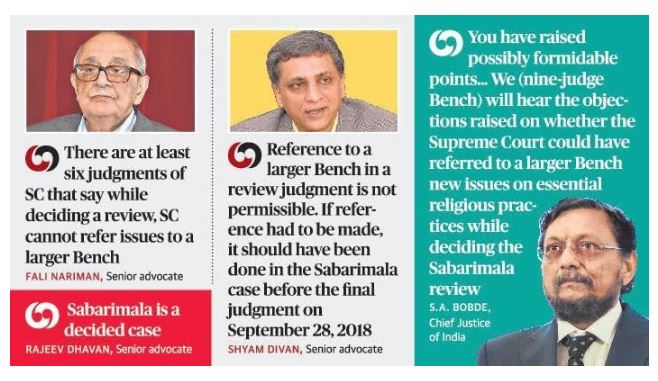
Whether certain essential religious practices of various faiths, including Islam and Zoroastrianism, should be constitutionally protected?
In past: Women devotees of menstruating age were not permitted to worship here, out of respect to the celibate nature of the deity in this temple.
1991 : A Kerala high-court judgement had legalized this Ban , and forbade women from entering the temple
In 2018 : The Constitution bench of the Supreme Court held that any exception placed on women because of biological differences violates the Constitution – that the ban violates the right to equality under Article 14, and freedom of religion under Article 25
From Prelims Point of View:
Article 14 :
State shall not deny to any person equality before the law or the equal protection of the laws within the territory of India.
Article 14 of our constitution provides that no one is above the law of the land.
Rule of the Law derived from Article 14 of the constitution.
The article 14 aims to establish the “Equality of Status and Opportunity” as embodied in the Preamble of the Constitution.
Article 25 :
No discrimination against anyone on grounds of faith,
Separation of religion from politics,
Acceptance of religion as purely and strictly private affairs of individuals having nothing to do with the State.
Daily Current Affairs IAS | UPSC Prelims and Mains Exam – 4th February 2020
A high-level group of Ministers has been constituted on the directions of Prime Minister Narendra Modi to review the management of the outbreak.
From Prelims Point of View:
Novel coronavirus 2019-nCoV :
coronavirus is a large family of viruses that are often the source of respiratory infections, including the common cold.
According to the World Health Organization, during previous outbreaks due to other coronaviruses, human-to-human transmission occurred through droplets or objects making contact, suggesting that the transmission mode of the 2019-nCoV can be identical.
Symptoms may include fever, cough and shortness of breath.
Antibiotics do not work against such viral pneumonia and there are no vaccines against them.
Virus is contagious even during incubation, that is even before a patient exhibits any symptoms. This characteristic amplifies transmissibility.
NCRB study on Missing Women & Children
Part of: GS Prelims and GS Mains II – Secularism
In news:
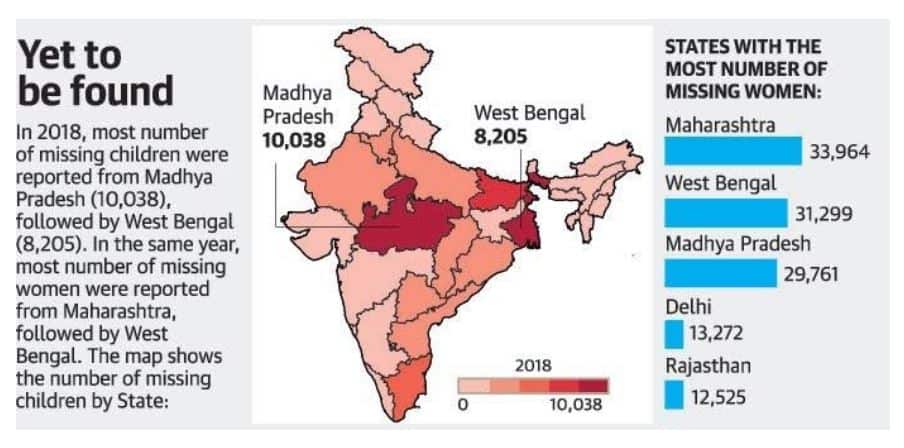
In 2019, the Supreme Court had directed the NCRB to “analyse the data on missing persons [especially on women and children], so that areas prone to persons being trafficked can be identified”.
Report says that The highest number of women and children who go missing in the country are from Maharashtra and Madhya Pradesh respectively.
Daily Current Affairs IAS | UPSC Prelims and Mains Exam – 4th February 2020
HQ in New Delhi, set-up in 1986 under the Ministry of Home Affairs
To function as a repository of information on crime and criminals so as to assist the investigators in linking crime to the perpetrators.
It was set up based on the recommendations of the National Police Commission (1977-1981) and the MHA’s Task Force (1985).
NCRB brings out the annual comprehensive statistics of crime across the country (‘Crime in India’ report).
The report serves as a crucial tool in understanding the law and order situation across the country.
If tap water meets BIS norms, RO systems will be banned
Part of: GS Prelims and GS Mains II – Health
In news:
Union Environment Ministry has published a draft notification that effectively prohibits users from installing membrane-based water purification, (RO), systems in their homes if the water has been sourced from a supply that meets the Bureau of Indian Standards’ (BIS) drinking water norms.
From Prelims Point of View:
Membrane-based water purification (Osmosis) :
Osmosis is the naturally occurring tendency for two solutions of differing salinities to want to neutralize.
Reverse Osmosis utilizes pressure to overcome the natural tendency and to force pure water through a semi-permeable membrane while concentrating salts and other dissolved solids on the feed side of the membrane.
It is commonly used to generate clean drinking water from brackish groundwater.
Bureau of Indian Standards:
National Standard Body of India for the harmonious development of the activities of standardization, marking and quality certification of goods.
BIS has been providing traceability and tangibility benefits to the national economy in a number of ways by:
Providing safe reliable quality goods.
Minimizing health hazards to consumers.
Promoting exports and imports substitute.
Control over proliferation of varieties etc through standardization, certification and testing.
(MAINS FOCUS)
Indian Polity & Federalism
Topic: General Studies 2:
Functions and responsibilities of the Union and the States, issues and challenges pertaining to the federal structure
Bodo Issue
Context
The signing of Historic Comprehensive Bodo Settlement Agreement (third Bodo Accord in three decades) in Jan 2020 between Government of India (Ministry of Home Affairs), Government of Assam and Bodo representatives.
Bodo representatives included: Bodoland Territorial Council (BTC), All Bodo Students Union (ABSU), United Boro People Organization (UBPO), National Democratic Front of Bodoland (NDFB) factions
Daily Current Affairs IAS | UPSC Prelims and Mains Exam – 4th February 2020
Bodos are the single largest tribal community in Assam, making up over 5-6 per cent of the state’s population. They have controlled large parts of Assam in the past
A timeline of Bodo Conflict
Although the Bodo agitation has a long history that dates back to the pre-Independence era, the movement gained momentum in the late 1980s, when calls were made for the bifurcation the state of Assam.
1929 – Bodo leader Gurudev Kalicharan Brahma submits a memorandum to the Simon Commission asking for reservations in the Legislative assembly, and for a separate political entity for his people. His efforts go in vain
1960s and 1970s – There are calls from Bodos and other tribes for a separate state of ‘Udayachal’ as immigrants are accused of illegally encroaching on Bodo-inhabited lands
Late 1980s – Calls for a separate state for Bodos – Bodoland – and for Assam to be divided “50-50” are raised. The demand was primarily led through peaceful methods by All Bodo Students Union (ABSU) and its leader Upendranath Brahma
Also during this time armed separatist group – The National Democratic Front of Bodoland is founded (1986).
Why the demand for separate Bodoland?
For centuries, they survived sanskritisation without giving up their original ethnic identity. However, in the 20th century, they had to tackle a series of issues such as illegal immigration, encroachment of their lands, forced assimilation, loss of language and culture.
The Bodos have thus not only become an ethnic minority in their own ancestral land but have also been struggling for their existence and status as an ethnic community.
The movement peaked in 1980s primarily due to Assam movement and its culmination with the Assam Accord whichaddressed the demands of protection and safeguards for the “Assamese people”. This lead the Bodos to launch a movement to protect their own identity.
Progress made by government for resolution of Bodo issue
First Accord – Feb 1993
The Bodoland Autonomous Council (BAC) is constituted after the Centre, the Assam government and the ABSU sign a tripartite agreement.
The BAC was given power over 38 subjects, with a 40-member General Council, including 5 members nominated by the state government, while rest of the seats were reserved for ST.
But, soon a section of Bodo people rejected the accord, and claimed it was “inadequate” to meet the long-cherished political aspirations of the people.
The Bodo Liberation Tigers (BLT), an armed insurgent group, formed in June 1996, launched its armed movement for a separate Bodoland state.
Second Accord- Feb 2003
After six years of subversive activities, BLT signed a tripartite agreement with the Centre and Assam government.
The second Bodo accord led to the formation of the Bodoland Territorial Council (BTC) under the provisions of the Sixth Schedule of the Constitution, which had more political power than the BACA large number of the BLT cadres were absorbed in the CRPF.
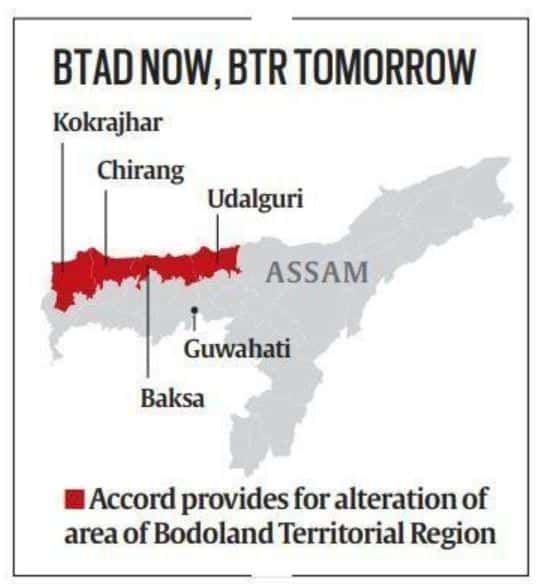
The area under the BTC jurisdiction is officially called the Bodoland Territorial Area Districts (BTAD) comprising of 3,082 villages in four districts— Kokrajhar, Chirang, Udalguri and Baska.
However, ABSU continued with its movement of separate Statehood and different factions of NDFB continued to carry out hit-and-run operations, and disturbed peace.
Third Accord – Jan 2020
The 2020 agreement has the following provisions:
Renaming: From BTAD to Bodoland Territorial Region.
A commission (representative of ABSU, BTC & State) under Section 14 of the Sixth Schedule to the Constitution of India, which will recommend the inclusion or exclusion of tribal population residing in villages adjoining BTAD areas.
Redrawing Boundaries: Villages dominated by Bodos that were presently outside the BTAD would be included and those with non-Bodo population would be excluded
Bodoland territorial Council (BTC)- The agreement would lead to more legislative, executive, administrative and financial powers of the BTC including increase in seats from 40 to 60
Bodos living in the hills would be granted Scheduled Hill Tribe status.
Bodo language with Devnagri script will become associate official language for entire of Assam and a separate directorate for Bodo medium schools will be set up.
Development Package of ₹1500 crore by the Centre for the development of Bodo areas
Bodo-Kachari Welfare Council for focused development of Bodo villages outside BTAD
The agreement also involved rehabilitation of members of National Democratic Front of Boroland (NDFB) factions- over 1500 armed cadres will abjure violence and join the mainstream
Implication of the Third Accord
The agreement is hailed as a permanent solution to a conflict, which has taken over 4,000 human lives.
Home Minister stated that Assam’s territorial integrity is assured with this agreement, as every single Bodo group has come on board.
Enhanced focus by Union government on tackling the issues of North-East so as to usher development in the region.
This is reflected in Bru-Reang agreement signed on January 16, 2020 to end the humanitarian crisis in Meghalaya and Tripura, recent surrender of 644 armed cadres in Assam and surrender of 88 armed NLFT cadres in Tripura to bring them to mainstream.
Conclusion
The peace in Bodoland Territorial Region will depend on the evolving relationship between the Bodos, the dominant but not the majority in the BTR and other communities.
It also depends on the final implementation of the accord and the ability of the state to rehabilitate the militants so as to prevent them from taking up anti-social activities.
(TEST YOUR KNOWLEDGE)
Model questions: (You can now post your answers in comment section)
Note:
Featured Comments and comments Up-voted by IASbaba are the “correct answers”.
IASbaba App users – Team IASbaba will provide correct answers in comment section. Kindly refer to it and update your answers.
Q 1. One of the implications of equality in society is the absence of ?
Privileges
Restraints
Competition
Ideology
No Right is absolute, exclusive or inviolable. The Right of personal property, similarly, has to be perceived in the larger context of its assumed legitimacy. The Right of personal property should unite the principle of liberty with that of equality, and both with the principle of cooperation.
Q2. In the light of the argument in the above passage, which one of the following statements is the most convincing explanation?
The Right of personal property is a Natural Right duly supported by statutes and scriptures.
Personal property is a theft and an instrument of exploitation. The Right of personal property is therefore violative of economic justice.
The Right of personal property is violative of distributive justice and negates the principle of cooperation.
The comprehensive idea of economic justice demands that the Right of each person to acquisition of property has to be reconciled with that of others.
Q 3. In India, if a religious sect/community is given the status of a national minority, what special advantages it is entitled to?
It can establish and administer exclusive educational institutions.
The President of India automatically nominates a representative of the community to Lok Sabha.
It can derive benefits from the Prime Minister’s 15-Point Programme.
Which of the statements given above is/are correct ?