All states, union territories can now set up foreign Tribunals
Part of: Prelims and Mains GS Paper II Polity
In News
In the backdrop of updation process of National Register of Citizen in Assam, Ministry of Home Affairs has amended the Foreigners (Tribunals) Order, 1964.
Amendments:
The amended order has empowered District Magistrates in all States and Union Territories to set up tribunals to decide whether a person staying illegally in India is a foreigner or not. Earlier, the powers to constitute tribunals were vested only with the Centre.
The amended Foreigners (Tribunal) Order, 2019 also empowers individuals to approach the Tribunals.
Do you Know?
National Register of Citizens (NRC)
National Register of Citizens, 1951 was a register prepared after the conduct of the Census of 1951.
Any citizens whose does not find his/her name in NRC shall be considered as foreigner under Foreigner’s Act, 1946 and shall be liable for deportation.
NRC regards all migrants who have come to India after March, 24, 1971 as illegal irrespective of their religion. Such illegal immigrant needs to be deported back to their home country as per Assam Accord
Sportswear giant set to tap Indian firms’ PET project to cut virgin plastic use
Part of: Environment and Ecology, Mains GS paper III: Environmental conservation
In News:
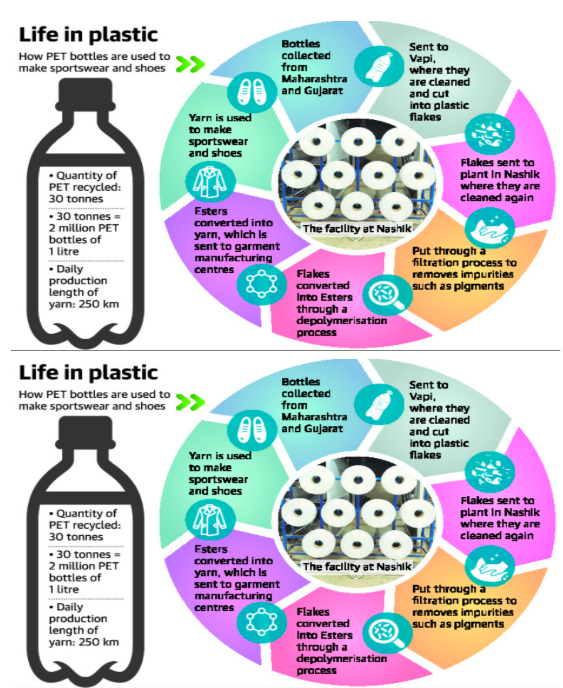
Adidas aims at eliminating the use of virgin plastics in its products by 2024.
According to the United Nations, around 300 million tonnes of plastic are produced every year with eight million tonnes of plastic waste ends up in the oceans.
PET bottles are the main contributors to plastic waste globally and in India.
It is taking help of Polygenta Technology Limited, a Maharashtra based company which is the only one company in the country to produce yarn out of discarded PET bottles.
Recycling in India; Downcycling and Upcycling
PET material collection rate in India is nearly 80% — among the best in the world — but a good portion of these bottles are downcycled, eliminating the possibility of further recycling.
Downcycling is reuse of waste in a manner that the recycled product is of lower value than the original material.
The PET recycling by PTL uses an upcycling process which consumes 86% less water and 75% less energy than conventional manufacturing. However, it costs approximately 10% more.
Miscellaneous
Mula Mutha River: ₹990-crore river cleaning project, a ‘gift from the Centre’, has been fast-tracked
Formalin, used to preserve fish, is harmful to human and ecosystem health
NATIONAL
TOPIC:
General studies 3:
Issues related to direct and indirect farm subsidies and minimum support prices
Inclusive growth and issues arising from it.
General Studies 2:
Government policies and interventions for development in various sectors and issues arising out of their design and implementation.
Indian Agriculture: Improving global competitiveness
Background:
Indian industry is today complaining that the rural demand is collapsing. Tractor sales are down by 13 per cent, two-wheeler sales are down by 16 per cent, car sales are down by similar percentage, and even FMCG (fast move consumer goods) sales are down in April 2019 over April 2018. One of the reasons is that India has never had any major agri-reforms and farmers’ incomes have remained very low. So, if industry wants to prosper, we must aim at an agri-GDP growth of more than 4 per cent.
Issues:
Need to raise farm productivity in a manner that can cut down unit costs and make Indian agriculture more competitive, enabling higher exports. Officials managing agri-trade need to pay heed to this massive failure as it has implications not only for overall agri-GDP growth, but also for slowing down of manufacturing growth due to sluggish demand for industrial products in rural areas.
Restrictive policies constrain the private sector from building direct supply chains from farms to ports, which bypass the mandi system. This leads to a weak infrastructure for agri-exports. The net result of all this is that Indian farmers do not get full advantage of global markets.
An obsessive focus on inflation targeting by suppressing food prices through myriad controls works against the farmer.
Improving global competitiveness:
Investment in agri-R&D. Today, India spends roughly 0.7 per cent of agri-GDP on agri-R&D and extension together. This needs to double in the next five years. The returns are enormous. Example: The meagre investments in Pusa Basmati 1121 and 1509, for example, have yielded basmati exports between $ 4 and 5 billion annually. The returns from the sugarcane variety Co-0238 in Uttar Pradesh are similarly impressive. The recovery ratio has increased from about 9.2 in 2012-13 to more than 11 per cent today.
Massive investments are also needed in managing our water resources more efficiently, to produce more with less.
Investment in infrastructure for agri-exports value chains.
Conclusion:
Augmenting productivity should be accompanied with pushing for export markets. Improving competitiveness in Indian agriculture is must if the dream of doubling farmers’ income by 2020 needs to be achieved.
Connecting the dots:
Indian agriculture lacks global competitiveness. Analyze critically.
INTERNATIONAL
TOPIC: General studies 2:
India and the World
International Relations
Policies of developed and developing countries and their impact on India’s interests
Foreign Policy Challenges
Background:
The world looks more disorderly in 2019 than was the case five years ago.
U.S. President Donald Trump’s election and the new dose of unpredictability in U.S. policy pronouncements.
The trade war between the U.S. and China which is becoming a technology war.
Brexit and the European Union’s internal preoccupations.
Erosion of U.S.-Russia arms control agreements and the likelihood of a new arms race covering nuclear, space and cyber domains.
The U.S.’s withdrawal from the Iran nuclear deal and growing tensions between Saudi Arabia and Iran.
Above are some of the developments that add to the complexity of India’s principal foreign policy challenge of dealing with the rise of China.
Redefining neighbourhood:
Pakistan:
Despite good planning there is always the risk of unintended escalation as Balakot (this year) and the downing of an Indian Air Force (IAF) MiG-21 showed. In the absence of communication channels between India and Pakistan, it appears that the U.S., Saudi Arabia and the United Arab Emirates played a role in ensuring the quick release of the IAF pilot, Wg. Cdr. Abhinandan Varthaman, thereby defusing the situation.
Unless the Modi government wants to outsource crisis management to external players, it may be better to have some kind of ongoing dialogue between the two countries.
Other neighbors:
Translating India’s natural weight in the region into influence was easier in a pre-globalised world and before China emerged in its assertive avatar.
It is preferable to work on the basis of generating broad-based consent rather than dominance. This necessitates using multi-pronged diplomatic efforts and being generous as the larger economy.
It also needs a more confident and coordinated approach in handling neighbourhood organisations — SAARC, BIMSTEC, the Bangladesh, the Bhutan, India, Nepal Initiative, the Bangladesh-China-India-Myanmar Forum for Regional Cooperation, the Indian Ocean Rim Association.
Above should be preferably in tandem with bilateralism because our bilateral relations provide us with significant advantages.
Managing China:
China will remain the most important issue, as in 2014. The policy followed was of growing economic, commercial and cultural relations while managing the differences on the boundary dispute through dialogue and confidence-building measures, in the expectation that this would create a more conducive environment for eventual negotiations. The Doklam stand-off was a rude reminder of that the assumption behind the policy followed for three decades could no longer be sustained.
The informal summit in Wuhan restored a semblance of calm but does not address the long-term implications of the growing gap between the two countries.
Meanwhile, there is the growing strategic rivalry between the U.S. and China unfolding on our doorstep. We no longer have the luxury of distance to be non-aligned.
Managing U.S.:
A number of issues have emerged that need urgent attention.
As part of its policy on tightening sanctions pressure on Iran, the U.S. has terminated the sanctions waiver that had enabled India to import limited quantities of Iranian crude till last month.
The Generalised System of Preferences scheme has been withdrawn, adversely impacting about 12% of India’s exports to the U.S., as a sign of growing impatience with India’s inability to address the U.S.’s concerns regarding market access, tariff lines and recent changes in the e-commerce policy.
The threat of sanctions under the Countering American Adversaries Through Sanctions Act (CAATSA), were India to proceed with the purchase of the S-400 air and missile defence system from Russia.
The reconciliation talks between the U.S. and the Taliban as the U.S. negotiates its exit from Afghanistan raise New Delhi’s apprehensions about the Taliban’s return, constituting another potential irritant.
Way forward:
India lacks the ability to shape events around it on account of resource limitations. These require domestic decisions in terms of expanding the foreign policy establishment though having a seasoned professional at the top does help.
We need to ensure far more coordination among the different ministries and agencies than has been the case so far.
Our record in implementation projects is patchy at best and needs urgent attention.
The focus on the neighbourhood is certainly desirable, for only if we can shape events here can we look beyond. However, the fact that China too is part of the neighbourhood compounds Mr. Modi’s foreign policy challenges in his second term.
Employing external balancing to create a conducive regional environment is a new game that will also require building a new consensus at home.
Connecting the dots:
Recent developments have added to the complexity of India’s principal foreign policy challenge of dealing with the rise of China. Discuss strategies to deal with the situation.
(TEST YOUR KNOWLEDGE)
Model questions: (You can now post your answers in the comment section)
Note:
Featured Comments and comments Up-voted by IASbaba are the “correct answers”.
IASbaba App users – Team IASbaba will provide correct answers in comment section. Kindly refer to it and update your answers.
Q.1) Which of the following cities is/are located on Mula Mutha River?