
IASbaba's Daily Current Affairs Analysis

Archives
(PRELIMS Focus)
Category: Defence and Security
Context:
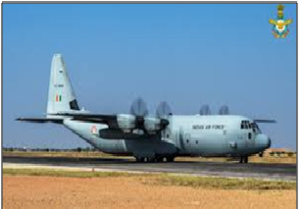
- Tata began building a maintenance, repair and overhaul (MRO) facility in Bengaluru for C-130J aircraft as Lockheed Martin pitched the plane for IAF’s 80-transport acquisition.
About C-130J Super Hercules Aircraft:
- Nature: It is a four-engine turboprop military transport aircraft.
- Development: It was developed by Lockheed Martin, a US security and aerospace company.
- Uniqueness: It is the US Air Force’s principal tactical cargo and personnel transport aircraft. Equipped with an Infrared Detection Set, the aircraft can perform precision low-level flying, airdrops, and landing in blackout conditions.
- Major operators: It is the airlifter of choice for 26 operators in 22 nations. The largest operators are the US Air Force, US Marine Corps, Australia, Canada, India, Italy, and the United Kingdom.
- Presence in Indian Air Force: The Indian Air Force (IAF) currently operates 12 C-130J Super Hercules.
- Highest Landing: An IAF C-130J made a global record for the highest-ever landing by a C-130 at the Daulat Beg Oldi airstrip in Ladakh (at an altitude of 16,614 feet) near the Line of Actual Control (LAC).
- Capability: The aircraft is capable of operating from rough, dirt strips and is the prime transport for airdropping troops and equipment into hostile areas.
- Crew: It has reduced crew requirements. A minimal crew of three men is required to operate this aircraft, including two pilots and one loadmaster.
- Powered by: It is powered by four Rolls-Royce AE 2100D3 turboprop engines.
- Payload Capacity: It has a payload capacity of approximately 19 tons (42,000 lbs). The stretch version (C-130J-30) has a maximum payload capacity of over 21 tons.
- Range: Its range is 6,852 km and can endure for 20+ hours.
- Speed: Its speed is 644 km/hr and it is capable of short take-offs and landings from unprepared runways.
- Accommodation of oversized cargo: It can accommodate a wide variety of oversized cargo, including everything from utility helicopters and six-wheeled armoured vehicles to standard palletized cargo and military personnel.
Source:
Category: Government Schemes
Context:
- According to a NITI Aayog report, India ranks first globally in the production of various oilseeds, primarily due to steps taken after National Mission on Edible Oils.
About National Mission on Edible Oils (NMEO):
-
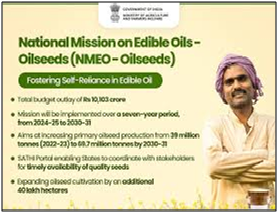
- Objective: It aims to strengthen the country’s oilseed ecosystem and achieve Atmanirbharta in edible oil production.
- Targets of the mission:
-
- It aims to increase the area coverage from 29 million ha (2022-23) to 33 million ha, primary oilseed production from 39 million tonnes (2022-23) to 69.7 million tonnes, and yield from 1,353 kg/ha (2022-23) to 2,112 kg/ha by 2030-31.
- This mission targets domestic edible oil production at 25.45 million tonnes by 2030-31.
- The Mission also seeks to expand oilseed cultivation by an additional 40 lakh hectares by targeting rice and potato fallow lands.
- Two-pronged approach: It has two-pronged approach which is as follows:
- National Mission on Edible Oils-Oil Palm
- National Mission on Edible Oils– Oilseeds
About National Mission on Edible Oils-Oil Palm:
- Objective: It aims to expand oil palm cultivation and increasing domestic crude palm oil output.
- Approval: It was approved in 2021, as a Centrally Sponsored Scheme, with the aim to enhance the edible oilseeds production and oils availability in the country by area expansion and increasing Crude Palm Oil (CPO) production.
- Focus: It focuses on increasing production of seedlings by establishment of seed garden, and nurseries of oil palm in order to assure domestic availability of seedlings as per target fixed under NMEO-OP.
- Targets: It targets to bring 6.5 lakh hectares under oil palm cultivation by 2025–26 and increase crude palm oil production to 28 lakh tonnes by 2029–30.
- Implementation: The Department of Agriculture & Farmers Welfare (DA&FW) serves as the nodal central authority.
About National Mission on Edible Oils- Oilseeds:
- Objective: It aims to improve productivity, seed quality, processing, and market linkages for traditional oilseed crops.
- Target: It targets to increase oilseed production from 39 to 69.7 million tonnes by 2030–31 through cluster-based interventions and improved seed systems.
- Approval: It was approved in 2024, for a seven-year period, from 2024-25 to 2030-31.
- Focus: It focuses on increasing production of key primary oilseed crops such as Rapeseed-Mustard, Groundnut, Soybean, Sunflower, Sesamum, Safflower, Niger, Linseed and Castor. It also focuses on increasing collection and extraction efficiency from secondary sources like coconut, rice bran as well as Tree-Borne Oilseeds (TBOs).
- Implementation: It will be implemented in all States/UTs with the funding pattern of 60:40 in case of general States, Delhi & Puducherry and 90:10 in case of North-Eastern States and hill States, and 100% funding for UTs and Central Agencies.
Source:
Category: Environment and Ecology
Context:
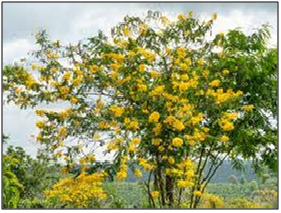
- The Tamil Nadu Forest Department has set an ambitious target to eradicate Senna spectabilis from all forest divisions by March 2026.
About Senna Spectabilis:
-
- Origin: It is native to the tropical regions of South and Central America
- Family: It belongs to Fabaceae (legume) family.
- Common names: It is also known as Popcorn Bush Cedar, Archibald’s Cassia, Calceolaria Cassia, Golden Shower, Scented Shower, Fetid Cassia.
- Appearance: It resembles Kerala’s state flower Cassia fistula, known locally as kanikkonna.
- Length: It is a tree with a very dense, spreading crown; it can grow 7 – 18 metres tall.
- Uses: It is often planted for fuelwood, as an ornamental, and as a shade tree in agroforestry situations.
- Status in India: It is classified as a major invasive species in India.
- IUCN Classification: It is classified as Least Concern under the IUCN Red List.
- Concerns:
-
- Aggressive growth rate: It has very aggressive growth rate and degrade lands in forest ecosystems which make it challenging to control its spread.
- Suppression of Native Flora: Its thick foliage and canopy inhibit sunlight, while its shed leaves alter the soil chemistry through allelopathy, preventing native trees and grasses from growing.
- Food Scarcity for Wildlife: The wiping out of native grasses and herbs leads to food shortages for herbivores like elephants, deer, and gaurs, which do not feed on Senna leaves as they are unpalatable.
- Increased Man-Animal Conflict: The declining carrying capacity of the forests for wildlife accelerates human-wildlife conflict.
Source:
Category: Economy
Context:
- The IMF report on ‘Growing Retail Digital Payments’ recognized Unified Payments Interface (UPI) as the world’s largest retail fast-payment system by transaction volume.
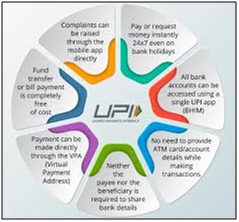
About Unified Payments Interface (UPI):
- Development: UPI is a real-time mobile payment system developed by National Payments Corporation of India (NPCI).
- Launch: It was launched in 2016.
- Uniqueness: It allows users to link multiple bank accounts into one app for seamless peer-to-peer and merchant transactions.
- Working: UPI enables both push (send) and pull (receive) transactions using a Virtual Payment Address (VPA), with two-factor authentication, eliminating the need to enter bank details each time.
- Technologies Used: UPI is built on IMPS (Immediate Payment Service) and integrates Aadhaar Enabled Payment System (AePS).
- Role of IMPS: IMPS facilitates funds transfer to an account of the beneficiary with a participating bank, based on beneficiary’s Mobile Number & Mobile Money Identification Number (MMID) or Account number & Indian Financial System Code.
- Role of AePS: The AePS allows basic banking services like cash withdrawal, deposit, balance enquiry, and money transfer (interbank or intrabank) using Aadhaar authentication.
- BHIM App: Bharat Interface for Money (BHIM) is a UPI-based payment app developed by NPCI.
- Use in other countries: Unified Payment Interface (UPI) is currently accepted in eight countries, viz. Bhutan, Singapore, Qatar, Mauritius, Nepal, UAE, Sri Lanka and France.
- Role in financial Inclusion: UPI’s zero-cost, real-time transfers have made digital payments accessible for small vendors and first-time users.
Source:
Category: International Organisations
Context:
- Union Minister Kirti Vardhan Singh departed for Nairobi to represent India at United Nations Environment Assembly (UNEA) session.
About United Nations Environment Assembly (UNEA):
- Nature: It is the world’s highest-level decision-making body on the environment.
- Establishment: UNEA was established in 2012, as an outcome of the UN Conference on Sustainable Development (Rio+20), held in Brazil.
- Headquarters: Its headquarters is located at the United Nations Environment Programme (UNEP) headquarters in Nairobi, Kenya.
- Objective: It sets the global environmental agenda, provides overarching policy guidance, and defines policy responses to address emerging environmental challenges.
- Membership: It has the universal membership of all 193 UN Member States and the full involvement of major groups and stakeholders.
- Organisational Structure: It consists of a President and 8 Vice Presidents (forming the UNEA Bureau).
- Leadership: The Assembly is headed by a President and a Bureau, who are environment ministers from different countries serving two-year terms.
- Policy review: It undertakes policy review, dialogue and the exchange of experiences, sets the strategic guidance on the future direction of the UN Environment Programme (UNEP). It also fosters partnerships for achieving environmental goals.
- Seventh UNEA session (2025) Theme: Its theme is “Advancing sustainable solutions for a resilient planet.”
Source:
(MAINS Focus)
(UPSC GS Paper II – Governance, Health, Social Justice; GS Paper III – Inclusive Growth & Human Development)
Context (Introduction)
Amid persistent inequities and commercialisation in India’s health sector, the 2025 National Convention on Health Rights seeks to realign public health policy toward universal access, stronger public systems, and legal recognition of health as a fundamental right, drawing lessons from COVID-19 and global best practices.
Main Arguments
- Privatisation Risks: Expansion of public–private partnerships and hospital outsourcing threatens to erode public provisioning, which currently serves over 80 crore people, raising concerns of affordability and weakened regulatory oversight.
- Regulatory Weakness: Poor enforcement of the Clinical Establishments Act has enabled overcharging, unnecessary procedures (India’s C-section rate at 21.5%, WHO: 10–15%), opaque billing and inconsistent patient rights protection.
- Insufficient Public Spending: India’s public health expenditure remains at 1.28% of GDP (NHA 2023-24) — among the world’s lowest, far below WHO’s recommended 5% of GDP, driving high out-of-pocket costs covering 48% of total health expenditure.
- Workforce Precarity: Frontline workers who carried the COVID-19 burden still face contractualisation, low pay and inadequate social protection, undermining health system resilience identified as critical in Lancet (2022) COVID-19 Health Workforce Review.
- Medicines Affordability Crisis: With medicines forming 52% of household medical expenditure, and 80% of drugs outside price control, market failures deepen exclusion, despite evidence that expanded price caps under DPCO reduce catastrophic spending.
Challenges / Structural Barriers
- Health Insurance Limitations: Government schemes such as PM-JAY cover hospitalisation but leave gaps in outpatient care, diagnostics and medicines, which constitute two-thirds of household health spending (NSS 77th Round).
- Fragmented Public Health Systems: Tiered infrastructure disparities — sub-centres, PHCs, CHCs — remain stark: only 11% of PHCs meet IPHS norms, and specialist posts in CHCs face 69% shortages (RHS 2023).
- Urban–Rural Inequities: India has 2 beds per 1,000 population (OECD avg: 4.4), with 70% of these located in urban centres, limiting rural access to emergency and specialty care.
- Social Discrimination: Studies (NFHS-5, Oxfam Inequality Report) show Dalits, Adivasis, Muslims and women face systemic barriers: lower hospitalisation rates, delayed treatment, and higher maternal mortality in marginalised districts.
- Environmental Determinants: Air pollution causes 1.7 million premature deaths annually (Lancet Planetary Health, 2023), linking environmental injustice directly to health disparities.
Way Forward
- Legalising the Right to Health: Adopt a Rajasthan-style Right to Health Act nationally, similar to Brazil’s SUS constitutional guarantee, ensuring enforceable accountability for universal, quality services.
- Strengthening Public Financing: Increase health expenditure to 2.5% of GDP by 2027, aligning with National Health Policy 2017 targets, and follow Thailand’s UHC model which dramatically cut out-of-pocket spending by prioritising public financing.
- Regulating Private Healthcare: Standardise rates, mandate transparent billing and enforce the Charter of Patient Rights, inspired by Germany’s DRG-based system that prevents arbitrary pricing.
- Expanding Public Sector Drug Production: Scale up PSUs like IDPL & Kerala’s KMSCL to reduce retail markups, following the Brazil, Thailand and Bangladesh models where state-run pharma lowered essential medicine costs by 30–60%.
- Rewarding and Protecting Health Workers: Guarantee minimum wages, stable contracts and occupational safety, mirroring Philippines’ Magna Carta for Health Workers that improved retention and morale.
- Community-Led Health Governance:” Institutionalise Health & Wellness Committees and social audits, building on Kerala’s decentralised health model, which strengthened primary care and enabled rapid pandemic response.
- Integrated Determinant-Based Approach: Link health interventions with food security, clean air missions and climate adaptation, reflecting UK’s Marmot Review framework on social determinants.
Conclusion
India’s right-to-health agenda requires a decisive shift from fragmented, market-driven approaches toward equitable, well-funded public systems anchored in accountability and inclusion. The 2025 convention offers a timely opportunity to rebuild health governance around justice, dignity and universal care.
Mains Question
- India continues to face inequities in health access despite expanding insurance schemes and private-sector growth. Critically analyse the need for a rights-based approach to health, and outline reforms necessary to strengthen equity in India’s health system. (250 words, 15 marks)
Source: The Hindu
(UPSC GS Paper II – Election Commission, Electoral Reforms, Constitutional Provisions, Governance)
Context (Introduction)
India’s electoral rolls have increasingly suffered from duplicates, outdated entries and inaccuracies due to rapid migration and urbanisation. The Election Commission’s Special Intensive Revision (SIR) 2025 seeks to rebuild accuracy and trust in electoral rolls amid constitutional, administrative and political scrutiny.
Main Arguments (Need for SIR)
- Constitutional Mandate: Article 324 entrusts the ECI with superintendence and control over electoral roll preparation, making periodic intensive verification essential for maintaining universal adult franchise under Article 326.
- Demographic Shifts: Rapid migration and urban churn have rendered summary revisions insufficient, necessitating door-to-door SIR to correct duplicates, shifted electors, and outdated entries.
- Global Comparisons: Countries like Germany and Canada, which seamlessly update rolls using civil registries, avoid inaccuracies; India, lacking such integrated databases, depends on independent verification by ECI.
- Enhanced Documentation Framework: SIR 2025 expands admissible documents to 11 types (up from four in 2003) and includes Aadhaar as proof of identity, making enumeration more citizen-friendly.
- Technological Integration: Digitisation of records, online claim/objection filing, and uploading of supporting documents mark a governance shift toward transparency and accessibility.
Challenges / Criticisms
- Fear of Disenfranchisement: Civil society concerns stem from the requirement of producing documents afresh, raising apprehensions of mass deletions or exclusion of vulnerable voters.
- Citizenship Verification Complexity: India lacks a central population registry, making citizenship screening difficult—particularly in States with high migration or porous borders.
- Administrative Burden: Door-to-door verification of 7.5 crore entries in Bihar alone strains field machinery and raises questions of uniform implementation quality nationwide.
- Political Sensitivities: Opposition parties fear misuse of SIR for targeted disenfranchisement, amplifying mistrust in electoral processes.
- Public Awareness Gap: Only 2.5 lakh objections were filed after 65 lakh deletions, suggesting limited voter engagement, digital divide issues, and low citizen understanding of the process.
Way Forward
- Integrated Population Registry: Adopt a model similar to Estonia’s digital population registry, enabling seamless updates across departments and reducing manual verification burdens.
- Granular Transparency Measures; Publish booth-level deletion, addition, and verification statistics in machine-readable formats to allow third-party audits, increasing confidence in revisions.
- Targeted Voter Outreach: Use Kerala-style decentralised awareness campaigns, deploying local bodies, civil society and digital platforms to ensure every elector understands their rights and obligations.
- Strengthening Appeal Mechanisms: Establish simple, offline-friendly grievance redress systems and mandates for time-bound disposal of objections at BLO and ERO levels.
- Continuous Roll Updating System: Shift from episodic revisions to a rolling system—like Australia’s continuous electoral roll update—allowing real-time corrections via municipal and utility data.
Conclusion
Electoral roll revision is indispensable to ensure the integrity of India’s democratic process. SIR 2025 represents an ambitious yet constitutionally grounded effort to restore accuracy, provided transparency, public engagement and safeguards against exclusion remain central to its implementation.
Mains Question
- The Election Commission of India’s Special Intensive Revision (SIR) 2025 has triggered debate on the balance between electoral roll accuracy and inclusive franchise. Critically examine the constitutional basis, need, concerns, and reforms required for strengthening India’s electoral roll management system. (250 words, 15 marks)
Source: The Hindu
(UPSC GS Paper III – Inclusive Growth, Employment, MSME Sector, Industrial Policy, Economic Development)
Context (Introduction)
India’s employment challenge is less about job creation in large industries and more about uplifting millions of low-productivity, self-employed micro enterprises. ASUSE 2023–24 data shows 12+ crore workers depend on 7.3 crore unincorporated enterprises whose growth is severely constrained.
Main Arguments: Why Small Enterprises Matter
- MSME Dominance: Own Account Enterprises (OAEs) form 87% of all non-agricultural enterprises, absorbing the bulk of India’s workforce, signalling economic necessity—not entrepreneurial vibrancy.
- Job Elasticity with Growth: A 10% rise in GVA correlates with a 4.5% increase in hired workers, showing productivity-driven expansion directly fuels employment creation.
- HWE Productivity Advantage: Hired Worker Enterprises generate 7.5 times more GVA than OAEs, highlighting immense gains from enterprise upgradation.
- Low Formalisation Incentives: Entrepreneurs avoid registering due to high compliance costs and fear of delayed payments—issues flagged in the RBI MSME Report (2019).
- Credit–Productivity Link: Only 10–12% of unincorporated enterprises access bank credit; institutional loans increase medium enterprise GVA by 72%, and more than threefold in large enterprises.
Challenges / Criticisms
- Credit Constraints: Informal lenders dominate; limited collateral and procedural complexity restrict access to formal finance.
- Technology Gaps: Adoption of ICT tools remains low, preventing firms from leveraging e-commerce, digital payments, or productivity-enhancing software.
- Delayed Payments: Persistent non-recovery of dues impairs cash flows, discouraging scale expansion or formalisation.
- Low Skill Levels: Many OAEs lack exposure to business training, accounting systems, and digital literacy, trapping them in low-productivity cycles.
- Fragmented Schemes: Digital MSME, UDYAM, ONDC, DISHA and UPI incentives exist, but weak handholding limits their real-world impact.
Way Forward: Productivity-Led Employment Strategy
- Differentiated Credit Architecture: Shift from microcredit to growth capital, linking loan size to enterprise stage (learning from Japan’s JFC and South Korea’s SME Bank).
- Technology Enablement: Expand digital capacity-building, e-commerce onboarding, and subsidised digital tools (similar to Singapore’s SMEs Go Digital).
- Ease of Doing Business (Micro-Level): Simplify local licensing, tax procedures, and compliance—a major impediment for OAEs transitioning to HWEs.
- Strengthened Market Linkages: Use ONDC and state-level procurement platforms to secure steady demand for micro enterprises.
- Vocational & Managerial Training: Align skilling with enterprise needs—finance, inventory, online sales—following Germany’s dual vocational system model.
- Payment Security Mechanisms: Enforce the MSME Delayed Payments Portal, mandate digital invoicing, and enable time-bound settlement similar to the UK Prompt Payment Code.
Conclusion
India’s employment future will be shaped not by a few large factories but by millions of micro and small enterprises that form its economic backbone. Raising their productivity through credit access, digital adoption, market linkages, and supportive regulation can transform self-employment from subsistence activity into sustained job creation.
UPSC Mains Question
- Analyse the structural constraints faced by unincorporated enterprises and suggest policy measures to enable their transition into job-creating units. (250 words,15 marks)
Source: Indian Express