IASbaba's Daily Current Affairs Analysis

Archives
(PRELIMS Focus)
Category: Government Schemes
Context:
- The Union Cabinet Committee on Economic Affairs recently approved the CoalSETU Policy by creation of new window in the NRS Linkage Policy.

About CoalSETU Policy:
-
- Full Form: CoalSETU stands for Coal Linkage for Seamless, Efficient & Transparent Utilisation.
- Nature: It is a new auction-based coal linkage window under the Non-Regulated Sector (NRS) Linkage Policy, allowing any domestic industrial buyer to secure long-term coal linkages for own use or export (up to 50%), except resale within India.
- Objective: It will allow allocation of coal linkages on auction basis on long-term for any industrial use and export.
- Nodal ministry: It is implemented by Ministry of Coal, Government of India.
- Participation: Any domestic buyer requiring coal can participate in the linkage auction. Traders are not allowed to bid under this window.
- Key features of the policy:
-
-
- New CoalSETU Window in NRS Policy (2016): It allows any industrial consumer to participate in coal linkage auctions. Existing NRS auctions for cement, sponge iron, steel, aluminium, CPPs will continue.
- No End-Use Restrictions: Coal can be used for own consumption, washing, or export (up to 50%). Coking coal is excluded from this window.
- Export Flexibility: Companies may export up to 50% of allotted coal. Coal can also be shared across group companies as per operational needs.
- Alignment with Coal Sector Reforms: It complements the 2020 reform allowing commercial mining without end-use restrictions.
-
- Focus areas:
-
- To ensure transparent, seamless and efficient utilisation of domestic coal resources.
- To promote ease of doing business and reduce dependence on coal imports.
- To boost availability of washed coal and support export opportunities.
Source:
Category: International Relations
Context:
- The Congress party recently targeted Prime Minister over India’s exclusion from the United States-led strategic initiative, Pax Silica.
About Pax Silica Initiative:
-
- Nature: It is a U.S.-led strategic initiative to build a secure, prosperous, and innovation-driven silicon supply chain—from critical minerals and energy inputs to advanced manufacturing, semiconductors, artificial intelligence (AI) infrastructure, and logistics.
- Nomenclature: The term ‘Pax Silica’ comes from the Latin term ‘pax’ which means peace, stability, and long-term prosperity. Silica refers to the compound that is refined into silicon, one of the chemical elements foundational to the computer chips that enable AI.
- Objective: It aims to reduce coercive dependencies, protect the materials and capabilities foundational to AI, and ensure aligned nations can develop and deploy transformative technologies at scale.
- Countries that are part of Pax Silica: These include Japan, South Korea, Singapore, Netherlands, United Kingdom, Israel, United Arab Emirates and Australia.
- India’s position: Despite being part of the Quad critical minerals initiative and having a critical technology partnership with the US, India is not part of Pax Silica.
- Major focus areas:
-
- Pursue projects to jointly address AI supply chain opportunities and vulnerabilities in priority critical minerals, semiconductor design, fabrication, and packaging, logistics and transportation, compute, and energy grids and power generation.
- Pursue new joint ventures and strategic co-investment opportunities.
- Protect sensitive technologies and critical infrastructure from undue access or control by countries of concern.
- Build trusted technology ecosystems, including ICT systems, fibre-optic cables, data centres, foundational models and applications.
Source:
Category: Science and Technology
Context:
- The U.S. Food and Drug Administration (FDA) has granted approval for two new oral medicines to treat gonorrhoea.
About Gonorrhea:
- Nature: It is a preventable and curable sexually transmitted infection (STI)
- Causing agent: It is caused by the bacteria Neisseria gonorrhea.
- Other names: It’s also sometimes called “the clap” or “drip.”
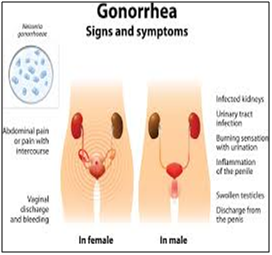
- Infected areas: Gonorrhea bacteria can infect the urethra, rectum, female reproductive tract, mouth, throat, or eyes.
- Transmission: It is most commonly spread during vaginal, oral or anal sexual activity. But babies can get the infection during childbirth. In babies, gonorrhea most commonly affects the eyes.
- Vulnerable people: IT can affect people of any age, anatomy, or gender, but it’s particularly common among teens and young adults between the ages of 15 and 24.
- Symptoms: Many people with gonorrhoea do not notice any symptoms. Men are more likely to experience symptoms. However, the symptoms include sore throat, conjunctivitis, unusual vaginal or penile discharge, and pelvic and genital pain.
- Prevention: It can be prevented by practicing safe sex.
- Treatment: It is treatable and curable with antibiotics. Antimicrobial resistance to gonorrhoea is a serious and growing problem, rendering many classes of antibiotics ineffective with the risk of becoming untreatable.
Source:
Category: Miscellaneous
Context:
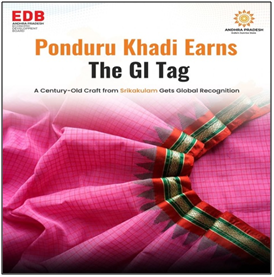
- Ponduru Khadi, which was appreciated by Mahatma Gandhi 100 years ago, recently received Geographical Indication (GI) tag.
About Ponduru Khadi:
- Location: Ponduru Khadi, is a famous handspun and handwoven cotton fabric from Andhra Pradesh.
- Other names: It is locally known as Patnulu and it is produced in Ponduru village in Srikakulam district.
- Associated schemes: It has been nominated for the One District One Product (ODOP) scheme from the Srikakulam district.
- Historical significance: During the pre-independence era, Mahatma Gandhi mentioned its virtues in his Young India (the national weekly that Gandhiji edited).
- Raw material: It is produced from one of three types of cotton: hill cotton, punasa cotton, or red cotton.
- Source of cotton: Cotton is indigenous to Srikakulam district and is grown in and around Ponduru. The entire process, from cotton to fabric, is carried out manually.
- Uniqueness: The process of cleaning the cotton with the jawbone of Valuga fish is unique to Ponduru khadi and is not practiced anywhere else in the world. Ponduru is the only place in India where spinners still use single-spindle charkhas with 24 spokes, also known as the “Gandhi Charkha”.
- High quality fabric: The fabric is known for its very high yarn count of about 100–120, indicating extreme fineness.
Source:
Category: Geography
Context:
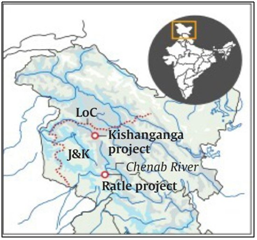
- Recently, Megha Engineering and Infrastructures Ltd. threatened to pull out of 850MW Ratle power project in J&K if ‘threats and political interferences’ were not stopped.
About Ratle Hydroelectric Project:
- Location: It is located in the Kishtwar District of Jammu & Kashmir.
- Associated river: It is being built on the Chenab River.
- Capacity: Its capacity is 850 MW (850,000 kW).
- Implementing authority: The project is implemented by the Ratle Hydroelectric Power Corporation (RHPCL).
- Construction: The construction work is being undertaken by Megha Engineering and Infrastructure Limited (MEIL).
- Cost: It was approved by the Cabinet Committee on Economic Affairs in January 2021 at a cost of ₹5,281.94 crore.
- Project type: It is Run-of-the-river project, which means it uses the natural flow of the river with a small or no reservoir.
- Gravity dam: The project includes a 133-meter-tall and 194.8-meter-long concrete gravity dam, a diversion dam, and an underground powerhouse on the right bank of the river.
- Powerhouse: The underground powerhouse measuring 168 m x 24.5 m x 49 m will house four 205 MW Francis turbine-generating units and a 30 MW auxiliary turbine-generating unit.
- Significance: It is part of India’s plan to utilize its share of water under the Indus Waters Treaty, 1960. It is strategically also vital in the context of China’s CPEC initiative.
Source:
(MAINS Focus)
(UPSC GS Paper II – International Relations: India and its neighbourhood; Bilateral, regional and global groupings and agreements involving India and/or affecting India’s interests)
Context (Introduction)
Prime Minister Narendra Modi’s December 2025 visit to Oman, marking 70 years of diplomatic relations, comes amid West Asia’s geopolitical volatility, energy transitions, connectivity initiatives, and shifting global trade alignments, making it strategically significant rather than ceremonial.
Strategic Significance of Oman for India
- A Trusted Regional Balancer: Oman has historically pursued a foreign policy of moderation, mediation, and deliberate neutrality, making it a reliable partner for India in a conflict-prone West Asia, even when regional sentiment was unfavourable to New Delhi.
- Pillar of India’s West Asia Policy: India–Oman ties were elevated to a strategic partnership in 2008, with Oman invited as a guest country during India’s G20 Presidency in 2023, underlining mutual strategic trust.
- Geostrategic Location: Oman’s position overlooking the Gulf of Oman and the Arabian Sea enhances India’s maritime situational awareness, particularly amid expanding Chinese PLA Navy presence in the region.
Defence and Security Cooperation
- Deep Military Engagement: Oman is the first Gulf country to conduct joint exercises with all three wings of India’s armed forces, backed by a 2005 MoU on military cooperation.
- Maritime Security Role: Since 2012–13, Indian naval ships have been deployed in the Gulf of Oman for anti-piracy operations, with Oman facilitating overflight and transit for Indian military aircraft.
- Duqm Port Logistics Agreement: Signed in 2018, it provides basing and operational turnaround facilities for the Indian Navy, strengthening India’s Indian Ocean Region (IOR) security posture.
- Defence Trade and Future Scope: Oman was the first Gulf nation to procure Indian INSAS rifles; future cooperation may include Tejas aircraft, naval platforms, radar systems, and joint production.
Economic, Trade and Investment Engagement
- Growing Trade Relations: Bilateral trade has reached over $10.6 billion in FY 2024–25, reflecting steady expansion despite global economic uncertainty.
- Investment Architecture: The Oman–India Joint Investment Fund (OIJIF) has invested around $600 million in India, reinforcing long-term financial partnership.
- CEPA Prospects: The proposed India–Oman Comprehensive Economic Partnership Agreement would make Oman the second Gulf country after the UAE to sign such an accord with India, aiding trade diversification amid global tariff pressures.
Energy, Connectivity and Emerging Domains
- Energy Transition Cooperation: Engagement is expected to expand into green hydrogen, renewable energy, critical minerals, and strategic petroleum reserves, aligning with global decarbonisation trends.
- Connectivity Corridors: Oman’s potential role in the India–Middle East–Europe Economic Corridor (IMEC) enhances India’s strategic connectivity to Europe and West Asia.
- Digital Public Infrastructure (DPI): Linking payment systems through RuPay and NPCI cooperation positions Oman as a key partner in India’s global DPI outreach.
- Education, Health and Space: Proposals for offshore campuses of IITs and IIMs, along with expanded health and space cooperation, reflect diversification beyond traditional sectors.
Way Forward
- Institutionalise Strategic Cooperation: Fast-track CEPA implementation and expand defence logistics and joint production to deepen strategic interdependence.
- Anchor Oman in India’s Connectivity Vision: Integrate Oman more firmly into IMEC and maritime connectivity initiatives.
- Leverage Oman’s Neutrality: Use Oman as a diplomatic bridge in regional dialogues amid West Asian instability.
- Expand People-Centric Cooperation: Promote education, health, and digital partnerships to sustain long-term societal linkages.
Conclusion
The Oman visit reaffirms one of India’s oldest and most stable Gulf partnerships. In a rapidly evolving regional and global order, India–Oman ties exemplify how trust, strategic autonomy, and diversification can anchor India’s expanding footprint in West Asia and the Indian Ocean Region.
Mains Question
- “Oman occupies a unique position in India’s West Asia policy as a trusted strategic and maritime partner.” Examine the significance of India–Oman relations.
Source: The Hindu
(UPSC GS Paper II – Governance, International Treaties, Security Challenges, Health Governance)
Context (Introduction)
Rapid advances in biotechnology have expanded humanity’s ability to manipulate biological agents, raising the risk of deliberate misuse. India’s ecological diversity, porous borders and demographic scale necessitate an urgent upgrade of its biosecurity framework to address emerging state and non-state biothreats.
Main Arguments (Need for Biosecurity & International Framework)
- Conceptual Basis of Biosecurity: Biosecurity encompasses systems and practices aimed at preventing the intentional misuse of biological agents, toxins and technologies. It extends beyond human health to animal, agricultural and environmental protection, and is closely linked to biosafety, which prevents accidental pathogen release.
- Biological Weapons Convention (BWC): The BWC, operational since 1975, is the first global disarmament treaty prohibiting the development, production, stockpiling and use of biological weapons. It mandates destruction of existing stockpiles and promotes peaceful use of biological sciences, though it lacks a robust verification mechanism.
- Technological Convergence and Dual-Use Risks: Advances in synthetic biology, gene editing and recombinant DNA research have lowered entry barriers for manipulating pathogens. These dual-use technologies, while beneficial for medicine and agriculture, increase risks of misuse by malicious actors.
- India’s Structural Vulnerabilities: India’s long land and maritime borders, high population density, biodiversity hotspots and heavy dependence on agriculture amplify the impact of biological threats, whether natural, accidental or deliberate.
- Emergence of Non-State Actors: Incidents such as the alleged preparation of Ricin toxin highlight that biothreats are no longer confined to states. Terror groups and lone actors can exploit accessible biological materials, intensifying the need for preventive biosecurity measures.
Existing Institutional and Legal Framework in India
- Multi-Agency Governance Structure: The Department of Biotechnology regulates research governance and lab safety; the National Centre for Disease Control oversees disease surveillance; animal and plant biosecurity fall under specialised departments, reflecting a sectoral approach.
- Legal and Regulatory Instruments: The Environment (Protection) Act, 1986 regulates hazardous microorganisms and GMOs. The WMD Act, 2005 criminalises biological weapons activities. Biosafety Rules (1989) and Recombinant DNA and Biocontainment Guidelines (2017) provide laboratory-level safeguards.
- Disaster Preparedness Mechanisms: The National Disaster Management Authority has issued guidelines for managing biological disasters, integrating bio-events into the broader disaster management framework.
- International Engagements: India is a signatory to the BWC and participates in export-control regimes such as the Australia Group, reflecting its commitment to global biosecurity norms.
Challenges / Criticisms
- Fragmented Governance Architecture: Despite multiple agencies, India lacks a unified national biosecurity framework, leading to coordination gaps across health, agriculture, environment and security sectors.
- Response Capacity Deficit: India ranks 66th on the Global Health Security Index. While detection capabilities have improved, response readiness has declined, indicating weaknesses in surge capacity, logistics and inter-agency coordination.
- Verification and Oversight Gaps: The absence of an international verification regime under the BWC limits enforcement, placing greater responsibility on national mechanisms that remain unevenly developed.
- Non-State Actor Threat Escalation: Accessible biological knowledge and materials increase the probability of asymmetric attacks, which are harder to detect and attribute than conventional security threats.
- Infrastructure and Workforce Constraints: Shortages of high-containment laboratories, trained biosecurity professionals and advanced surveillance systems constrain India’s preparedness against high-impact biological events.
Way Forward
- National Biosecurity Framework: Develop an integrated biosecurity policy that coordinates health, agriculture, environment, defence and intelligence agencies under a single strategic vision.
- Capacity and Infrastructure Enhancement: Invest in high-containment labs, genomic surveillance networks and rapid response teams, building on lessons from pandemic preparedness.
- Strengthening Legal and Ethical Oversight: Update biosecurity regulations to address emerging technologies such as synthetic biology, while ensuring ethical research governance and accountability.
- Countering Non-State Actor Risks: Enhance intelligence-led monitoring of biological materials, research facilities and supply chains, and strengthen international cooperation on bio-threat intelligence sharing.
- Global Leadership and Diplomacy: Advocate for strengthening the BWC through confidence-building measures, transparency norms and discussions on verification mechanisms, positioning India as a responsible biosecurity leader.
Conclusion
In an era of rapid biotechnological change, biosecurity is no longer a niche health concern but a core national security imperative. Upgrading India’s biosecurity architecture through coordination, capacity-building and global engagement is essential to safeguard lives, livelihoods and democratic stability.
Mains Question
- Discuss the mandate of Biological Weapons Convention. Does India need to upgrade its biosecurity measures in the context of emerging biotechnologies and non-state actor threats? (250 words, 15 marks)
Source: The Hindu
(UPSC GS Paper III – Inclusive Growth and Employment; GS Paper II – Welfare Schemes, Federalism, Governance)
Context (Introduction)
The Union government has proposed replacing MGNREGA with the Viksit Bharat–Guarantee for Rozgar and Ajeevika Mission (Gramin) Bill. While promising expanded employment and technological efficiency, the move has raised concerns over fiscal federalism, demand-driven design and the dilution of the rural safety net.
Main Arguments (Rationale for Reform)
- Need for Reform in MGNREGA: MGNREGA has faced long-standing issues such as delayed wage payments, asset quality concerns, leakages and weak worksite monitoring. Reforming design and implementation was necessary to improve efficiency and accountability.
- Enhanced Employment Guarantee: VB-G RAM G proposes 125 days of guaranteed wage employment per rural household annually, compared to 100 days under MGNREGA, signalling an intent to strengthen livelihood security amid rural distress.
- Avoiding Agricultural Labour Distortions: The Bill restricts employment during a 60-day notified peak sowing and harvesting period, addressing criticism that MGNREGA distorted farm labour availability and agricultural wages.
- Technology-Driven Governance: Use of biometric authentication, GPS-enabled attendance, mobile-based monitoring and AI-driven fraud detection aims to reduce leakages and improve transparency, building on DBT reforms under MGNREGA.
- Crisis-Time Performance Legacy: The government highlights record employment generation during the pandemic—389 crore person-days in 2020–21 and 364 crore in 2021–22—demonstrating the scheme’s counter-cyclical role during economic shocks.
Challenges / Criticisms
- Adverse Fiscal Federalism Shift: MGNREGA mandated 100% central funding of wages and 75% of material costs. VB-G RAM G shifts to a 60:40 Centre–State sharing ratio (90:10 for North-East and Himalayan states), significantly burdening fiscally constrained states.
- Risk of Suboptimal Implementation: States struggling to mobilise their share may limit coverage or delay payments, echoing the experience of PM Fasal Bima Yojana where delayed state contributions undermined scheme performance.
- Erosion of Demand-Driven Architecture: MGNREGA was designed as a rights-based, demand-driven programme where states assessed labour demand and the Centre responded with funds. VB-G RAM G replaces this with “normative allocations” determined by the Centre, weakening decentralisation.
- Threat to Legal Entitlement: MGNREGA provided a statutory right to work with unemployment allowance for non-provision. Centralised allocation risks converting a rights-based guarantee into a budget-limited welfare programme.
- State Capacity and Equity Concerns: Backward states with high poverty, weak revenue bases and high MGNREGA dependence may be disproportionately affected, undermining regional equity and inclusive growth objectives.
Way Forward
- Restore Strong Central Funding: For flagship social protection schemes like rural employment, the Centre should bear a dominant share of financing, especially wages, to prevent exclusion due to state fiscal stress.
- Retain Demand-Driven Core: Normative allocations may be used as a baseline, but demand-based supplementary funding must be guaranteed to preserve the scheme’s legal and counter-cyclical character.
- Differentiated Fiscal Design: Introduce variable Centre–State ratios based on state poverty levels, fiscal capacity and distress indicators, rather than a uniform 60:40 formula.
- Technology with Human Oversight: Digital tools should complement—not replace—local verification. Safeguards against biometric failures, digital exclusion and wrongful deletions must be institutionalised.
- Strengthen Panchayati Raj Role: Empower Gram Panchayats in planning, monitoring and social audits to preserve bottom-up governance and community accountability.
Conclusion
MGNREGA undoubtedly required reform, but VB-G RAM G risks weakening India’s rural employment safety net through poor fiscal design and centralisation. Sustainable reform must balance efficiency with federal equity, demand responsiveness and the rights-based spirit of rural employment guarantees.
Mains Question
- Q. Critically examine the rationale for reform and key changes proposed in MGNREGA scheme (250 words, 15 marks)
Source: Indian Express