
IASbaba's Daily Current Affairs Analysis

Archives
(PRELIMS Focus)
Category: Polity and Governance
Context:
- Recently, Union Minister of Health and Family Welfare reviewed the progress of Indian Pharmacopoeia Commission (IPC), underscoring its vital role in pharmacovigilance.
About Indian Pharmacopoeia Commission (IPC):
-
- Nodal ministry: It is an autonomous Institution of the Ministry of Health and Family Welfare, Govt. of India.
- Objective: It is created to set standards of drugs in the country. Its basic function is to regularly update the standards of drugs commonly required for treatment of diseases prevailing in this region.
- Organizational Structure: The Secretary of the Ministry of Health and Family Welfare is the chairperson of IPC. It has a three-tier structure comprising a General Body, a Governing Body, and a Scientific Body.
- Pharmacovigilance: IPC acts as the National Coordination Centre (NCC) for the Pharmacovigilance Programme of India (PvPI), monitoring adverse drug reactions (ADRs).
- Materiovigilance: It operates the Materiovigilance Programme of India (MvPI) to track safety issues related to medical devices.
- Reference Substances: It provides certified reference substances used as analytical standards for drug testing.
- Major focus areas:
-
-
- It promotes rational use of generic medicines by publishing National Formulary of India.
- It prescribes standards for identity, purity and strength of drugs essentially required from the health care perspective of human beings and animals.
- It also provides IP Reference Substances (IPRS) which act as a fingerprint for identification of an article under test and its purity as prescribed in IP.
-
- Official Publications:
-
- Indian Pharmacopoeia (IP): The official book of standards for drugs in India, having legal status under the Second Schedule of the Drugs and Cosmetics Act, 1940.
- National Formulary of India (NFI): A guide to promote the rational and safe use of medicines.
Source:
Category: Defence and Security
Context:
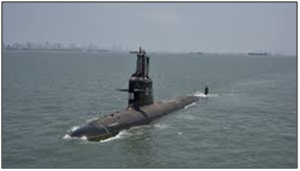
- Recently, President Droupadi Murmu undertook a sortie onboard Indian Navy’s frontline submarine INS Vaghsheer on the Western seaboard.
About INS Vaghsheer:
- Nature: It is the sixth submarine of the first batch of six Kalvari-class, or Scorpene-class, submarines ordered by the Indian Navy under Project-75.
- Nomenclature: It is named after the sandfish, a deadly deep-sea predator of the Indian Ocean.
- Commissioning: It was officially commissioned into the Indian Navy in January 2025. It now joins its sister vessels INS Kalvari, INS Khanderi, INS Karanj, INS Vela, and INS Vagir, which were commissioned, respectively, in December 2017, September 2019, March 2021, November 2021, and January 2023.
- Construction: These submarines have been completely built by Mazagon Dock Shipbuilders Limited (MDL) through French technology transfer.
- Suited for warfare: Armed with torpedoes, anti-ship missiles, and mine-laying capabilities, it excels in anti-surface and anti-submarine warfare, intelligence gathering, and surveillance.
- Stealth capability: It features advanced acoustic absorption techniques, low radiated noise levels, and a hydro-dynamically optimized shape, making it one of the quietest submarines globally.
- Weaponry: It is armed with exocet anti-ship missiles, heavy-weight torpedoes, and naval mines. It is designed for sea denial and access denial missions.
- Endurance: It is capable of operating for up to 50 days at sea and reaching speeds of 20 knots when submerged.
- Accommodation: It can accommodate 8 officers and 35 sailors and is fitted with an anti-torpedo countermeasure system.
- Modernization: It is equipped with indigenously developed systems like the Ku-Band SATCOM (Rukmini) and an internal communication network.
Source:
Category: History and Culture
Context:
- Recently, Prime Minister Narendra Modi praised the lace products made by self-help groups in Narsapuram of West Godavari district during his “Man-Ki-Baat.”

About Narasapuram Lace Craft:
- Location: This craft is associated with Narsapur, which is situated on the bank of Godavari River in the state of Andhra Pradesh.
- Origin: It was introduced in 1844 by a Scottish missionary, Macrae, and his wife.
- History: It is believed that the women of the farming community of this region started creating highly attractive artefacts from colourful lace, about 150 years ago.
- Resilience: The craft has survived the Indian famine (1899) and the Great Depression (1929). By the early 1900s, above 2,000 women were involved in the craft in the Godavari region.
- Significance: It was recognized with the Geographical Indication tag in 2024.
- Raw materials: It primarily uses fine cotton threads in various thicknesses and colours. Artisans also incorporate silk, rayon, or synthetic threads for decorative pieces, with beads and sequins added to enhance export-quality designs.
- Technique: Artisans use crochet needles and fine cotton thread to create intricate floral, geometric, and paisley patterns.
- Tools: The main tool is the crochet hook, available in different sizes to create diverse patterns and textures.
- Design: This craft showcases intricate floral, geometric, and paisley patterns inspired by nature and traditional motifs.
- Famous products: Narsapuram’s famed hand-made crochet industry produces doilies, pillow covers, cushion covers, bed spreads, table-runners, and table cloths etc.
Source:
Category: Environment and Ecology
Context:
- Kolleru Lake is now getting recognition for its delicious black dried fish that has carved a special place for itself in both domestic and international markets.
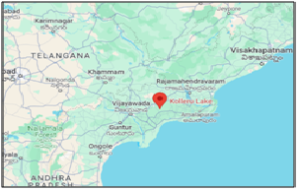
About Kolleru Lake:
- Location: It is one of the largest freshwater lakes in India, located in the state of Andhra Pradesh. It is located in the inter-deltaic plain of rivers Krishna and Godavari near the city of Eluru and serves as a natural flood-balancing reservoir for these two rivers.
- Other names: This lake is also known as the “Peerless Fisherman”s Paradise and Bird Heaven”.
- Area: It spreads over an area of about 308 sq. km. and expands up to 954 sq.km. at the highest flood level.
- Uniqueness: It is one of India’s largest natural freshwater lakes. It is also characterized as the largest shallow freshwater lake in Asia.
- Associated rivers: It is a shallow lake and it receives water from four rivers, namely Budameru, Ramileru, Tammileru, and Errakalva, and 18 drains.
- Outlet: This lake empties its water into the Bay of Bengal through a single outlet called ‘upputera’.
- Significance: The lake was declared as a wildlife sanctuary in November 1999. It was also designated as a wetland of international importance in November 2002 under the International Ramsar Convention.
- Important for migratory birds: It supports over 20 million migratory birds annually, including grey pelicans, painted storks, and open-billed storks. It is a haven for species migrating from Siberia, Central Asia, and the Himalayas, making it one of India’s richest avian habitats.
- Economic importance: The lake is deeply intertwined with local livelihoods, sustaining thousands who depend on fishing, duck farming, and paddy cultivation.
Source:
Category: Science and Technology
Context:
- The Alipurduar Division of the Northeast Frontier Railway has recorded its highest-ever single-day output of 1,033 track metres using Plasser’s Quick Relaying System (PQRS).
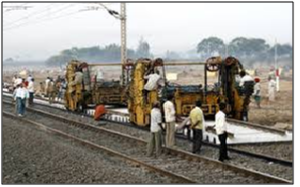
About Plasser’s Quick Relaying System (PQRS):
-
- Nature: It is a modern semi-mechanized system automatic machine used for quick railway track replacement.
- Objective: It aims to speed up track renewal while minimizing traffic disruption, enhancing safety, reliability, and maintenance efficiency.
- Composition: It consists of self-propelled cranes which move on an auxiliary track of 3400 mm gauge having the same centre line as that of track to be relayed. These portal cranes are capable of self-loading and unloading from BFRs (Bogie Flat Wagons).
- Lifting capacity: Newer models can lift up to 9 tonnes, allowing them to handle 13-meter-long Pre-stressed Concrete (PRC) sleeper panels.
- Uses: The system is widely used for new track construction as well as the modernisation of existing track infrastructure.
- Significance: It helps longer track lengths to be renewed within shorter traffic blocks. Further, it is cost effective, as it reduces manual labour and lifecycle maintenance costs.
- Operational Sequence:
-
- New panels are prefabricated at a Base Depot.
- Old panels are lifted and transferred directly to BFRs.
- New panels are laid using the portal cranes.
Source:
(MAINS Focus)
(GS Paper III – Inclusive growth and issues arising from it)
Context (Introduction)
Recent global legal and market developments show that inclusion, particularly of LGBTQIA+ communities, is no longer just a rights-based issue but a business and economic imperative, influencing consumer behaviour, talent retention and long-term corporate competitiveness.
Inclusive Growth: Core Idea and Relevance
- Definition: Inclusive growth refers to economic growth that creates opportunities for all sections of society and ensures equitable access to employment, markets, resources and public services.
- Economic Logic: Growth that excludes segments of the population underutilises human capital, lowers aggregate productivity and weakens long-term demand.
- Indian Context: Persistent inequalities based on gender, caste, region and identity reduce labour force participation and skill utilisation, constraining India’s demographic dividend.
- Market Dimension: Inclusion expands consumer bases, strengthens trust in institutions and improves workforce retention and innovation capacity.
- Global Evidence: International studies show that economies with lower discrimination levels record higher productivity growth and better human capital outcomes.
Challenges to Inclusive Growth in India
- Low Labour Force Participation: Women’s LFPR remains structurally low, and marginalised groups face informalisation and precarious employment.
- Social Exclusion Costs: Discrimination leads to health losses, lower educational attainment and reduced lifetime earnings.
- Skill and Opportunity Gaps: Unequal access to quality education, skilling and networks limits upward mobility.
- Regional Inequalities: Growth remains concentrated in a few States and urban centres, leaving aspirational districts behind.
- Policy–Practice Gap: Constitutional equality often does not translate into workplace inclusion or market access.
- Informality Dominance: Over 80% of employment remains informal, limiting social security and productivity gains.
Why Inclusion Drives Growth
- Higher Workforce Participation: Inclusion brings more people into productive employment, raising potential output.
- Productivity Gains: Diverse teams and inclusive workplaces show better problem-solving and innovation outcomes.
- Demand Expansion: Inclusion enlarges consumer markets and stabilises consumption-led growth.
- Human Capital Returns: Reduced discrimination improves health, education and skill outcomes.
- Business Competitiveness: Firms with inclusive policies attract talent and retain skilled workers.
- Macroeconomic Stability: Broad-based growth reduces social tensions and policy uncertainty.
Way Forward: Making Growth Truly Inclusive
- Policy Integration: Mainstream inclusion across economic, labour, education and industrial policies.
- Labour Market Reforms: Promote formalisation, equal pay, safe workplaces and non-discriminatory hiring.
- Human Capital Investment: Target marginalised groups through education, skilling and digital access.
- Private Sector Role: Encourage inclusive corporate practices through ESG norms and disclosure frameworks.
- Data-Driven Governance: Use disaggregated data to design targeted interventions and track outcomes.
- Social Infrastructure: Strengthen healthcare, childcare, transport and housing to enable participation.
Conclusion
Inclusive growth is not redistribution after growth, but growth itself. Economies that integrate social inclusion into markets, workplaces and institutions achieve higher productivity, resilience and legitimacy. For India, inclusion is essential to fully realise its demographic and economic potential.
Mains Question
- “Inclusive growth is both a moral necessity and an economic imperative.” Discuss the statement in the context of India’s development trajectory. (250 words, 15 marks)
Source: The Hindu
(GS Paper III – Infrastructure, Energy, Inclusive and Sustainable Growth)
Context (Introduction)
India’s clean energy push is central to its climate commitments, energy security and growth strategy. With rising electricity demand, import dependence on fossil fuels and global climate pressures, renewables and green hydrogen are seen as pillars of a long-term transition. Recent investment and capacity trends signal promise, but systemic bottlenecks threaten momentum.
Current Status of India’s Clean Energy Sector
- Strong Investment Momentum: Clean energy attracted $3.4 billion FDI in the first nine months of FY2025, accounting for over 80% of total power sector inflows, reflecting investor confidence in India’s scale and policy intent.
- Globally Competitive Tariffs: Reverse auctions have pushed solar and wind tariffs to historic lows, making renewables among the cheapest electricity sources in India, supporting affordability and industrial competitiveness.
- Ambitious Capacity Expansion: India is progressing towards its 500 GW non-fossil capacity target by 2030, backed by large-scale solar parks and hybrid renewable projects.
- Green Hydrogen Push: The National Green Hydrogen Mission targets 5 million metric tonnes annually by 2030, aligned with decarbonisation of steel, fertilisers and refining.
- Manufacturing Ecosystem Developing: Domestic solar module and cell manufacturing is expanding under PLI schemes, but remains partially dependent on imports, especially upstream components.
Key Challenges and Structural Constraints
- DISCOM Financial Stress: Persistent unpaid dues and weak balance sheets of power distribution companies undermine payment security, increasing counterparty risk for developers.
- Contractual Uncertainty: Post-auction attempts by some States to renegotiate tariffs weaken contract sanctity, raising sovereign and regulatory risk perceptions.
- Transmission Bottlenecks: Around 60 GW of renewable capacity is stranded due to inadequate transmission infrastructure, preventing evacuation of clean power.
- Curtailment Risk: Renewable generators face frequent curtailment without compensation, complicating revenue forecasting and increasing financing costs.
- High Cost of Capital: Renewable financing costs in India are nearly 80% higher than in advanced economies, driven by grid, payment and policy risks.
- Green Hydrogen Economics: Current green hydrogen costs ($4.1–$5/kg) are significantly higher than grey hydrogen, with viability dependent on subsidies, mandates or carbon pricing.
Sector-Specific Challenges
- Demand Uncertainty: Industries hesitate to retrofit without assured supply and price stability.
- Supply-Side Risk: Producers are reluctant to invest without long-term offtake guarantees.
- Infrastructure Gaps: Storage, transport pipelines and end-use systems are underdeveloped, requiring capital beyond production facilities.
- Policy Coordination Needs: Hydrogen requires alignment across power, industry, transport and climate policy, which remains fragmented.
Way Forward:
- Strengthen Contractual Sanctity: Ensure enforceability of power purchase agreements to restore investor confidence and reduce risk premiums.
- Reform DISCOM Finances: Expand payment security mechanisms, escrow systems and direct benefit reforms to stabilise revenue flows.
- Accelerate Grid Expansion: Synchronise renewable capacity addition with transmission build-out through proactive planning and faster clearances.
- Compensation for Curtailment: Introduce transparent curtailment frameworks with compensation norms to lower financing uncertainty.
- Deepen Manufacturing Integration: Enforce domestic content rules consistently and support upstream components to reduce import dependence.
- Create Green Hydrogen Demand: Use blending mandates, long-term offtake contracts, and carbon pricing to overcome the demand–supply deadlock.
Conclusion
India’s clean energy transition is no longer constrained by ambition or demand, but by execution and system design. Resolving grid, financial and contractual bottlenecks is as critical as adding capacity. If these reforms align with realistic hydrogen timelines and industrial demand creation, India can emerge as a global model for managing a complex, large-scale energy transition.
Mains Question
- “India’s clean energy transition faces fewer technological constraints than institutional and financial ones.” Discuss with reference to renewables and green hydrogen. (250 words, 15 marks)
Source: Indian Express