IASbaba's Daily Current Affairs Analysis

Archives
(PRELIMS Focus)
Category: Geography
Context:
- Scientists recently obtained first 3D images from inside Popocatépetl Volcano, one of the world’s most active volcano and whose eruption could affect millions of people.
About Popocatépetl Volcano:
-
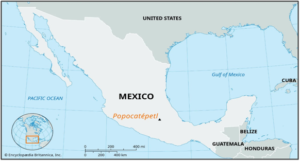
- Nomenclature: Popocatépetl means “Smoking Mountain” in the Aztec Nahuatl language.
- Location: It is located in central Mexico roughly 45 miles (72 kilometers) southeast of Mexico City. It is on the border of the states of México and Puebla.
- Mythology: In Aztec mythology, it is linked to the twin volcano Iztaccíhuatl. The legend depicts Popocatépetl as a warrior and Iztaccíhuatl as a princess who died of grief.
- National Park: Both peaks are protected within the Izta-Popo Zoquiapan National Park.
- Interaction of tectonic plates: It lies on the Trans-Mexican Volcanic Belt, which is the result of the small Cocos Plate subducting beneath the North American Plate.
- Significance: It is one of Mexico’s most active volcanoes, with recorded eruptions since 1519. It is one of the most dangerous volcanoes in the Ring of Fire.
- Type: It is a stratovolcano (also called a composite volcano), characterized by a steep, conical shape built by layers of ash, lava flows, and pyroclastic materials.
- Elevation: It is approximately 5,452 meters (17,883 ft) in height, making it the second-highest peak in Mexico after Citlaltépetl (Pico de Orizaba).
- Eruption Characteristics: Primarily andesitic to dacitic in composition, it produces viscous lava flows, explosive ash clouds, and pyroclastic flows.
- Hazard Zone: An estimated 25 million people live within a 100 km radius of the summit, making it one of the most high-risk volcanoes globally.
Source:
Category: Science and Technology
Context:
- Gandhinagar is facing a surge in typhoid cases linked to contaminated drinking water, exposing serious flaws in the city’s newly laid water supply system.
About Typhoid:
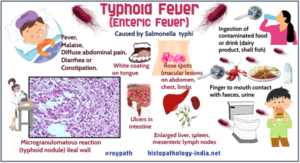
- Causative agent: It is a life-threatening infection caused by the bacterium Salmonella Typhi.
-
- Target Organs: The bacteria primarily inhabit the small intestine, liver, spleen, and bone marrow.
- Transmission: It follows a faecal-oral route through contaminated food or water. It can also spread via “4 F’s”: Flies, Fingers, Faeces, and Fomites.
-
- Uniqueness: Humans are the only known carriers of the disease. This means that the pathogen naturally resides and is transmitted within the human population, with no other known animal reservoirs.
- Prevalence: Typhoid is more prevalent in places with less efficient sanitation and hygiene.
- Global hotspots: It is most prevalent in South Asia, Southeast Asia, Latin America, and sub-Saharan Africa.
-
- Symptoms: These include prolonged high fever, fatigue, headache, nausea, abdominal pain, and constipation or diarrhoea. Some patients may have a rash. Severe cases may lead to serious complications or even death.
- Diagnostic Tools:
-
- Gold Standard: Blood culture or bone marrow culture, though these are resource-intensive.
- Widal Test: Widely used in India but often unreliable due to high false-positive rates and cross-reactivity with other infections.
- Treatment: Typhoid fever can be treated with antibiotics.
- Concerns: S. Typhi is becoming resistant to multiple antibiotics. XDR (Extensively Drug-Resistant) strains, which are resistant to five classes of antibiotics (including third-generation cephalosporins), have emerged in South Asia.
Source:
Category: Environment and Ecology
Context:
- In a historic move confirmed by the Ministry of Defence, the double-humped Bactrian camels will make their official debut on the Kartavya Path on January 26.
About Double Humped Bactrian Camel:
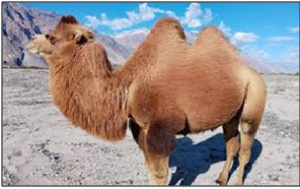
- Scientific name: It is scientifically known as Camelus bactrianus.
-
- Distinctive feature: They have two humps on the back, compared to the single hump of the Dromedary (Arabian) camel. The humps store fat (not water) that provides energy and metabolic water during scarcity.
- Global spread: They are native to the harsh and arid regions of Central Asia. They occupy habitats in Central Asia from Afghanistan to China, primarily up into the Mongolian steppes and the Gobi desert.
- Distribution in India: Small populations of these camels are found in high altitude cold deserts of Ladakh’s Nubra Valley.
-
- Resilient: They possess thick, shaggy coats that fluctuate with the seasons, growing dense to withstand temperatures as low as minus 40 degrees Celsius. Their nostrils are sealable to block out frozen dust, while their broad feet act like natural snowshoes.
- Uniqueness: They are among the few land animals that can survive by eating snow to meet their hydration needs.
- Diet: Bactrian camels are omnivores but primarily herbivores and eat various types of plants.
- Strategic significance: They are formally inducted into the Indian Army for logistical and patrol duties along the Line of Actual Control (LAC) in Eastern Ladakh.
- Conservation Status: They are classified as ‘Critically Endangered’ as per IUCN Red List.
Source:
Category: International Organisations
Context:
- OPEC Plus has agreed in principle to maintain steady oil output despite rising political tensions among key members and widening geopolitical uncertainty.
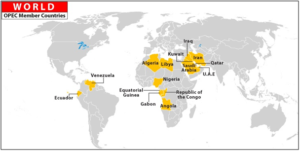
About OPEC (Organization of the Petroleum Exporting Countries) Plus:
-
- Nature: It is an alliance of major oil-exporting nations that work together to regulate global oil supply and prices.
- Members: It comprises of 22 countries (12 OPEC countries plus Azerbaijan, Bahrain, Brunei, Kazakhstan, Russia, Mexico, Malaysia, South Sudan, Sudan, and Oman).
- Objective: It aims to work together on adjusting crude oil production to bring stability to the oil market.
-
- Formation: It was established in 2016 through the “Declaration of Cooperation” at the Vienna Group meeting. It was formed to counter falling oil prices caused by the surge in U.S. shale oil production.
- Headquarters: Its headquarters is located in Vienna, Austria.
- Strategic Significance: It controls approximately 40% of global oil production and nearly 80% of proven reserves.
About OPEC (Organization of the Petroleum Exporting Countries):
- Nature: It is a permanent intergovernmental organization of oil-exporting countries.
- Formation: It was established in 1960 by the five founding members Iran, Iraq, Kuwait, Saudi Arabia, and Venezuela.
- Objective: It aims to coordinate members’ petroleum policies to ensure stable oil prices, an efficient supply to consumers, and a fair return for investors.
- Headquarters: Its headquarters is located in Vienna, Austria.
- Members: Currently, it has 12 members, including Algeria, Congo, Equatorial Guinea, Gabon, Libya, Nigeria, and the United Arab Emirates.
- Reports: It publishes the World Oil Outlook and the Monthly Oil Market Report.
Source:
Category: Defence and Security
Context:
- Pakistan Air Force has successfully conducted a flight test of the indigenously developed Taimoor Weapon System, capable of hitting targets at 600 kilometres.

About Taimoor Missile:
-
- Origin country: It is an air-launched cruise missile developed by Pakistan.
- Objective: It is designed to enhance Pakistan’s conventional deterrence and precision-strike capabilities against both land and sea targets.
- Capability: It is capable of striking enemy land and sea targets with high precision.
- Propulsion: It uses subsonic turbojet propulsion for long-range efficiency.
- Range: It has a range of upto 600 kilometers, carrying a conventional warhead.
- Speed: It is subsonic in nature and has a speed up to 0.8 Mach.
- Navigation: It uses a sophisticated mix of Inertial Navigation System (INS), Satellite guidance (GPS/GNSS), and terrain-based navigation (DSMAC/TERCOM).
- Launch platform: It is primarily launched from the Mirage-III aircraft, though it is designed for integration across the PAF fighter fleet.
- Stealth design: It has a low-observable airframe with a box-shaped fuselage, X-type tail, and foldable wings to minimize radar cross-section. It is designed to fly at very low altitudes, allowing it to effectively evade hostile air and missile defence systems.
Source:
(MAINS Focus)
GS-II: Government policies and interventions and issues arising out of their design and implementation.
Context (Introduction)
Digital technologies have transformed work into a 24×7 activity, eroding the boundary between professional and personal life. This culture of constant availability has produced a silent crisis of burnout, mental health stress, and declining productivity. The debate on the “right to disconnect” has thus moved from a labour welfare concern to a global governance and international norms issue.
Core Idea
The right to disconnect recognises an employee’s entitlement to disengage from work-related digital communication beyond prescribed working hours without fear of reprisal. It reframes occupational safety to include mental well-being, aligning labour rights with contemporary realities of platform work, remote employment, and hyper-connectivity.
Problem Diagnosis (Indian Context)
- Excessive Working Hours: ILO data show over half of India’s workforce works more than 49 hours per week.
- Mental Health Externalities: National surveys link work-related stress to rising anxiety, depression, and lifestyle diseases.
- Regulatory Gaps: The Occupational Safety, Health and Working Conditions Code, 2020 caps hours mainly for “workers”, excluding large sections of contractual, freelance, and gig employees.
- Power Asymmetry: Fear of disciplinary action for delayed responses skews bargaining power towards employers in digitally monitored workplaces.
Why It Matters (Global and Economic Logic)
- Article 21 – Right to Life with Dignity: Mental well-being and reasonable rest are integral to a dignified life, as recognised in judicial interpretations of Article 21.
- Directive Principles: Articles 39(e), 39(f), and 42 obligate the State to protect workers’ health and ensure just and humane working conditions.
- Equality Concerns: Exclusion of gig and contractual workers raises issues under Article 14 due to arbitrary classification.
- Democratic Governance: A fatigued workforce weakens citizen participation and long-term institutional capacity.
- International Norm Diffusion: Countries such as France, Italy, Ireland, Portugal, and Australia have legislated limits on after-hours digital communication, recognising downtime as essential to productivity.
- Competitiveness Argument: Empirical evidence from advanced economies shows that respecting rest improves innovation, reduces errors, and sustains long-term output.
- Human Capital Protection: In an economy driven by services and knowledge work, mental well-being is a strategic asset.
- Normative Alignment: Adoption strengthens India’s compliance with evolving global labour standards promoted by the ILO.
Way Forward
- Amend the OSH Code to extend the right to disconnect to all categories of workers, including gig and contractual employees
- Create grievance redress mechanisms against digital overreach
- Promote organisational culture change through awareness and compliance audits
- Integrate mental health support within occupational safety frameworks
Conclusion
The right to disconnect is not an anti-growth measure but an investment in sustainable productivity. As global labour norms evolve to address the realities of the digital economy, India’s willingness to institutionalise this right will signal whether its growth model values speed alone—or the strength and resilience of its human capital.
Mains Question
In the context of increasing digitalisation of work, the demand for a “right to disconnect” has acquired constitutional significance. Examine the relevance of this right in light of Article 21 and the Directive Principles of State Policy, and discuss the need for its statutory recognition in India. (250 words, 15 marks)
GS-II: Government policies and interventions and issues arising out of their design and implementation.
GS-III: Environmental pollution and degradation; conservation, environmental impact assessment.
Context (Introduction)
The Aravalli range, one of the world’s oldest mountain systems, faces sustained ecological degradation due to mining, urbanisation, and fragmented governance across Rajasthan, Haryana, and the National Capital Region. Despite recent Supreme Court interventions—such as pausing height-based reclassification of hills—the crisis persists, highlighting deeper governance and environmental failures.
Core Idea
The ecological principle of “thinking like a mountain”, coined by Aldo Leopold, which emphasises long-term ecosystem integrity over short-term economic gains. Applied to the Aravallis, this approach demands treating the mountain range as an integrated ecological system rather than as discrete parcels defined by administrative or legal thresholds.
Problem Diagnosis: Governance and Environmental Failures
- Short-termism in policymaking: Prioritisation of construction materials and real estate over ecological stability has led to quarrying, deforestation, and landscape fragmentation.
- Reductionist legal definitions: Height-based classification of hills ignores ecological functions of low-lying ridges, exposing them to mining and degradation.
- Fragmented governance: District-wise mining leases and State-level jurisdictions fail to reflect the transboundary nature of the Aravalli ecosystem.
- Ecological disruption: Mining and urban sprawl disturb natural drainage, accelerate soil erosion, reduce forest cover, and disrupt food webs.
Why the Aravallis Matter
- Environmental security: The Aravallis act as groundwater recharge zones, biodiversity corridors, and a climatic barrier limiting desertification from the Thar. Recognising these functions, the Supreme Court in MC Mehta v. Union of India (Aravalli mining cases) prohibited mining in ecologically sensitive areas, affirming that environmental protection must override commercial exploitation
- Climate resilience: Forested hills capture carbon, regulate microclimates, and influence the monsoon system in northern India.
- Constitutional mandate: Article 48A directs the State to protect and improve the environment, while Article 21 (as judicially interpreted) includes the right to a healthy environment. In Vellore Citizens’ Welfare Forum v. Union of India (1996), the Court embedded the doctrine of Sustainable Development into Indian law, holding that development cannot be pursued at the cost of irreversible environmental damage
- Intergenerational equity: Irreversible ecological damage violates the principle that development must not compromise future generations.
Way Forward:
- Adopt ecosystem-scale governance, treating the Aravallis as a single ecological unit rather than fragmented administrative zones
- Replace district-wise mining permissions with a comprehensive Aravalli management plan based on ecological carrying capacity
- Align judicial definitions with scientific understanding of ecological connectivity
- Strengthen enforcement of environmental laws through coordinated Centre–State mechanisms
- Embed long-term ecological impact assessments into all land-use and infrastructure decisions
Conclusion
The Aravalli crisis illustrates the dangers of governance that values immediate economic returns over ecological permanence. “Thinking like a mountain” is not environmental romanticism but policy realism recognising that while forests may regrow in decades, mountain ecosystems formed over millions of years are irreplaceable. For a megadiverse country like India, ecological short-sightedness would be the costliest failure of governance.
Mains Question
- The degradation of the Aravalli range reflects the limitations of fragmented governance and short-term development-centric policymaking. Examine the environmental significance of the Aravallis and discuss how constitutional principles and judicial interventions can guide a sustainable governance framework for their protection. (250 words, 15 marks)