IASbaba's Daily Current Affairs Analysis

Archives
(PRELIMS Focus)
Category: Environment and Ecology
Context:
- In a significant boost to tiger conservation in western Maharashtra, a third tigress was released into the wild at the Sahyadri Tiger Reserve (STR) recently.
About Sahyadri Tiger Reserve (STR):
-
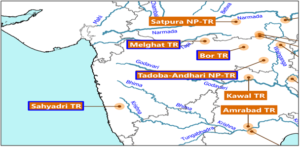
- Location: It is located in the Sahyadri Ranges of the Western Ghats in Maharashtra. It is the northernmost tiger habitat in the Western Ghats.
- Recognition: It is the first tiger reserve of Western Maharashtra and the fourth tiger reserve of the State.
- Spread: It spans four districts of Satara, Sangli, Kolhapur, and Ratnagiri. It is spread over two protected areas of Koyana Sanctuary (KWLS) and Chandoli National Park.
- Rivers: The central portion of STR is occupied by the “Shivsagar” reservoir of the Koyana River and the “Vasant Sagar” reservoir of the Warana River.
- Connectivity: It is linked to Radhanagari Wildlife Sanctuary (north) and Kali Tiger Reserve in Karnataka (south) via the Sahyadri-Konkan corridor.
- Terrain: The habitat of Sahyadri is composed of woodlands, grasslands, and plateaus, the latter locally referred to as “Sadaa”, which are lateritic in nature with considerable habitat value.
- Vegetation: The forest cover here is that of moist evergreen, semi-evergreen, moist, and dry deciduous vegetation. It is the only place where climax and near-climax vegetation are plentiful and prospects of adverse anthropogenic influence in the future are minimal.
- Flora: Dense tree cover includes species such as teak, bamboo, Indian laurel, and jamun. Medicinal plants like Asparagus racemosus and Aegle marmelos grow abundantly. Unique Western Ghats endemics, including rare orchids and shrubs, flourish in the reserve’s humid microclimates.
- Fauna: It is home to the endangered species of top carnivores such as Tiger, Wild dog, and Leopard. The herbivores include Gaur, Sambar, Four Horned Antelope, Mouse Deer, and Giant Squirrel. The habitat also supports hornbills, and many other endemic birds.
Source:
Category: Science and Technology
Context:
- The European Space Agency’s Copernicus Sentinel-2 mission recently released a high-resolution image of the 2026 Winter Olympic venues across northern Italy.
About Copernicus Sentinel-2 Mission:
-
- Nature: It is an Earth observation satellite mission and it is part of Copernicus – the European Union’s Earth observation program.
- Development: It is developed and operated by the European Space Agency (ESA).
-
- Objective: It aims at monitoring variability in land surface conditions.
- Satellite constellation: It comprises two twin polar-orbiting satellites, Sentinel-2A (launched 2015) and Sentinel-2B (launched 2017), placed in the same sun-synchronous orbit but phased at 180°. A third satellite, Sentinel-2C, was launched in September 2024 to ensure data continuity.
- Technical specifications:
-
-
- 13 spectral bands: Captures data across visible, near-infrared, and shortwave infrared regions.
- Spatial resolution: Varies by band—10m, 20m, and 60m.
- Wide swath width: 290 km, which is significantly wider than many other missions in its class.
- Revisit frequency: 5 days at the equator with two satellites.
-
- Applications:
-
- Agriculture & Food Security: Monitoring crop health, leaf area index, and chlorophyll content to support precision farming.
- Disaster Management: Real-time mapping of floods, volcanic eruptions, landslides, and wildfires to assist humanitarian relief.
- Environmental Monitoring: Tracking deforestation, desertification, and land-cover changes.
- Water Quality: Observing pollution in lakes and coastal waters and monitoring harmful algal blooms.
- Methane Emissions: Recent capabilities include observing anthropogenic methane emissions.
Source:
Category: Miscellaneous
Context:
- India recently started work on the Sawalkote Hydroelectric Project in Jammu and Kashmir- the first such new project after the abrogation of the Indus Water Treaty.
About Sawalkote Hydroelectric Project:
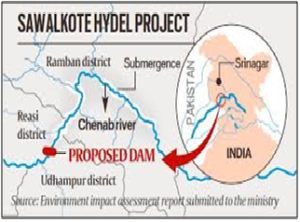
- Location: It is a 1,856-MW run-of-the-river hydropower project on the Chenab River in the Ramban District of Jammu and Kashmir.
-
- Significance: It will be the largest hydroelectric project in the Union Territory (J&K) and one of the biggest in North India.
- Inception: The project has been in the planning stage since the 1980s and has undergone multiple revisions to address environmental, ecological, and technical concerns.
- Construction: The project will be built by the National Hydroelectric Power Corporation (NHPC).
- Structure: It will comprise nine turbines and an underground power station. It will feature a Roller Compacted Concrete Gravity Dam at a height of 192.5 metres.
- Capacity: It will produce around 8000 million units of electricity every year.
- Reliable power supply: The plant will ensure reliable power supply to the region, particularly during the harsh winter months, when electricity demand peaks and shortages are common.
- Exporting capability: It also has the potential to turn J-K into a power-surplus region, creating scope for exporting surplus energy to the national grid.
- Flood mitigation: By regulating the flow of the Chenab River, the Sawalkote project could contribute to flood mitigation downstream, while also ensuring better water management for agriculture and domestic use.
- Association with IWT: It is the first major hydropower project on the Indus rivers to be accorded environmental clearance following India’s suspension of the 1960 Indus Waters Treaty (IWT) on April 23, 2025, following the Pahalgam terror attack.
Source:
Category: History and Culture
Context:
- The Union minister of state recently announced plans for the comprehensive development of the historic Kondaveedu Fort.
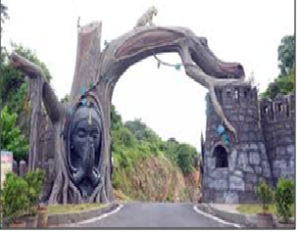
About Kondaveedu Fort:
- Location: Kondaveedu Fort is a historical fortification located at Kondaveedu village in the Guntur district of Andhra Pradesh.
- Other names: It is also known as Kondavid Fort.
-
- Height: It is spread across a range of hills at around 1,050 feet elevation.
- Significance: It is the largest hill fort in present Andhra Pradesh.
-
- Construction: It was constructed during the time of the Telugu Chodas, strengthened by the Kakatiyas and occupied by Prolaya Vema Reddy, who shifted his capital from Addanki to Kondaveedu in 1323 AD.
- Later rulers: Later it was taken over by the Gajpathis of Orissa and ravaged by the Bahmani Sultans in 1458. The fort later came under the control of the Vijayanagara Empire, the Golconda Sultanate, the Mughals, the French, and the British.
- Related personalities: The great Telugu poet Srinatha was associated with the Reddy court and praised the fort in his writings.
- Architecture: The architecture displays a blend of Hindu and Islamic styles.
- Building materials: It was mainly constructed with granite stones and lime mortar.
- Notable features: It features massive granite fortifications, 23 bastions connected by defensive walls, and two main entrances called Kolepalli Darwaza and Nadella Darwaza.
- Engineering marvels: The fort is renowned for its advanced water conservation systems, utilizing natural depressions and three main reservoirs: Mutyalamma, Puttalamma, and Vedulla cheruvus.
- Cultural artifacts: Ruins of temples, pillared halls, and a mosque are located within the premises. Recent archaeological findings include Buddhist stupa remains dating to the 1st or 2nd century CE
Source:
Category: Geography
Context:
- India and Greece recently signed a joint declaration of intent on strengthening defence industrial cooperation between the two countries.
About Greece:
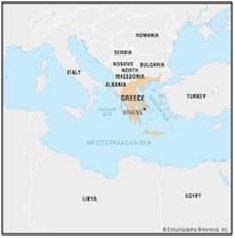
- Location: It is located on the southern edge of the Balkan Peninsula.
-
- Bordering countries: It is bordered by 4 nations namely, North Macedonia and Bulgaria in the north, Albania in the northwest, and Turkey in the northeast.
- Bordering seas: It is also bounded by the Aegean Sea in the east, Ionian Sea in the west and the Mediterranean Sea in the south.
- Capital: Its capital is Athens.
-
- Terrain: It is predominantly mountainous, with approximately 80% of its terrain consisting of mountains or hills, making it one of the most mountainous countries in Europe.
- Climate: The climate of Greece is typically Mediterranean.
- Major mountains: Pindus mountain range on the mainland contains one of the world’s deepest gorges, Vikos Gorge, which plunges 3,600 feet (1,100 meters).
- Highest peak: The highest Greek mountain is Mount Olympus, rising to 2,918 meters.
- Major rivers: These include Maritsa, Struma and Vardar etc.
- Natural resources: It mainly consists of petroleum, magnetite, lignite, bauxite, hydropower, and marble.
Source:
(MAINS Focus)
(GS Paper II — Governance, Constitution, Polity, Social Justice: Structure, organisation and functioning of the Executive; Civil Services)
Context(Introduction)
India’s civil services were originally designed to serve a colonial, extractive state and have since faced the complex task of adapting to democratic governance, developmental responsibilities and rising citizen expectations.
- From constitutional safeguards and successive Administrative Reforms Commissions to transparency and digital governance initiatives, civil service reform has been incremental rather than transformative.
- The recent introduction of “administrative scorecards” for Union Secretaries by the Cabinet Secretariat must be viewed as part of this long continuum of reform efforts aimed at improving efficiency, accountability and outcome-oriented governance at the highest levels of administration.
What Are the Administrative Scorecards?
- Performance Measurement Framework: Union Secretaries and their departments are assessed on a 100-mark scorecard, enabling both self-comparison over time and cross-departmental benchmarking.
- Key Quantitative Parameters:
- File disposal (20 marks)
- Output / activities (15 marks)
- Expenditure on schemes and capital expenditure (15 marks)
- Public grievance redressal
- Timely completion of PMG-monitored projects
- Timely disposal of bills by PAO and CCA
- Discipline and Incentives:
- Negative marks (up to 12) for delayed MSME payments, excessive foreign travel, abnormal pendency
- Discretionary marks (5) for exceptional performance, awarded by the Cabinet Secretary
- Stated Rationale: To ensure that administrative leadership is judged on delivery and results, reinforcing the principle that governance must produce outcomes, not explanations.
How Scorecards Fit into Recent Civil Service Reforms
The scorecard initiative builds upon — and attempts to correct the limitations of — several recent reform measures:
- Mission Karmayogi (2020): Introduced to shift civil services from rule-based to role-based and competency-based governance, focusing on continuous capacity building through digital learning platforms (iGOT).
- PRAGATI Platform: Enabled real-time monitoring of infrastructure projects and grievance redressal through direct Prime Ministerial review, improving inter-ministerial coordination and execution speed.
- E-Office and Digitisation Reforms: Adoption of electronic file systems aimed at reducing delays, enhancing transparency and enabling faster decision-making.
- Lateral Entry at Senior Levels: Introduced to bring domain expertise from outside government into policymaking roles, though limited in scale and subject to debate on institutional continuity.
- Right to Information Act, 2005: A landmark reform that transformed bureaucratic culture by making decision-making processes subject to public scrutiny.
Despite these measures, a persistent criticism has been that performance evaluation remained subjective, politically influenced and weakly linked to outcomes — a gap that scorecards attempt to address.
Positive Contributions of Administrative Scorecards
- Operationalising Second ARC Recommendations: The Second Administrative Reforms Commission (2009) strongly advocated performance management systems, objective assessment and outcome orientation — principles directly reflected in scorecards.
- Reducing Subjectivity in Evaluation: Unlike confidential reports or informal reviews, scorecards rely on measurable indicators, limiting arbitrary assessments.
- Strengthening Financial and Administrative Discipline: Penalising delayed payments, inefficiencies and avoidable expenditure reinforces fiscal responsibility and service delivery discipline.
- Embedding Accountability at the Apex Level: By focusing on Secretaries, the reform targets the commanding heights of administration, signalling seriousness of intent.
Concerns and Structural Limitations
- Risk of Mechanical Compliance: Bureaucracies have historically absorbed reforms into routine processes; scorecards may degenerate into a box-ticking exercise.
- Metric Dominance over Meaningful Outcomes: There is a danger that scores overshadow substance, where numerical performance matters more than policy quality or long-term impact.
- Residual Executive Control: Discretionary marks and centralised oversight may still allow political preferences to shape evaluations.
- Incomplete Reflection of Governance Complexity: Quantitative indicators may inadequately capture complex functions such as inter-governmental coordination, institutional reform or crisis management.
What More Needs to Be Done
- Integrate Scorecards with Career Progression: Performance assessments should be meaningfully linked to promotions, postings and training pathways under Mission Karmayogi.
- Balance Quantitative Metrics with Qualitative Review: Independent audits, peer review and outcome evaluation should complement numerical scoring.
- Institutionalise Autonomy with Accountability: Reform must reduce fear-driven decision-making while maintaining responsibility — a core concern highlighted across reform commissions.
- Continuous Feedback and Refinement: As sought by the Cabinet Secretary, iterative redesign is essential to prevent reform fatigue and ensure credibility.
Conclusion
Administrative scorecards represent an evolutionary reform, not a revolutionary one. They address a long-standing weakness in India’s civil service architecture — the absence of objective, outcome-linked evaluation at senior levels.
- If implemented thoughtfully and integrated with broader reforms such as Mission Karmayogi and digital governance, they can strengthen the democratic “steel frame”. If reduced to procedural compliance, they risk becoming another absorbed reform. The difference lies in political commitment and institutional follow-through.
Mains Question
- Civil services forms the backbone of Indian administration, still it is rued that it needs reforms to be more effective. In this light discuss the measures taken by government in recent times to reform the working of civil services to make it more professional and outcome oriented (250 words)
Source: Indian Express
(GS Paper II — Governance, Constitution, Polity, Social Justice: Issues relating to digital governance, privacy, technology and society)
Context (Introduction)
Capitalism has historically expanded by identifying new resources for extraction — land, labour, minerals, data. In the contemporary digital economy, a new commodity has emerged: the human self.
Through digital platforms, media ecosystems and algorithmic profiling, human sociality, identity and personal narratives are increasingly mined, commodified and monetised, reshaping ideas of privacy, individuality and consent. This marks a structural shift in how value is created in the global economy.
What Is the ‘Mineable Self’?
- Transformation of Sociality into Resource: Capital extraction now targets relationships, emotions, identities, networks and life stories, not merely labour or data.
- Beyond Traditional Profiling: This represents “profiling on steroids” — mapping not just consumer behaviour but intimate social ties, affinities and vulnerabilities.
- Stories as Access Codes: Personal narratives function as gateways for extraction, allowing platforms and markets to convert lived experience into economic value.
- Infinite Renewability: Unlike physical commodities, the self is continuously reproduced as long as human social life exists.
Global Story Markets and the Reconfiguration of Locality
- Collapse of the Global–Local Binary: Stories are increasingly valued for their local rootedness combined with global portability, especially narratives of migration, violence, marginality and volatility.
- Media as Extraction Infrastructure: News platforms, OTT services and streaming giants operate as global refineries, processing local experiences into globally consumable content.
- Narrative First Responders: Ordinary individuals capturing crises or conflict become instant content producers, feeding global media circuits.
- Redefinition of ‘Local’: Locality is no longer parochial or contained; it is refracted through global frames, reshaping how identities and places are perceived.
Streaming Platforms and the Democratisation of the Self
- Rise of the ‘Ordinary’ Protagonist: OTT platforms favour mid-market actors and everyday characters, expanding who can become narratively valuable.
- Apparent Democratisation: More individuals gain visibility and narrative agency, but this simultaneously widens the pool for extraction.
- Self as Market-Ready Unit: Unknown individuals, communities and identities are rendered legible, sortable and monetisable at scale.
From ‘Sources of the Self’ to ‘Sources of the Selfie’
- Fragmentation of the Individual: The modern self is no longer a unified moral subject but a composite of credit scores, data profiles, algorithmic predictions and consumption histories.
- AI and Synthetic Selves: Digital agents increasingly mimic human emotions and intuition, eroding the boundary between authentic and simulated selves.
- Cultural Shift: Personal visibility, rather than moral autonomy, becomes the currency of recognition.
The Chain of Storytelling and Self-Commodification
- Universal Narratability: Every individual is encouraged to frame life as a story worthy of an audience.
- Market Intermediation: Influencers, platforms, publishers and algorithms mediate how stories are told, amplified and monetised.
- Voluntary Participation: Individuals increasingly consent to self-extraction, selling access to their identities in exchange for visibility or livelihood.
- The Self as Super-Commodity: The convergence of platforms, storytelling and technology has produced a commodity bounded only by human appetite for self-exposure.
Challenges and Implications for India
- Erosion of Privacy and Intimacy: In a digitally unequal society, consent becomes formal rather than meaningful.
- Asymmetric Power Relations: Platforms extract disproportionate value from individuals with limited bargaining power.
- Cultural and Social Vulnerability: Marginal identities and communities risk becoming raw material for global story markets.
- Governance Gap: Existing data protection and platform regulation frameworks inadequately address identity, narrative and social extraction.
Conclusion
The rise of the mineable self signals a fundamental shift in capitalism — from extracting what humans produce to extracting who humans are. While this expansion appears democratic, it simultaneously deepens commodification of identity, intimacy and social life. The challenge for governance lies not merely in regulating data, but in safeguarding the dignity and autonomy of the human self in a story-driven digital economy.
Mains Question
- “The commodification of personal identity marks a new phase in capitalist extraction.”
In the light of the idea of the ‘mineable self’, examine how digital platforms and story markets are transforming social life and discuss the governance challenges this poses for India. (250 words)
Source: The Hindu