IASbaba's Daily Current Affairs Analysis

Archives
(PRELIMS Focus)
Category: Polity and Governance
Context:
- Recently, Quality Council of India (QCI) announced a set of next-generation quality reforms on the eve of Sushasan Divas 2025.
About Quality Council of India (QCI):
-
- Nature: It is a non-profit autonomous organisation registered under Societies Registration Act XXI of 1860.
- Establishment: It was set up in 1997 jointly by the Government of India and the Indian Industry, represented by the three premier industry associations, i.e., Associated Chambers of Commerce and Industry of India (ASSOCHAM), Confederation of Indian Industry (CII) and Federation of Indian Chambers of Commerce and Industry (FICCI).
- Nodal ministry: It is under the administrative control of the Department for Promotion of Industry and Internal Trade (DPIIT), Ministry of Commerce and Industry.
- Objective: It has been established to create a mechanism for independent third-party assessment of products, services, and processes.
- Significance: It works as the national accreditation body. It also plays a pivotal role at the national level in propagating, adoption, and adherence to quality standards in all important spheres of activities.
- Composition: The council comprises 38 members, with equal representation from the government, industries, and other stakeholders.
- Accreditation services: It also promotes the adoption of quality standards relating to Quality Management Systems, Food Safety Management Systems, and Product Certification and Inspection Bodies through the accreditation services provided by the National Accreditation Board for Certification Bodies (NABCB).
Boards under QCI:
-
- National Accreditation Board for Testing & Calibration Laboratories (NABL)
- National Accreditation Board for Hospitals & Healthcare Providers (NABH)
- National Accreditation Board for Education & Training (NABET)
- National Accreditation Board for Certification Bodies (NABCB)
- National Board for Quality Promotion (NBQP).
Source:
Category: Environment and Ecology
Context:
- The tiger population in the Valmiki Tiger Reserve (VTR) has increased more than sevenfold, rising from eight in 2010 to 54 in the last census conducted in 2022.
About Valmiki Tiger Reserve:
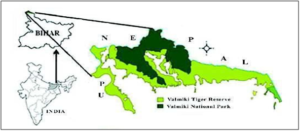
- Location: It is located at the India-Nepal border in the northern part of the West Champaran District of Bihar.
- Establishment: It was established as the 18th Tiger Reserve of India under Project Tiger in 1994.
- Uniqueness: It is the only tiger reserve of Bihar and forms the easternmost limit of the Himalayan Terai forests in India.
- Landscape: Situated in the Gangetic Plains bio-geographic zone of the country, the forest has a combination of Bhabar and Terai tracts.
- Bordered by: It is surrounded by the Royal Chitwan National Park of Nepal in the north and the river Gandak on the western side, with the Himalayan mountains as a backdrop.
- Tribal Presence: The Tharu tribe is the dominant indigenous community in the region.
- Rivers: The rivers Gandak, Pandai, Manor, Harha, Masan, and Bhapsa flow through various parts of the reserve.
- Vegetation: The reserve boasts a variety of vegetation types, including tropical wet deciduous forests, grasslands, savannas, and riverine forests.
- Flora: Sal trees dominate the forests, but the region also features species like teak, bamboo, semal, and khair.
- Fauna: Tiger, leopard, fishing cat, leopard cat, sambar, hog deer, spotted deer, black buck, gaur, sloth bear, langur, rhesus monkey, etc.
Source:
Category: Defence and Security
Context:
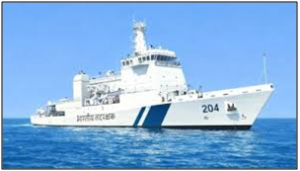
- Recently, the Indian Coast Guard inducted the first in-built Pollution Control Vessel (PCV), SAMUDRA PRATAP under the 02 PCV project of Goa Shipyard Limited (GSL).
About Samudra Pratap:
- Nature: It is the largest ship in the ICG fleet, significantly enhancing the Coast Guard’s operational reach and capability.
- Construction: It is indigenously designed and constructed by Goa Shipyard Limited (GSL).
- Uniqueness: It is the first indigenously designed and built Pollution Control Vessel of the Indian Coast Guard.
- Significance: It is the first Indian Coast Guard ship to be equipped with Dynamic Positioning capability (DP-1), with FiFi-2 / FFV-2 notation certificate.
- Structure: It is approximately 114.5 meters long and 16.5 meters wide, with a displacement of 4,170 tonnes.
- Capacity: It has a displacement capacity of 4,170 tonnes.
- Capability: It is equipped with advanced systems to detect oil spills. It is capable of high precision operations, recover pollutants from viscous oil, analyse contaminants, and separate oil from contaminated water.
- Armament: The vessel is equipped with state-of-the-art technology, including a 30mm CRN-91 gun, two 12.7mm stabilised remote-controlled guns with integrated fire control systems.
- Advanced systems: It consists of Integrated Bridge System, Integrated Platform Management System, Automated Power Management System, and a high-capacity external firefighting system.
Source:
Category: History and Culture
Context:
- Recently, a Sikh Nagar Kirtan or religious procession in South Auckland, New Zealand, was protested in the form of a traditional tribal “haka” dance.

About Haka Dance:
- Origin: It is a traditional dance of the indigenous Māori people of New Zealand.
- Nature: It is known for its powerful energy, fierce facial expressions (pukana), and physical movements like stamping, hand gestures, and chanting.
- Mythology: Rooted in Māori mythology, the dance is associated with Tāne-rore, the son of the sun god Tama-nui-te-rā. The shimmering heat of a summer day is seen as the spirit of Tāne-rore dancing, represented by the trembling hand movements (wiri) in the Haka.
- Significance: Haka varies by tribal region, with many haka telling the story of significant events in a tribe’s history. It symbolizes tribal pride, strength, and unity.
- Evolution: Traditionally, the haka was performed for war, to celebrate achievements, or to welcome guests. Today, it is performed at important occasions like sporting events, weddings, and funerals.
- Popularity: It became known to the world at large when, in the early 20th century, it was incorporated into the pregame ritual of New Zealand’s national rugby union team, the All Blacks. It also made headlines globally in November 2024 when two lawmakers used Haka to protest against a bill in the New Zealand parliament.
Source:
Category: Miscellaneous
Context:
- Recently, Prime Minister Narendra Modi inaugurated the Rashtra Prerna Sthal in Lucknow, dedicated to Atal Bihari Vajpayee, marking his 101st birth anniversary.
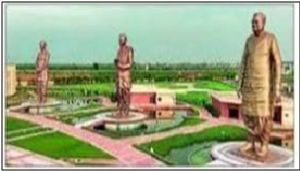
About Rashtriya Prerna Sthal:
- Location: It is located on the banks of the Gomti River in Lucknow, Uttar Pradesh.
- Development: It is developed by the Lucknow Development Authority (LDA) on a 65-acre site along the Gomti Riverfront (Vasant Kunj Yojana).
- Area: It is spread across 65 acres.
- Environmental significance: The site was notably constructed on reclaimed land that previously held approximately 6.5 lakh metric tonnes of legacy waste, serving as a model for urban environmental restoration.
- Dedicated leaders: The memorial honours three primary nationalist icons:
- Atal Bihari Vajpayee: Former PM and Bharat Ratna recipient.
- Dr. Syama Prasad Mookerjee: Founder of Bharatiya Jana Sangh.
- Pandit Deendayal Upadhyaya: Proponent of the “Integral Humanism” philosophy.
- Statues: The sprawling complex also features 65-foot-high bronze statues of BJP ideologues Syama Prasad Mookerjee and Pandit Deendayal Upadhyaya, alongside Vajpayee. Each statue weighs 42 tonnes and has a water body surrounding their platforms.
- Museum: It consists of a state-of-the-art lotus-shaped museum covering 98,000 square feet. It uses digital and immersive technologies (3D projection, holographs) across five galleries to showcase India’s national journey.
- Cost: Constructed at an approximate cost of ₹230 crore, the complex is envisioned as a permanent national asset dedicated to fostering leadership values, national service, cultural consciousness, and public inspiration.
- Public Amenities: It includes an amphitheatre with a capacity for 3,000 people, meditation and yoga centres, and a large rally ground.
- Significance: It has been developed as a landmark national memorial and inspirational complex of enduring national significance.
Source:
(MAINS Focus)
(UPSC GS Paper I – Society: Women, Social Empowerment; GS Paper II – Government Policies and SDGs)
Context (Introduction)
Despite a steady decline over the last two decades, child marriage remains a deeply entrenched social practice in India, weakening outcomes in health, education, poverty alleviation and gender equality, and threatening India’s commitment to end it by 2030.
Current Status: Progress with Deep Regional and Social Gaps
- Declining National Trend, Uneven Reality: National surveys show child marriage among women has fallen from nearly half in the mid-2000s to about one-fourth by 2019–21, reflecting policy attention and social change.
- Large Absolute Numbers Persist: Given India’s population size, even reduced percentages translate into millions of girls married before 18, keeping India among countries with the highest absolute burden.
- Inter-State Variations: Eastern and central States such as West Bengal, Bihar, Tripura, Jharkhand, Madhya Pradesh and Rajasthan continue to report high prevalence, indicating uneven social development.
- Rural and Marginalised Communities Most Affected: Child marriage is concentrated in rural areas, among Scheduled Castes, Scheduled Tribes and minority communities, reinforcing cycles of disadvantage.
- Slow Progress among Young Adults: High prevalence among women aged 18–29 shows that recent cohorts continue to be affected despite legal prohibition.
- Threat to SDG Commitments: Experts note that failure to curb child marriage undermines progress on multiple development goals related to health, education, poverty and gender equality.
Key Drivers of Child Marriage
- Poverty and Economic Insecurity: Girls from the poorest households are several times more likely to be married early, as marriage is viewed as a coping strategy to reduce economic burden.
- Low Educational Attainment: Girls with little or no schooling face a dramatically higher risk of early marriage, as education delays marriage and improves bargaining power.
- Gender Norms and Patriarchy: Deep-rooted beliefs around female chastity, honour and caregiving roles continue to prioritise early marriage over girls’ autonomy.
- Inadequate School Infrastructure: Lack of secondary schools, safe transport, toilets and hostels pushes adolescent girls out of education, increasing vulnerability.
- Weak Law Enforcement: Low reporting, poor registration of marriages and limited convictions under child marriage laws reduce deterrence.
- Unintended Legal Consequences: The use of stringent child protection laws has sometimes driven underage girls towards unsafe, informal solutions, worsening health risks.
Socio-economic Impacts
- Poor Maternal and Child Health Outcomes: Early pregnancies are linked to higher maternal mortality, anaemia, malnutrition and low birth weight.
- Intergenerational Poverty Trap: Girls married young are more likely to drop out of school, have fewer skills and remain in low-income households.
- Educational Discontinuity: Marriage almost always marks the end of formal education for girls, limiting lifetime earnings.
- Reduced Female Workforce Participation: Early marriage and childbirth restrict women’s entry into paid work, weakening demographic dividend gains.
- Higher Exposure to Domestic Violence: Evidence shows child brides face higher risks of spousal violence and limited decision-making power.
- Strain on Public Services: Poor health and nutrition outcomes increase long-term pressure on healthcare and welfare systems.
Government Efforts and Policy Response
- Legal Framework: The Prevention of Child Marriage Act, 2006, provides for annulment, penalties and protection, forming the backbone of legal action.
- Awareness Campaigns: Initiatives such as Bal Vivah Mukt Bharat Abhiyan aim to mobilise communities through sustained social messaging.
- Girl Child Education and Incentives: Conditional cash transfers and scholarship schemes seek to keep girls in school and delay marriage.
- Gender-Focused Campaigns: Programmes like Beti Bachao Beti Padhao combine advocacy with investments in education and welfare.
- Convergence with Health and Nutrition Schemes: Adolescent health programmes address anaemia, nutrition and reproductive health risks.
- Local Governance Involvement: Panchayats, frontline workers and women’s self-help groups are increasingly involved in prevention efforts.
Reforms Needed
- Target the Poorest and Most Vulnerable: Social protection and livelihood support for vulnerable families can reduce economic incentives for early marriage.
- Strengthen Secondary Education Access: Expanding schools, hostels, toilets and safe transport for adolescent girls is critical.
- Improve Law Enforcement Sensitively: Focus on prevention, counselling and community resolution rather than only punitive action.
- Address Gender Norms at Community Level: Long-term engagement with parents, religious leaders and boys is essential to shift attitudes.
- Enhance Data and Monitoring: District-level tracking and early warning systems can help identify high-risk areas.
- Integrate Health, Education and Legal Responses: A coordinated approach across sectors is necessary to break the cycle of early marriage.
Conclusion
Child marriage in India is not merely a legal issue but a multidimensional development challenge. Unless poverty, education deficits, health risks and gender inequality are addressed together, India’s goal of ending child marriage by 2030 will remain aspirational rather than achievable.
Mains Question
- Analyse the reasons for persistence of Child marriage and evaluate the effectiveness of government interventions.(250 words, 15 marks)
Source: The Hindu
(UPSC GS Paper III – Indian Economy: Growth, Federal Finance, Infrastructure)
Context (Introduction)
India’s recent growth story shows an important shift: several historically poorer States are now growing faster than richer ones, driven mainly by sustained public investment in infrastructure and supportive Centre–State fiscal coordination.
What Has Changed in India’s Growth Pattern?
- Earlier Divergence, Now Convergence: Before the pandemic, richer States consistently outpaced poorer ones; after FY19, lower-income States began growing faster, reversing the earlier trend.
- Key Catch-Up States: Uttar Pradesh, Rajasthan and Bihar have shown a clear improvement in relative growth performance.
- Why This Matters Nationally: Since India’s GDP is the sum of State GSDPs, faster growth in populous lagging States significantly lifts overall national growth.
- Unexpected Post-Pandemic Outcome: Contrary to fears, poorer States did not suffer lasting damage from COVID and instead improved growth momentum.
- Early but Broad-Based Trend: The convergence is recent but visible across multiple States, suggesting structural change rather than a one-off rebound.
- Inclusive Growth Signal: Narrowing regional growth gaps strengthen the foundations of long-term, inclusive development.
The Main Engine: State Capital Expenditure
- Public Investment Drives Growth: Higher State spending on roads, urban infrastructure and logistics emerged as the strongest factor explaining faster growth.
- Infrastructure Catch-Up: Emerging States sharply increased infrastructure investment, improving connectivity and reducing costs for businesses.
- Crowding-In Private Investment: Public capex boosted investor confidence, encouraging private firms to invest alongside the State.
- Stronger Growth Multipliers: Capital spending generates more output and jobs than routine revenue spending.
- Governance Signal: Sustained capex signals policy stability and reform intent, shaping long-term growth expectations.
- Complements Central Projects: State investments filled critical gaps around national highways, railways and logistics corridors.
How Centre–State Finance Made This Possible
- Post-Pandemic Revenue Support: Higher transfers after COVID improved State finances and enabled investment.
- Capex Loans to States Programme: Low-cost, ring-fenced loans ensured funds were used only for capital projects.
- Rapid Scale-Up: The programme expanded significantly over six years, giving States predictable funding.
- Protection of Capex: States chose to widen deficits rather than cut infrastructure spending.
- Fiscal Coordination Success: Cooperation between Centre and States reduced pro-cyclical investment cuts.
- Stability Despite GST Changes: Capex loans cushioned States even after GST compensation ended.
Risks to the Convergence Momentum
- Slower Central Tax Growth: Recent moderation in nominal GDP growth and successive direct and indirect tax cuts have slowed the Centre’s gross tax revenues. Since around 41% of the divisible tax pool is shared with States, any slowdown directly compresses State revenues, as seen in the decline in aggregate State receipts in FY25 after several years of steady growth.
- Rising State Fiscal Deficits: To protect capital expenditure, many States allowed deficits to widen post-pandemic. As a result, several States are now operating close to or above 3% of GSDP, limiting their capacity to absorb future revenue shocks without cutting spending.
- Expansion of Welfare and Cash Transfers: Ahead of recent State elections, governments in States such as Rajasthan, Madhya Pradesh, Chhattisgarh and Telangana expanded cash transfer and subsidy schemes. While socially important, these schemes raise committed revenue expenditure and reduce fiscal space for infrastructure.
- Risk of Capital Expenditure Squeeze: State budgets show that when revenue pressure intensifies, capex is often the first adjustment variable. With revenues already softening in FY25, prolonged stress could force States to scale back infrastructure projects.
- Uneven Fiscal Capacity Across States: Richer States have stronger own-tax bases and borrowing capacity, while poorer States remain more dependent on central transfers. This makes emerging States such as Bihar and Assam more vulnerable to revenue volatility.
- Fragility of Policy Continuity: Infrastructure investment requires multi-year commitment, but past experience shows that changes in political priorities or fiscal stress can abruptly interrupt capex cycles, diluting long-term growth benefits.
What Needs to Be Done to Sustain Catch-Up?
- Expand Capex Loans Programme: Larger and more predictable multi-year funding can stabilise State investment planning.
- Protect Infrastructure Spending: Capex should be prioritised over short-term revenue expenditure.
- Use Deregulation Fully: States must implement labour and business reforms to convert infrastructure into jobs.
- Attract Labour-Intensive Manufacturing: Emerging States can leverage wage advantages in textiles, footwear and furniture.
- Link Capex with Private Investment: Public projects should be designed to crowd in private capital.
- Leverage Global Supply-Chain Shifts: States can integrate into mid-tech manufacturing as firms diversify production locations.
Conclusion
India’s future growth hinges on sustained State-led convergence. With State capital expenditure now exceeding 4% of GDP and the Centre targeting Viksit Bharat by 2047, emerging States are poised to drive growth. If infrastructure investment, fiscal discipline and reforms continue, convergence can deepen. However, revenue stress and policy discontinuity could derail progress, making long-term Centre–State coordination essential.
Mains Question
- “India’s growth story is increasingly being written at the State level.”
Discuss this statement in light of recent trends in State finances, infrastructure investment, and regional development. (250 words, 15 marks)
Source: Indian Express