IASbaba's Daily Current Affairs Analysis

Archives
(PRELIMS Focus)
Category: Science and Technology
Context:
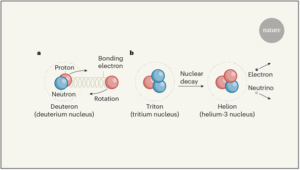
- Recently, a new study out of the ALICE collaboration at CERN’s Large Hadron Collider (LHC) has explained how deuterons survive high-energy particle collisions.
About Deuteron:
-
- Nature: A deuteron is a stable isotope of hydrogen with a nucleus containing one proton and one neutron.
- Symbol: It is denoted by the symbol “²H” or “D”.
- Presence: It is found in small amounts in natural water and in the atmosphere of Jupiter and Saturn.
- Mass: The mass of a deuteron is approximately about twice the mass of a proton.
-
- Charge: A deuteron has a net positive charge of +1, since it contains one proton.
- Spin: The deuteron has a nuclear spin of 1, which means that it behaves like a tiny magnet with a north pole and a south pole.
- Magnetic moment: The deuteron has a magnetic moment that is approximately 0.8574 nuclear magnetons, which is about 0.31 times the magnetic moment of a proton.
- Applications:
-
- It is used in the production of heavy water, which is used as a moderator in nuclear reactors.
- It is used in the production of deuterium, which is used as a fuel in fusion reactors.
- It is used in the production of tritium, which is used in nuclear weapons.
Source:
Category: Geography
Context:
- Recently, North Korea fired a ballistic missile towards the Sea of Japan.
About Sea of Japan:
-
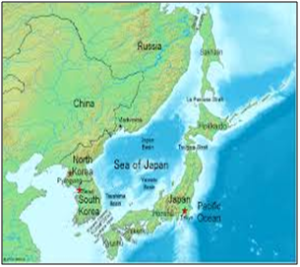
- Location: The Sea of Japan, or East Sea, is a marginal sea of the western Pacific Ocean.
- Boundaries: It is bound by Japan and Sakhalin to the east and by mainland Russia, North Korea, and South Korea to the west.
- Connections: It is connected with the East China Sea via the Tsushima and Korea straits and with the Okhotsk Sea in the north by the La Perouse and Tatar straits. In the east, it is connected with the Inland Sea of Japan via the Kanmon Strait and the Pacific Ocean by the Tsugaru Strait.
-
- Deepest point: Dohoku Seamount, an underwater volcano, is its deepest point.
- Climate: Its relatively warm waters contribute greatly to the mild climate of Japan.
- Tides: Like the Mediterranean Sea, it has almost no tides due to its nearly complete enclosure from the Pacific Ocean.
- Uniqueness: The sea is known for its high concentration of oxygen (dissolved in the seawater), which results in high biological productivity.
- Major Ports:
-
- Russia: Vladivostok, Sovetskaya Gavan, Nakhodka, Alexandrovsk-Sakhalinsky, and Kholmsk.
- North Korea: Hamhung, Chongjin, and Wonsan.
- Japan: Niigata, Tsuruta, and Maizuru.
Source:
Category: History and Culture
Context:
- Supreme Court of India recently declined to entertain a plea against the practice of ‘VIP Darshan’ at the Shri Mahakaleshwar Temple in Ujjain.
About Shri Mahakaleshwar Temple:
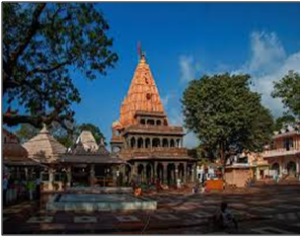
- Location: It is a Hindu temple located on the banks of the River Shipra at Ujjain in Madhya Pradesh.
- Significance: It is dedicated to Lord Shiva. It is one of the 12 Jyotirlingas in India.
- Uniqueness: It is the only Jyotirlinga that faces south (Dakshinamukhi), a unique feature associated with Tantric traditions where Shiva is considered the ‘Lord of Time and Death’.
- History: The history of the temple dates back to ancient times, with references to the temple found in various Hindu scriptures and texts. The temple finds mention in the Puranas. The renowned poet Kalidas also mentioned this temple in his creations.
- Construction: The current structure of the temple was built in the 18th century by the Maratha ruler Ranoji Shinde. However, the temple has been destroyed and rebuilt several times throughout history.
- Architecture: The architecture of the temple shows the influence of Maratha, Bhumija, and Chalukya styles of structural design.
- Spread: The temple complex is spread over five levels, one of which is underground. The Sabha Mandap (assembly hall) and Garbha Griha (sanctum sanctorum) are adorned with elaborate sculptures depicting various Hindu deities and mythological scenes.
- Craftsmanship: The sanctum houses the Jyotirlinga, which is the focal point of devotion and rituals. The grand spire (shikhara), intricately carved pillars, and ornate ceilings are proof of the exquisite craftsmanship.
Source:
Category: Government Schemes
Context:
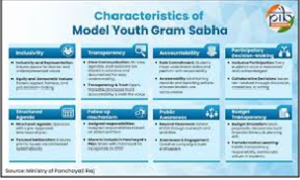
- The Ministry of Panchayati Raj recently organised a National Award Ceremony to felicitate the winners of the Model Youth Gram Sabha.
About Model Youth Gram Sabha:
- Nature: It is a simulated forum for school children to participate in mock Gram Sabha sessions.
- Objective: It is a pioneering initiative to strengthen Janbhagidari and promote participatory local governance by engaging students in simulated Gram Sabha sessions.
- Uniqueness: It is an initiative based on the Model UN – an educational simulation of the United Nations – in schools across the country
- Nodal ministries: It is an initiative of the Ministry of Panchayati Raj, in collaboration with the Ministry of Education and the Ministry of Tribal Affairs.
- Implementation: It will be rolled out across more than 1,000 schools nationwide, including Jawahar Navodaya Vidyalayas, Eklavya Model Residential Schools (EMRSs), and State Government Schools.
- Focus: Students from classes 9-12 will play the roles of sarpanch, ward members, and village-level officials, including village secretary, Anganwadi worker etc. They will hold mock meetings of the Gram Sabha, discuss various issues, and prepare the village budget and development plans.
- Financial support: The Panchayati Raj Ministry also provides a support of Rs 20,000 to each school for holding the mock Gram Sabha.
Source:
Category: Environment and Ecology
Context:
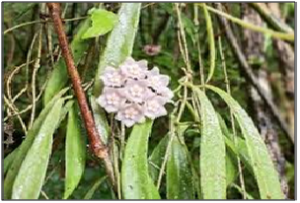
- Recently, a new plant species has been discovered in Nagaland and it’s named as Hoya Nagaensis.
About Hoya Nagaensis:
- Location: It is a new plant species found in the high-altitude forests of Nagaland.
-
- Nature: It is a member of the ‘wax plant family’ discovered in the Kavunhou Community Reserved Forest in Phek district.
- Genus: It belongs to the Hoya genus, a group known for its ornamental value.
- Uniqueness: It is currently known from only a single location, making it highly vulnerable.
- Features: The plant displays unique leaf shapes and floral features. It produces distinctive star-shaped flowers and exudes milk-like latex, a characteristic of many species in the Apocynaceae or milkweed family.
- Habitat: It was found growing in a temperate forest ecosystem that remains largely unexplored by science.
- Threats: Major threats to this plant include shifting cultivation and forest disturbance.
- Ecological significance: It highlights the importance of community-protected forests of Nagaland as a vital refuge for rare and endemic plants. It underscores the Eastern Himalaya as a reservoir of undiscovered plant diversity.
- Conservation status: It is classified as ‘Critically Endangered’ (provisional classification) as per the IUCN Red List.
Source:
(MAINS Focus)
GS-II: India and its neighbourhood–extended (West Asia / Middle East).
Context (Introduction)
The 2nd India–Arab Foreign Ministers’ Meeting (Jan 30–31, 2026, New Delhi) marks a significant milestone in India’s West Asia diplomacy. It comes amid:
- Intensifying conflicts in Gaza, Iran–Israel tensions, Syria, and
- A shifting global order shaped by U.S. unilateralism and erosion of rule-based norms.
At a time of regional instability, India’s outreach to the 22-member Arab League (LAS) signals its intent to build institutionalised, multi-pillar engagement with the Arab world.
Core Idea
India–Arab League relations have evolved from historical goodwill and energy dependence into a comprehensive strategic partnership, encompassing:
- Energy security
- Trade and investment
- Defence and maritime security
- Digital public infrastructure
- Connectivity and supply chains
As India grows into a major economic and geopolitical power, the Arab League region has become a critical pillar of India’s global matrix.
Key Pillars of Engagement
- Institutional and Diplomatic Architecture
- Arab League founded: 1945 (Cairo)
- India–LAS engagement formalised via MoU (2002)
- Arab-India Cooperation Forum (AICF) established in 2008
- Regular ministerial and summit-level interactions
- Trade, Investment and Connectivity
- Bilateral trade: ~$240 billion
- CEPA with UAE and Oman; trade with UAE crossed $115 billion
- Target: $200 billion trade with UAE by 2030
- Major investments pledged:
- UAE: $75 bn
- Saudi Arabia: $100 bn
- Qatar: $10 bn
- India–Middle East–Europe Economic Corridor (IMEC) adds strategic depth
- Energy Security (Critical Pillar)
- Arab region supplies:
- ~60% of India’s crude oil
- 70% of natural gas
- >50% of fertilisers
- Strategic agreements:
- UAE strategic oil storage in India ($400 million)
- Qatar LNG deal (2024): 7.5 million tonnes/year for 20 years
- ADNOC–IOC LNG contract (2023): 1.2 MTPA for 14 years
- Security and Defence Cooperation
- Defence agreements with Oman, UAE, Saudi Arabia, Egypt, Qatar
- Maritime security under SAGAR framework
- Strategic access to Duqm Port (Oman) – Indian Navy advantage
- Joint production and exports:
- Tejas, BrahMos, Akash missiles
- Convergence on counter-terrorism; LAS countries condemned major terror attacks in India
- Digital & Financial Integration
- RuPay card launched in UAE (2019)
- Indian Rupee accepted at Dubai airports (2023)
- UPI operational in UAE, Saudi Arabia, Qatar, Bahrain
- Rupee–dirham settlement system with UAE
Challenges & Strategic Risks
- Regional volatility: Gaza conflict, Iran tensions, Yemen war
- Intra-Arab fault lines (Saudi Arabia–UAE competition)
- Risk of India being drawn into great-power rivalries
- Balancing relations with Israel, Iran and Arab states simultaneously
- Maritime security threats in Red Sea and Gulf of Aden
Why It Matters for India
- Secures India’s energy lifelines and sea lanes
- Supports India’s rise as a net security provider in the Indian Ocean
- Strengthens India’s position in Global South leadership
- Enables diversification from over-dependence on any single bloc
- Enhances India’s strategic autonomy
Way Forward
- Deepen India–LAS economic corridor integration
- Expand defence co-production and maritime coordination
- Leverage digital public infrastructure as a soft-power tool
- Institutionalise crisis-consultation mechanisms
- Promote people-to-people ties, skilling and diaspora engagement
Conclusion
India–Arab League relations are no longer limited to oil and remittances. They reflect a mature strategic partnership based on trust, convergence and shared interests. As geopolitical turbulence intensifies, closer India–LAS engagement offers: Stability for the region, Strategic depth for India, and a credible alternative model of cooperation in a fractured global order
Mains Question
India’s engagement with the Arab League reflects a shift from transactional ties to strategic convergence. Examine the key pillars, opportunities and challenges of India–Arab League relations. (15 marks) (250 words)
GS-III: “Indian Economy and issues relating to planning, mobilisation of resources, growth, development and employment.”
GS-II: “Important aspects of governance, transparency and accountability, e-governance—applications, models, successes, limitations, and potential; citizens’ charters, transparency & accountability and institutional and other measures.”
Context (Introduction)
Public Sector Enterprises (PSEs), once associated with policy paralysis, inefficiency and fiscal burden, have undergone a remarkable transformation in the last decade, particularly at the Central level (CPSEs).
CPSEs today are emerging as drivers of investment, profitability and national savings, offering important governance lessons for State PSUs.
Core Idea
The turnaround of CPSEs is not accidental, but the outcome of systematic governance reforms involving:
- Strategic clarity
- Financial discipline
- Professional management
- Market accountability
This experience provides a template for reforming State-level PSUs, many of which continue to suffer from inefficiency and fiscal stress.
Key Drivers of CPSE Turnaround
- Policy Clarity through the New PSE Policy, 2020
- Classification of sectors into:
- Strategic sectors (defence, energy, space, telecom)
- Non-strategic sectors with minimum presence (1–4 PSEs)
- Enabled:
- Exit from non-core areas
- Private participation
- Focused resource allocation
- Improved Financial Performance
- Profit-making CPSEs increased from 157 (FY15) → 227 (FY25)
- Loss-making CPSEs declined from 77 → 63
- Net profit:
- ₹1.30 lakh crore (FY15) → ₹3.09 lakh crore (FY25)
- Contribution to Capital Formation & Savings
- CPSEs account for:
- ~10% of national savings
- Significant share in gross capital formation
- Gross capital formation by non-financial CPSEs grew by 11.9%
- Governance Reforms & Market Discipline
- Listing of CPSEs and adoption of:
- Corporate governance norms
- Professional boards
- Performance benchmarking
- Market capitalisation of CPSEs (FY25): ₹38.57 lakh crore
- Sector-Specific Turnarounds
- Public sector banks:
- Net profits: ₹8,913 crore (FY14) → ₹1.78 lakh crore (FY25)
- ROE improved from –14.09% (FY18) → +14.09% (FY25)
- Indian Railways:
- Electrification of 45,000 km
- Transition towards green energy (solar, wind, hydrogen)
- Defence CPSEs:
- Defence exports at ₹23,622 crore (2024-25)
Why This Matters for Governance (GS-2)
- CPSEs now:
- Reduce fiscal burden
- Support counter-cyclical investment
- Strengthen strategic autonomy
- Demonstrates that public ownership and efficiency are not mutually exclusive
- Reinforces the role of the state as:
- Facilitator, not micromanager
Lessons for State PSUs
- Replicate Strategic Clarity
- Clearly identify:
- Core public interest sectors
- Non-essential commercial activities
- Improve Transparency & Professionalism
- Independent boards
- Market-linked incentives
- Performance audits
- Reduce Political Interference
- Separate ownership from management
- Minimise populist pricing distortions
- Use Technology & Skill Upgradation
- Focus on:
- Digital systems
- Energy transition
- Human capital renewal
- Cooperative Federalism in Reform
- Centre can act as:
- Knowledge provider
- Reform catalyst
- State PSU reforms can unlock regional development potential
Challenges Ahead
- Technology disruption
- Skill gaps
- Market volatility
- Need for sustained governance discipline
Reforms must be institutionalised, not personality-driven.
Conclusion
As India prepares for the next phase of growth, State-level PSU reform is the missing link. Learning from CPSE successes can transform public enterprises from fiscal liabilities into engines of inclusive development.
Mains Question
- Recent turnaround of Central Public Sector Enterprises (CPSEs) highlights the role of governance reforms in improving public sector performance. Examine the key drivers of this turnaround and discuss lessons for State-level PSUs. (15 marks) (250 words)