Part of: Mains GS Paper III- Indian Economy
Key pointers:
Pic credits: http://www.thehindu.com/news/national/fu19hy/article23944217.ece/alternates/FREE_660/21THFDIcol
TOPIC:
General Studies 2:
General Studies 3:
In news:
India’s new National Policy on Biofuel has been announced recently.
Key provisions:
Execution will be a challenge:
Way ahead:
Conclusion:
From encouraging the use of biofuels in public transport to ensuring that civic bodies actually realise the potential of municipal waste and sewage the policy needs to be implemented in mission mode on a nationwide basis.
Connecting the dots:
TOPIC:General Studies 2:
- India and its neighbourhood- relations.
- Bilateral, regional and global groupings and agreements involving India and/or affecting India’s interests
- Effect of policies and politics of developed and developing countries on India’s interests
Introduction:
One of the key non-military issues that does not just bedevil India-China relations but also significantly affects many countries in the region is the inability of the two Asian giants to communicate, cooperate and coordinate on matters of regional trade and connectivity which could have benefited all.
Poor connectivity in South Aisa:
Poor connectivity is the major reason why intra-regional trade is among the lowest in South Asia.
In addition to enhancing trade, connectivity can significantly improve people-to-people interaction leading to better understanding, greater tolerance\ and closer diplomatic relations in the region.
Regional initiatives:
States in South and Southeast Asia are involved in multiple regional initiatives led by India and China but are unable to get the benefit due to their slow progress.
The South Asian Association for Regional Cooperation remains moribund with little hope of it becoming functional in the near future.
BIMSTEC:
The India-led Bay of Bengal Initiative for Multi-Sectoral Technical and Economic Cooperation (BIMSTEC) involving Bangladesh, Bhutan, India, Myanmar, Nepal, Sri Lanka, and Thailand, has made little progress.
Serving as a funnel to the Malacca Straits, one of the world’s busiest waterways, the Bay of Bengal has now become one of the most important strategic hotspots for global trade. All countries in BIMSTEC are losing out due to this prolonged period of dormancy.
The organisation till now has only had meetings, negotiations and leaders’ summit and stalled free trade agreement negotiations.
There has been some progress through the establishment of the BIMSTEC Energy Centre and a task force on Trans Power Exchange and Development Projects, established to develop a memorandum of understanding for the establishment of the BIMSTEC Grid Interconnection.
Initiatives by China and India: Complementary rather than competing
China is leading its own regional ambition with its BRI. A portion of the Maritime Silk Route crosses the Bay of Bengal and involves Bangladesh, Myanmar and Sri Lanka.
Both China and India are pursuing regional initiatives on their own which could lead to benefit for all involved states.
Regional agendas could have been pursued efficiently if the initiatives were complementary rather than competing. The BRI, BIMSTEC and BBIN should be developed through coordination and consultation, led by the two Asian giants, so that the projects under the schemes can be implemented more efficiently.
With the minimum required cooperation in pursuing regional initiatives, India and China can significantly enhance trade, investment and connectivity in the region. This would not only would be a win-win for the two giants but also enormously benefit smaller countries.
The BBIN: An example
In South Asia, most multi-country connectivity initiatives are usually deemed to be mere talk shops, one recent positive development has been the trial run of a Bangladesh-Nepal bus service through India under the Bangladesh-Bhutan-India-Nepal (BBIN) motor vehicles agreement.
Although Bhutan failed to ratify the agreement due to opposition from its parliament, instead of halting progress, the country asked other stakeholders to move ahead and expressed hope of joining the initiative if and once it gets clearance from the parliament.
Bhutan’s positive go-ahead demonstrated the immense potential to be realised through simple cooperation and showed that it is possible to implement pragmatic plans even when all members are not able to participate at the same time.
Conclusion:
Slow moving regional projects end up hurting the resource-constrained citizenry of the region who are deprived from the benefits emanating from well-thought-out and carefully strategised regional connectivity projects.
India and China must forge a pragmatic understanding on the efficacy of regional initiatives through greater communication, enhanced cooperation and better coordination.
Connecting the dots:
Model questions: (You can now post your answers in comment section)
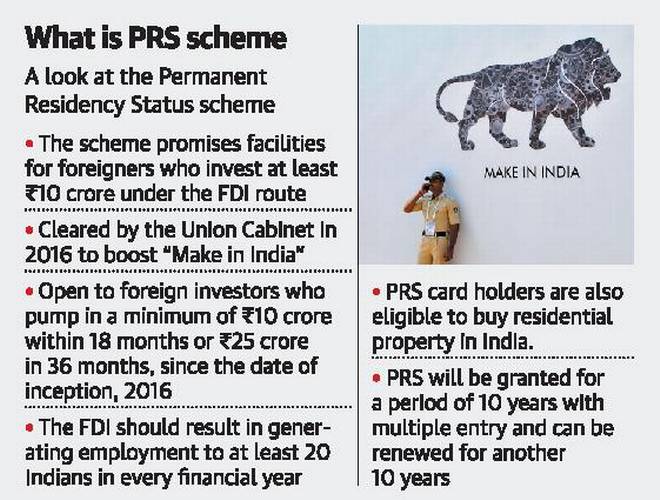
Q.1) Which of the following statements are true regarding the Permanent Residency Status Scheme.
Select the correct option
Miles to go
What’s in an election?
The Meghalaya example
India’s diplomacy, Trump effect
The invisible majority