For Previous Daily Quiz (ARCHIVES) – CLICK HERE
The Current Affairs questions are based on sources like ‘The Hindu’, ‘Indian Express’ and ‘PIB’, which are very important sources for UPSC Prelims Exam. The questions are focused on both the concepts and facts. The topics covered here are generally different from what is being covered under ‘Daily Current Affairs/Daily News Analysis (DNA) and Daily Static Quiz’ to avoid duplication. The questions would be published from Monday to Saturday before 2 PM. One should not spend more than 10 minutes on this initiative.
Gear up and Make the Best Use of this initiative.
Do remember that, “the difference between Ordinary and EXTRA-Ordinary is PRACTICE!!”
0 of 5 questions completed
Questions:
To view Solutions, follow these instructions:
You have already completed the test before. Hence you can not start it again.
Test is loading...
You must sign in or sign up to start the test.
You have to finish following test, to start this test:
0 of 5 questions answered correctly
Your time:
Time has elapsed
You have scored 0 points out of 0 points, (0)
| Average score |
|
| Your score |
|
| Pos. | Name | Entered on | Points | Result |
|---|---|---|---|---|
| Table is loading | ||||
| No data available | ||||
Consider the following statements about Sisal Plants
How many of the statements given above are correct?
Solution (b)
Statement Analysis
| Statement 1 | Statement 2 | Statement 3 |
| Incorrect | Correct | Correct |
| · Sisal (Agave sisalana) is a plant of the family Asparagaceae and its fibre, the most important of the leaf fibre group.
· The lifespan of a sisal plant is about 7-10 years, during which it produces 200-250 usable leaves. · The plant is native to Central America, where its fibre has been used since pre-Columbian times. |
· Each leaf has about a thousand fibres that can be used to make ropes, paper, and cloth. Now, it could be used to make a highly absorbent material as well.
· The absorption capacity of the material is high and found to be higher than those found in commercial menstrual pads. |
· The ancient Aztec and Mayan civilisations were the first to begin making paper out of sisal leaves.
· The plant itself is also used to make mezcal, a distilled alcoholic beverage. |
Context: Recently researchers at Stanford University has found that the absorption capacity of a sisal-based material to be higher than commercial menstrual pads that could make sanitary napkins more sustainable in India.
Solution (b)
Statement Analysis
| Statement 1 | Statement 2 | Statement 3 |
| Incorrect | Correct | Correct |
| · Sisal (Agave sisalana) is a plant of the family Asparagaceae and its fibre, the most important of the leaf fibre group.
· The lifespan of a sisal plant is about 7-10 years, during which it produces 200-250 usable leaves. · The plant is native to Central America, where its fibre has been used since pre-Columbian times. |
· Each leaf has about a thousand fibres that can be used to make ropes, paper, and cloth. Now, it could be used to make a highly absorbent material as well.
· The absorption capacity of the material is high and found to be higher than those found in commercial menstrual pads. |
· The ancient Aztec and Mayan civilisations were the first to begin making paper out of sisal leaves.
· The plant itself is also used to make mezcal, a distilled alcoholic beverage. |
Context: Recently researchers at Stanford University has found that the absorption capacity of a sisal-based material to be higher than commercial menstrual pads that could make sanitary napkins more sustainable in India.
Consider the following statements about NUTEC Plastics, sometimes seen in news?
How many of the statements given above are correct?
Solution (a)
Statement Analysis
| Statement 1 | Statement 2 | Statement 3 |
| Incorrect | Correct | Incorrect |
| · NUTEC Plastics is a flagship initiative by the International Atomic Energy Agency (IAEA). | · It aims to address the global challenge of plastic pollution.
· It brings together countries and partners from around the world to fight plastic pollution on 2 fronts: · At point of source, by introducing new technologies to improve plastic recycling. · In the ocean, where the bulk of plastic waste ends up. |
· 63 countries are participating in marine monitoring of micro-plastics and 30 around the world are developing innovative recycling technology.
· India is part of the NUTEC Plastics Initiative. |
Context: Recently the International Atomic Energy Agency and the Argentine Antarctic Institute (IAA), under the IAEA’s NUTEC Plastics Initiative conducted a study about effects of micro-plastics in the Antarctic.
Solution (a)
Statement Analysis
| Statement 1 | Statement 2 | Statement 3 |
| Incorrect | Correct | Incorrect |
| · NUTEC Plastics is a flagship initiative by the International Atomic Energy Agency (IAEA). | · It aims to address the global challenge of plastic pollution.
· It brings together countries and partners from around the world to fight plastic pollution on 2 fronts: · At point of source, by introducing new technologies to improve plastic recycling. · In the ocean, where the bulk of plastic waste ends up. |
· 63 countries are participating in marine monitoring of micro-plastics and 30 around the world are developing innovative recycling technology.
· India is part of the NUTEC Plastics Initiative. |
Context: Recently the International Atomic Energy Agency and the Argentine Antarctic Institute (IAA), under the IAEA’s NUTEC Plastics Initiative conducted a study about effects of micro-plastics in the Antarctic.
Consider the following statements about Chemical, Biological, Radiological and Nuclear (CBRN) Warfare/Disasters
Choose the incorrect statements:
Solution (b)
Statement Analysis
| Statement 1 | Statement 2 |
| Correct | Incorrect |
| · CBRN is the acronym for nuclear, radiological, biological and chemical agents.
These agents include: · Material from nuclear fission or fusion, or other radioactive material with the potential to affect human health, · Biological agents causing infection or disease and · Toxic chemicals that can cause poisoning. · CBRN emergency can occur as a result of industrial disaster, occupational exposure, natural catastrophe, warfare or acts of terrorism. · The CBRN teams of the National Disaster Response Force (NDRF) is the first respondent of any disaster related to CBRN in India. |
· TARKASH – Is a joint exercise by the National Security Guard (NSG), India and US Special Operations Forces (SOF), USA.
· It aims to address the threats related to the CBRN terror attacks. |
Context: The Chemical, Biological, Radiological, Nuclear (CBRN) teams reached the spot of the Chlorine leak in Dehradun with detectors and rescue equipment.
Solution (b)
Statement Analysis
| Statement 1 | Statement 2 |
| Correct | Incorrect |
| · CBRN is the acronym for nuclear, radiological, biological and chemical agents.
These agents include: · Material from nuclear fission or fusion, or other radioactive material with the potential to affect human health, · Biological agents causing infection or disease and · Toxic chemicals that can cause poisoning. · CBRN emergency can occur as a result of industrial disaster, occupational exposure, natural catastrophe, warfare or acts of terrorism. · The CBRN teams of the National Disaster Response Force (NDRF) is the first respondent of any disaster related to CBRN in India. |
· TARKASH – Is a joint exercise by the National Security Guard (NSG), India and US Special Operations Forces (SOF), USA.
· It aims to address the threats related to the CBRN terror attacks. |
Context: The Chemical, Biological, Radiological, Nuclear (CBRN) teams reached the spot of the Chlorine leak in Dehradun with detectors and rescue equipment.
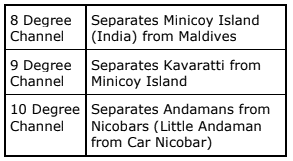
Consider the following pairs
| Channel | Location |
| 8 Degree Channel | Minicoy Island and Maldives |
| 9 Degree Channel | Little Andaman and Nicobar |
| 10 Degree Channel | Laccadive Islands and Minicoy Island |
How many of the above given pairs is/are correctly matched?
Solution (a)
| Option a |
| Correct |
|
|
Context: The Indian Air Force (IAF) has proposed to set up a forward fighter airbase in Minicoy Islands, to safeguard the sea lanes of communications and to keep the Arabian Sea free from non-state actors in the region.
Solution (a)
| Option a |
| Correct |
|
|
Context: The Indian Air Force (IAF) has proposed to set up a forward fighter airbase in Minicoy Islands, to safeguard the sea lanes of communications and to keep the Arabian Sea free from non-state actors in the region.
Ugram, recently seen in news is?
Solution (b)
| Option b |
| Correct |
| · ‘Ugram’ is a state-of-the-art indigenous assault rifle.
· It has been developed by the Armament Research and Development Establishment (ARDE), a unit of DRDO, in collaboration with a private industry partner. · It was developed in less than 100 days. · It has been developed as per the General Staff Qualitative Requirements (GSQR) of the army into consideration. Features: · The rifle will deploy rounds of 7.62 mm calibre, making it more ferocious than rifles that use 5.62 mm calibre rounds, like the INSAS rifle, which is popularly used by the armed forces in India, including paramilitary forces. · It has an effective range of 500 metres. · It weighs less than four kilograms. · The rifle has a 20-round magazine that fires robust and in full auto mode. |
Context: The Defence Research and Development Organisation recently launched an indigenous assault rifle named ‘Ugram’.
Solution (b)
| Option b |
| Correct |
| · ‘Ugram’ is a state-of-the-art indigenous assault rifle.
· It has been developed by the Armament Research and Development Establishment (ARDE), a unit of DRDO, in collaboration with a private industry partner. · It was developed in less than 100 days. · It has been developed as per the General Staff Qualitative Requirements (GSQR) of the army into consideration. Features: · The rifle will deploy rounds of 7.62 mm calibre, making it more ferocious than rifles that use 5.62 mm calibre rounds, like the INSAS rifle, which is popularly used by the armed forces in India, including paramilitary forces. · It has an effective range of 500 metres. · It weighs less than four kilograms. · The rifle has a 20-round magazine that fires robust and in full auto mode. |
Context: The Defence Research and Development Organisation recently launched an indigenous assault rifle named ‘Ugram’.