- Home
- UPSC Mains
- Daily Free Initiatives
- Courses
- KPSC / KAS
- हिंदी
- Centres
- Contact Us


Hello Friends
The 60 Days Rapid Revision (RaRe) Series is IASbaba’s Flagship Initiative recommended by Toppers and loved by the aspirants’ community every year.
It is the most comprehensive program which will help you complete the syllabus, revise and practice tests on a daily basis. The Programme on a daily basis includes
Daily Prelims MCQs from Static (Monday – Saturday)
Daily Current Affairs MCQs (Monday – Saturday)
Daily CSAT Quiz (Monday – Friday)
Note – Daily Test of 20 static questions, 5 current affairs, and 5 CSAT questions. (30 Prelims Questions) in QUIZ FORMAT will be updated on a daily basis.
To Know More about 60 Days Rapid Revision (RaRe) Series – CLICK HERE
60 Day Rapid Revision (RaRe) Series Schedule – CLICK HERE
60 Day Rapid Revision (RaRe) Series Questions & Solutions DAY 20–CLICK HERE
0 of 30 questions completed
Questions:
The following Test is based on the syllabus of 60 Days Plan-2023 for UPSC IAS Prelims 2022.
To view Solutions, follow these instructions:
You have already completed the test before. Hence you can not start it again.
Test is loading...
You must sign in or sign up to start the test.
You have to finish following test, to start this test:
0 of 30 questions answered correctly
Your time:
Time has elapsed
You have scored 0 points out of 0 points, (0)
| Average score |
|
| Your score |
|
| Pos. | Name | Entered on | Points | Result |
|---|---|---|---|---|
| Table is loading | ||||
| No data available | ||||
Which of the following is NOT a type of drainage pattern?
Solution (d)
Explanation:
Solution (d)
Explanation:
With reference to the Indian drainage system, consider the following statements:
Which of the above statements is/are correct?
Solution (a)
Explanation:
(i) the Arabian Sea drainage; and (ii) the Bay of Bengal drainage.
They are separated from each other through the Delhi ridge, the Aravalli and the Sahyadri
Solution (a)
Explanation:
(i) the Arabian Sea drainage; and (ii) the Bay of Bengal drainage.
They are separated from each other through the Delhi ridge, the Aravalli and the Sahyadri
With reference to the course of a river, consider the following statements:
Which of the statements given above is/are correct?
Solution (a)
Explanation:
A knickpoint is a location on a river where there is a sharp change in the river’s slope or gradient. It often marks the boundary between an upper reach with a steep gradient and a lower reach with a gentler gradient. The knickpoint represents a change in the river’s erosion capability, and it is the point where the old, steep profile of the river meets the new, gentler profile. Hence statement 1 is correct.
Solution (a)
Explanation:
A knickpoint is a location on a river where there is a sharp change in the river’s slope or gradient. It often marks the boundary between an upper reach with a steep gradient and a lower reach with a gentler gradient. The knickpoint represents a change in the river’s erosion capability, and it is the point where the old, steep profile of the river meets the new, gentler profile. Hence statement 1 is correct.
Consider the following statements with respect to difference between meanders over plains and Incised meanders:
Which of the above statements is/are correct?
Solution (c)
Explanation:
Solution (c)
Explanation:
Which of the following statements are correct about an antecedent river system?
Select the correct answer from the codes given below:
Solution (b)
Explanation:
Solution (b)
Explanation:
Match the following pairs correctly:
| Sr.no. | Drainage pattern | Characteristic |
| 1. | Dendritic | Tree-branch like flow pattern found in plains |
| 2. | Radial | The river discharges all of its water into a lake or depression. |
| 3. | Trellis | The tributaries initially flow parallelly and later join at right angles. |
Select the correct answer from the codes given below:
Solution (b)
Explanation:
Solution (b)
Explanation:
Which of the following rivers are antecedent rivers?
Select the correct answer from the codes given below:
Solution (c)
Explanation:
Solution (c)
Explanation:
With reference to a particular river in India, consider the following statements:
Which of the following rivers has been described in the statements given above?
Solution (d)
Explanation:
Solution (d)
Explanation:
Consider the following rivers:
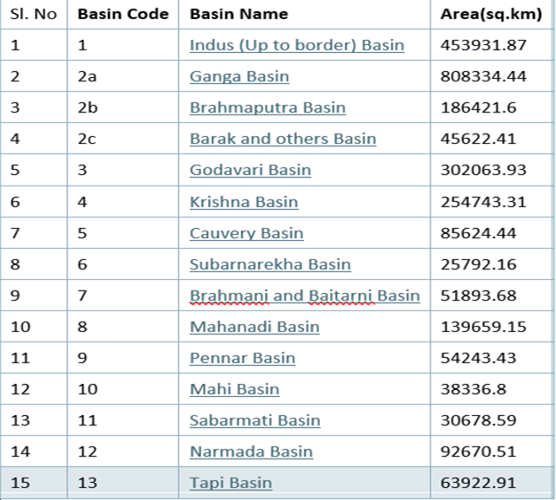
Arrange the above rivers in the increasing order of catchment area (in India). Select the correct answer from the code given below:
Solution (d)
Explanation:
Cauvery < Narmada < Mahanadi < Brahmaputra < Krishna < Godavari < Indus < Ganga
Solution (d)
Explanation:
Cauvery < Narmada < Mahanadi < Brahmaputra < Krishna < Godavari < Indus < Ganga
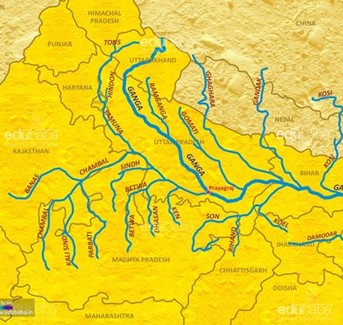
Arrange the following tributaries of the river Yamuna from north to south according to the points where they join the river Yamuna:
Select the correct answer using the code given below.
Solution (a)
Explanation:
Solution (a)
Explanation:
Wainganga and Pranhita are tributaries of:
Solution (a)
Explanation:
Solution (a)
Explanation:
Which of the following rivers are the tributaries of the Brahmaputra River?
Select the correct answer using the code given below.
Solution (c)
Explanation:
Solution (c)
Explanation:
With reference to the Monsoon winds of the Arabian Sea, consider the following statements:
Select the correct answer from the codes given below:
Solution (a)
Explanation:
Solution (a)
Explanation:
Consider the following statements with respect to Tibetan High:
Which of the statements given above is/are correct?
Solution (c)
Explanation:
Greater the Tibetan High à Greater will be the low pressure over Horn of Africaà Stronger will be the deflection of Monsoon winds à Stronger will be the monsoons.
Thus, Statement 2 is correct.
Solution (c)
Explanation:
Greater the Tibetan High à Greater will be the low pressure over Horn of Africaà Stronger will be the deflection of Monsoon winds à Stronger will be the monsoons.
Thus, Statement 2 is correct.
Consider the following statements regarding Pacific Decadal Oscillation (PDO):
Which of the statements given above is/are correct?
Solution (a)
Explanation:
Solution (a)
Explanation:
Consider the following statements with reference to Madden Julian Oscillation (MJO):
Which of the statements given above are correct?
Solution (c)
Explanation:
Solution (c)
Explanation:
The Tamil Nadu coast receives rainfall during the northeast monsoon season because:
Which of the above statements is/are correct?
Solution (b)
Explanation:
Solution (b)
Explanation:
Which of the following statements is correct regarding the season of retreating monsoon in India?
Solution (b)
Explanation:
Solution (b)
Explanation:
With reference to monsoon depressions in India, consider the following statements:
Which of the statements given above is/are correct?
Solution (c)
Explanation:
Solution (c)
Explanation:
Which of the following statements is correct with reference to the Western Disturbances?
Solution (a)
Explanation:
Solution (a)
Explanation:
Consider the following statements about the Red Mud
Choose the correct statements:
Solution (d)
Explanation:
Source: CLICK HERE
Solution (d)
Explanation:
Source: CLICK HERE
Consider the following statements about ‘Genetic Engineering Appraisal Committee (GEAC)’
Choose the incorrect statements:
Solution (c)
Explanation:
Source: CLICK HERE
Solution (c)
Explanation:
Source: CLICK HERE
Consider the following statements about ‘Agni Prime missile’
Choose the correct statements:
Solution (b)
Explanation:
Source: CLICK HERE
Solution (b)
Explanation:
Source: CLICK HERE
Consider the following statements about ‘Official Languages Committee’
Choose the incorrect statements:
Solution (d)
Explanation:
Source: CLICK HERE
Solution (d)
Explanation:
Source: CLICK HERE
‘Tigray’ a region which is conflict-ridden seen in news is in
Solution(c)
Explanation:
Source: CLICK HERE
Solution(c)
Explanation:
Source: CLICK HERE
In an MBA entrance examination, 44% of the students failed in quants and 32% failed in reasoning. If 30% of the students failed in both the topics, then find the percentage of students who passed in both the topics.
Solution (c)
Explanation:
Failed in quants, n (A) = 44
Failed in reasoning, n (B) = 32
n(A∪B) = n(A)+n(B)−n(A∩B)
è 44+32−30 = 46
Failed in either one or both topics are 46
Percentage passed = (100−46) % = 54%
Solution (c)
Explanation:
Failed in quants, n (A) = 44
Failed in reasoning, n (B) = 32
n(A∪B) = n(A)+n(B)−n(A∩B)
è 44+32−30 = 46
Failed in either one or both topics are 46
Percentage passed = (100−46) % = 54%
An Astrologer has 2 parrots with him which tells the fortune of a person. Parrot 1 speaks truth in 75% of cases and Parrot 2 in 80% of cases. In what percentage of cases are they likely to contradict each other, narrating the same incident?
Solution (c)
Explanation:
Let A = Event that Parrot 1 speaks the truth.
B = Event that Parrot 2 speaks the truth
Then P (A) = 75/100 = 3/4
P (B) = 80/100 = 4/5
P (A-lie) = 1-3/4 = 1/4
P (B-lie) = 1-4/5 = 1/5
Now
Parrot 1 and Parrot 2 contradict each other = [Parrot 1 lies and Parrot 2 true] or [Parrot 1 true and Parrot 2 lies]
= P (A)*P(B-lie) + P(A-lie)*P(B) [Please note that we are adding at the place of OR]
= (3/5*1/5) + (1/4*4/5) = 7/20
= (7/20 * 100) % = 35%
Solution (c)
Explanation:
Let A = Event that Parrot 1 speaks the truth.
B = Event that Parrot 2 speaks the truth
Then P (A) = 75/100 = 3/4
P (B) = 80/100 = 4/5
P (A-lie) = 1-3/4 = 1/4
P (B-lie) = 1-4/5 = 1/5
Now
Parrot 1 and Parrot 2 contradict each other = [Parrot 1 lies and Parrot 2 true] or [Parrot 1 true and Parrot 2 lies]
= P (A)*P(B-lie) + P(A-lie)*P(B) [Please note that we are adding at the place of OR]
= (3/5*1/5) + (1/4*4/5) = 7/20
= (7/20 * 100) % = 35%
Two numbers are less than third number by 30% and 37% respectively. How much percent is the second number less than by the first?
Solution (d)
Explanation:
Let the third number is x
Then first number = (100-30) % of x
= 70% of x = 7x/10
Second number is (63x / 100)
Difference = 7x/10 – 63x/100 = 7x/10
So required percentage is, difference is what percent of first number
=> (7x/100 * 10/7x * 100) % = 10%
Solution (d)
Explanation:
Let the third number is x
Then first number = (100-30) % of x
= 70% of x = 7x/10
Second number is (63x / 100)
Difference = 7x/10 – 63x/100 = 7x/10
So required percentage is, difference is what percent of first number
=> (7x/100 * 10/7x * 100) % = 10%
A cocktail contains a mixture of 175 ml water and 700 ml alcohol. Gopal takes out 10% of the mixture and substitutes it by water of the same amount. The process is repeated once again. The percentage of water in the mixture is now
Solution (d)
Explanation:
Given that a cocktail contains a mixture of 175 ml water and 700 ml alcohol.
It is given that 10% of the mixture is removed and it is substituted by water of the same amount and the process is repeated once again
Now we have to find the percentage of water in the mixture.
Since the mixture is removed and substituted with water, we can deal with alcohol and the second step we can find how much amount of alcohol is retained and not about how much amount of alcohol is removed
As 10% of alcohol is removed, 90% of alcohol is retained
So alcohol remaining = 700 × 90% × 90%
⟹ 700 × 0.9 × 0.9 = 567
We totally have 875 ml overall mixture and of this 567 ml is alcohol.
Remaining 875 – 567 = 308 is the amount of water.
We have to find the percentage of water in the mixture i.e. 308/875
Approximately 308 is 30% of 1000 so by this we know that 308 is more than 30%
Hence, 35.2% is the percentage of water in the given mixture.
Solution (d)
Explanation:
Given that a cocktail contains a mixture of 175 ml water and 700 ml alcohol.
It is given that 10% of the mixture is removed and it is substituted by water of the same amount and the process is repeated once again
Now we have to find the percentage of water in the mixture.
Since the mixture is removed and substituted with water, we can deal with alcohol and the second step we can find how much amount of alcohol is retained and not about how much amount of alcohol is removed
As 10% of alcohol is removed, 90% of alcohol is retained
So alcohol remaining = 700 × 90% × 90%
⟹ 700 × 0.9 × 0.9 = 567
We totally have 875 ml overall mixture and of this 567 ml is alcohol.
Remaining 875 – 567 = 308 is the amount of water.
We have to find the percentage of water in the mixture i.e. 308/875
Approximately 308 is 30% of 1000 so by this we know that 308 is more than 30%
Hence, 35.2% is the percentage of water in the given mixture.
Read the following passage and answer the item that follow. Your answer to these items should be based on the passages only
Passage 1
In the past, the few women professionals who dotted our corporate landscape suffered in silence, not willing to complain about discrimination or harassment for fear of losing their jobs. Today, there is strength in numbers and women are willing to raise issues of gender discrimination and sexual harassment publicly. Although women have greater confidence, financial independence, strong peer groups and a deeper understanding of their rights, they are still reluctant to expose issues related to sexual harassment and to take their tormentors down the legal path of justice. There exists, unfortunately, a huge psychological challenge that women, and society as a whole, need to address. This relates to behavioural attitudes and codes of conduct in the workplace.
It was in 1997 that a women’s rights group called Vishaka filed a PIL in the Supreme Court in response to a humiliating legal battle fought by a rape victim in Rajasthan, who did not get justice and was shamed and ostracised by her community instead. Consequently, the Supreme Court’s Vishaka judgement laid down guidelines for employers to deal with complaints of sexual harassment/assault at the workplace, which included the formation of an independent redressal committee.
Which of the following is true with regard to women professionals who worked in corporate offices in the past?
Choose the correct code
Solution (c)
Explanation:
Refer to, “In the past, the few women professionals who dotted our corporate landscape suffered in silence, not willing to complain about discrimination or harassment for fear or losing their jobs.”
From the opening statement of the passage, it’s evident that in the past women had to suffer in silence because of male dominance and fear of losing jobs.
Hence, option c is the correct answer.
Solution (c)
Explanation:
Refer to, “In the past, the few women professionals who dotted our corporate landscape suffered in silence, not willing to complain about discrimination or harassment for fear or losing their jobs.”
From the opening statement of the passage, it’s evident that in the past women had to suffer in silence because of male dominance and fear of losing jobs.
Hence, option c is the correct answer.
All the Best
IASbaba