Syllabus
Context: In a recent tweet, Prime Minister Narendra Modi said that the PM-MITRA mega textile parks will bolster productivity, foster innovation and generate many employment opportunities.
About PM-MITRA:-
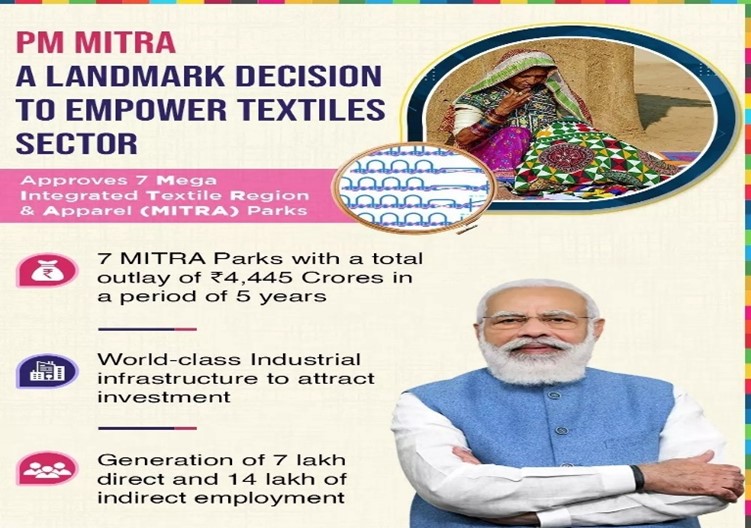
IMAGE SOURCE: yojanapandit.com
Key Features of PM MITRA:-
Advantages of PM MITRA:-
MUST READ: Textile Industry in India
SOURCE: AIR
PREVIOUS YEAR QUESTIONS
Q.1) Consider the following statements in relation to Janani Suraksha Yojana: (2023)
How many of the statements given above are correct?
Q.2) In India, which one of the following compiles information on industrial disputes, closures, retrenchments and lay-offs in factories employing workers? (2022)
Syllabus
Context: As per recent announcements, President Droupadi Murmu will present Bhoomi Samman awards in New Delhi.
Background:-
About Bhoomi Samman 2023:-
MUST READ: Revised Rural Area Development Plan Formulation and Implementation (RADPFI) Guidelines
SOURCE: AIR
PREVIOUS YEAR QUESTIONS
Q.1) Consider the following statements: (2023)
Statement-I:
India accounts for 3·2% of the global export of goods.
Statement-II:
Many local companies and some foreign companies operating in India have taken advantage of India’s ‘Production-linked Incentive’ scheme.
Which one of the following is correct in respect of the above statements?
Q.2) With reference to Ayushman Bharat Digital Mission, consider the following statements: (2022)
Which of the statements given above is/are correct?
Syllabus
Context: Recently, India and UAE signed a historic Memorandum of Understanding on Local Currency Settlement (LCS) system.
Background:-
About Local Currency Settlement (LCS) system:-

IMAGE SOURCE: blogspot.com
MUST READ: India-UAE relations
SOURCE: AIR
PREVIOUS YEAR QUESTIONS
Q.1) Consider the following statements: (2023)
The ‘Stability and Growth Pact’ of the European Union is a treaty that
How many of the above statements are correct?
Q.2) Consider the following statements about G-20: (2023)
Which of the statements given above is/are correct?
Syllabus
Context: Recent reports suggest that London is at risk of a major measles outbreak.
Background:-
About Measles:-

IMAGE SOURCE: KVAL News
Symptoms of measles:-
Risk factors for measles:-
Treatment for measles:-
Prevention for measles:-
MUST READ: Ni-kshay Mitra
SOURCE: HINDUSTAN TIMES
PREVIOUS YEAR QUESTIONS
Q.1) Consider the following statements: (2023)
Statement-I:
India’s public sector health care system largely focuses on curative care with limited preventive, promotive and rehabilitative care.
Statement-II:
Under India’s decentralized approach to health care delivery, the States are primarily responsible for organizing health services.
Which one of the following is correct in respect of the above statements?
Q.2) Consider the following statements: (2021)
Which of the statements given above is/are correct?
Syllabus
Context: Recent conflicts in Blue Nile or Darfur regions of Sudan has led to nationwide displacement.
Background:-
About Sudan conflicts:-
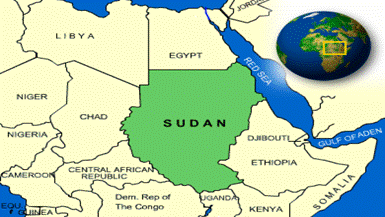
IMAGE SOURCE: countryreports.org
India and Sudan conflict:-
MUST READ: Sudan and Israel Agree to Normalise Relations
SOURCE: DOWN TO EARTH
PREVIOUS YEAR QUESTIONS
Q.1) Which one of the following countries have been suffering from decades of civil strife and food shortages and was in the news in the recent past for its very severe famine? (2023)
Q.2) Consider the following countries: (2023)
How many of the above-mentioned countries share a land border with Ukraine?
Vector-borne Diseases
Syllabus
Context: The Union health ministry has sounded the alarm on a vector-borne disease outbreak with record rainfall in North India.
About Vectors:
About Vector-borne diseases:
Vector-borne diseases in India:
Challenges:
Global Vector Control Response (GVCR) 2017–2030 by WHO:
India’s Efforts:
National Anti – Malaria Programme (NAMP)
Kala -Azar Control Programme
National Filaria Control Programme
Japanese Encephalitis Control Programme
Dengue and Dengue Hemorrhagic Fever
Way Forward:
As Vector Borne disease is becoming a public health threat, it becomes necessary for a country to reduce its GHG Emissions as Climate change proves to be a major driver behind the expansion of such vectors.
Modelling future scenarios using state-of-the-art techniques that allow predictive future disease patterns or hotspots can be a useful tool to aid decision-makers in planning suitable and timely interventions.
Source: Indian Express
Syllabus
Context: The latest Consumer Price Index data showing a resurgence in retail inflation proves exactly why the RBI’s monetary authorities have reiterated the need to keep the policy approach firmly tilted towards ensuring price stability.
Consumer Price Index (CPI):
The Inflation figures
Reasons for the rising inflation:
Impact of agricultural trends on inflation:
Tackling Inflation
Monetary Policy Measures
Fiscal Policy Measures
Supply Measurement Measures
Constraints in Controlling Inflation
Way Forward:
Thus, the policies can target inflation levels. A low level of inflation is considered to be healthy for the economy. If inflation is high, a contractionary policy can address this issue. Policymakers must tighten their grip over prices to prevent the broader economic recovery from floundering.
Source: The Hindu
Q1) Consider the following statements
Statement-I:
Exercise “Nomadic Elephant – 2023” will commence in Ulaanbaatar, Mongolia.
Statement-II:
The last edition of the exercise was held at, Bakloh, Himachal Pradesh in October 2019.
Which one of the following is correct in respect of the above statements?
Q2) Consider the following statements
Statement-I:
Having a vitamin A deficiency is a risk factor for Measles.
Statement-II:
There is no vaccine available for Measles.
Which one of the following is correct in respect of the above statements?
Q3) Consider the following pairs:
Rescue Operation Countries
Vande Bharat Mission: Yemen
Operation Raahat: Kuwait
Operation Maitri: Nepal
How many of the above pairs are correctly matched?
Mains Practice Questions
Q.1) What do you understand by inflation targeting? Has the adoption of an inflation-targeting regime served the interests of the Indian economy well? Critically examine (250 words)
Q.2) How should India address the rising challenge of vector-borne diseases? Discuss (250 words)
Comment the answers to the above questions in the comment section below!!
ANSWERS FOR ’ 17th July 2023 – Daily Practice MCQs’ will be updated along with tomorrow’s Daily Current Affairs.st
Q.1) – a
Q.2) – d
Q.3) -a