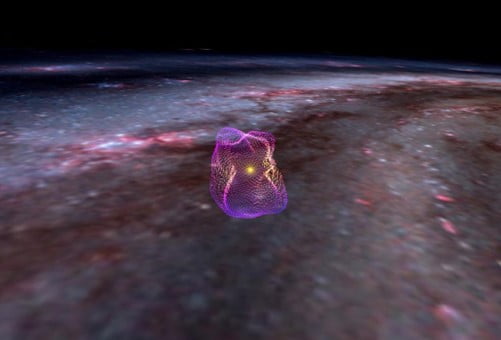
In News: Researchers from the Center for Astrophysics (CfA) | Harvard & Smithsonian have generated a 3D magnetic map of the cavity called Local Bubble.
Local Bubble:
It is a 1,000-light-year-wide cavity or a superbubble.
Local Bubble is thought to have originated from supernovae roughly 14 million years ago. (Supernova is a cosmic explosion occurring when stars meet their end)
Other superbubbles also exist in the Milky Way –
Superbubbles are comparable to holes in Swiss cheese – Supernova explosions blow holes in the cheese and new stars form around these holes
Significance:
Superbubbles trigger the formation of new stars and planets and influence the overall shapes of galaxies
Star-forming regions occur along the bubble’s surface.
About the study:
Mechanisms powering the formation and expansion of the Local Bubble are not well-understood
Further, there is little information on how magnetic fields likely impact the bubble and local star formation.
To generate a magnetic map of the Local Bubble, Gaia and Planck were used — space-based observatories launched by the European Space Agency (ESA)
Gaia was used to identify the location and local concentration of cosmic dust. This helped them trace the boundaries of the Local Bubble.
Planck provided information on the magnetic alignment of cosmic dust. This alignment can indicate the orientation of the magnetic field acting on the dust particles, allowing the researchers to generate a 3D magnetic field orientation on the surface of the Local Bubble
It is expected to improve the 3-D map’s accuracy with technology and a clearer understanding of the Local Bubble