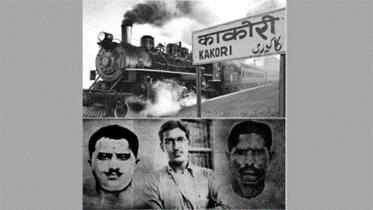
Context: Four revolutionaries of the Indian independence movement were hanged on December 17 (Rajendranath Lahiri) and December 19 (Ashfaqullah Khan, Ram Prasad Bismil, Thakur Roshan Singh) in 1927. This came two years after the Kakori Train Robbery, in which members of the Hindustan Republican Association (HRA) had looted a train transporting money to the British treasury.
About 1925 Kakori Train Action:
The Kakori Conspiracy (or Kakori train robbery) was a train robbery that took place near Lucknow. The robbery was organized by Hindustan Republican Association (HRA).
On 9 August 1925, the Number 8 Down Train travelling from Shahjahanpur to Lucknow was approaching the town of Kakori, when one of the revolutionaries pulled the emergency chain to stop the train and subsequently overpowered the guard.
The target was the guard cabin, carrying money collected from various railway stations to be deposited in Lucknow. Revolutionaries looted only these bags (which contained more than 100,000 rupees) and escaped to Lucknow.
Though no passengers were targeted by the revolutionaries, one passenger named Ahmed Ali was killed in the crossfire between the guards and revolutionaries. This made it a manslaughter case.
The robbery plan was executed by Ram Prasad Bismil, Ashfaqulla Khan, Rajendra Lahiri, Chandrashekhar Azad, Swaran Singh, Sachindra Bakshi, Keshab Chakravarty, Manmathnath Gupta, Mukundi Lal, Banwari Lal , Kundan Lal, and Pranawesh Mukherjee.
According to official records, 40 people were arrested during the trial.
Most of these detainees were provided legal defense by Pandit Gobind Ballabh Pant, Mohanlal Saxena, Chandrabhanu Gupta, Ajit Prasad Jain, Gopinath Srivastava, R. M. Bahadurji and B. K. Chaudhury.
Ram Prasad Bismil famously defended his own case.
5 members including Swaran Singh (Uncle of Bhagat Singh), Ram Prasad Bismil, Ashfaqullah Khan, Rajendra Lahiri and Roshan Singh were given sentence to death.
The Urdu poem Sarfaroshi ki Tamanna was made popular by Ram Prasad Bismil during this time. This poem was actually written by Bismil Azimabadi following the Jallianwala Bagh massacre.
Chandrashekhar Azad who could not be captured reorganized the HRA and ran the organization till 1931.
About Hindustan Republican Association:
Hindustan Republican Association (HRA) was a revolutionary organization of India established in 1924 at village Bholachang in East Bengal by Sachindra Nath Sanyal, Narendra Mohan Sen and Pratul Ganguly as an offshoot of Anushilan Samiti.
Its objective was to establish a “Federated Republic of the United States of India” through an organized and armed revolution.
The name was chosen as Hindustan Republican Association on the lines of Irish Republican Army. The manifesto of this revolutionary organization was “The Revolutionary“.
Objective:
The Objective of the HRA was to establish “Federated Republic of the United States of India” through an organized armed revolution”
The tactics of HRA were killing the officials; organize political dacoities to raise funds, terrorism among the British and British loyalists and strikes against the raj.
Despite being a revolutionary terrorist organization, the perspective of the HRA was socialistic and it wanted to establish a United States of India by deposing the British.
Many other revolutionaries soon joined the HRA including Chandrashekhar Azad, Ashfaqullah Khan, Ram Prasad Bismil etc.
Bhagat Singh later established Hindustan Socialist Republican Army (HSRA).