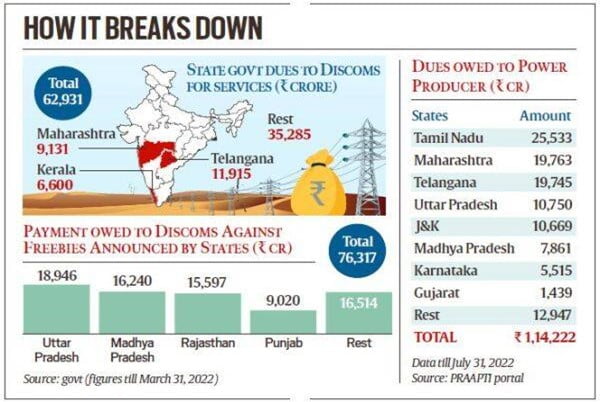
In News: As the dues of power distribution companies (discoms) to power generators surge to unsustainable levels, with states holding back payments to be made to discoms for electricity supplies as well as against subsidies for free power schemes, the Centre is set to give distribution reforms a renewed push.
The Electricity (Amendment) Bill 2022, to be introduced in the ongoing monsoon session of Parliament, is likely to push state electricity regulatory commissions to take up timely revision of tariffs and catalyse competition in the retail power distribution sector, among other provisions.
Stats
This comes amid a renewed debate on the freebie culture and the focus on the mounting dues of power distribution companies.
According to latest government data, discoms of three states — Tamil Nadu, Maharashtra and Telangana — owed about 57 per cent of total dues to power generating companies (gencos); followed by Uttar Pradesh and Madhya Pradesh and the UTs of Jammu & Kashmir, which account for another about 26 per cent of the total dues of Rs 1,14,222 crore owed to power generation companies.
Electricity (Amendment) Bill 2022
The suggested amendments are to the Electricity Act, 2003 which was enacted to consolidate the laws relating to the generation, transmission, distribution, trading, and use of electricity and generally for taking measures conducive to the development of electricity.
The Bill proposes that power distribution licensees will be allowed to use the networks of other licensees, which could boost competition and enhance efficiency.
The government also hopes to insert a new section in the Act that will enable the management of power purchase and cross-subsidy in case of multiple distribution licensees in the same area of supply.
These measures are expected to promote competition in the power distribution sector so that consumers benefit from competitive prices.
The government also proposes to enable regulators to fix a minimum tariff ceiling to discourage unhealthy pricing wars among distributors and a maximum ceiling to ensure consumers are protected against price increase shock.
Amendments are also being made in the Act to strengthen the functioning of the National Load Despatch Centre for ensuring the safety and security of the grid and for the economic and efficient operation of the power system in the country.
The amendments to the act and other recent policy initiatives like the Ministry of Power’s flagship Revamped Distribution Sector Scheme (RDSS) are aimed at resolving issues in the power sector by improving the performance of the distribution sectors which has been a drag on the industry.