Hi
Please find the UPSC Mains 2021 GENERAL STUDIES PAPER 1 (GS1) Paper below
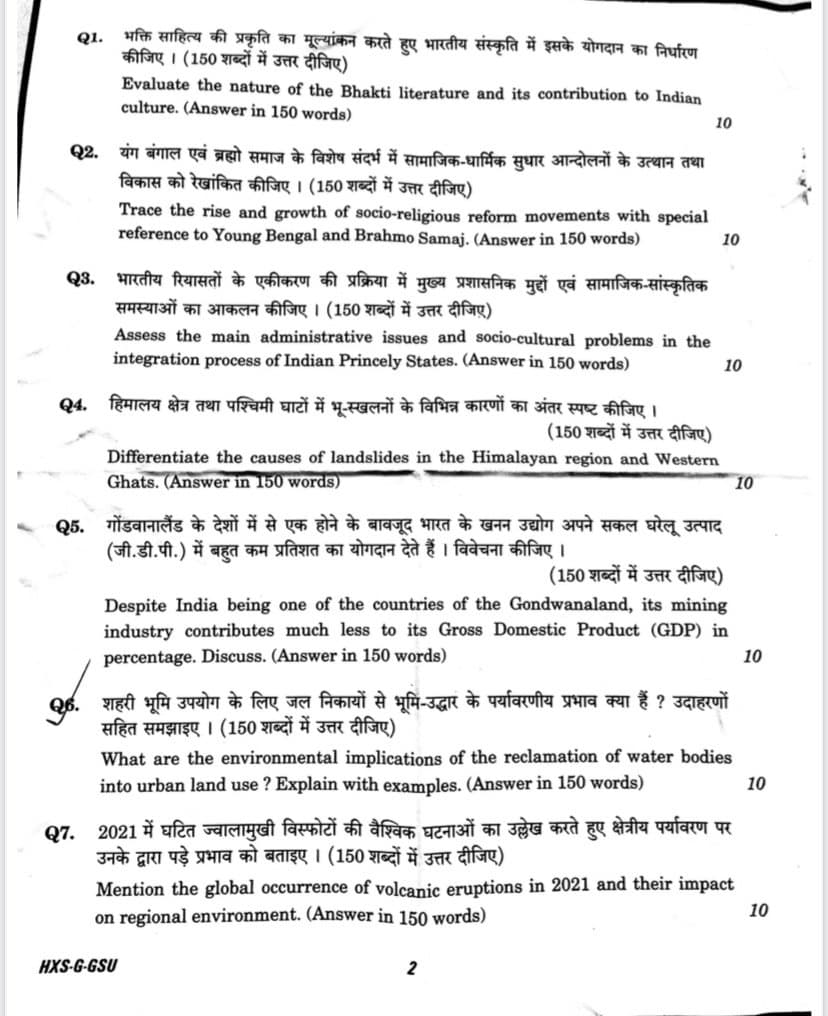
Q.1) Evaluate the nature of the Bhakti literature and its contribution to Indian culture. (Answer in 150 words)
Q.2) Trace the rise and growth of socio-religious reform movements with special reference to young Bengal and Brahmo Samaj. (Answer in 150 words)
Q.3) Access the main administrative issues and socio –cultural problems in the integration process of Indian princely states. (Answer in 150 words)
Q.4) Differentiate the causes of landslides in the Himalayan region and Western Ghats. (Answer in 150 words)
Q.5) Despite India being one of the countries of the Gondwanaland, its mining industry contributes much less to its Gross Domestic Product (GDP) in percentage. Discuss. (Answer in 150 words)
Q.6) What are the environmental implications of the reclamation of water bodies into urban land use? explain with examples? (Answer in 150 words)
Q.7) Mention the global occurrence of volcanic eruptions in 2021 and their impact on regional environment. (Answer in 150 words)
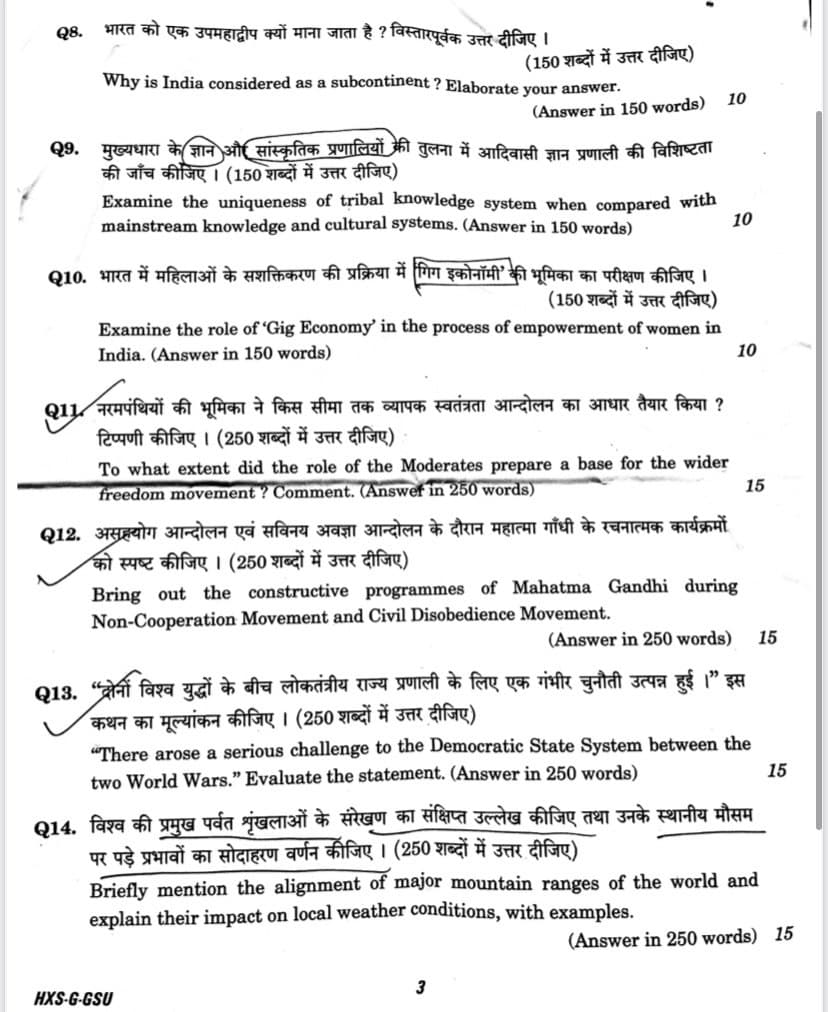
Q.8) Why is India considered as a subcontinent? Elaborate your answer (Answer in 150 words)
Q.9) Examine the uniqueness of tribal knowledge system when compared with mainstream knowledge and cultural systems. (Answer in 150 words)
Q.10) Examine the role of ‘Gig Economy’ in the process of empowerment of women in India. (Answer in 150 words)
Q.11) To what extend did the role of the Moderates prepare a base for the wider freedom movement? Comment (Answer in 250 words)
Q.12) Bring out the constructive programmes of Mahatma Gandhi during Non-Cooperation Movement and Civil Disobedience Movement. (Answer in 250 words)
Q.13) “There arose a serious challenge to the democratic state system between the two world wars”. Evaluate the statement. (Answer in 250 words)
Q.14) Briefly mention the alignment of major mountain ranges of the world and explain their impact on local weather conditions with examples. (Answer in 250 words)
Q.15) How do the melting of Arctic ice and glaciers of the Antarctic differently affect the weather patterns and human activities on earth? Explain. (Answer in 250 words)
Q.16) Discuss the multidimensional implications of uneven distribution of mineral oil in the world. (Answer in 250 words)
Q.17) What are the main socio-economic implications arising out of development of IT industries in major cities of India (Answer in 250 words)
Q.18) Discuss the main objectives of Population Education and point out the measures to achieve them in India in detail. (Answer in 250 words)
Q.19) What is Cryptocurrency? How does it affect global security? Has it been affecting Indian society also? (Answer in 250 words)
Q.20) How does Indian Society maintain continuity in traditional social values? Enumerate the changes taking place in it. (Answer in 250 words)